
Sign up to save your podcasts
Or



Botulinum toxin is widely used to correct fine lines and wrinkles, but what happens when its effects extend beyond the intended target?
Guest: Megan McCue, MS, CCC-SLP
Earn 0.10 ASHA CEUs for this episode with Speech Therapy PD
Watch on YouTube
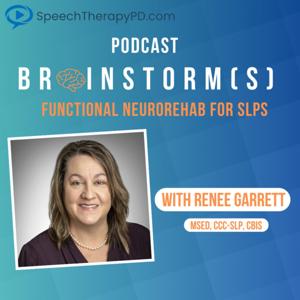
In this episode of Brainstorms: Functional Rehab for SLPs, Renee Garrett, MSEd, CCC-SLP, CBIS, is joined by Megan McCue, MS, CCC-SLP, to take a closer look at the mechanism of action behind Botox and how localized chemodenervation can, in some cases, lead to broader, systemic consequences.
About the Guest: Megan McCue, MS, CCC-SLP, is a California-based home health speech-language pathologist and the author of Iatrogenic Botulism 101: A Guide for Doctors, Nurses, and Other Healthcare Providers. She is passionate about working with adults with neurodegenerative diseases and raising awareness among clinicians about the often-overlooked adverse effects of botulinum toxin injections.
Show Notes: www.iatrogenicbotulism.com
Book - Iatrogenic Botulism 101: A Guide for Doctors, Nurses, and Other Healthcare Providers
Why is understanding the brain-gut connection important for SLPs?
Guest: Dr. Camille Thélin, MD, MSc, and Jaimie Anderson, MS, CCC-SLP, BC-ANCDS
Earn 0.10 ASHA CEUs for this episode with Speech Therapy PD
Watch on YouTube
Emerging evidence continues to highlight the complex, bidirectional relationship between the brain and the gastrointestinal system, with important implications for speech-language pathology practice.
In this episode of Brainstorms, Renee Garrett, MSEd, CCC-SLP, CBIS, is joined by Dr. Camille Thélin, MD, MSc, and Jaimie Anderson, MS, CCC-SLP, BC-ANCDS, to explore disorders of gut-brain interaction (DGBI) through the lens of hypervigilance and sensory processing.
About the Guests:
Jaimie Anderson, MS, CCC-SLP, BC-ANCDS, is a medical speech-language pathologist (SLP) board-certified by the Academy of Neurologic Communication Disorders and Sciences (BC-ANCDS). She currently evaluates and treats complex, multiphase swallowing, voice, upper airway, and motor speech disorders as part of a multidisciplinary team at the University of South Florida Joy McCann Culverhouse Center for Swallowing Disorders in Tampa, Florida.
Dr. Camille Thélin, MD, MSc, is an Associate Professor of Medicine at the University of South Florida (USF), where she has served on the faculty since 2019. She is the Co-Founder and Co-Director of the USF Neurogastroenterology & Motility Center, launched in 2024 to expand coordinated, multidisciplinary care for complex lower GI motility disorders. As part of this effort, she also helped establish USF’s in-house anorectal manometry program to improve access and continuity of care across the region.
Show Notes:
3rd Annual Swallowing Symposium in honor of Dysphagia Awareness Month (June 2026)
What happens between therapy sessions often determines whether progress carries over or fades.
Guest: Zach Smith, MS, CCC-SLP
Earn 0.10 ASHA CEUs for this episode with Speech Therapy PD
Watch on YouTube
In this episode of Brainstorms: Functional Neurorehab for SLPs, Zach Smith, MS, CCC-SLP, and Renee Garrett, MSEd, CCC-SLP, CBIS, take a closer look at how app-enabled neurorehabilitation is reshaping the way clinicians support patients beyond the therapy room. As digital tools become more integrated into care, they are helping shift intervention from episodic sessions to more continuous, real-world practice.
About the Guest: Zachary “Zach” Smith, MS, CCC-SLP, received training from both Boston University and the MGH Institute of Health Professions, and has been a practicing speech-language pathologist for the past decade. He specializes in the evaluation and treatment of neurologically based communication and swallowing disorders and has experience across the medical continuity of care.
Show Notes:
Constant Therapy
Mentioned in this episode:
Register for the Aphasia Discourse Conference on June 7
Guests: Rebecca Klam, PsyD, and Jaimie Anderson, MS, CCC-SLP, BC-ANCDS
Earn 0.10 ASHA CEUs for this episode with Speech Therapy PD
Watch on YouTube
Functional dysphagia is often treated as a physical issue, but for many patients, swallowing is shaped just as much by the brain as it is by the body. In this episode, host Renee Garrett, MSEd, CCC-SLP, CBIS, is joined by Rebecca Klam, PsyD, and Jaimie Anderson, MS, CCC-SLP, BC-ANCDS, to explore the psychological side of dysphagia and why perception, not just physiology, matters.
About the Guests:
Jaimie Anderson, MS, CCC-SLP, BC-ANCDS, is a medical speech-language pathologist (SLP) board-certified by the Academy of Neurologic Communication Disorders and Sciences (BC-ANCDS). She currently evaluates and treats complex, multiphase swallowing, voice, upper airway, and motor speech disorders as part of a multidisciplinary team at the University of South Florida Joy McCann Culverhouse Center for Swallowing Disorders in Tampa, Florida.
Rebecca Klam, PsyD, serves as Section Chief of Psychology and the founder and Director of the Digestive Disease Behavioral Medicine Program at Tampa General Hospital, a leading academic medical center in Florida. A Clinical Health Psychologist by training, she specializes in eating disorders, obesity medicine, and complex digestive diseases, with advanced expertise in gastrointestinal (GI) psychology.
Mentioned in this episode:
Register for the Aphasia Discourse Conference on June 7
Guest: Lisa Thornburg, MS, CCC-SLP
Earn 0.10 ASHA CEUs for this episode with Speech Therapy PD
Watch on YouTube
In this episode of Brainstorms, Renee Garrett, MSEd, CCC-SLP, CBIS, is joined by Lisa Thornburg, MS, CCC-SLP, to explore how rehabilitation can extend beyond the clinic to support connection, identity, and meaningful participation for individuals living with aphasia.
About the Guest: Lisa Thornburg, MS., CCC-SLP, has been a speech-language pathologist for over 30 years, working at every level of care in adult neurorehabilitation, including acute care, inpatient and outpatient rehabilitation, and home health care. Lisa is the Director of the Snyder Center for Aphasia Life Enhancement (SCALE) and the Multiple Sclerosis Day Program at the League for People with Disabilities
Mentioned in this episode:
Register for the Aphasia Discourse Conference on June 7
*****Originally Aired: October 16, 2025*****
How do emotional well-being and psychological safety influence communication recovery?
Guest: Jaime Bauer Malandraki, MS, CCC-SLP, BCS-S
Earn 0.10 ASHA CEUs for this episode with Speech Therapy PD
In this episode of Brainstorms, we look at the often-overlooked role of mental health in education and rehabilitation. Guest Jaime Bauer Malandraki, MS, CCC-SLP, BCS-S, and host Renee Garrett, MSEd, CCC-SLP, CBIS, explore the emotional toll of mental health challenges faced by students and patients, as well as the role of SLPs and teachers in creating trauma-informed, empathetic environments.
About the Guest: Jaime Bauer Malandraki, MS, CCC-SLP, BCS-S, is a Clinical Associate Professor in the Department of Speech, Language, and Hearing Sciences at Purdue University. She received her bachelor’s degree from Portland State University and her master’s degree from the University of Wisconsin-Madison. Her primary clinical and research interests lie in the evaluation and management of swallowing disorders across the lifespan, with a special emphasis on neurodegenerative conditions and head and neck cancer.
Mentioned in this episode:
Register for the Aphasia Discourse Conference on June 7
What happens when brain injury survivors don’t just rebuild their lives, but pick up a microphone and invite others into the journey?
Guests: Jesse Aron, Ken Bernson, and Melissa Capo, MS, CCC-SLP
Earn 0.10 ASHA CEUs for this episode with Speech Therapy PD
Watch on YouTube
In this powerful episode, Jesse Aron, an anoxic brain injury survivor, and Ken Bernson, a stroke survivor and peer advocate, join Renee alongside Melissa Capo, MS, CCC-SLP. Together, they share how their lived experiences led them to create a podcast that centers on connection, perspective, and life after injury. Through their conversation, Jesse and Ken reflect on what it means to build a meaningful life years after a brain injury and why sharing that journey matters. They discuss identity shifts, navigating communication and cognition, and the confidence it takes to show up in a public space. They also speak to the responsibility and vulnerability that come with telling your story and how survivor-led platforms are creating community where isolation is still common
About the Guests:
Jesse Aron sustained an anoxic Brain Injury 17 years ago in his early 20s and enjoys talking with Ken about his perspectives on putting together a meaningful life post-injury.
Ken Bernson is a 16-year stroke survivor who likes sharing his experiences to help others in similar situations. Ken is a participant in the New York State TBI Medicaid Waiver program. He is employed as a peer advocate at The Center for Independent Living in Schenectady, NY.
Melissa Capo, M.S., CCC/SLP, is an SLP in Albany, NY, and a Clinical Education Support Specialist in the online Speech@Emerson program at Emerson College. She has over 25 years of experience working with adults with Acquired Brain Injury and co-occurring disabilities, including substance abuse and mental health disorders. Her work is heavily influenced by Dr. Mark Ylvisaker and his person-driven, collaborative approach to improving the quality of life for individuals following ABI.
Mentioned in this episode:
Register for the Aphasia Discourse Conference on June 7
How does Parkinson’s disease alter communication beyond movement?
Guest: Samantha Elandary, MA, CCC-SLP
Earn 0.10 ASHA CEUs for this episode with Speech Therapy PD
Watch on YouTube
In this episode of Brainstorms, Renee Garrett, MSEd, CCC-SLP, CBIS, is joined by Samantha Elandary, MA, CCC-SLP, to explore the neurological changes that impact communication and engagement in individuals living with Parkinson’s. Together, they unpack how declining dopamine levels influence more than motor function, shaping sensory processing, motivation, and overall participation. The conversation also examines how sensory changes can affect a person’s awareness of their own speech and movement, leading to unique communication challenges that are often misunderstood or overlooked.
About the Guest: Samantha Elandary is the Founder and CEO of Parkinson Voice Project. She has devoted her life to making quality speech therapy accessible to individuals with Parkinson’s disease and related neurological conditions. Under her leadership, Parkinson Voice Project developed the SPEAK OUT!® Therapy Program, an effective, comprehensive speech therapy program for treating motor speech deficits associated with Parkinson’s.
Mentioned in this episode:
Register for the Aphasia Discourse Conference on June 7
Burnout is one of the most common concerns among speech-language pathologists. But is the problem always workload? Or could it sometimes be misalignment?
Guest: Angelyn Franks, SLPD, CCC-SLP
Earn 0.10 ASHA CEUs for this episode with Speech Therapy PD
Watch on YouTube
In this episode of Brainstorms: Functional Neurorehab for SLPs, host Renee Garrett, MSEd, CCC-SLP, CBIS, sits down with Dr. Angelyn Franks, SLPD, CCC-SLP, to explore the difference between feeling overwhelmed and feeling out of alignment in your professional role. Together, they unpack why burnout does not always come from too much work. Sometimes it comes from a mismatch between your values, strengths, scope of practice, and the environment in which you work.
About the Guest: Dr. Angelyn Franks, SLPD, CCC-SLP, is a burnout coach, mindfulness expert, and speech-language pathologist dedicated to helping healthcare professionals, educators, and caregivers break free from burnout and design lives rooted in what truly matters. Drawing on years of clinical practice—and firsthand experience with the burnout cycle—she equips her clients with evidence-based tools to manage stress, set meaningful boundaries, and align their self-care with their core values.
Show Notes:
Contact Angelyn Franks: dr.angelynfranks on IG
Mentioned in this episode:
Register for the Aphasia Discourse Conference on June 7
As an SLP, are you in control of your money—or is your money quietly controlling you?
Guest: Valeria Gary, MA, CCC-SLP
Earn 0.10 ASHA CEUs for this episode with Speech Therapy PD
Watch on YouTube
In this episode, Valeria Gary, MA, CCC-SLP, joins host Renee Garrett, MSEd, CCC-SLP, CBIS, for a candid conversation about money in our profession. Together, they address the financial realities SLPs face across settings and career stages, and why traditional budgeting advice often misses the mark for healthcare providers.
About the Guest: Valeria Gary, M.A., CCC-SLP, is a speech-language pathologist and owner of Thrive Collective Coaching LLC, where she coaches healthcare professionals on writing conference proposals and provides copywriting services for small businesses. She is also a certified YNAB coach, helping clinicians apply intentional budgeting strategies to the unique financial demands of a healthcare career.
Mentioned in this episode:
Register for the Aphasia Discourse Conference on June 7
From the publisher's feed

90,783 Listeners

43,814 Listeners

883 Listeners

369,412 Listeners
213 Listeners
47 Listeners

17,989 Listeners

27 Listeners
6 Listeners
5,831 Listeners
20 Listeners

13 Listeners
3 Listeners
7 Listeners
7 Listeners