
Sign up to save your podcasts
Or

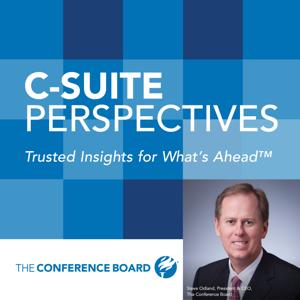


The latest Conference Board Measure of CEO Confidence™ in collaboration with The Business Council reveals cautious optimism among US CEOs, with only 30% expecting a recession in the next 12 to 18 months. What do CEOs expect in terms of hiring and wages, and what are the biggest risks they see in the marketplace?
Join Steve Odland and guest Dana Peterson, Chief Economist at The Conference Board, to find out why recession has faded as an immediate fear, whether CEOs plan to reduce headcount, and why they're especially worried about cyber risks right now.
(00:28) Overview of the CEO Confidence Survey (01:13) Current CEO Sentiment and Market Conditions (02:44) CEO Predictions on Recession (05:10) Labor Market and Wage Trends (07:18) Industry-Specific Insights (13:45) Impact of Interest Rates on Housing (15:59) Tech Sector Dynamics (18:07) Key Risks Identified by CEOs
For more from The Conference Board:
With 40% of the US living in coastal areas, the risk of flooding from stronger storms and rising sea levels isn’t just an inconvenience; it’s a looming crisis for businesses, insurers, and governments. How can businesses and governments assess the risks, update their strategies, and balance the needs of all stakeholders, including residents?
Join Steve Odland and guest Alex Heil, PhD, Senior Economist at The Conference Board, to explore the rising costs of more severe flooding, the challenges of urban planning and development in flood-prone areas, and how businesses can build resilience against these risks.
(00:08) Overview of Economic Impact of Flooding (00:41) Discussion on Recent Flooding Events (01:53) Global Warming and Weather Events (04:12) Development in Flood-Prone Areas (06:22) Economic Costs of Flooding (09:30) Insurance Industry Challenges (13:49) Business Adaptation Strategies (25:17) Public Policy and Flood Management
For more from The Conference Board:
Consumers are happy to be working, but they’re still concerned about elevated prices and interest rates. That’s according to The Conference Board Consumer Confidence Index® for July.
Join Markus Schomer, Senior Economist at The Conference Board, and Dana Peterson, Chief Economist and Leader of the Economy, Strategy & Finance Center, to find out what’s affecting US consumer attitudes and spending—and how it fits into the bigger picture of economic growth around the world.
(00:36) Key Insights from the July Consumer Confidence Survey (00:55) Consumer Concerns: Inflation, Interest Rates, and Politics (01:46) Labor Market and Economic Expectations (03:57) Consumer Spending and Financial Sentiment (05:33) Recession Fears and Economic Indicators (10:49) Durable Goods and Service Spending Trends (17:17) Global Economic Outlook (26:20) Inflation and Central Bank Policies
For more on this topic from The Conference Board:
Most workers and leaders believe in the benefits of hybrid work, but they're struggling to measure these effects or find an approach that serves all employees. How can human capital leaders create a compelling vision for new hybrid policies?
Join Diana Scott and guest Matt Rosenbaum, Principal Researcher in the Human Capital Center at The Conference Board, to find out about the shortcomings of existing metrics, why hybrid policies require a clear vision, and the benefits of training people on how to work in this new reality.
00:30 Maximizing the Value of Hybrid Work
01:57 Challenges in Measuring Productivity
03:43 Optimizing Hybrid Work Models
05:28 Importance of Clear Communication
09:48 Engaging Employees in Hybrid Work Decisions
27:55 Training Managers for Hybrid Work
31:05 Evaluating Hybrid Work Effectiveness
32:57 Conclusion and Final Thoughts
For more from The Conference Board:
When it comes to ESG, most companies feel better about their progress on “E” — environmental — than on the “S” or the “G,” according to a new report by the ESG Center at The Conference Board. How can companies reset their ESG agendas and make meaningful progress in the face of economic, political, and other tailwinds?
Join Steve Odland and guest Andrew Jones, Senior Researcher, ESG Center, at The Conference Board to find out about the political and economic factors creating a backlash against ESG investing, the role of regulation in achieving ESG goals, and the business opportunities available in the “S” and “G” pillars of ESG.
(00:47) Understanding ESG: A Brief Overview (01:38) The Evolution of ESG and Stakeholder Capitalism (02:52) Challenges and Backlash in ESG (03:48) The Importance of Hitting the Reset Button (10:29) Deep Dive into Environmental (E) Changes (14:53) Social (S) Aspects and Corporate Citizenship (18:00) Governance (G) and Its Role in ESG (28:16) Emerging Trends and Future Outlook
For more from The Conference Board:
The countries of the Global South comprise 88% of the world’s population but only 40% of GDP. How is this bloc’s growing economic and geopolitical influence manifesting, and what role does Russia play in all of this?
Join Steve Odland and guest Dr. Lori Esposito Murray, former president of the Committee for Economic Development (CED), the public policy center of The Conference Board, to learn about the evolution of the Global South, how the pandemic and the war in Ukraine have empowered these countries, and what China and Russia’s closer ties mean.
(00:13) Understanding the Global South
(01:04) Geopolitical and Economic Definitions
(02:20) Countries in the Global South
(04:41) Origins of the Term 'Global South'
(10:09) Friction Points Between Global South and North
(13:29) Impact of COVID-19 and Ukraine on Global South
(22:00) The Role of BRICS
(24:27) Military Coordination and Exercises
Many large economies across the globe are experiencing or will experience labor shortages over the next decade. How can countries address these gaps, and to what extent can artificial intelligence (AI) and immigration solve the workforce crisis?
Join Steve Odland and guest Dana Peterson, Chief Economist and Leader, Economy, Strategy & Finance Center, to find out about the current state of global labor markets, the impact of an aging population, and potential solutions to labor shortages.
00:40 Welcome to C Suite Perspectives
01:11 Global Labor Market Outlook
02:12 Aging Population and Labor Shortages
05:23 Impact of Immigration on Labor Markets
08:30 AI and Automation in the Workforce
10:15 Regional Labor Market Differences
15:43 Solutions to Labor Shortages
18:21 Engaging the Domestic Workforce
29:49 Final Thoughts and Conclusion
Hybrid work works, according to The Conference Board Reimagined Workplace 2024 report, with 84% of human capital leaders reporting higher job satisfaction and 79% citing better worker attraction and retention. But can HR leaders continue to demonstrate the ROI of flexibility and employee well-being, or are we headed for a Great Resignation 2.0?
Join Diana Scott and guest Robin Erickson, Vice President, Human Capital, at The Conference Board, to find out about the tightening job market, trends in employee well-being and flexibility, and how human capital leaders are exploring AI.
(00:58) History and Methodology of the Reimagined Workplace Study (02:30) Demographics and Trends in the Workplace (03:45) Recruiting and Retaining Employees: Trends and Challenges (07:59) The Impact of Flexibility on Employee Retention (10:25) Current Rates and Benefits of Hybrid Work (13:49) Economic Impact of Remote Work on Cities (16:51) Employee Well-being: Current Trends and Strategies (20:12) AI in HR: Opportunities and Challenges (28:51) Future Predictions and Concluding Thoughts
Consumer confidence has pulled back in June, according to The Conference Board Consumer Confidence Index®. The index dipped to 100.4, down from 101.3 in May, with consumers expressing mixed feelings on the labor market and short-term business outlook.
Join Markus Schomer, Senior Economist with The Conference Board, and Dana Peterson, Chief Economist and Leader of the Economy, Strategy & Finance Center, to find out why consumer confidence continues to decline—and what that means for US and global economic growth.
(00:31) June Consumer Confidence Survey Insights
(00:53) Factors Influencing Consumer Confidence
(02:04) Age and Income Differentiation in Confidence
(02:58) Present Situation and Expectations Indices
(06:09) Consumer Views on Recession and Inflation
(07:49) Interest Rates, Stock Market, and Finances
(10:16) Consumer Spending and Buying Plans
(13:50) Outlook for the U.S. Economy
(17:04) Global Economic Outlook
The Measure of CEO Confidence™ for China suggests CEOs are cautiously optimistic about current and future conditions, even as hiring slows and demand remains below pre-COVID levels. How should CEOs respond to the new competitive reality of economic, regulatory, and geopolitical risk factors?
Join Steve Odland and guest Alfredo Montufar-Helu, Head of the China Center at The Conference Board, to find out how multinational corporations are managing the risk landscape, rethinking supply chains, and continuing to leverage innovation.
(00:09) Welcome to C Suite Perspectives (00:47) Introducing the CEO Confidence Index (01:40) Current CEO Sentiment in China (02:27) Challenges Facing Multinationals in China (06:46) Impact of Chinese Policies on Business (09:08) CEO Expectations on Sales, Investment, and Employment (10:19) Risks and Concerns for CEOs in China (11:40) Geopolitical Tensions and Business Strategy (27:47) Final Thoughts and Conclusion
From the publisher's feed

32,046 Listeners

30,701 Listeners

43,359 Listeners

8,731 Listeners

1,384 Listeners
1,712 Listeners
150 Listeners

5,441 Listeners

56,447 Listeners

3,979 Listeners

9,537 Listeners
9,070 Listeners
53 Listeners
334 Listeners
4,208 Listeners