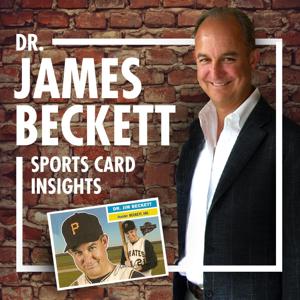
Dr. James Beckett: Sports Card Insights

Dr. James Beckett: Sports Card Insights

Download on the App Store
  • Favorites

    23

    Followers

  • Typical duration

    17 min

    per episode

Based on Podcast App listening data

Dr. James Beckett: Sports Card Insights episodes

  • 1515 - Offensive Manipulation Defenses
    Dr. Beckett addresses a question about “offensive” shill bidding, expanding the discussion to market manipulation as cards are treated like stocks and collectors take “positions” in multiple copies. He explains defensive manipulation as bidding (or reserves/house bids) intended to prevent or thwart recorded sales below a card’s comp range, while offensive manipulation is bidding a comparable copy up above comps to raise the perceived value of cards you already own, which he calls more insidious. Beckett distinguishes legal auction reserves from forbidden self-bidding in online auctions and describes shill/shield schemes involving friends, aliases, or proxy bidders. He also warns that fixed-price listings and brokered private sales can easily be manipulated, and suggests prediction markets could influence perceptions and bidding behavior, emphasizing buyer beware and ethical conduct.
     
    02:04 Offensive Manipulation Tactics
    03:46 Brokered Private Sales Manipulation
    05:55 Ethics and Buyer Beware
    08:24 Self Bidding vs Shilling
    11:16 Prediction Markets Risk
    12:51 High End Market Warnings
    14 min
  • 1514 - PSA MK?
    Dr. Beckett responds to Mike Lach’s question about why grading companies don’t apply an MK (mark) qualifier to post-production, in-person on-card autographs. He explains PSA’s early-1990s introduction of qualifiers (OC, MC, ST, MK, PD, OF) to note manufacturing related issues, and how MK indicates extraneous markings that lower the card’s value though the technical grade reflects centering, edges, corners, and surface(!). Dr. Beckett notes that autograph collecting and card grading were once separate, and that grading companies typically won’t slab cards with attempted or inauthentic autographs, often rejecting them rather than labeling them MK. He argues there should be a clearer solution—encapsulating cards as authentic while noting questionable or inauthentic signatures—to keep misleading items from remaining raw in the market.
     
    01:01 Origins of PSA Qualifiers
    02:51 How MK Affects Grade
    04:05 Factory Flaws vs Marks
    05:17 Autographs and Slabbing History
    06:20 Inauthentic Autographs Problem
    08:13 Why Slab Questionables
    09:40 Personal Stories on Writing
    11 min
  • 1513 - Whatnot Arbitration from Hobby Hotline 032126
    Dr. Beckett out-takes the recent Hobby Hotline segment with Adam Palmer and Victor Roman, focusing on Whatnot’s legal trouble over alleged backend practices tied to breaking, repacking, and quasi-gambling mechanics that may especially affect a younger demographic. The discussion explains how forced arbitration differs from court and why attorney quality matters, highlighting hobby attorney Paul Lesko representing 15 complainants and the possibility this is only the beginning. They speculate Whatnot will take the matter seriously and likely seek a settlement and non-financial changes, since cash payouts could trigger many more claims, possibly offering platform credit instead. The conversation frames live selling as entertainment driven by urgency and short attention spans, but distinguishes typical overpaying from complaints alleging severe financial harm and debt, and it raises the need for guardrails, education, and potential industry self-regulation.
     
    00:54 Whatnot Lawsuit Overview
    01:58 Arbitration Explained
    02:39 Paul Lesko Enters
    03:42 Settlement Stakes
    05:09 Live Selling Risks
    06:53 Is It A Scam?
    07:07 Why Live Selling Works
    09:00 Comps And Safeguards
    10:02 Real Harm And Debt
    11:30 Regulation Pressure
    13:13 Gambling Definitions
    15:49 What Happens Next
    16:43 Arbitrator Bias Concerns
    18 min
  • 1512 - Watters Creek Show Report, March 2026
    Dr. Beckett recaps attending all four days of the Watters Creek Show, noting it was slightly less crowded than the peak January show but still one of the best, and praises Kyle’s promotion work. He describes his approach to working dollar boxes, adding a new regular dealer, learning that some sellers move “non-Whatnot” cards into value boxes, and how quantity deals can lead to both wins and a few buying mistakes. He shares tactics for spotting worthwhile tables (inventory quantity, disorganization, box-price structure, fresh stock, and posted quantity breaks) and recounts hearing a bulk quarter-box negotiation. Beckett also highlights show conversations about eye appeal, grading inconsistency, the T-Pot experiment, Pokémon’s rise, and Whatnot, and discusses price-sensitive vs non-price-sensitive cards, trading liquidity, ethical vs deceptive flipping, willpower as a “muscle,” gamblification fallacies, and how ChatGPT learning from his queries feels creepy.
     
    01:33 Whatnot Dealers and Dollar Boxes
    06:14 How to Spot Good Tables
    08:16 Negotiations and Box Stamina
    10:57 Price Sensitive vs Casual Cards
    11:56 Trading Culture and Flipping Ethics
    13:04 Mindset Gamification and ChatGPT
    16 min
  • 1511 - 1984 Donruss, with Rich Klein
    Dr. Beckett and Rich Klein discuss why 1984 Donruss surged to the top of the baseball card market after trailing Topps in 1981–83 in response to a question from notable hobby contributor Skep1. They explore whether the set was truly short-printed versus simply harder to find than 1984 Topps, and how a combination of distribution differences, strong design and photography, and Don Mattingly’s breakout season in New York drove demand. The episode highlights 1984 Donruss innovations and quirks, including the first prominent “Rated Rookie” front logo (with Bill Madden involved in selections), notable rated rookies like Joe Carter, Sid Fernandez, and Ron Darling, printing/variation errors (missing back numbers on some cards and the “Perez-Steele Gallery” misspelling corrected in factory sets), and A/B insert cards honoring players who retired in 1983. They also discuss perceived differences between pack-pulled cards and factory sets, Donruss factory sets being cellophane-packed and in numerical order, and how card stock and collation improved by 1984 compared to earlier Donruss years. The conversation compares 1984 Donruss and 1984 Fleer to other era-defining releases (including 1989 Upper Deck), notes how demand and long-term holding by collectors can affect availability, and touches on missed opportunities like the absence of a 1984 Donruss extended set that could have included rookies such as Kirby Puckett and Dwight Gooden.
     
    01:29 Scarcity vs. Distribution: What Made 84 Donruss Harder to Find
    02:06 Mattingly Mania + a Gorgeous Design = The Perfect Storm
    02:41 Rated Rookies, Errors & Quirks: The Hidden Fun in the Set
    03:37 Local Shop Memories: How Collectors Actually Bought 84 Donruss
    04:29 Was 84 Donruss Really Short-Printed? Debunking the Myth
    09:36 Market Strength, Condition, and Why 84 Donruss Still Holds Up
    13:14 The Missing Donruss Update Set Opp (Gooden, Puckett)
    13:59 Bigger Picture: First Topps Cards, Competition, Perceived Demand
    17 min
  • 1510 - Beckett Online Price Guide (OPG), with Rich Klein
    Dr. Beckett and Rich Klein discuss the Beckett Online Price Guide (OPG) and how collectors can get value from it even when some pricing is imperfect. Using an email from Austin Goodman as a prompt, they explain that the OPG’s biggest strengths are card nomenclature, set checklists, and time-saving lookup for groups of cards, while pricing accuracy is generally solid for many commons but can be wrong for thinly traded, obscure, or fast-moving cards and newer products. They describe how to apply due diligence by checking additional sources like eBay sold listings, Card Ladder, Market Movers, and COMC (where Klein works), emphasizing the difference between asking vs sold prices and how readily available fixed-price listings can cap value. They also discuss how less frequent repricing of older/obscure sets and limited market data contribute to stale prices, how grading and condition scarcity can create counterintuitive demand (e.g., some low grades being harder to find than mid grades), and why most commons do not appreciate like investments. The episode touches on checklist verification challenges, past production oddities, the difficulty of fully automating pricing (even with AI), the risk of manipulation in thinly traded markets, and a desire for better photo coverage (front/back) and community-assisted editing to improve the OPG.
     
    00:00 Beckett OPG Origins & Early Memories
    00:36 Subscriber Question: Is Beckett OPG Worth Renewing?
    01:22 What the OPG Offers: Names, Checklists, Then Prices
    04:18 Experience-Based Red Flags: Dollar Boxes, Regional Demand
    05:40 Why Some Sets Don’t Get Updated (and How to Double-Check)
    10:28 Practical Advice: Use Short-Term Access & Verify With Sold Prices
    11:52 New Product Pricing, Checklist Fixes & Limits of Automation/AI
    14:16 Prediction Markets, Commons, and Stagnant Cards
    18:11 Exceptions: Grade Scarcity & Counterintuitive Prices
    18:57 OPG as a “Diamond in the Rough” to Be Polished

    22 min
  • 1509 - Evaluating Non-Blind Boxes, with Rich Klein
    Dr. Beckett and Rich Klein discuss strategies for buying card collections and “shoebox” lots when time is limited and you can’t comp every card. They compare top-down approaches that quickly pull out the biggest hits and treat the rest as filler versus bottom-up methods that value the long tail by years/sets, partial sets, and even per-card minimums, while also factoring in condition and what might be gradable. They talk about the appeal and risk of uncertainty in Huggins & Scott treasure chest lots, including the option to preview in person, and why quick evaluation is necessary at shows and stores. Both share times they overpaid or misread lots—such as a monster box of “rookie cards” that turned out to be mostly junk wax, and buying a large accumulation based on extrapolating from a few good boxes—highlighting lessons like checking every box and staying in your lanes. They also cover negotiating tactics, the costs of dealing with huge quantities (space, transport, disposal), how show table prices influence deals (including end-of-show boxes under tables), and why good eyesight and fast processing matter for working dollar boxes.
     
    01:05 Rich’s Collection-Buying (the time they matched numbers)
    01:57 Two Valuation Mindsets: Key Hits First vs. Long-Tail Sets & Filler
    03:38 Blind Box / Treasure Chest Psychology
    04:31 Show-Floor Reality: Minutes Not Hours (quick ways to value)
    05:37 Condition & Grading Upside: When “Filler” Isn’t Really Filler
    07:30 Getting Burned (or Not): Conservative Offers and Painful Lessons
    10:15 Modern Show Economics: Dollar Boxes, FOMO, and Piles
    12:48 Quantity Traps, Table-Space Deals, and Final Takeaways
    16 min
  • 1508 - Ramblings 5.0
    Dr. Beckett discusses opening three new Upper Deck hockey products, emphasizing he seeks “good” pulls rather than only “great” hits. He highlights 2025–26 O-Pee-Chee’s 600-card base set, inserts, and differential scarcity in playing-card inserts; reviews the 2025 Detroit Red Wings Centennial release with guaranteed autographs and higher-number scarcity; and covers 2025–26 Fleer Ultra Hockey’s tougher high numbers, medallion parallels, and focus on aesthetics over hits, naming O-Pee-Chee his value winner. He addresses a misconception about Star Company, clarifying he doesn’t hate Star but disputes treating it as a major company or its cards as full rookie cards. He also weighs in on getting a good deal on a second copy of a card you already own and closes with thoughts on money, side gigs, and difficulty selling modern sets.
     
    00:53 Good Pulls vs Great Pulls
    02:11 OPC Hockey Box Breakdown
    03:48 Red Wings Centennial Set
    06:09 Fleer Ultra Hockey Overview
    07:33 Aesthetics in Collecting
    08:46 Star Company Misconceptions
    12:08 Money, Success, and Side Gigs
    16 min
  • 1507 - BlindBoxification, with Josh Luber, Part 3
    Dr. Beckett hosts Josh Luber about his 136 page white paper on “BlindBoxification”. They debate Shohei Ohtani’s “GOAT” case in comparison to Babe Ruth, including Ruth’s influence on Japanese baseball, and discuss hobby myths and legends surrounding iconic cards like the 1952 Topps Mantle and T206 Wagner, arguing the myths are “frosting” on already great cards. The discussion covers Bruce McNall’s perceived wealth and relationship with Gretzky, PSA grade price spreads in bull vs. bear markets (especially the gap between 9 and 10), and the Pareto principle as collectors consolidate toward “best of the best” items. Beckett connects blind products to buyers overestimating odds of landing grails and explores an analogy between collecting decisions and Pascal’s Wager, including opportunity cost of staying out of the hobby and why 2021 is cited as the only year a new entrant might regret. Beckett also shares a personalized ChatGPT critique of Josh’s arguments, touching on novelty, collector intent, information asymmetry changing over time, liquidity vs. hobby health, and saturation risk, while both agree markets adapt and digital repacks may dominate.
     
    00:48 Ohtani vs Babe Ruth
    02:30 Mantle and Wagner Myths
    03:45 McNall and Gretzky Scandal
    04:17 Grading Spreads in Markets
    06:14 Pareto and Blind Packs
    07:35 Pascal Wager for Collectors
    10:59 ChatGPT Critiques the Thesis
    16 min
  • 1506 - Blindboxification, with Josh Luber, Part 2
    Dr. Beckett interviews Josh Luber, discussing Luber’s 136-page book on “BlindBoxification”, covering transparency versus mystery in the hobby, hybrid product concepts, and Panini’s outlook without full licensing. Beckett highlights Griffey’s rise prior to grading and factory set production, then points to prediction markets as a major emerging topic—raising issues like insider knowledge, manipulation, regulation, and examples of real-world event control. They discuss pseudonymous hobby identities and how real-world presence can act as a safeguard. Beckett and Luber explore “truly collectible cards” (TCCs)—cards that aren’t for sale—contrasting illiquid “inaccessible” grails with liquid bellwether cards. Beckett shares his 1977 experience splitting a 1952 Topps set to keep 406 cards while a partner took the Mantle, using it to frame what makes a card iconic, alongside T206 Honus Wagner. They revisit how “hits” used to be high-number short prints and speculate on series-by-series supply differences, including Beckett’s thesis about the 1952 Topps fifth series drop-off and the Mantle double print. The conversation also contrasts earlier hobby knowledge-sharing with today’s widespread access to data (e.g., pop reports and market tools), and concludes with Wagner’s long-standing mystique predating grading, PSA’s origins in coin grading, and challenges graders face with trimming detection and policy choices.
     
    00:48 Transparency and Licensing Talk
    01:33 Griffey Before Grading
    02:09 Prediction Markets in Cards
    04:37 Handles and Hobby Pseudonyms
    05:35 Truly Collectible Cards
    07:38 What Makes a Card Iconic
    08:54 High Numbers as the Hits
    11:21 Information Then vs Now
    13:52 Wagner Mystique and Grading Origins
    18 min

About Dr. James Beckett: Sports Card Insights

From the publisher's feed

Dr. Beckett unretires to share sports card stories, analyses, and opinions, based on his six decades of intensive experience.

Best of Dr. James Beckett: Sports Card Insights

Ranked by our users in the last 21 days

More shows like Dr. James Beckett: Sports Card Insights

Sports Card Nation Podcast by John Newman

Sports Card Nation Podcast

98 Listeners

Sports Card Investor by Sports Card Investor

Sports Card Investor

371 Listeners

Hobby Hotline Podcast by JN Enterprises

Hobby Hotline Podcast

24 Listeners

Stacking Slabs by Brett McGrath

Stacking Slabs

175 Listeners

The Hobby With Cage by Hosted by: @cagelawyer

The Hobby With Cage

113 Listeners

Golden Age of Cardboard | A vintage sports card podcast by Michael Moynihan

Golden Age of Cardboard | A vintage sports card podcast

105 Listeners

Sports Cards Nonsense by Sports Cards Nonsense

Sports Cards Nonsense

1,039 Listeners

Sports Cards Live by Cloud10

Sports Cards Live

52 Listeners

The Crossover by Card Ladder

The Crossover

46 Listeners

Cards To The Moon by Five Card Guys

Cards To The Moon

35 Listeners

Sports Card Lessons Podcast by Ken Cairns

Sports Card Lessons Podcast

33 Listeners

The Shallow End by david.asa.schwartz

The Shallow End

25 Listeners

Splendid Sports Cards Podcast by Splendid Sports Cards Podcast

Splendid Sports Cards Podcast

15 Listeners

Vintage Spotlight by Cloud10

Vintage Spotlight

8 Listeners

Sports Card Clubhouse by Sports Card Clubhouse

Sports Card Clubhouse

15 Listeners