
Sign up to save your podcasts
Or

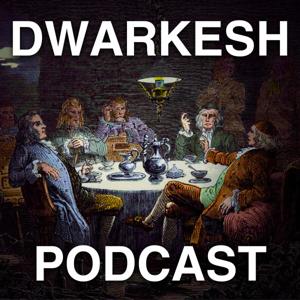
By Dwarkesh Patel


4.6
475475 ratings


The podcast currently has 145 episodes available.
The most played episodes among Podcast App listeners.
Had a lot of fun chatting again with my twin brother Dylan Patel. We went through lab economics over the next few years - the shift from inference to training as RSI draws near; and how Anthropic and OpenAI are on track to control most of the world’s usable FLOPs within the next few years (because they can monetize compute better and thus outbid everyone). And then we discuss whether the >$10T of total AI capex we’ll see by the end of the decade will cause a sovereign debt crisis, where hyperscaler debt raises interest rates, drives non-AI exposed countries into bankruptcy, and crashes non-AI equities. One question we weren’t able to resolve is whether there’s anything that can counter all the forces barrelling towards centralization in this industry - the economies of scale in training, the scarcity of compute, and eventually continual learning and RSI. Watch on YouTube; read the transcript. Sponsors * Grok Bot has been quite helpful with my search for a new editor. I created a recruiter bot and described the type of editor I was looking for. That bot then spun up a handful of subagents that combed through my emails and X DMs, read the end credits of various documentaries I like, and figured out who edits for some of my favorite YouTubers. It took all of those results, and then delivered me a shortlist of candidates that matched my criteria. Try Grok Bot for yourself at x.ai/bot * Antithesis lets you add time travel to your software testing toolkit. Since the Antithesis platform is fully deterministic, everything that happens inside of it is perfectly reproducible. So if your software crashes, you can rewind to the exact right moment, freeze time, and investigate. Or you can test different hypotheses by perturbing the system: kill a node or disable a feature, see what happens, then reset the trajectory and try something else. Learn more at antithesis.com/dwarkesh * Jane Street is hiring for two separate ML internships right now, one focused primarily on research and one focused on engineering. In both cases, interns are expected to contribute to real work, not contrived exercises: one common project is adapting a frontier LLM paper to financial markets, which tend to come with a ton of different gnarly challenges. Importantly, you don’t need any finance background to apply. 2027 applications are open now at janestreet.com/dwarkesh Timestamps (00:00:00) – Two labs will soon control most of the world’s compute (00:07:01) – $6 billion in fab capex enables $1t+ of end revenue (00:13:08) – Compute prices will rise if the labs outbid everyone (00:18:22) – Which layer will capture most of the surplus? (00:25:40) – What could slow down progress? (00:29:43) – Labs are shifting compute from inference to R&D (00:33:27) – China gets less than 10% of new compute, but its labs need less (00:48:48) – Will AI cause a sovereign debt crisis? (01:07:52) – Will the world’s future workforce belong to a few companies? This is a public episode. If you would like to discuss this with other subscribers or get access to bonus episodes, visit www.dwarkesh.com

Read the essay here. This is a public episode. If you would like to discuss this with other subscribers or get access to bonus episodes, visit www.dwarkesh.com
This is a video recording of a post I wrote last week. If you want to read the original you can check it out here. Thanks to Mercury for sponsoring this video. Mercury’s built-in AI, Command, helps me close my books and saves me a bunch of time. At the end of each month, Command categorizes my transactions and provides its rationale for every choice: I just review, fix anything that’s off, and approve... and then Mercury syncs everything to QuickBooks. Get started at mercury.com/command This is a public episode. If you would like to discuss this with other subscribers or get access to bonus episodes, visit www.dwarkesh.com
Ryan Greenblatt is the Chief Scientist at Redwood Research, where he works on technical AI safety research. He's also lead author on the "Alignment faking in Large Language Models", and is currently working on a third party investigation into the OpenAI/HuggingFace incident. In my opinion, he's one of the most interesting thinkers on the future of AI. Had him on to discuss/debate recursive self-improvement. This might be the most important question in the world right now – whether within a year or so of achieving human-level intelligence, you slingshot towards having 10s of billions of superintelligences, each of which is dramatically more competent than human experts across all fields. I’ve historically been skeptical of this possibility. My intuition has been that we will end up significantly bottlenecked by not only compute scaling but human expert data, which I think underlies most of the AI progress today. If, because of RSI, we got a jump as big as GPT-3 to a Mythos (i.e. 6 years of AI progress) within a single year of achieving AGI, then the thing we get there at the end of that year is definitively and wildly superhuman. We hashed it out, and I think Ryan made a pretty good case that this kind of speedup is plausible. FWIW, Ryan’s median for when we automate AI R&D is 2031. We then discussed the alignment implications of this scenario. Who should these superintelligences be aligned to? In the future, our capacity to steward our votes and our capital, and to make sense of what’s happening in the world, will all be titrated by superintelligences. And I worry that specs like the Claude Constitution are not shaping these ASIs to truly be my personal advocates and guardian angels. And can we get them aligned to anything in the first place? Ryan and I had a long debate about whether the kind of reward hacking we saw with the OAI/Hugging Face hack extrapolates to superintelligences that would team up to literally take over the world. The first piece of advice you get when you’re learning to drive is that it will go much smoother if you look at the horizon instead of directly in front of your tires. And so it is with the trajectory of AI. Hope you enjoy! Watch on YouTube; read the transcript. Sponsors * Antithesis is a software testing platform that finds the failures no human or AI could ever anticipate. It runs thousands of copies of your code inside a fully deterministic computer, injecting faults and steering each trajectory toward the most insidious bugs. This lets you find critical issues in minutes rather than waiting months for your users to uncover them. Learn more at antithesis.com/dwarkesh * Jane Street’s back with a new puzzle. They designed an ASIC and sent me the final masks… but they didn’t tell me what the chip actually does. So that’s the challenge: reverse engineer the circuit and figure out the chip’s purpose. Jane Street has a bunch of swag ready to send to the most creative solutions, and they’re also planning to feature the top write-ups in a blog post. Download the files and get started at janestreet.com/dwarkesh * Cursor and SpaceX recently released Grok 4.5, and I’ve been surprised by just how good the model is. For example, when I tested it against Fable and Sol on a bunch of AI governance questions, all three models gave substantially the same answers, but Grok was faster, more concise, and cheaper. Grok 4.6 is coming soon, but in the meantime, you can try 4.5 at cursor.com/dwarkesh Timestamps (00:00:00) – Is AI R&D verifiable enough to unlock recursive self-improvement? (00:16:52) – Is AI progress bottlenecked by human expert data? (00:34:02) – Flat token prices suggest scaling has been slow (00:39:47) – Skills AI can’t train on: does it even need them? (00:48:07) – Aligned to whom? (01:09:18) – Recent incidents of AIs colluding and deceiving humans (01:19:38) – What could possibly go wrong? A concrete scenario (01:48:02) – From reward hacking to takeover This is a public episode. If you would like to discuss this with other subscribers or get access to bonus episodes, visit www.dwarkesh.com
Read it here. Thanks to Mercury for sponsoring this essay. Mercury has automated basically my entire bill pay process for my business. I just give contractors a dedicated email address, and when they send an invoice, Mercury automatically creates a draft payment for me to review. I no longer have to hunt through my inbox for invoices or deal with messy spreadsheets to track my bills. Mercury handles it all. Learn more at mercury.com Timestamps: (00:00:00) – The big research bet the labs are making (00:02:12) – Grindability is just as important as verifiability (00:06:10) – Will RLVR alone generalize? (00:08:41) – Getting the learning back to the weights (00:15:22) – Dreaming (00:17:23) – What 2027 looks like This is a public episode. If you would like to discuss this with other subscribers or get access to bonus episodes, visit www.dwarkesh.com
The podcast currently has 145 episodes available.

541 Listeners

2,457 Listeners

1,086 Listeners

230 Listeners

10,131 Listeners

502 Listeners

591 Listeners

138 Listeners

101 Listeners
690 Listeners

146 Listeners
456 Listeners

32 Listeners
140 Listeners
39 Listeners