
Sign up to save your podcasts
Or



Based on Podcast App listening data
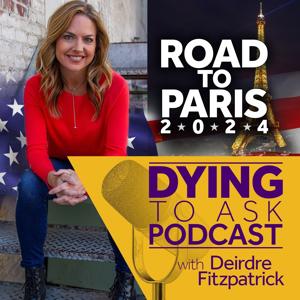
Will the 2020 Summer Olympics happen given the COVID-19 pandemic? It’s anyone’s guess at this point. However, we do know the impact the coronavirus threat is having on Olympic hopefuls around the world and especially those hoping to qualify for Team USA.
Gabe Gardner is a 2008 gold medalist in volleyball. His wife, Lauren Gardner, won bronze in synchronized swimming at the 2004 Games in Athens. The Gardners are still highly involved with their sports, offering mentoring to Olympic hopefuls.
In this "Dying to Ask," the Gardners explain how devastating the virus threat, self-quarantines and anxiety are to athletes who find their entire careers in a holding pattern. We talk about what athletes typically would be doing at this point in the Olympic qualification cycle. And, I ask them to place a bet on whether the International Olympic Committee will pull the plug on staging an Olympics this summer. Let’s just say the Gardners don’t agree on everything.
Oh, and Gabe issues an Olympic challenge to me and Domi, and I’m 100% in.
What has happened? A few months ago, we were ringing in 2020 with chants of the “roaring '20s” heading our way.
Three months later, the world is on a lockdown of sorts and social distancing is a thing. I know we were supposed to be kicking off our ALL OLYMPIC season, but, seriously, what I need now is answers. How do I work from home? What am I supposed to do with my kids now that schools are closed? How can I work out without leaving my house? And, what do I do if I catch this darn virus?
We’re going to use the "Dying to Ask" podcast as a way to hack through life during this, say it with me, unsettling time.
Have an idea for an episode? Email me at [email protected].
Message me on social media:
Could you give up sugar for a solid year? This week's guest did just that for a magazine assignment, and the changes in his weight, mental health and virtually every other aspect of his life are staggering.
Michael Mackie is a writer for In Kansas City Magazine. He's also a longtime friend and former colleague. Michael and I met more than 20 years ago working at KCCI-TV in Des Moines, Iowa.
I never in a million years thought Michael would survive going sugar-free for a year. Two reasons. One, he has an addictive personality and sugar was one of his biggest vices. And two, sugar is in EVERYTHING!
UC San Francisco researchers just released the bitter results of a study about sweets. The average American consumes an average of 17 teaspoons of sugar a day. The recommendation? No more than 6 added teaspoons for women and 9 for men.
One year after going sugar-free, Michael is down 50 pounds and says he'll never go back to his mindless sugary ways.
On this Dying to Ask:
What's that saying? You are what you eat? More like you are what you THINK you're eating.
Get ready for a food reality check with Dr. Jonny Bowden. He's known as the "nutrition myth buster," and he's going to change how you look at food in 2020.
Dr. Jonny is a nationally known nutrition expert and psychologist. He's written 15 books and has appeared in publications such as "O, The Oprah Magazine" and "GQ."
But he wasn't always so healthy and he wasn't always a doctor. His career started on the road as a musician where he lived what he describes as, "100% the rock 'n' roll lifestyle." That life was great until it wasn't. And that's when Dr. Jonny discovered that working out and eating well have their merits. He's been singing that song to anyone who will listen ever since.
On this Dying to Ask:
Want to make more money? Want to be better liked? Want to climb the corporate ladder? Of course, you do, and that's why you must master modern etiquette.
Diane Gottsman is the founder of The Protocol School of Texas. Her insight into how our social interactions affect our professional and personal lives has made her a national expert in her field. She makes frequent appearances on the "Today" show and has written articles for publications like Forbes and The Wall Street Journal.
Modern manners go beyond saying "please" and "thank you." Knowing how to navigate negative people and decline invitations that don't interest you is an art. Diane walks us through some everyday situations that can get complicated quickly.
On this Dying to Ask:
Write a thank-you card. Change a life. Seriously, it's that easy.
New research has proved that sending someone a thank-you note generates an ecstatic response in the recipient. Did you catch that? Ecstatic! It gets better. Writing the note creates a positive response in the sender, too.
On this Dying to Ask:
Most of what you own is worthless. I'm not being judgmental. It's a fact.
A recent viral article with the headline "Most of What You Own is Worthless: 3 Things You Should Be Doing to Reduce What You Own" explains why a lot of what we hold dear isn't worth the box you're storing it in.
The author of that article? My sister, Siobhan Fitzpatrick Kratovil.
Siobhan is a lawyer and mom of four who writes a legal blog called "The Law Mother."
She wrote this article after she and her husband had to clear her late mother-in-law's home to sell it. The experience radically changed how she looks at all the stuff in her own home. As a mom of four girls, she's got a lot of stuff -- most of it pink. As a lawyer who does a lot of estate planning, she's now advocating for families to look at what they really leave behind when they die.
On this Dying to Ask:
It's a good thing Jeff Rossen and I don't share an office. I'd probably talk his ear off all day long. Jeff is the newly named chief national consumer correspondent for Hearst Television.
He joined Hearst after a decade at NBC News and "The Today Show," where his franchise, "Rossen Reports," exposed scams, tested products and cost big companies big money when it turned out they weren't delivering on their promises.
He's as impossible to ignore in real life as he is on TV. It's an energy that fuels his creative side that even he admits can be exhausting to be around! (I might relate to that.)
On this Dying to Ask:
2020 is the year of self-care for a lot of people. There's no quicker way to calm your mind than by shutting off your phone (after you listen to this podcast, of course) and picking up a book.
But, a lot of us struggle to find time to read. How many times have you said, "I don't have time to read"? Are we really that busy? Or, is it just easier to zone out on Netflix and social media?
This episode of our "Dying To" series on "Dying to Ask" will help anyone dying to read more by outlining three simple ways to fit more reading into your life.
Leslie Guillon is my guest this week. She's one of my closest friends, and last year, she set a goal of reading 12 books in 2019.
Leslie is a single mom of two, an attorney, an ultra runner and the epitome of busy. But she realized she was cheating herself with her choices of how to spend free time. She just finished her "12 book challenge" and she's sharing the three things she changed in her life to pull off the goal.
And, she's getting real about what she noticed in her mental health and overall happiness. Is reading a book the quickest road to self-care? Read between the lines and you'll find out the answer is yes!
Did you know you are 42% more likely to follow through with a goal or resolution if you write it down?
Seriously, just writing a goal down is that powerful.
That's not surprising to Tim Collom. He's been writing 100 goals a year down on paper for the last 25 years. It started as a high school assignment, but it's transformed into a life-changing affirmation of where he's been and where he's going.
Tim credits his financial success in business, his creative success in art and his personal happiness to the fact that he writes down those goals.
From the publisher's feed
Ranked by our users in the last 21 days
12,890 Listeners

1,845 Listeners

1,958 Listeners
3,307 Listeners

1,487 Listeners

4,981 Listeners

3,386 Listeners
9,157 Listeners
282 Listeners

29,207 Listeners
41,388 Listeners

19,273 Listeners

10,666 Listeners

1,034 Listeners
224 Listeners