
Sign up to save your podcasts
Or

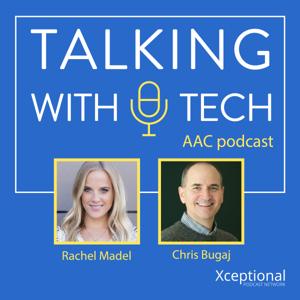

This week, the TWT team presents Chris's interview with Dr. Elena Dukhovny, professor at CSU East Bay! She is a leading researcher on motor planning, AAC training for paraeducators, and more, and she shares some of what she has learned about these two important topics!
Before the interview, Rachel shares a wealth of useful advice on preparing to consult with parents and the circle of support, including 1) asking what gets kids excited to communicate; 2) having parents write down all non-verbal communication, including behaviors; and 3) asking what parents would change about the child’s communication, if they could. Rachel also shares about gently approaching situations where a non-robust language system was already recommended to parents and she wants a robust language system implemented instead.
Key ideas this week:
🔑 Developing a motor plan allows AAC users to have a rate of speech that is closest to verbal speech.
🔑 Elena’s research indicates fluent AAC device users plan and remember words by where their hands move on the device, similar to how speaking people remember words by how they sound and sign-language users remember words by how they are signed.
🔑 Briefly trialing different language systems isn’t always the best way to determine what system will be best for a user in the long term. For example, a system that is simpler or easier to visually scan may be learned quickly, but if motor planning isn’t supported then a user may not become as fluent with that system long term.
Help us develop new content and keep the podcast going strong! Support our podcast at patreon.com/talkingwithtech!
Visit bit.ly/twtpod for access to previous episodes, resources, and CEU credits that you can earn for listening to TWT episodes!
Research
Dukhovny, E., Gahl, S. (2014) Manual motor-plan similarity affects lexical recall on a speech- generating device: Implications for AAC users. Journal of Communication Disorders 48, 52-60.
Thistle, J. J., Holmes, S. A., Horn, M. M., & Reum, A. M. (2018). Consistent symbol location affects motor learning in preschoolers without disabilities: Implications for designing augmentative and alternative communication displays. American journal of speech-language pathology, 27(3), 1010-1017.
 View all episodes
 By Rachel Madel and Chris Bugaj

4.9
220220 ratings
This week, the TWT team presents Chris's interview with Dr. Elena Dukhovny, professor at CSU East Bay! She is a leading researcher on motor planning, AAC training for paraeducators, and more, and she shares some of what she has learned about these two important topics!
Before the interview, Rachel shares a wealth of useful advice on preparing to consult with parents and the circle of support, including 1) asking what gets kids excited to communicate; 2) having parents write down all non-verbal communication, including behaviors; and 3) asking what parents would change about the child’s communication, if they could. Rachel also shares about gently approaching situations where a non-robust language system was already recommended to parents and she wants a robust language system implemented instead.
Key ideas this week:
🔑 Developing a motor plan allows AAC users to have a rate of speech that is closest to verbal speech.
🔑 Elena’s research indicates fluent AAC device users plan and remember words by where their hands move on the device, similar to how speaking people remember words by how they sound and sign-language users remember words by how they are signed.
🔑 Briefly trialing different language systems isn’t always the best way to determine what system will be best for a user in the long term. For example, a system that is simpler or easier to visually scan may be learned quickly, but if motor planning isn’t supported then a user may not become as fluent with that system long term.
Help us develop new content and keep the podcast going strong! Support our podcast at patreon.com/talkingwithtech!
Visit bit.ly/twtpod for access to previous episodes, resources, and CEU credits that you can earn for listening to TWT episodes!
Research
Dukhovny, E., Gahl, S. (2014) Manual motor-plan similarity affects lexical recall on a speech- generating device: Implications for AAC users. Journal of Communication Disorders 48, 52-60.
Thistle, J. J., Holmes, S. A., Horn, M. M., & Reum, A. M. (2018). Consistent symbol location affects motor learning in preschoolers without disabilities: Implications for designing augmentative and alternative communication displays. American journal of speech-language pathology, 27(3), 1010-1017.
21,954 Listeners

43,687 Listeners

12,130 Listeners
14,969 Listeners
69,626 Listeners
4,807 Listeners
420 Listeners
4,524 Listeners

3,457 Listeners

5,813 Listeners
12,848 Listeners

17,788 Listeners

10,883 Listeners
13,710 Listeners
3,555 Listeners