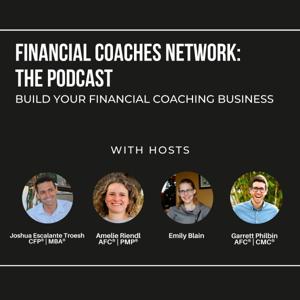
Financial Coaches Network - The Podcast: Build your Financial Coaching Business

Financial Coaches Network - The Podcast: Build your Financial Coaching Business

By Joshua Escalante Troesh, Garrett Philbin, Amelie Riendl, and Emily BlainBusinessEntrepreneurship
Download on the App Store

Financial Coaches Network - The Podcast: Build your Financial Coaching Business episodes

  • #216: How can I use AI to help create marketing materials?

    Josh and Amelie explore how financial coaches and small‑business owners can use AI as an idea‑generating tool to help with marketing materials without letting it replace human judgment. 

    Top takeaways:

    • Start with deep research about your audience. AI works best when fed detailed information about your niche, including their anxieties, hopes, and motivations.
    • AI is best used as an idea generator, not a final creator. 
    • AI can help give ideas during your brainstorming phase when working on creating a new ad. One or more suggestions may spark ideas, though they will likely be different from the actual suggestions from AI.
    • Use AI to build the different assets of the advertisement one part at a time, such as themes, headlines, taglines, imagery, body copy and call to action. 
    • AI generated imagery requires careful review to look for biases and odd patterns.
    • Full ads created by AI tend to be oversaturated with communications. With multiple messages fighting for attention, key messaging gets lost or left out completely.
    • The final polishing of an ad is faster and more effective when done by a human. 
    • Everyone who uses AI should fact check any information received from AI before publishing any content (see ‘Dead Internet Theory). 
    • To help keep alignment with your brand voice, a Brand Bible can help AI stay consistent with your brand voice, values, and style.
    • Ownership of intellectual property related to AI generated content is not defined and will continually change depending on bodies of law and case law. 
    • AI‑generated content is likely not copyrightable.
    • Content created by AI may pull from copyrighted sources. 
    • AI is best used to help provide inspiration for your marketing materials, writing the copy yourself. 

    • AI can help speed up brainstorming and production, but only when paired with strong marketing fundamentals, careful prompting, and thoughtful human refinement. 

      Want help building or growing a successful financial coaching business? Start here:

      Love coaching but not running a business? Check out MoneyCoach Network:
      https://www.financialcoachesnetwork.com/moneycoachnetwork 

      Exploring financial coaching? Join our free community of 6,000+ coaches:
      https://www.facebook.com/groups/financialcoachescommunity

      Launching your business? Check out FCN Biz DIY, our step‑by‑step program:
      https://www.financialcoachesnetwork.com/biz-diy

      Ready to learn more? Get our free 8‑part email series with 30+ tips:
      https://www.financialcoachesnetwork.com/pre-launch-email-series

      42 min
    • #215: Inside the State of Financial Coaching: New Data Hub, 2025 Data & 2026 Survey Launch

      Josh and Amelie summarize the high level findings from the 2025 State of Financial Coaching Study. Plus, they announce the launch of the new Survey Data Hub, along with how to get free (limited time) access by completing the 2026 survey.

      Top takeaways:

      • Niches work: Coaches with clearly defined niches consistently charge more across all pricing models, likely because they deliver specialized support.
      • Success takes time: On average, it takes about 3.5 years to reach the growing phase and 5 years to reach the coasting phase of a coaching practice.
      • Credentials may help drive growth: Two‑thirds of high revenue growth coaches hold credentials (most commonly the AFC® ), while two‑thirds of declining revenue coaches have no credentials.
      • “Financial coach” title leads: Most practitioners identify as financial coaches, with financial counselor as the second‑most common self-assigned title.
      • Access to survey insights is now easier: The new Survey Data Hub provides expanded data, available for purchase or free limited time access when completing the survey.

      • The 2026 survey is live through December 1, 2026. With the 2026 survey now open, it’s the ideal time to share your experience and gain limited time access to the expanded Data Hub: https://form.jotform.com/261254448203149.

        Want help building or growing a successful financial coaching business? Start here:

        Exploring financial coaching?
        Join our free community of 6,000+ coaches:
        https://www.facebook.com/groups/financialcoachescommunity

        Love coaching but not running a business? Check out MoneyCoach Network:
        https://www.financialcoachesnetwork.com/moneycoachnetwork 

        Ready to learn more? Get our free 8‑part email series with 30+ tips:
        https://www.financialcoachesnetwork.com/pre-launch-email-series

        Launching your business? Check out FCN Biz DIY, our step‑by‑step program:
        https://www.financialcoachesnetwork.com/biz-diy

        25 min
      • #214: Financial Counseling Chapter 5 - The Importance of Self-Awareness for Financial Counselors and Clients

        Josh and Emily continue their discussion of the Financial Counseling textbook by Durband, Law, and Mazzolini. This episode focuses on Chapter 5, exploring how self‑awareness shapes the effectiveness of financial counselors, emphasizing the need for professionals to understand their own traits, biases, past experiences, and emotional triggers. The hosts discuss how counselor self‑awareness influences client relationships, goal‑setting, and the ability to adapt plans, while highlighting tools like transference awareness, cognitive bias recognition, and reflective practice.

        Top takeaways:

        • Self‑confidence can be both a strength and a blind spot, often reducing a counselor’s tendency to self‑question.
        • Flexibility is essential—rigid, book‑based systems (e.g., Ramsey‑style plans) fail to meet clients where they are.
        • Emotional bonds require vulnerability with boundaries, balancing empathy with professionalism.
        • Mutual agreement on goals is critical to success; when counselors impose their own priorities or values, the goal will likely not be achieved.
        • Understanding personality theory strengthens counselor self‑awareness, helping professionals recognize how their traits, past experiences, and default reactions shape client interactions.
        • Transference and counter‑transference shape client interactions, especially around emotionally charged topics like debt.
        • Cognitive biases distort judgment, making ongoing self‑reflection critical for accurate decision-making. 
        • Past experiences shouldn’t become default recommendations; what worked for the counselor may not fit the client’s situation.
        • Self‑awareness practices matter: seek feedback, record and review sessions (with client permission), track session participation, work underneath or with other coaches, track recommendation success, and watch yourself for auto‑recommendations.
        • Money history questions can deepen understanding of yourself.
        • Self‑care supports counselor effectiveness, improving emotional presence and reducing reactivity.
        •  
          Chapter 5 of Financial Counseling reinforces that self‑awareness is not optional—it’s foundational. Counselors who understand their own biases, triggers, and histories are better equipped to build trust, personalize guidance, and support clients with clarity and compassion.

          Want help building or growing a successful financial coaching business? Start here:

          Exploring financial coaching? Join our free community of 6,000+ coaches:
          https://www.facebook.com/groups/financialcoachescommunity

          Ready to learn more? Get our free 8‑part email series with 30+ tips:
          https://www.financialcoachesnetwork.com/pre-launch-email-series

          Launching your business? Check out FCN Biz DIY, our step‑by‑step program:
          https://www.financialcoachesnetwork.com/biz-diy

          Love coaching but not running a business? Beta test MoneyCoach Network:
          https://form.jotform.com/231063470154043

          42 min
        • #213: When Should I Get an Office?

          In this episode, Joshua Escalante Troesh CFP® and Amelie Riendl AFC® break down the stages of evolving your workspace as a financial professional, from arranging your first home office to deciding when it’s time for an office outside the home. They explore privacy, professionalism, client expectations, city regulations, and how AI is reshaping in‑person trust.

          Top takeaways:

          • Stage 1: A dedicated, private, lockable space is essential for confidentiality when meeting with clients.
          • Stage 2: As more clients request in‑person meetings (especially in an era of AI uncertainty) having a professional, a client‑ready space within the home becomes increasingly important.
          • Stage 3: Growth, hiring staff, city zoning rules, and client volume may require transitioning to an external office.
          • Shared office spaces have changed; subleasing from professionals may be a better option.
          • Not every client should be invited into a home office, identify your criteria such as an established relationship, signed agreement, advance payment, and engagement level.
          • Business maturity drives the final step. When your workload, staff needs, or client flow exceed what a home setup can support, a standalone office becomes the natural next phase.
          • This episode gives financial coaches a clear, practical framework for recognizing when it’s time to upgrade their workspace to support long‑term business growth.

            Want help building or growing a successful financial coaching business? Start here:

            Exploring financial coaching? Join our free community of 6,000+ coaches:
            https://www.facebook.com/groups/financialcoachescommunity

            Ready to learn more? Get our free 8‑part email series with 30+ tips:
            https://www.financialcoachesnetwork.com/pre-launch-email-series

            Launching your business? Check out FCN Biz DIY, our step‑by‑step program:
            https://www.financialcoachesnetwork.com/biz-diy

            Love coaching but not running a business? Beta test MoneyCoach Network:
            https://form.jotform.com/231063470154043

            33 min
          • #212: When The Money Runs Out Before the Month Does

            In this episode, Joshua Escalante Troesh CFP® and Amelie Riendl AFC® explore why households sometimes run out of money before the month ends, how to recognize warning signs, and what practical steps can help close the gap between income and expenses. Josh and Amelie discuss emotional dynamics, spending patterns, budgeting strategies, and ways to thoughtfully increase income. Together, they break down both short‑term fixes and long‑term solutions for getting back on track.

            Top takeaways:

            • Spot the warning signs: Rising debt balances, shrinking savings, denied loans, relationship stresses, or unusual financial account activity may signal a need to look into your spending.
            • Avoid blame: Blame (toward a partner or yourself) shuts down conversations and problem‑solving. Focus on understanding the cause rather than assigning fault.
            • Identify the root cause: Determine whether the issue is a one‑time event, an annual expense, or a recurring monthly shortfall. Each requires a different solution.
            • Start big: Look for opportunities to change your biggest expenses first (e.g., housing, cars). Even though they’re harder to change, they can be easily ruled out and may have a massive impact if you can find one to change.
            • Prioritize what matters: Protect “sacred” spending categories and start trimming low‑priority, high‑cost areas first.
            • Introduce friction: Make impulse spending harder—remove saved cards, disable one‑click purchases, and delete shopping accounts.
            • Increase visibility: Track spending using software, avoid cash, and set regular check‑ins to understand where you are throughout the month. Before making a major financial decision, set a spending limit that prompts a check-in. 
            • Analyze impact of cutting expenses: When looking for places to reduce expenses, take time to understand the impact of reducing or eliminating that expense. Instead of going cold turkey, try cutting back slowly to see how it actually impacts your life and well-being.
            • Consider income adjustments: Explore job changes, negotiate raises, or pursue small educational steps that boost earning potential.
            • Small wins matter: Even closing the gap by $100–$200 a month is meaningful progress. Focus on positive progress, not the total gap. 
            • With awareness, communication, and some intentional changes, you can turn a stressful money shortfall into a path toward stability and confidence.

              Resources:

              • Episode 210: The Simple Budget Roadmap
              • Episode 205: Guilt & Shame Around Money

              • Want help building or growing a successful financial coaching business? Start here:

                Exploring financial coaching?
                Join our free community of 6,000+ coaches:
                https://www.facebook.com/groups/financialcoachescommunity

                Ready to learn more? Get our free 8‑part email series with 30+ tips:
                https://www.financialcoachesnetwork.com/pre-launch-email-series

                Launching your business? Check out FCN Biz DIY, our step‑by‑step program:
                https://www.financialcoachesnetwork.com/biz-diy

                Love coaching but not running a business? Beta test MoneyCoach Network:
                https://form.jotform.com/231063470154043

                44 min
              • #211: Business Loans - From Setup to Repayment

                In this episode, Joshua Escalante Troesh CFP® and Amelie Riendl AFC® break down how to properly structure, document, and repay owner-funded business loans—from deciding whether the money should be treated as a loan or a capital contribution, to understanding tax, legal, and bookkeeping implications. The conversation highlights why documentation matters, when to involve an attorney, and how repayment mechanics work.

                Top takeaways:

                • Many new businesses start with capital contributions, not loans, which add unnecessary complexity early on.
                • The first (and most important) step is deciding whether the money should be a loan or a capital contribution, as each has different tax and legal consequences.
                • Proper documentation protects you in audits and lawsuits; even loans to yourself could benefit from having a signed agreement outlining the key terms of the loan. 
                • Loan payments must be split between principal and interest, and interest must be reported as income to the owner.
                • Proper bookkeeping may benefit from hiring professional services to help.  
                • If repayment terms need flexibility, an attorney should draft provisions that a reasonable third party would accept.
                • Poorly documented loans can jeopardize liability protection and may require costly retroactive bookkeeping and tax corrections.
                • With thoughtful planning and proper documentation, owner loans can support your business without creating future financial or legal headaches.

                  Want help building or growing a successful financial coaching business? Start here:

                  Exploring financial coaching? Join our free community of 6,000+ coaches:
                  https://www.facebook.com/groups/financialcoachescommunity

                  Ready to learn more? Get our free 8‑part email series with 30+ tips:
                  https://www.financialcoachesnetwork.com/pre-launch-email-series

                  Launching your business? Check out FCN Biz DIY, our step‑by‑step program:
                  https://www.financialcoachesnetwork.com/biz-diy

                  Love coaching but not running a business? Beta test MoneyCoach Network:
                  https://form.jotform.com/231063470154043

                  31 min
                • #210: The Simple Budget Roadmap

                  In this episode, Joshua Escalante Troesh CFP® and Amelie Riendl AFC® break down why most first-time budgets fail and offers a simple, realistic roadmap for building a budget you can actually stick with.

                  Top takeaways:

                  • Budgets fail when they’re too complex, too time‑consuming, or overly restrictive.
                  • Start with a simple budget:
                    1. Use reliable monthly income as your baseline—especially if your income varies.
                    2. Identify fixed expenses first (such as rent/mortgage, utilities, groceries), turning them into a fixed expense if possible.
                    3. Estimate optional obligations (like streaming or gym memberships).
                    4. Identify lifestyle expenses, recognizing that your estimates will be off the first few months (or longer!). 
                    5. List financial goals as if money were unlimited (both debt & savings goals).
                    6. Prioritize your goals realistically–you will likely not fund them all at one time.
                      • Building your first budget should take about 15 minutes—don’t get lost in details.
                      • Focus on forward progress when you first start budgeting, not perfection.
                      • Make sure your experience with budgeting is a positive one.
                      • Be careful not to identify optional expenses as necessities.
                      • Building a basic budget will take months to get “right” (and it will never be perfect).
                      • Convert irregular costs (holidays, car repairs, gifts) into monthly sinking funds.
                      • High‑interest debt payoff will likely be one of the top goals for most people.
                      • Create a “wish list” for extra income months so decisions aren’t driven by impulse.
                      • To go beyond the simple budget, consider using a software to help track spending ongoing.
                      • With a simple roadmap and a few intentional choices, anyone can build a budget that fuels their goals and transforms their financial future.

                        Want help building or growing a successful financial coaching business? Start here:

                        Exploring financial coaching? Join our free community of 6,000+ coaches:
                        https://www.facebook.com/groups/financialcoachescommunity

                        Ready to learn more? Get our free 8‑part email series with 30+ tips:
                        https://www.financialcoachesnetwork.com/pre-launch-email-series

                        Launching your business? Check out FCN Biz DIY, our step‑by‑step program:
                        https://www.financialcoachesnetwork.com/biz-diy

                        Love coaching but not running a business? Beta test MoneyCoach Network:
                        https://form.jotform.com/231063470154043

                        33 min
                      • #209: Effective Websites Part II

                        In this episode, Joshua Escalante Troesh CFP® and Amelie Riendl AFC® continue their discussion into what makes a website truly effective. The conversation explores how to build trust, structure your site, avoid common design pitfalls, and ensure your website actually supports your business goals.  

                        Top takeaways:

                        • Build trust on your website through signals, such as credentials, media mentions, and affiliations, rather than volume of content.
                        • A homepage should clarify your value proposition and guide the next step
                        • Match your website’s design to your niche’s preferences (e.g., compartmentalized vs. one page, device used for access, scrolling vs. clicking).
                        • Know when to stop DIY‑ing and get help designing or managing your website
                        • Don’t overload your website with information, unless your niche wants the detail
                        • Attract your niche and intentionally filter out people who are not your ideal client
                        • Focus on a primary purpose for your website (e.g., client vs prospect), rather than trying to appeal to multiple audiences
                        • Review your site regularly for outdated pricing, processes, or credentials
                        • When your website reflects your purpose, your values, and your niche, it becomes one of the most powerful marketing tools in your business.

                          Want help building or growing a successful financial coaching business? Start here:

                          Exploring financial coaching? Join our free community of 6,000+ coaches:
                          https://www.facebook.com/groups/financialcoachescommunity

                          Ready to learn more? Get our free 8‑part email series with 30+ tips:
                          https://www.financialcoachesnetwork.com/pre-launch-email-series

                          Launching your business? Check out FCN Biz DIY, our step‑by‑step program:
                          https://www.financialcoachesnetwork.com/biz-diy

                          Love coaching but not running a business? Beta test MoneyCoach Network:
                          https://form.jotform.com/231063470154043

                          26 min
                        • #208: Effective websites: Part I

                          In this first episode of a two part series, Joshua Escalante Troesh CFP® and Amelie Riendl AFC® discuss what makes a website convert, starting with defining your site’s primary purpose and truly understanding your niche. 

                          Top takeaways:

                          • Start by identifying your website’s primary goal, even if it will support many functions
                          • Don’t copy websites you like, instead focus on what your audience would like
                          • Focus on your niche for messaging, such as language, depth, and tone
                          • Navigation should follow how users naturally search, and your website’s purpose
                          • Analyze real user behavior to refine pages, navigation, and calls to action.
                          • Lead with what prospects care about most

                          • If you don’t deeply understand your niche, you don’t have one. As Josh puts it, “When you just have a group of people that you haven’t done the research on… you don’t have a niche.”

                            Watch for the next episode, where we continue our conversation on building effective, high‑converting websites. 

                            Want help building or growing a successful financial coaching business? Start here:

                            Exploring financial coaching? Join our free community of 6,000+ coaches:
                            https://www.facebook.com/groups/financialcoachescommunity

                            Ready to learn more? Get our free 8‑part email series with 30+ tips:
                            https://www.financialcoachesnetwork.com/pre-launch-email-series

                            Launching your business? Check out FCN Biz DIY, our step‑by‑step program:
                            https://www.financialcoachesnetwork.com/biz-diy

                            Love coaching but not running a business? Beta test MoneyCoach Network:
                            https://form.jotform.com/231063470154043

                            23 min
                          • #207: Decode Your Paycheck: What All Those Numbers Really Mean

                            In this episode, Joshua Escalante Troesh CFP® and Amelie Riendl AFC® break down each section of a paycheck—what the numbers mean, why they matter, and how understanding them can help you avoid surprises and make smarter financial decisions. They explore required and optional deductions, tax withholdings, employer‑provided benefits, PTO tracking, and common paycheck misconceptions. The conversation empowers listeners to confidently read their pay stubs, spot errors, and use HR and financial professionals as resources.

                            Top takeaways:

                            • Why it matters: Understanding your paycheck helps you anticipate taxes, bonuses, and benefits—and avoid surprises.

                            • Required deductions: Federal and state tax withholding, Social Security, Medicare, unemployment insurance (UI), and disability insurance (DI) all appear on your pay stub, often under confusing acronyms.

                            • Bonuses aren’t taxed more: They feel heavily taxed because withholding formulas differ, not the tax rate itself.

                            • Your W‑4 is powerful: Adjusting it can prevent big tax bills or oversized refunds; many never revisit it after being hired.

                            • You pay for Unemployment Insurance (UI) and Disability Insurance (DI): These aren’t “government handouts”—the insurance premiums are deducted from your paycheck. Using them when you need them is no different than filing a claim with your car insurance after an accident.

                            • Optional deductions: 401(k) contributions, employer stock plans, life and disability insurance, and other benefits may impact taxable income.

                            • PTO tracking matters: Vacation and sick time accruals are often miscalculated—monitoring them protects benefits you’ve earned.

                            • Paycheck fluctuations: Changes often come from hitting the Social Security cap, maxing out 401(k) contributions, benefit changes, PTO payout, or reimbursement timing.

                            • Red flags: Hours worked not matching the pay stub, PTO not accruing correctly, or unexplained swings in deductions.

                            • HR/Payroll is your ally: Most issues are simple system errors, and HR teams want to help employees understand their benefits and deductions (they may even be excited to share it with you).


                              Want help building or growing a successful financial coaching business? Start here:

                              Exploring financial coaching? Join our free community of 6,000+ coaches:
                              https://www.facebook.com/groups/financialcoachescommunity

                              Ready to learn more? Get our free 8‑part email series with 30+ tips:
                              https://www.financialcoachesnetwork.com/pre-launch-email-series 

                              Launching your business? Check out FCN Biz DIY, our step‑by‑step program:
                              https://www.financialcoachesnetwork.com/biz-diy

                              Love coaching but not running a business? Beta test MoneyCoach Network:
                              https://form.jotform.com/231063470154043

                              47 min

                            About Financial Coaches Network - The Podcast: Build your Financial Coaching Business

                            From the publisher's feed

                            Looking to build a successful financial coaching business? Join thousands of others in the Financial Coaches Community who are building successful financial coaching businesses. Hosted by Joshua…

                            More shows like Financial Coaches Network - The Podcast: Build your Financial Coaching Business

                            Freakonomics Radio by Freakonomics Radio + Stitcher

                            Freakonomics Radio

                            32,058 Listeners

                            Planet Money by NPR

                            Planet Money

                            30,689 Listeners

                            The Ramsey Show by Ramsey Network

                            The Ramsey Show

                            39,044 Listeners

                            Money Guy Show by Brian Preston and Bo Hanson

                            Money Guy Show

                            3,233 Listeners

                            Retirement Starts Today by Benjamin Brandt CFP®, RICP®

                            Retirement Starts Today

                            539 Listeners

                            ChooseFI | Financial Independence Podcast by ChooseFI

                            ChooseFI | Financial Independence Podcast

                            5,145 Listeners

                            Stay Wealthy Retirement Podcast by Taylor Schulte, CFP®

                            Stay Wealthy Retirement Podcast

                            699 Listeners

                            The Indicator from Planet Money by NPR

                            The Indicator from Planet Money

                            9,546 Listeners

                            The Rational Reminder Podcast by Benjamin Felix, Cameron Passmore, and Dan Bortolotti

                            The Rational Reminder Podcast

                            479 Listeners

                            Ready For Retirement by James Conole, CFP®

                            Ready For Retirement

                            834 Listeners

                            Personal Finance for Long-Term Investors by Jesse Cramer

                            Personal Finance for Long-Term Investors

                            160 Listeners

                            Money For Couples with Ramit Sethi by Ramit Sethi

                            Money For Couples with Ramit Sethi

                            3,456 Listeners

                            The Money with Katie Show by Katie Gatti Tassin

                            The Money with Katie Show

                            1,535 Listeners

                            Retire With Style by Wade Pfau & Alex Murguia

                            Retire With Style

                            187 Listeners

                            Money Made Human Podcast by Kelsa Dickey

                            Money Made Human Podcast

                            106 Listeners