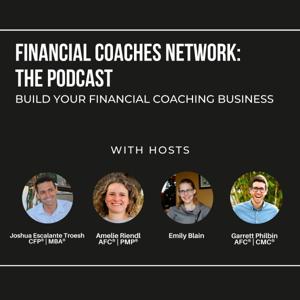
Financial Coaches Network - The Podcast: Build your Financial Coaching Business

Financial Coaches Network - The Podcast: Build your Financial Coaching Business

By Joshua Escalante Troesh, Garrett Philbin, Amelie Riendl, and Emily BlainBusinessEntrepreneurship
Download on the App Store

Financial Coaches Network - The Podcast: Build your Financial Coaching Business episodes

  • #207: Decode Your Paycheck: What All Those Numbers Really Mean

    In this episode, Joshua Escalante Troesh CFP® and Amelie Riendl AFC® break down each section of a paycheck—what the numbers mean, why they matter, and how understanding them can help you avoid surprises and make smarter financial decisions. They explore required and optional deductions, tax withholdings, employer‑provided benefits, PTO tracking, and common paycheck misconceptions. The conversation empowers listeners to confidently read their pay stubs, spot errors, and use HR and financial professionals as resources.

    Top takeaways:

    • Why it matters: Understanding your paycheck helps you anticipate taxes, bonuses, and benefits—and avoid surprises.

    • Required deductions: Federal and state tax withholding, Social Security, Medicare, unemployment insurance (UI), and disability insurance (DI) all appear on your pay stub, often under confusing acronyms.

    • Bonuses aren’t taxed more: They feel heavily taxed because withholding formulas differ, not the tax rate itself.

    • Your W‑4 is powerful: Adjusting it can prevent big tax bills or oversized refunds; many never revisit it after being hired.

    • You pay for Unemployment Insurance (UI) and Disability Insurance (DI): These aren’t “government handouts”—the insurance premiums are deducted from your paycheck. Using them when you need them is no different than filing a claim with your car insurance after an accident.

    • Optional deductions: 401(k) contributions, employer stock plans, life and disability insurance, and other benefits may impact taxable income.

    • PTO tracking matters: Vacation and sick time accruals are often miscalculated—monitoring them protects benefits you’ve earned.

    • Paycheck fluctuations: Changes often come from hitting the Social Security cap, maxing out 401(k) contributions, benefit changes, PTO payout, or reimbursement timing.

    • Red flags: Hours worked not matching the pay stub, PTO not accruing correctly, or unexplained swings in deductions.

    • HR/Payroll is your ally: Most issues are simple system errors, and HR teams want to help employees understand their benefits and deductions (they may even be excited to share it with you).


      Want help building or growing a successful financial coaching business? Start here:

      Exploring financial coaching? Join our free community of 6,000+ coaches:
      https://www.facebook.com/groups/financialcoachescommunity

      Ready to learn more? Get our free 8‑part email series with 30+ tips:
      https://www.financialcoachesnetwork.com/pre-launch-email-series 

      Launching your business? Check out FCN Biz DIY, our step‑by‑step program:
      https://www.financialcoachesnetwork.com/biz-diy

      Love coaching but not running a business? Beta test MoneyCoach Network:
      https://form.jotform.com/231063470154043

      47 min
    • #206: What do I do when a past client reaches out for "free" advice?

      In this episode, Josh and Amelie tackle the tricky situation of past clients reaching out for “quick” free advice and how financial coaches can respond professionally, ethically, and without resentment. The hosts explore liability concerns, time boundaries, client expectations, and the importance of avoiding assumptions about a client’s motivations. They also share practical scripts and strategies for setting clearer expectations in future engagements.

      Top takeaways:

      • A client’s history matters: a positive past relationship may lower risk, while a contentious one increases liability concerns.
      • Not responding can create more liability than providing advice — or vice versa — depending on the situation.
      • Your time has value; if a question requires more than a quick response, you may choose to offer a paid one‑off session.
      • When you can’t responsibly answer, explain why (e.g., I don’t have updated information, I have questions for you) and offer factors and questions for them to consider.
      • Provide a path forward; some ideas include: a link to schedule a consultation or coaching session, a short‑term engagement proposal, or suggestion for an annual update.
      • Frequent “quick question” clients may need a gentle nudge toward an ongoing or annual service model.
      • Never assume a client’s motivation — many genuinely believe their question is simple and may be reaching out simply because they trust you.
      • Set expectations early: define what follow‑up support includes, what’s out of scope, and how additional questions are handled.
      • Avoid reinforcing the pattern by responding with “no problem, reach out anytime,” even when the question is simple.
      • Boundaries protect both sides: responsible advice requires current information, context, and a professional structure. 
      •  

        Want help building or growing a successful financial coaching business? Start here:

        Exploring financial coaching? Join our free community of 6,000+ coaches: 
        https://www.facebook.com/groups/financialcoachescommunity

        Ready to learn more? Get our free 8‑part email series with 30+ tips: 
        https://www.financialcoachesnetwork.com/pre-launch-email-series

        Launching your business? Check out FCN Biz DIY, our step‑by‑step program: 
        https://www.financialcoachesnetwork.com/biz-diy 

        Love coaching but not running a business? Beta test MoneyCoach Network: 
        https://form.jotform.com/231063470154043

        26 min
      • #205: Guilt & Shame Around Money

        This episode with Josh and Amelie explores the difference between guilt and shame around money, why so many people internalize financial mistakes, and how those emotions can either motivate change or shut it down. The hosts break down how societal pressure, financial pundits, and even well‑meaning professionals can unintentionally fuel shame — and what it takes to separate your identity from your financial actions. They close with practical steps for rebuilding a healthier relationship with money through small, consistent decisions.

        Top takeaways:

        • Guilt is about actions (“I made a mistake”), while shame attacks identity (“I am a bad person” or “I don’t have self control”).
        • Shame often comes from external sources — society, family, financial pundits — while guilt tends to come from within.
        • Tone and language matter: even well‑meaning financial professionals can unintentionally trigger shame.
        • Common guilt triggers include debt, retirement savings, renting vs. owning, parenting pressures, and social comparison.
        • Social media amplifies unrealistic comparisons, making people feel uniquely flawed even when their struggles are common.
        • The first step in healing is separating you from your financial actions — you are not your mistakes.
        • Professional psychological support can help untangle shame and build healthier thinking patterns.
        • Change starts with identifying specific actions, not broad failures (“What exactly led to this?”).
        • Not all “bad” financial outcomes mean the decision was wrong — context and long‑term impact matter.
        • Small, repeated good decisions compound over time; you don’t need perfection, just a better ratio of good to bad choices.
        • 32 min
        • #204: FINRA Fellowship - A Path to AFC® Certification for Military Spouses

          Amelie discusses FINRA Foundation Military Spouse Fellowship Program, a path to AFC Certification for mil spouses! She is joined by Valerie Richards from AFCPE® and Cherie Stueve, a frequent FINRA Fellowship Instructor to discuss the process!

          Top takeaways:

          • The FINRA Fellowship process is a great networking and community building opportunity.
          • The AFCPE Symposium is a huge networking and community building conference for everyone!!
          • It’s a very strong, tightknit group with strong interpersonal connections and support both during and after the certification process.
          • There are regular, virtual, regional meetings as well to chat and connect.
          • Applications are open now! You can find more info here: https://www.finrafoundation.org/military-spouse-fellowship-program   
          • 2026 Deadline: April 15, 2026
          •  

            35 min
          • #203: Estate Planning/Wills

            Joshua and Amelie break down what an estate really is, why everyone already has an estate plan (even if they never created one), and why the Last Will and Testament is often the least powerful document in the entire process. The conversation explores essential documents like advance medical directives and powers of attorney, clears up common misconceptions, and highlights the one crucial role a will play for parents of minor children.

            Top takeaways:

            • An “estate” includes far more than real estate — it’s everything you own, owe, or control before and after death, including digital assets.
            • If you don’t create an estate plan, your state already has one for you — and it may not reflect your wishes.
            • The most essential documents for nearly everyone are: an advance medical directive (living will), durable powers of attorney (health + finances), and, for parents of minors, a will.
            • Guardianship designations for minor children only live in a will, making it critical for parents.
            • Titling and beneficiary designations (in that order) override your will, meaning most financial assets never pass through it. Trusts also override the will.
            • Wills are often less powerful than people assume; they mainly serve as a safety net for anything not handled elsewhere.
            • Trusts can provide control, clarity, and protection — but they require thoughtful planning and aren’t one‑size‑fits‑all.
            • Estate plans should be reviewed after major life events — both in your family and in the lives of your chosen guardians or decision‑makers.
            • Executors often have less responsibility than people expect when the rest of the estate plan is structured well.
            • Estate Planning Podcast Series

              • What Is an Estate Plan? 
                • A practical overview of what an estate includes, why everyone already has an estate plan by default, and the essential documents every adult should have in place.
                • Trusts: How They Work & When They Matter (episode 151)
                  • A clear breakdown of what trusts actually do, common misconceptions, and when they’re useful for clients.
                  • https://www.financialcoachesnetwork.com/podcasts/financial-coaches-network-the-podcast-build-your-financial-coaching-business/episodes/2148895609
                    • Executors, Trustees & Key Roles in an Estate Plan (episode 152)
                      • An explanation of what executors and trustees really do, how to choose them, and common pitfalls to avoid.
                      • https://www.financialcoachesnetwork.com/podcasts/financial-coaches-network-the-podcast-build-your-financial-coaching-business/episodes/2148898929
                      • Marital Assets, Separate Property & Your Estate Plan (episode 153)
                        • A discussion of how marital vs. separate assets are defined, how different states treat them, and why that matters for estate planning decisions.
                        • https://www.financialcoachesnetwork.com/podcasts/financial-coaches-network-the-podcast-build-your-financial-coaching-business/episodes/2148903744 
                        • DIY Estate Planning: When It Works and When It Doesn’t (episode 155)
                          • An exploration of when simple, do‑it‑yourself estate planning tools can be appropriate and when they may create costly problems.
                          • https://www.financialcoachesnetwork.com/podcasts/financial-coaches-network-the-podcast-build-your-financial-coaching-business/episodes/2148917443 
                          • Your Role as a Financial Coach in Estate Planning (episode 156)
                            • A conversation about how far coaches can go, where the line to legal advice is, and how to collaborate effectively with attorneys
                            • https://www.financialcoachesnetwork.com/podcasts/financial-coaches-network-the-podcast-build-your-financial-coaching-business/episodes/2148921115
                            • 42 min
                            • #202: Just Do It -- Creating Content for Your Niche

                              Joshua and Amelie explore how financial coaches can confidently create content that truly resonates with their niche—whether for speaking engagements, freebies, or prospecting. They break down why generic financial topics fall flat, how to anchor your message based on real pain points, and why saying “yes” to opportunities (even before you feel ready) is the key to growth. 

                              Top takeaways:

                              • Start with real niche research. You can’t create meaningful content without understanding your audience’s lived experiences, pain points, and financial realities through solid research of large studies or extensive conversations with hundreds within your niche.
                              • Generic financial topics won’t help you stand out. Budgeting, emergency funds, and debt payoff are oversaturated and dominated by huge voices; your differentiation comes from specificity, not repetition.
                              • Pain points drive everything. People don’t search for “how to budget”—they search for solutions to problems like saving for a down payment. 
                              • Good content solves a real problem. Frame your content around a high‑priority pain point, then introduce financial tools as part of the solution—not the headline.
                              • Avoid stretching to make a connection. If you have to force a link between their pain point and your financial solution, skip it. If it’s a stretch for you, it’s a leap for them.
                              • Your expertise is in finances, not their profession. You don’t need to know more about being a pilot than a pilot—you need to know how money works for people like them. Research fills the gap.
                              • The worst‑case scenario isn’t actually bad. If a talk doesn’t land, they weren’t going to hire you anyway. The real loss is never taking the opportunity.
                              • Focus on the engaged people in the room. Some attendees will tune out no matter what; they’re not your audience. The ones paying attention are the ones who might become clients.
                              • Prepare content before you need it. Build simple, flexible slide decks or outlines so you can confidently say yes and customize later instead of starting from scratch when an opportunity comes along.
                              • Learn basic teaching skills. Community college or extension courses on lesson planning or pedagogy can make you a stronger, more confident presenter.
                              • 28 min
                              • #201: Tax Deductions 101

                                Joshua and Amelie break down the basics of tax deductions and tax credits, offering a simple, high‑level overview to help listeners understand how these tools may reduce their tax bill. 

                                Top takeaways:

                                • Tax deductions and tax credits both help you pay less in taxes, but they work differently
                                  • Tax credits offer a dollar‑for‑dollar reduction in your taxes owed— the government treats you as if you paid that amount in taxes.
                                  • Tax deductions reduce the amount of income the IRS considers taxable.
                                  • The value of a deduction depends on your tax bracket; higher‑income earners generally benefit more because of progressive tax rates
                                  • In some cases, you can choose between claiming something as a tax credit or a tax deduction
                                  • When comparing “above the line” and “below the line” deductions, the “line” refers to your Adjusted Gross Income (AGI).
                                  • Above the line deductions (adjustments to income) reduce your AGI, which can affect eligibility for certain benefits and credits.
                                    • Common above the line deductions include retirement contributions (like 401(k)s) and legitimate business expenses 
                                    • Below the line deductions are taken as either the standard deduction or itemized deductions (such as charitable giving or state taxes)
                                    • MAGI (Modified AGI) is used throughout the tax code, but calculating it can be complex and varies by program — tax professionals handle this best
                                    • A tax professional can sometimes help you legally shift deductions from below the line to above the line
                                    • Nearly everyone can benefit from working with a qualified tax professional
                                    • Many valuable tax credits exist for people with low income, but they’re often missed when taxes aren’t filed or are filed incorrectly
                                    • The Earned Income Tax Credit (EITC) is widely under‑claimed; most eligible households never receive it.
                                      • For families with children, the EITC can average around $3,000 — far more than the cost of basic tax preparation.
                                      • Check out AICPA’s Guide on How to Choose a CPA
                                      • Look for tax professionals with one of these credentials: Certified Public Accountant (CPA), Enrolled Agent (EA), or Tax Attorney
                                      • 28 min
                                      • #200: Your Business Emergency Plan

                                        Joshua and Amelie share their thoughts on what should go into a business emergency plan. As a section in your business plan, the emergency plan is there to guide you whenever there is any kind of action that causes a disruption to your normal business operations, from natural disasters that displace you for weeks or months to power outages that last just a few hours.

                                        Top takeaways:

                                        • A written emergency plan shows that you care about serving your clients. 
                                        • The SEC requires a disaster recovery plan for Registered Investment Advisors (RIAs).
                                        • Sections to include in your emergency plan include: 
                                          • Office Space - including short term and long term plans
                                          • Equipment - including your computer and phone
                                          • Regulatory - including liability and access to client data
                                          • Third party vendors - including key contacts at each
                                          • Employees - emergency recovery plan for employees
                                          • Critical contact list - contact information for clients in the case of an emergency
                                          • A small battery back up system for your computer combined with the plan to use your phone as a hotspot are simple starting points.
                                          • Having suitable alternative office spaces readily available will help when an actual emergency happens.
                                          • A password management system can help give you access to your important websites, passwords and third party vendors.
                                          • Include software security for any new or alternative equipment in the appropriate section.
                                          • Make a paper copy of your business recovery plan for easy access.
                                          • Notify clients of an emergency or change to your business only when they’re impacted (e.g., upcoming meetings you may miss).
                                          • Documentation of your plan is important, but you can start with big picture steps and refine it over time.
                                          • You can contact an RIA compliance consultant for a template.
                                          • 29 min
                                          • #199: How to Vet a Financial Advisor

                                            In this episode, Josh and Amelie discuss the confusing world of financial advisors and give listeners ideas for evaluating a potential advisor. The hosts explain why job titles are meaningless and certifications vary widely in rigor, with the Certified Financial Planner® (CFP®) standing out as the gold standard. They clarify how the fiduciary standard works, including why just the Series 65–only advisors are legally bound to act in a client’s best interest at all times. The conversation then walks through how to use BrokerCheck and Form ADV to uncover an advisor’s licenses, conflicts of interest, fees, custody arrangements, and more. Together, these tools may help consumers find the right advisor for their needs. 

                                            Top takeaways:

                                            • Job Titles Are Meaningless: Vice president, wealth manager, and similar titles are unregulated and don’t indicate competence or ethics.
                                            • Certifications Vary Widely
                                              • Over 400 financial certifications exist; many require little more than paying a fee.
                                              • The CFP® is the gold standard for personal financial planning due to its rigorous exam, education requirements, enforced code of ethics, and continuing‑education requirements.
                                              • BrokerCheck Is Your First Stop (https://brokercheck.finra.org/)
                                                • Every licensed advisor remains in the system permanently.
                                                • If an “investment professional” isn’t listed, they’re either an insurance agent or they’re operating illegally.
                                                • Review disclosures carefully; multiple complaints or hidden details are red flags.
                                                • Fiduciary Status Is Critical
                                                  • Only advisors with a Series 65 license (look for “IA” in BrokerCheck) and no other licenses are legally bound to act in the client’s best interest at all times.
                                                  • Advisors with multiple licenses (e.g., IA and broker) can switch roles—and obligations—mid‑conversation (and without telling you they switched roles).
                                                  • Commissions Influence Advice
                                                    • Academic studies show that advisors recommend products with higher commissions.
                                                    • Brokers and insurance agents are legally obligated to act in the best interest of their firms, not their clients. 
                                                    • Form ADV Part 2 Shares Key Information About the Advisor
                                                      • Required for all registered Investment Advisers (IAs).
                                                      • Includes services, fee schedule, conflicts of interest, investment philosophy, and custody details (who is the custodian of your money).
                                                      • Good advisors make their ADV and fee schedule easy to find.
                                                      • Custody Protects You
                                                        • Look for advisors who use large, third‑party custodians who will protect you (not the firm).
                                                        • Small custodians can be vulnerable to conflicts of interest, as seen in the Bernie Madoff case.
                                                        • Transparency Is Important
                                                          • Advisors who openly share fees, conflicts of interest, and regulatory documents demonstrate integrity.
                                                          • Marketing transparency often reflects operational transparency.
                                                          • One Advisor Profile to Look For (in our opinion)
                                                            • Series 65 license only (legal fiduciary duty)
                                                            • CFP® designation (rigorous training and ethics)
                                                            • Clear, accessible disclosures and fee transparency
                                                            • Uses a large, reputable third‑party custodian
                                                            • Want help building or growing a successful financial coaching business? Find resources below based on where you’re at in your journey:

                                                              - Deciding whether Financial Coaching is right for you? Join our free Facebook Community with over 5000 current and aspiring financial coaches! https://www.facebook.com/groups/financialcoachescommunity

                                                              - Already decided you’re going to be a Financial Coach and want to learn more? Get 30+ tips and best practices in our free 8-part email series! https://www.financialcoachesnetwork.com/pre-launch-email-series

                                                              - Ready to Launch your Financial Coaching business? Join FCN Biz DIY, our step-by-step program that will help you successfully launch your business in four months and grow it to a consistent part-time income. https://www.financialcoachesnetwork.com/biz-diy  

                                                              - Are you excited by financial coaching but not running a coaching business? MoneyCoach Network partners with financial coaches to handle the entire “business” side of having a financial coaching business. Sign up to Beta Test MoneyCoach Network (https://form.jotform.com/231063470154043) 

                                                              29 min
                                                            • #198: From the Vault: Tax Obligations - 1099 Requirements

                                                               Join Josh and Amelie to discuss everyone’s favorite…taxes! What are your obligations in sending 1099s to someone? Did you know that there may be requirements for you to send 1099s to someone?!

                                                              Top takeaways:

                                                              • If you receive over $600 income through a third party (AdvicePay/Stripe/Paypal etc.), that third party will issue you a 1099 (though this has and will continue to change a lot).
                                                              • Double check 1099 numbers so they all line up correctly.
                                                              • If you pay someone/some company over $600 over the course of a year, you have to issue a 1099 to them UNLESS it is a corporation or if you pay by credit card (NOT debit card).
                                                              • Your deadline is January 30!!!! If you missed that…do it ASAP and be prepared to pay penalties.
                                                              • Want help building or growing a successful financial coaching business? Find resources below based on where you’re at in your journey:

                                                                • Deciding whether Financial Coaching is right for you? Join our free Facebook Community with over 5000 current and aspiring financial coaches! https://www.facebook.com/groups/financialcoachescommunity
                                                                • Already decided you’re going to be a Financial Coach and want to learn more? Get 30+ tips and best practices in our free 8-part email series! https://www.financialcoachesnetwork.com/pre-launch-email-series
                                                                • Ready to Launch your Financial Coaching business? Join FCN Launch, our step-by-step program that will help you successfully launch your business in four months and grow it to a consistent part-time income. https://www.financialcoachesnetwork.com/launch
                                                                • Looking for financial coaching software? Sign up for the interest list for FCN MoneyCoach, the premier cash flow analysis software for financial coaches and advisers. https://www.financialcoachesnetwork.com/money-coach
                                                                • Are you already coaching clients and want to grow your business to a full-time income? Join FCN Grow, our program that helps you scale your business to a full-time income. https://www.financialcoachesnetwork.com/grow
                                                                • 25 min

                                                                About Financial Coaches Network - The Podcast: Build your Financial Coaching Business

                                                                From the publisher's feed

                                                                Looking to build a successful financial coaching business? Join thousands of others in the Financial Coaches Community who are building successful financial coaching businesses. Hosted by Joshua…

                                                                More shows like Financial Coaches Network - The Podcast: Build your Financial Coaching Business

                                                                Freakonomics Radio by Freakonomics Radio + Stitcher

                                                                Freakonomics Radio

                                                                31,925 Listeners

                                                                Planet Money by NPR

                                                                Planet Money

                                                                30,695 Listeners

                                                                The Ramsey Show by Ramsey Network

                                                                The Ramsey Show

                                                                39,030 Listeners

                                                                Money Guy Show by Brian Preston and Bo Hanson

                                                                Money Guy Show

                                                                3,231 Listeners

                                                                Retirement Starts Today by Benjamin Brandt CFP®, RICP®

                                                                Retirement Starts Today

                                                                542 Listeners

                                                                ChooseFI | Financial Independence Podcast by ChooseFI

                                                                ChooseFI | Financial Independence Podcast

                                                                5,133 Listeners

                                                                Stay Wealthy Retirement Podcast by Taylor Schulte, CFP®

                                                                Stay Wealthy Retirement Podcast

                                                                699 Listeners

                                                                The Indicator from Planet Money by NPR

                                                                The Indicator from Planet Money

                                                                9,512 Listeners

                                                                The Rational Reminder Podcast by Benjamin Felix, Cameron Passmore, and Dan Bortolotti

                                                                The Rational Reminder Podcast

                                                                474 Listeners

                                                                Ready For Retirement by James Conole, CFP®

                                                                Ready For Retirement

                                                                829 Listeners

                                                                Personal Finance for Long-Term Investors by Jesse Cramer

                                                                Personal Finance for Long-Term Investors

                                                                158 Listeners

                                                                Money For Couples with Ramit Sethi by Ramit Sethi

                                                                Money For Couples with Ramit Sethi

                                                                3,453 Listeners

                                                                The Money with Katie Show by Katie Gatti Tassin

                                                                The Money with Katie Show

                                                                1,535 Listeners

                                                                Retire With Style by Wade Pfau & Alex Murguia

                                                                Retire With Style

                                                                184 Listeners

                                                                Money Made Human Podcast by Kelsa Dickey

                                                                Money Made Human Podcast

                                                                106 Listeners