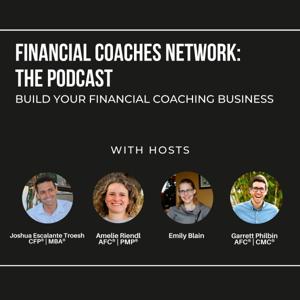
Financial Coaches Network - The Podcast: Build your Financial Coaching Business

Financial Coaches Network - The Podcast: Build your Financial Coaching Business

By Joshua Escalante Troesh, Garrett Philbin, Amelie Riendl, and Emily BlainBusinessEntrepreneurship
Download on the App Store

Financial Coaches Network - The Podcast: Build your Financial Coaching Business episodes

  • #197: The 50-year mortgage

    Joshua and Amelie dive into the newly introduced 50-year mortgage option (as of 2025), exploring its potential benefits and drawbacks. They highlight the importance of understanding how any mortgage fits into an individual or family’s financial plan, and why consulting with a trusted financial advisor could help consumers evaluate whether this loan structure may make sense for them. 

    Topics Discussed:

    • A brief history of mortgages and how they’ve evolved alongside the rising cost of building homes.
    • The debate: Why discussions about the 50-year mortgage often exaggerate pros or cons depending on personal bias. 
    • Interest rate considerations:
      • A 50-year mortgage is more appealing when rates are low.
      • The interest rate difference compared to a 30-year mortgage is relatively small 
      • Monthly payments are lower than a 30-year mortgage. However, the reduction isn’t as significant as the jump from a 15-year to a 30-year loan.
      • Refinancing potential: Moving to a 50-year mortgage could ease financial strain by freeing up cash flow

      •  Affordability myth: A 50-year mortgage doesn’t necessarily encourage buyers to purchase “too much house” any more than a 30-year loan would.

      •  Actual mortgage duration: Most homeowners don’t keep a mortgage for the full term—on average, loans last about 8 years before being refinanced or paid off.

      •  Fixed payments: Regardless of length, mortgages lock in principal + interest payments, even as inflation and income levels change.

      •  Total interest: Technically you’ll pay more total interest with a 50-year loan. However, the time value of money matters too—$10,000 in year 40 doesn’t feel the same as $10,000 in year 10 due to inflation and income growth.

      • Cash flow impact: The interest rate has more of an impact on your current and future cash flow than the length of the mortgage.
      • Housing market effects: In the short term, 50-year mortgages may affect home prices, but long-term supply -and-demand will likely play a bigger role.
      • 30 min
      • #196: What are the Most Effective Marketing Strategies to Get Clients?
        What are the Most Effective Marketing Strategies to Get Clients?
        • 2:15 - The Reality: There's NO Silver Bullet
        • 2:59  - Not All of Your Clients are Active on Facebook
        • 6:33 - Do Your Research and Understand Your Niche
        • 7:57 - Finding Alignment With What You Do and Match It With a Potential Medium
        • 9:16 - You Have to Start With Who is Your Audience
        • 12:11 - Not All Marketing Strategies Have the Same Results
        • 13:53 - Getting People to Go Through a Series of Processes
        • 14:17 - What Ad Campaigns Do in Marketing? 
        • 15:44 - Focusing on a Particular Channel and Building Engagement With Your Audience 
        • 18:11 - Leveraging the People You Already Have Personal Relationships With 
        • 18:46 - You Can Learn a Lot From the Multilevel Marketing Methodology 
        • 20:24 - The Basic Ideas of Utilizing Your Existing Network
        • 22:38 - The Stuff That's Going to Work is the Stuff That's Scary
        • 27:22 - Recommendation on a Marketing Strategy to Get Clients
        • 29:40 - The Long-Term Marketing Strategies 
        • 32:01 - Leveraging the Relationship With People Who Already Know You
        • Want help building or growing a successful financial coaching business? Find resources below based on where you’re at in your journey:

          • Deciding whether Financial Coaching is right for you? Join our free Facebook Community with over 5000 current and aspiring financial coaches! https://www.facebook.com/groups/financialcoachescommunity 
          • Already decided you’re going to be a Financial Coach and want to learn more? Get 30+ tips and best practices in our free 8-part email series! https://www.financialcoachesnetwork.com/pre-launch-email-series 
          • Ready to Launch your Financial Coaching business? Join FCN Launch, our step-by-step program that will help you successfully launch your business in four months and grow it to a consistent part-time income. https://www.financialcoachesnetwork.com/launch 
          • Are you already coaching clients and want to grow your business to a full-time income? Join FCN Grow, our program that helps you scale your business to a full-time income. https://www.financialcoachesnetwork.com/grow 
          • 35 min
          • #195: All About Lead Magnets

            In this podcast episode, Joshua and Amelie discuss lead magnets for financial coaches, focusing on how to create valuable content that attracts your specific niche. They emphasize the importance of understanding your niche, conducting in-depth research, and creating specialized content that appeals to your niche rather than generic material that’s available through a simple internet search. The conversation highlights that successful lead magnets require significant effort to create, and include follow up to provide additional value, helping prospects move through your marketing funnel.

            Topics Discussed:

            • Definition and purpose of lead magnets in the marketing funnel
            • Common but ineffective lead magnet examples (budget worksheets, quizzes)
            • How to develop a great lead magnet by researching your niche
            • Strategies for sharing lead magnets (conferences, paid advertising)
            • The importance of follow-up content after receiving the prospect’s contact information
            • 33 min
            • #194: AI For Financial Coaches

              In this episode, we dive into the evolving role of Artificial Intelligence (AI) in financial coaching and counseling. From boosting productivity to streamlining client support, AI offers exciting possibilities—but it also comes with important caveats. We unpack where AI can enhance your practice, what to watch out for, and how to get the most out of these tools without compromising quality or ethics.

              Top takeaways:

              • AI isn’t always cheap: High-performing tools may have a steep price tag.
              • AI can support nearly every aspect of your work—but don’t expect magic. Results may fall short of expectations.
              • AI is more time-consuming than you may think: Effective use of AI requires thoughtful input and iterations.
              • Prompts matter: The more context you provide—your goals, strategy, and desired tone—the better the output.
              • Refinement is key: Ask for multiple options and be prepared to give feedback across several rounds.
              • Expect formulaic results: AI tends to default to generic patterns.
              • Know your sources: Understand where your AI tool pulls its information from.
              • Copyright limitations: AI-generated content may not be eligible for copyright protection.
              • Start with your systems: Review your current workflows to identify where AI could improve efficiency or effectiveness.
              • Tune in to learn how to use AI as a thoughtful partner—not a shortcut—in your financial coaching journey.

                44 min
              • #193: AFCPE Symposium Q&A with AFCPE Executive Director Rachael DeLeon

                In this podcast, we talk to Executive Director of AFCPE Rachael DeLeon about the upcoming AFCPE Symposium, its purpose and why you should attend! 

                Top takeaways:

                • The AFCPE is a national nonprofit that certifies, educates and supports financial coaches, counselors, and educators.
                • The AFCPE Symposium brings together financial professionals from all different professions, who work with clients in a variety of sectors (e.g., military, government, private practice, academia, non profit, financial industry).  
                • The symposium allows people from different practice areas to learn from each other and bring new ideas to their counseling practice.
                • The magic happens in the halls and the side chats.
                • 4 keynote speakers: 
                  • The State of U.S. Financial Health and Capability by Gary Mottola and Lisa Berdie
                  • Redefining How We Understand Financial Behavior by Rahkim Sabree (check out our interview with him from last year)
                  • Every Conversation Counts by Riaz Meghji
                  • Put Your Money Where Your Mouth Is by Erika Wasserman
                  • The theme “Made For This Moment” injects hope and reminds us that collaborations are important to improving the nation’s financial health.
                  • Some topics this year include:
                    • More AI topics than ever before
                    • Members from FPA and Foundation for Financial Planning - building the bridge between financial counseling and financial planning
                    • The importance of systemic behavioral interventions (e.g., nudges) between counseling sessions (the Coaching Operating SystemTM)
                    • Why financial counseling are terrible business owners
                    • Annual State of Financial Coaching/Counseling results
                    • Researchers share information with practitioners
                    • How do you decide which sessions to attend?
                      • Make time to attend different types of presentations, especially those that may be different from your typical community. 
                      • Look at this as an opportunity to talk to people you don’t normally have a chance to interact with.
                      • Use your network to “divide and conquer” - take notes and share what you learned with each other
                      • Plan to attend a post-symposium “watch party” to continue learning by watching recorded videos followed by a group discussion - either through the AFCPE or with FCN
                      • The app has some new features to help support networking and collaboration and helps you navigate the events in the 30-day symposium so you don’t miss anything! 
                      • Continuing Education (CE) opportunities:
                        • Pre-Approved for 15 CEUs for AFC® and CFP® professionals
                        • AFC Candidates can submit experiential hours for attending and watching sessions
                        • Check out the pre-symposium options available for additional learning opportunities
                        • Sign up for the 2025 AFCPE Symposium here (in person or virtual)
                          • Phoenix-Glendale, Arizona 
                          • Renaissance Phoenix Glendale Hotel and Conference Center
                          • Tuesday, November 18 – Thursday, November 20, 2025 
                          • Listen for a coupon code to match the early bird discount! 
                          • Members can contact AFCPE to get a special code for a deeper discount (listen for info).
                          •  

                            32 min
                          • #192: Analyzing the gurus: Endorsements

                            We wrap up our series about analyzing the gurus by talking about endorsements! 

                            Top takeaways:

                            • All the “gurus” endorse a product
                            • Be aware of the conflicts of interest with any guru’s recommendations
                              • Anyone who endorses their own product has a conflict of interest
                              • Public gurus or “entertainers” have no obligation to make recommendations based on what’s in your best interest
                              • Endorsed products may not be vetted by the person recommending them
                                • In general, more money is paid for products that aren’t vetted, while less money is paid for products that are vetted
                                • Not all endorsements are bad, but you can’t trust what your favorite guru endorses without doing your own research
                                • People are almost always getting paid for endorsements, though there may be a few exceptions 
                                  • There are many different ways people can get paid for endorsements, and disclaimers on websites can be misleading (read and understand the meaning of the legalese in the the fine print) 
                                  • If you click on a link for an endorsed product, the endorser may get a percentage of anything else you buy from that company for a period of time, not just the endorsed product (e.g., Amazon)
                                  • A guru’s own product is likely aligned with what they teach publicly 
                                  • Following a guru’s (“be like me”) course will likely not make you as successful as them if most of their money was made through the course (their success was from selling the shovels, not mining the gold)
                                  • Gurus who recommend you work with their “expert” coaches likely receive revenue from those secondary coaches
                                    • Recommending secondary “expert” coaches provide a layer of safety to the guru, in case the secondary coaches are advising in areas they are not allowed to by law (e.g., credentials and certifications are required for some advising such as taxes and investing)
                                    • Look for consistent messaging and ask, “Are the details of this product consistent with what they’ve said about other similar products?”
                                    • Trust in a guru may not translate to trust in a product they endorse
                                    • Take the time to understand what an endorsement means – what did that person have to do to receive that endorsement – look for rigorous testing requirements rather than agreeing to teach a guru’s methods (e.g., AFC® Professional, CFP® Professional) 

                                      40 min
                                    • #191: Analyzing the gurus: Money Guy Show

                                      We continue our series about analyzing the gurus! We’ll be spending time discussing several big personal finance names, their recommendations, and why we do or do not agree with those. Josh and Amelie discuss the Money Guy Show, their "Financial Order of Operations" framework, and their philosophy on goals and saving for retirement. 

                                      Top takeaways:

                                      • A set of financial “rules” supposedly for everyone, doesn’t actually work for anyone.
                                      • Paying off student loans (and mortgages) early may or may not be right for you depending on your specific situation
                                      • The decision on which tax advantaged accounts to prioritize (e.g., HSA, Roth IRA, 401k) depends on your specific circumstances, and may change year to year
                                      • Choosing a high deductible health plan just to have access to an HRA may not be the right solution for all families
                                      • The order of recommendations assumes you have a 401(k) with an employer match
                                      • Consider contributing to retirement savings, in parallel with other financial “steps,” even if it’s a small percentage compared to other financial goals
                                      • Saving towards medium and long term goals may need to be part of your financial plan, prior to reaching the 25% retirement savings goal (e.g., new roof for home)
                                      • The percentage of income to save for retirement depends on your specific circumstances, and a generic amount of 25% likely isn’t right for most people
                                      • Oversaving for retirement may result in you being undersaved for everything else
                                      • Saving for life goals are important to incorporate into your financial plan throughout your life, not just after you complete a set of checklist items
                                      • Any generic framework will fail to adequately address your individual goals and values, both now and in retirement
                                      • Tax diversification in multiple tax buckets (e.g., tax free, income, capital gains) is a side effect rather than a goal in financial planning (the goal is to lower lifetime taxes paid)
                                      • 38 min
                                      • #190: Analyzing the gurus: Clark Howard

                                        We continue our series about analyzing the gurus! We’ll be spending time discussing several big personal finance names, their recommendations, and why we do or do not agree with those. Josh and Amelie discuss Clark Howard, his philosophy on saving and spending. 

                                        Top takeaways:

                                        • Saving small amounts of money may not be worth the time or effort involved.
                                        • DIY may not be the best approach for you. 
                                        • Reviews from gurus are not as thorough as other sources (e.g., Consumer Reports).
                                        • As your life becomes more complex, you likely have more complex investing needs.
                                        • An overemphasis on saving money elevates money above your time, relationships, and life experiences.
                                        • 17 min
                                        • #189: Analyzing the gurus: Robert Kiyosaki

                                          We continue our series about analyzing the gurus! We’ll be spending time discussing several big personal finance names, their recommendations, and why we do or do not agree with those. Josh and Amelie discuss Robert Kiyosaki, his philosophy of creating assets to generate money, leverage debt to create these assets, and his beliefs about formal education and savings. 

                                          Top takeaways:

                                          • With any financial celebrity, watch out for business ecosystems designed to get more money from you.
                                          • Choosing not to work for a company (aka “the man”) may limit loan funding options and will impact the terms of a loan, ultimately impacting your ability to get low cost debt. 
                                          • There is nearly always some of your time required for passive income sources (e.g., real estate), even if you’re paying someone else to manage it. 
                                          • The more passive an investment is, the less income you’re likely getting from it.
                                          • A primary residence is a non-performing asset, which builds your wealth but not as fast as a rental property. 
                                          • Putting a property into an LLC doesn’t eliminate all the risk with owning that asset. 
                                          • The biggest risk with owning rental real estate is likely created when you borrow money to purchase the property.
                                          • Oversimplification of the complexities and risk associated with real estate investments, coupled with overstating the potential return, often come from the “experts” who are trying to sell their own educational products. 
                                          • There is a lot of value in formal education. 
                                          • A real estate education from a community college includes valuable information that will help learn how to invest in real estate. 
                                          • Having a large savings account allows you to step further out on the risk spectrum. 
                                          • Institutions (e.g., banks, investment companies) are watched and controlled by regulators (e.g., SEC, state regulators) to protect the investors. Buying a house doesn’t have these same rigorous regulations.
                                          • 49 min
                                          • #188: Announcement & A Marketing Success Story

                                            This week we’re making an announcement – Emily will be moving on to new opportunities. She’s been spending time marketing her business this year and it paid off! Learn more about what she did to grow her business. Though she is no longer part of FCN, you will still see her in the Financial Coaches Community Facebook group!  

                                            Top takeaways:

                                            • Emily’s financial coaching business has grown recently and she will be focusing on continuing to build and grow that business. 
                                            • Podcasts will change to publishing every other week moving forward (instead of every week).
                                            • Small marketing activities can lead to prospects.
                                            • Chat GPT is a potential new source of prospects.
                                            • Welcome opportunities to present at conferences or other professionals related to your niche.
                                            • Presence in multiple locations helps establish you as an expert (e.g., media, social media, conferences, professional groups and services).
                                            • Announce to others related to your niche that you’re open to presenting to groups.
                                            • Having a hyper specific niche helps establish you as an expert. 
                                            • Active sales activities (the uncomfortable stuff coaches don’t like) leads to more prospects and clients!
                                            • Being more intentional and consistent with sales based activities helps build the business.
                                            • Building a successful coaching business takes time.
                                            • Don’t go into a conversation expecting it to result in a client (conversion rate may be <1%). The more conversations you have, the more results you’ll see (results may not just be clients, but opportunities).
                                            • As an original FCN Launch member and partner behind the scenes, FCN helped Emily build her business that’s ready to scale.
                                            • 38 min

                                            About Financial Coaches Network - The Podcast: Build your Financial Coaching Business

                                            From the publisher's feed

                                            Looking to build a successful financial coaching business? Join thousands of others in the Financial Coaches Community who are building successful financial coaching businesses. Hosted by Joshua…

                                            More shows like Financial Coaches Network - The Podcast: Build your Financial Coaching Business

                                            Freakonomics Radio by Freakonomics Radio + Stitcher

                                            Freakonomics Radio

                                            31,903 Listeners

                                            Planet Money by NPR

                                            Planet Money

                                            30,684 Listeners

                                            The Ramsey Show by Ramsey Network

                                            The Ramsey Show

                                            39,035 Listeners

                                            Money Guy Show by Brian Preston and Bo Hanson

                                            Money Guy Show

                                            3,228 Listeners

                                            Retirement Starts Today by Benjamin Brandt CFP®, RICP®

                                            Retirement Starts Today

                                            541 Listeners

                                            ChooseFI | Financial Independence Podcast by ChooseFI

                                            ChooseFI | Financial Independence Podcast

                                            5,134 Listeners

                                            Stay Wealthy Retirement Podcast by Taylor Schulte, CFP®

                                            Stay Wealthy Retirement Podcast

                                            698 Listeners

                                            The Indicator from Planet Money by NPR

                                            The Indicator from Planet Money

                                            9,508 Listeners

                                            The Rational Reminder Podcast by Benjamin Felix, Cameron Passmore, and Dan Bortolotti

                                            The Rational Reminder Podcast

                                            473 Listeners

                                            Ready For Retirement by James Conole, CFP®

                                            Ready For Retirement

                                            826 Listeners

                                            Personal Finance for Long-Term Investors by Jesse Cramer

                                            Personal Finance for Long-Term Investors

                                            158 Listeners

                                            Money For Couples with Ramit Sethi by Ramit Sethi

                                            Money For Couples with Ramit Sethi

                                            3,455 Listeners

                                            The Money with Katie Show by Katie Gatti Tassin

                                            The Money with Katie Show

                                            1,534 Listeners

                                            Retire With Style by Wade Pfau & Alex Murguia

                                            Retire With Style

                                            182 Listeners

                                            Money Made Human Podcast by Kelsa Dickey

                                            Money Made Human Podcast

                                            106 Listeners