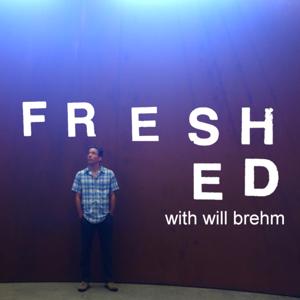
FreshEd

FreshEd

By FreshEd with Will BrehmEducation
Download on the App Store

FreshEd episodes

  • FreshEd #78 - Exploring educational privatization(Stephen Ball)
    We hear about educational privatization a lot these days. My Twitter feed is filled with countless stories about how Betsy DeVos is going to privatize education in America or how Bridge International has privatized education in some African countries. Even the first three episodes of FreshEd way back in 2015 looked at how privatization has gone global.
    But do you really know how it’s happening, how privatization as an educational policy is moving around the world? And what effect is it having on governments?
    The process of national and local governments enacting policies that advance private interests in education is rather complex and often opaque to the general public. My guest today, Stephen Ball, has written a series of books looking at educational privatization. In his latest book, Edu.net, co-written with Caroline Junemann and Diego Santori, he explores through network ethnography the evolution of the global education policy community that is advancing privatization.
    Stephen Ball is a Distinguished Service Professor at the Institute of Education, University College London.
    38 min
  • FreshEd #77 – What makes American higher education great? (David Labaree)
    How did American universities end up being seen as the best in the world?
    My guest today, David Labaree, argues it was the very decentralized and autonomous structure of the higher education system that allowed universities to develop an entrepreneurial ethos that drove American higher education to become the best. Today, America’s universities and colleges produce the most scholarship, earn the most Nobel prizes, hold the largest endowments, and attract the most esteemed students and scholars from around the world
    The messy structure of American higher education was not planned, however. There was no strong state or strong church directing the system from above. Rather higher education developed in a free market where survival was never guaranteed. Such a system produced unintended consequences that would make American higher education the envy of the world.
    David Labaree is a professor of Education at Stanford University. His new book is A Perfect Mess: The unlikely ascendancy of American Higher Education, which was published by the University of Chicago Press earlier this year.
    43 min
  • FreshEd #76 – Exploring global citizenship education (Miri Yemini)
    Today: global citizenship education. What is global citizenship education and how is it practiced?
    And what is the relationship between national citizenship and global citizenship? Are they compatible?
    My guest today is Miri Yemini, an Honorary Visiting Lecturer at the Institute of Education at University College London and a Lecturer in the School of Education at Tel Aviv University
    She has recently published a book entitled Internationalization and Global Citizenship in Education.
    29 min
  • FreshEd #75 – The Global Education Race (Sam Sellar)
    We’ve talked a lot about PISA on this show. Today we take a fresh look at the test, digging into the specifics about how the test is created and what the results can tell policy makers and teachers.
    My guest today is Sam Sellar, a reader in Education Studies at Manchester Metropolitan University and a Director of the Laboratory of International Assessment Studies. He has recently co-written with Greg Thompson and David Rutkowski a short book on PISA titled, The Global Education Race: Taking the measure of PISA and international assessment.
    30 min
  • FreshEd #74 – Fighting for graduate student unions at Yale (Jennifer Klein)
    A group of Yale graduate students are protesting their labor conditions as teachers. They are demanding the administration recognize them as a union and negotiate their contract as full employees of the university. After all, graduate students teach many undergraduate classes.
    But the administration is stalling, waiting for Donald Trump to appoint an anti-union National Labor Relations Board that, they hope, will throw out the union’s right to exist.
    My guest today is Jennifer Klein, a professor of history at Yale University who has followed the unionization efforts closely. She’s written a recent New York Times op-ed detailing the events at Yale.
    The fight over graduate student’s right to unionize at Yale is a microcosm of the reliance on precarious work across the American higher education system.
    You can find the solidarity statement in support of the graduate students here.
    38 min
  • FreshEd #73 – The globalization of curriculum markets (Catherine Doherty)
    Today we look at the globalization of curriculum markets with Professor Catherine Doherty. Catherine uses the example of the International Baccalaureate Diploma in Australia to think about the movement of global curriculum inside local markets.
    Why do schools choose to include global curricula like the IB? And what impact do these new curricular offerings have on educational choice both locally and globally?
    By looking at various schools across Australia, Catherine unpacks the social ecology of the IB, highlighting ideas about educational strategy and imagined motilities. She empirically demonstrates how the global-local binary is a historical artifact.
    Catherine Doherty is a Professor of Pedagogy and Social Justice in the School of Education at the University of Glasgow.
    37 min
  • FreshEd #72 - Human Rights Education (Monisha Bajaj)
    Today we discuss human rights education with Monisha Bajaj. Monisha, has recently edited a book entitled Human Rights Education: Theory, Research Praxis, which was published by the University of Pennsylvania Press.
    In our conversation, we discuss the origins of human rights education, its diverse range of practices, and the ways it has changed overtime.
    We also discuss the challenges to Human Rights Education today.
    Monisha Bajaj is a professor of International and Multicultural Education at the University of San Francisco.
    Check out www.freshedpodcast.com
    35 min
  • FreshEd #71 - Challenging the commonplace relationship between test scores and GDP
    What’s the relationship between test scores and gross domestic product? Do higher test scores lead to higher GDP?
    This question may seem a bit strange because most people think about the value of education on a much smaller, less abstract scale, usually in terms of “my children” or “my education.” Will my children earn a higher wage in the future if they do well on school examinations today? If I major in engineering, will I earn a higher income than if I majored in English?
    The answer to these question is usually assumed to be a resounding “yes.” Doing better on examinations or studying subjects that are perceived to be more valuable will result in higher wages at the individual level and higher GDP at the national level. Such a belief shapes educational policies and influences educational decision making by families. It has even resulted in a global private tutoring industry that prepares students for tests in hopes of getting ahead.
    But what if this assumption isn’t true? What if the relationship between test scores and GDP isn’t so straightforward?
    With me today are Hikaru Komatsu and Jeremy Rappleye. Recently they have been publishing numerous articles (see here, here, and here) challenging the statistical research supporting the conclusion that higher tests scores cause higher GDPs. Instead, they find that test scores don’t determine GDP by all that much. Hikaru and Jeremy were kind enough to give FreshEd a graph showing their results. You can find it on FreshEdpodcast.com.
    Hikaru Komatsu and Jeremy Rappleye are based at the Graduate School of Education at Kyoto University. Their most recent op-ed appeared in the Washington Post.
    36 min
  • FreshEd #70 - The power and perils of international large scale assessments (Gustavo Fischman)
    I hated tests growing up. They made me feel physically ill.
    But we aren’t going to look at the types of tests I disliked so much, those given by a teacher to her or his students. We aren’t even going to look at standardized tests administered across one country.
    Instead, today’s show focuses on tests that are administered around the world. We call these types of tests international large-scale assessments. One of the most popular today is called PISA — the Programme for International Student Assessment. PISA tests 15-year-old’s scholastic performance on mathematics, science, and reading. The latest test, in 2015, was administered in 72 countries.
    Think for a moment of how complex it must be to create, administer, and interpret PISA across 72 countries. The test must be reliable in different contexts; it must successfully recruit national government officials to help collect data; and it must rely on a small army of statisticians to discern what the test results actually mean. For many, the benefit of a test like PISA is that it allows governments to make evidence based policy. After learning where its students sit globally, education officials from one country can enact new and hopefully better policies to improve student learning.
    Sounds good, right?
    But that’s the whole story. Cross-national assessments have produced countless controversies — some within specific countries and others in the academic literature.
    With me today is Gustavo Fischman. He’s been studying this subject for some time. In November 2016, he helped organize a symposium at Arizona State University looking at these so-called “global learning metrics.” You might remember a few FreshEd podcasts on the subject. He has also recently co-written a working paper for the Open Society Foundation on the topic, which will be released later this year.
    Gustavo Fischman is a professor of educational policy and director of edXchange the knowledge mobilization initiative at the Mary Lou Fulton Teachers College at Arizona State University.

    41 min
  • FreshEd #69 – Elite Schools in Globalizing Circumstances (Debbie Epstein)
    Have you ever visited schools like Eton College in the United Kingdom, St. Albans in the United States, or Geelong Grammar School in Australia? Maybe you were among the lucky few to have attended one. These schools are primarily reserved for children from the most privileged families, members of the 1 percent, as we would say today. The schools are steeped in tradition, covered in oak and ivy, and cost a small fortune to attend. The fees at St. Albans, for instance, run as high as $58,000 USD. For that price, it’s no wonder that these schools offer some of the best education money can buy and have produced some notable graduates. For instance, 19 prime ministers from the UK attended Eaton. Talk about a small circle!
    These schools, which are found worldwide, produce and sustain social class and have had to adapt to changing global and local circumstances over the decades. Many started as all boy’s schools but have since become co-educational. Others were reserved for national elites to produce competent colonial administrators but have since turned their attend to the growing market of international students.
    My guest today, Debbie Epstein, has been part of a research team exploring elite schools in former British colonies, from Australia to Barbados and Hong Kong to India. The team, comprised of Jane Kenway, Johannah Fahey, Debbie Epstein, Aaron Koh, Cameron McCarthy, and Fazal Rizvi, have recently co-written a book on their findings entitled “Class Choreographies: Elite schools and globalization.” Debbie, a Professor of Cultural Studies in Education at the University of a Roehampton, joined me to talk about some of the major themes explored in the book.
    48 min

About FreshEd

From the publisher's feed

FreshEd is a weekly podcast that makes complex ideas in educational research easily understood. Five shows. Three languages.

More shows like FreshEd

Hidden Brain by Hidden Brain, Shankar Vedantam

Hidden Brain

43,324 Listeners

The NPR Politics Podcast by NPR

The NPR Politics Podcast

25,784 Listeners

Global News Podcast by BBC World Service

Global News Podcast

7,568 Listeners

The New Yorker: Fiction by The New Yorker

The New Yorker: Fiction

3,337 Listeners

The Gray Area with Sean Illing by Vox

The Gray Area with Sean Illing

10,713 Listeners

Amicus With Dahlia Lithwick | Law, justice, and the courts by Slate Podcasts

Amicus With Dahlia Lithwick | Law, justice, and the courts

3,475 Listeners

The Daily by The New York Times

The Daily

111,708 Listeners

Sean Carroll's Mindscape: Science, Society, Philosophy, Culture, Arts, and Ideas by Sean Carroll

Sean Carroll's Mindscape: Science, Society, Philosophy, Culture, Arts, and Ideas

4,165 Listeners

Have You Heard by Have You Heard

Have You Heard

469 Listeners

Science of Reading: The Podcast by Amplify Education

Science of Reading: The Podcast

647 Listeners

Tech Won't Save Us by Paris Marx

Tech Won't Save Us

573 Listeners

The Ezra Klein Show by New York Times Opinion

The Ezra Klein Show

16,072 Listeners

We Can Do Hard Things by Treat Media and Glennon Doyle

We Can Do Hard Things

41,313 Listeners

Ones and Tooze by Foreign  Policy

Ones and Tooze

356 Listeners

College Matters from The Chronicle by The Chronicle of Higher Education

College Matters from The Chronicle

93 Listeners