
Sign up to save your podcasts
Or



Ibrahim AlHusseini was born in Jordan and raised in Saudi Arabia by parents who are Palestinian refugees. He emigrated to the United States in the 1990s to attend college at the University of Washington and he currently resides in Los Angeles.
AlHusseini is a venture capitalist, sustainability-focused entrepreneur, and environmentalist. He is the founder and CEO of FullCycle, an investment company accelerating the deployment of climate-restoring technologies. AlHusseini is also the founder and managing partner of The Husseini Group.
· fullcycle.com
· www.oneplanetpodcast.org
· www.creativeprocess.info
Ben Pring discusses the future of work, cities, and the upside and downside of technology.
“They’re single-purpose engines doing one thing in extraordinary ways, and they’ve been encouraged in that by the ecosystem around them, by the funding that’s being pumped into them by people whose only motivation is simply to make more money–and you can see the results of that in the world as this technology has grown from a little acorn to now being the biggest Sequoia in the forest. And it’s shading every other tree, it’s taking all the light, it’s taking all the energy from the forest, and it’s distorting so much in the world.”
Ben Pring is the director of Cognizant’s Center for the Future of Work. In 2018 he was a Bilderberg Meeting participant and in 2020 was named one of world’s top management thinkers by Thinkers 50.
He co-authored Monster: A Tough Love Letter On Taming the Machines that Rule Our Jobs, Lives and Code Halos with Paul Roehrig, and Future, What To Do When Machines Do Everything with Roehrig & Malcolm Frank
· www.cognizant.com/futureofwork/author/details/benjamin-pring
· www.oneplanetpodcast.org
· www.creativeprocess.info
36% of cities will experience water insecurity by 2050. Giulio Boccaletti discusses the politics and history of water.
“The problem doesn’t really reside there. The problem is that people have gotten used to thinking about water as a technical issue that can be solved by somebody sitting in a room somewhere with a white coat. The reality is that the history of water shows that this is probably the most political and salient issue of society–How we share the resources that make it possible for us to live is a fundamentally political problem. And in nations that live together under a social contract is fundamentally a constitutional problem. So my hope is that we elevate water to a much higher level of political discourse.”
Giulio Boccaletti, Ph.D., is a globally recognized expert on natural resource security and environmental sustainability. Trained as a physicist and climate scientist, he holds a doctorate from Princeton University, where he was a NASA Earth Systems Science Fellow. He has been a research scientist at the Massachusetts Institute of Technology, a partner of McKinsey & Company, and the chief strategy officer of The Nature Conservancy, one of the largest environmental organizations in the world.
He is an Honorary Research Associate in the Smith School of Enterprise and the Environment at Oxford University. He writes on environmental issues for news media, and is an expert contributor to the World Economic Forum, which elected him as one of its Young Global Leaders. His work on water has been featured in the PBS documentary series H2O: The Molecule that Made Us. His new book, "Water, A Biography" is published by Pantheon Books, a division of Penguin Random House. He lives in London.
· www.giulioboccaletti.com
· www.penguinrandomhouse.com/books/602733/water-by-giulio-boccaletti/
· www.oneplanetpodcast.org
· www.creativeprocess.info
“I think the next crisis is going to be a materials crisis. The whole point of moving from a zero-sum game–like who makes the best cheapest product at the lowest price and can find lowest labor somewhere around the world so someone can be happy with a new laundry machine and buy another one in five years–that’s not going to work for us.”
Tiemen ter Hoeven is founder and CEO of Roetz, a manufacturer of circular bicycles and e-bikes. In the Netherlands alone, about 1 million bicycles are discarded every year - whilst many parts can still be used perfectly well. In the Roetz Fair Factory, the parts are cleaned, repaired, and reassembled into new bicycles by people with poor job prospects. Roetz’ mission is to bring circular design and innovation to the bike industry and beyond.
· roetz-bikes.com
· www.oneplanetpodcast.org
· www.creativeprocess.info
“The political struggle is really hard today and I feel like we haven't been winning, but I think it's important not to think of this as either we win it, or there's catastrophe and that's the end. We win or lose, and there’s this big tidal wave that kills us all. That's not the way the climate crisis is going to play out. It’s going to be a long, slow, attritional crisis punctuated by forms of natural disaster that will decimate populations, but it's also going to be something that people will be impacted by for generations and that people will continue to mobilize around, so I think it's important to keep that in mind.”
Ashley Dawson is currently Professor of Postcolonial Studies in the English Department at the Graduate Center, City University of New York (CUNY), and at the College of Staten Island/CUNY. He currently works in the fields of environmental humanities and postcolonial ecocriticism. He is the author of three recent books relating to these fields: People’s Power (O/R, 2020), Extreme Cities (Verso, 2017) and Extinction (O/R, 2016). Other areas of interest of his include the experience and literature of migration, including movement from colonial and postcolonial nations to the former imperial center (Britain in particular), and from rural areas to mega-cities of the global South such as Lagos and Mumbai.
· ashleydawson.info
· www.centerforthehumanities.org/programming/climate-action-lab
· www.oneplanetpodcast.org
· www.creativeprocess.info
Ashley Dawson is currently Professor of Postcolonial Studies in the English Department at the Graduate Center, City University of New York (CUNY), and at the College of Staten Island/CUNY. He currently works in the fields of environmental humanities and postcolonial ecocriticism. He is the author of three recent books relating to these fields: People’s Power (O/R, 2020), Extreme Cities (Verso, 2017) and Extinction (O/R, 2016).
Other areas of interest of his include the experience and literature of migration, including movement from colonial and postcolonial nations to the former imperial center (Britain in particular), and from rural areas to mega-cities of the global South such as Lagos and Mumbai.
· ashleydawson.info
·
www.centerforthehumanities.org/programming/climate-action-lab
· www.oneplanetpodcast.org
· www.creativeprocess.info
“In Edo Japan, basically life was pretty good, and they recycled everything. Everything was reused, upcycled. Waste was considered taboo. A person who was wasting was considered an ugly person. So there is a lot that we could talk about: design, the layout, scale. Buildings were rarely taller than two stories. Very good use of environmental features, microclimates, use of wind for cooling, passive solar heating. Good use of planting, gardens, etc. But regarding cities of the future, I think the main thing is it needs to be a place where people feel like they belong and want to take responsibility.
I'm from New Orleans, and I am very interested in the fact that cities and the places we live in teach us. They shape us, as much as we shape them. And New Orleans was a wonderful place to grow up in because you wouldn't have said it was sustainable, but the vernacular traditional architecture was naturally cooler in summers because of the way it was built with high ceilings with deep eaves from the roof, with verandas shaded with lots of breezes and lots of gardens, plus it is full of older buildings. And things become gentle over time.”
Azby Brown is a leading authority on Japanese architecture, design, and environmentalism and the author of several groundbreaking books, including Just Enough, Small Spaces, The Japanese Dream House, The Very Small Home, and The Genius of Japanese Carpentry. He is lead researcher for Safecast, a global citizen-science organization that pioneered crowdsourced environmental monitoring. Azby Brown has lived in Japan since 1985.
· azbybrown.com
· www.safecast.org
· www.oneplanetpodcast.org
· www.creativeprocess.info
From the publisher's feed
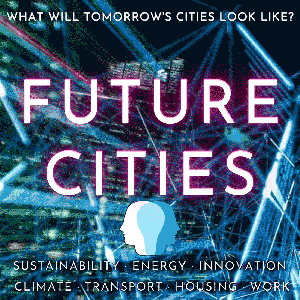
What will the city of tomorrow look like?
We are living in the Century of the City. Cities are the main drivers of creativity and innovation. Yet, a great number of people have little or no conception of what their future will look like when it comes to creating resilient, sustainable, and liveable cities. Even though a significant majority are intent on learning more about climate disruption, energy, transport, water, air, waste, education, and jobs.
In a decade of transformative change, Future Cities podcast tells stories about the best in democracy, culture, urbanism, and society. It is a story of the cities of tomorrow told in a relevant, exciting, and accessible way by the many stakeholders and changemakers reimagining and reshaping our future.
www.oneplanetpodcast.org
www.creativeprocess.info

7,579 Listeners

1,862 Listeners

74 Listeners

296 Listeners

1,161 Listeners

1,014 Listeners

459 Listeners
61 Listeners

276 Listeners
510 Listeners
93 Listeners

178 Listeners

149 Listeners

143 Listeners

433 Listeners
203 Listeners

229 Listeners

55 Listeners

55 Listeners

48 Listeners

35 Listeners

7 Listeners

89 Listeners

33 Listeners

13 Listeners

7 Listeners

18 Listeners

33 Listeners

40 Listeners

81 Listeners

11 Listeners

35 Listeners

2 Listeners

3 Listeners