
Sign up to save your podcasts
Or



“What is societal progress? I think the last 70 years, clearly, in the post World War II period, we have been thinking of economic growth and have been equating that with societal progress. To an extent of course that's right. To an extent, we need this economic growth to lift people out of poverty. We’ve kind of lost the reasoning. We have been following only this economic growth paradigm measured by the GDP, the Gross domestic product and we have forgotten that it measures many things, but it doesn't actually measure progress. It doesn't measure how healthy people are, how educated they are, how clean the environment is, how safe it is, how secure it is. Interestingly, even Simon Kuznets who conceptualized GDP knew this, but it somehow happened. I’m not saying the GDP is a measure we shouldn't be using, it has its values clearly, but it shouldn't be the only measure that we are focusing on. There are some countries and some cities also who have set alternative or additional goals.
I feel that there was a time around 5 to 10 years ago when a lot of people were talking about this. There were a lot of initiatives and I feel that it's still there. Bhutan is mentioned a lot as a country with an alternative framework to measure progress, namely the gross national happiness, which is very much built on these indicators that cover what I've just said. Education, healthcare, housing, security, and community. So it's clearly also about making people understand that we're not asking anyone to lead a life that's worse than the life that they've been leading before. It’s just changing to a much fuller realization of what is actually good for you. And it's a difficult position because who are we to tell people what's good for them, but to the extent, we can measure that. We can measure burnout rates. We can measure mental health issues. We can measure addictions to mobile phones. It’s something where we really need to do a lot to transform those mindsets and, in the end, understand that sustainability is about making their lives better and not worse.”
Alice Schmidt is a global sustainability advisor who has worked in 30 countries on 4 continents with 70+ organisations of all shapes and sizes. She has a deep passion for creating opportunities and win-wins across the social, environmental and economic spheres. Many of her experiences are highlighted in the new book “The Sustainability Puzzle: How Systems Thinking, Climate Action, Circularity and Social Transformation Can Improve Health, Wealth and Wellbeing for All”.
· www.aliceschmidt.at
· www.sustainability-puzzle.org
· www.oneplanetpodcast.org
· www.creativeprocess.info
“It's kind of a scary thought. We've got these PFAS (per- and polyfluoroalkyl substances), you hear them now referred to as forever chemicals because these chemicals–none of these existed on the planet prior to World War II–they're fairly recent invention and they have this unique chemical structure that makes them incredibly useful in a lot of different products, manufacturing operations, but also that same chemical structure makes them incredibly persistent and incredibly difficult to break down once they get out into the environment, into the natural world, into our soil, into our water. They simply, many of them, particularly the ones with eight or more carbons in their structure, don't break down under natural conditions. Or it may take thousands or millions of years for those chemicals to start breaking down. But not only that. Once they get into us, they get into people, they tend to accumulate in our blood and build up over time. They not only persist, they bioaccumulate. Unfortunately, as the science has slowly been revealed to the world about what these chemicals can do, we are seeing that they can have all kinds of toxic effects And unfortunately, we’re finding that those things can happen at lower and lower dose levels.”
“I can't speak highly enough of Mark Ruffalo and what he was able to accomplish with the film. He just did an amazing job. He reached out to me after reading the story that appeared in The New York Times Magazine back in 2016 about this situation down in West Virginia along the Ohio River and was really shocked when he read about it because it was really highlighting an environmental contamination problem that had potentially nationwide, if not worldwide implications but that he had never heard of, and you know he was active in the environmental arena and active in water issues and was surprised that he had not heard of this before and really wanted to find a way to help bring the story out to a wider audience so that we could hopefully start seeing some change in the way type of situations not only develop but how we deal with them. He was able to team up with the folks at Participant Media, who, if you go on their website, and see the types of films they've produced are just incredible filmmakers. Teamed up with Todd Haynes who is an incredible director, and just a terrific cast. Anne Hathaway, Tim Robbins and others. Really they were very dedicated to making sure they did the story and brought it to film in the right way, to show what really happened, not only legally and scientifically, but also to real people. What kind of impact these situations have on real people in real communities. What these people went through for 20 years in this community waiting for this process to unfold. So I think they did a tremendous job in taking a very complicated story that involves a lot of science and a lot of law and conveying it in a way that really impresses upon people why this is a story that matters to all of us and why this is a story that really is one that hopefully is inspiring because, as we discussed, it shows that things can be changed. Things that look impossible can be overcome.”
Rob Bilott is a partner in the Cincinnati and Northern Kentucky offices of the law firm, Taft Stettinius & Hollister LLP, where he has practiced in the Environmental and Litigation Practice Groups for over 31 years. During that time, Rob has handled and led some of the most novel and complex cases in the country involving damage from exposure to per- and polyfluoroalkyl substances (“PFAS”), including the first individual, class action, mass tort, and multi-district litigation proceedings involving PFAS, recovering over $1 billion for clients impacted by the chemicals. In 2017, Rob received the Right Livelihood Award, known as the “Alternative Nobel Prize,” for his decades of work on behalf of those injured by PFAS chemical contamination. Rob is the author of the book, “Exposure: Poisoned Water, Corporate Greed, and One Lawyer’s Twenty-Year Battle Against DuPont,” and his story is the inspiration for the 2019 motion picture, “Dark Waters,” starring Mark Ruffalo as Rob. Rob’s story and work is also featured in the documentary, “The Devil We Know.” Rob is a 1987 graduate of New College in Sarasota, Florida and a 1990 graduate of the Ohio State University Moritz College of Law. Rob also serves on the Boards of Less Cancer and Green Umbrella and is frequently invited to provide keynote lectures and talks at law schools, universities, colleges, communities and other organizations all over the world. Rob is a fellow in the Right Livelihood College, a Lecturer at the Yale School of Public Health, Department of Environmental Health Sciences, and an Honorary Professor at the National University of Cordoba in Argentina. Rob also has received Honorary Doctorate Degrees from both Ohio State University and New College.
· www.taftlaw.com
· www.oneplanetpodcast.org
· www.creativeprocess.info
“Net-zero is a big idea. It’s a big theme. And, unfortunately, what's going up are many ways to look like you're doing net-zero when you're not. So in the ideal world, getting to net-zero means essentially reducing your emissions, and then, where you have residual emissions left, that means you might need to have negative emissions. For example, it's relatively easy to decarbonize the power sector completely, and you can do it quickly and cheaply in most places, but you’re always going to be left with some levels of emissions from agriculture.”
Bill Hare is a physicist and climate scientist with 30 years of experience in science, impacts and policy responses to climate change and stratospheric ozone depletion. He is a founder and CEO of Climate Analytics, which was established to synthesize and advance scientific knowledge on climate change and provide state-of-the-art solutions to global and national climate change policy challenges.
He was a Lead Author for the Intergovernmental Panel on Climate Change (IPCC) Fourth Assessment Report, for which the IPCC was awarded the Nobel Peace Prize in 2007. Hare has contributed actively to the development of the international climate regime since 1989, including the negotiation of the 1992 UN Framework Convention on Climate Change, the 1997 Kyoto Protocol and the Paris Agreement in 2015.
Hare is a graduate of Murdoch University in Western Australia and a visiting scientist at the Potsdam Institute for Climate Impact Research.
· https://climateanalytics.org
· https://climateactiontracker.org
· www.oneplanetpodcast.org
· www.creativeprocess.info
“Is this true that we test for fewer than 100 chemicals in water, but in fact, there are thousands that go untested?”
“There are thousands just like there are in air, just like there are in food. We sometimes compartmentalize too much. We forget, but what is food? Food is made up of chemicals. And I think we need to be broader in our understanding because, for example, we all have on us and within us our Microbiomes and we think about the GI bacteria and we now know that if people are obese they have very different microbial content in their gut compared to people who are not obese. And we know that a baby born by C-section section has a different position than a baby born vaginally. And we know that these things have impacts. We know that many of the bacteria have the ability for example to metabolize the contaminants as well as things in our food. And we know that you can have a different response depending upon what people are eating.”
Dr. Linda Birnbaum is a scientist emeritus and former director of the National institute of Environmental Health Sciences and of the National Toxicology Program. She is also a Scholar in Residence at the Nicholas School of the Environment of Duke University, and an adjunct full professor at Duke, University of North Carolina, and Yale University School of Public Health. She is the author of more than 1000 peer reviewed articles, book chapters, and reports. She is a member of the National Academy of Medicine, has multiple honorary doctorates and awards. Best of all, now that she is retired after 40 years of government.
· sph.unc.edu/adv_profile/linda-birnbaum-phd/
· www.niehs.nih.gov
· www.oneplanetpodcast.org
· www.creativeprocess.info
“So, if we study transportation, then we need to study urban development and infrastructure. Suddenly, we need to think about housing. We need to think about the co-location of jobs and shops, and you realize it's all connected.
That might be one of the challenges of urban sustainability. It's all connected. So the way we move around is connected to the way we built the city. And I think the intrinsic sustainability or non-sustainability in urban areas seems to be designed in. Especially in the United States where there are just so many places where, if you don't have a car, you're basically stranded. You can't go anywhere. The European model is to have co-located things, and I miss that. I think it has some intrinsic sustainability built-in.”
Roland Geyer is a Professor at the Bren School of Environmental Science and Management, University of California at Santa Barbara, and the author of The Business of Less. Since 2000, he has worked with a wide range of governmental organizations, trade associations, and companies on environmental sustainability issues. His overarching goal is to help develop the knowledge, tools, and methods necessary to reduce the environmental impact from industrial production and consumption.
· www.rolandgeyer.com
· www.oneplanetpodcast.org
· www.creativeprocess.info
Roland Geyer is a Professor at the Bren School of Environmental Science and Management, University of California at Santa Barbara, and the author of The Business of Less. Since 2000 he has worked with a wide range of governmental organizations, trade associations, and companies on environmental sustainability issues. His overarching goal is to help develop the knowledge, tools, and methods necessary to reduce the environmental impact from industrial production and consumption.
· www.rolandgeyer.com
· www.oneplanetpodcast.org
· www.creativeprocess.info
From the publisher's feed
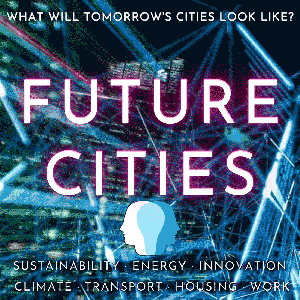
What will the city of tomorrow look like?
We are living in the Century of the City. Cities are the main drivers of creativity and innovation. Yet, a great number of people have little or no conception of what their future will look like when it comes to creating resilient, sustainable, and liveable cities. Even though a significant majority are intent on learning more about climate disruption, energy, transport, water, air, waste, education, and jobs.
In a decade of transformative change, Future Cities podcast tells stories about the best in democracy, culture, urbanism, and society. It is a story of the cities of tomorrow told in a relevant, exciting, and accessible way by the many stakeholders and changemakers reimagining and reshaping our future.
www.oneplanetpodcast.org
www.creativeprocess.info

7,579 Listeners
1,862 Listeners

74 Listeners

296 Listeners

1,161 Listeners
1,014 Listeners
459 Listeners
61 Listeners
276 Listeners
510 Listeners
93 Listeners
178 Listeners
149 Listeners
143 Listeners

433 Listeners
203 Listeners

229 Listeners
55 Listeners
55 Listeners
48 Listeners
35 Listeners

7 Listeners
89 Listeners
33 Listeners

13 Listeners
7 Listeners
18 Listeners

33 Listeners
40 Listeners

81 Listeners

11 Listeners
35 Listeners
2 Listeners
3 Listeners