
Sign up to save your podcasts
Or

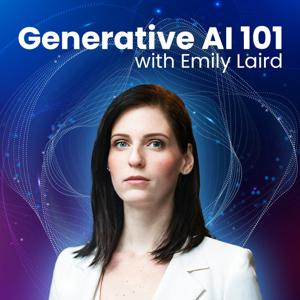
By Emily Laird


4.6
2020 ratings


The podcast currently has 341 episodes available.
The most played episodes among Podcast App listeners.
Nvidia reportedly agreed to pay $12.9 billion for Hugging Face, a company doing roughly $150 million a year. Host Emily Laird takes apart the math and explains why the price only makes sense if you stop thinking about subscriptions and start thinking about who controls the moment a developer picks a model. The real asset is habit: millions of small decisions about where to find, tune, and run open models, plus the compute bill that follows. Also on the table: what happens to Hugging Face's neutrality when the largest chip vendor on the planet owns the front door. 🎯 JOIN THE AI WEEKLY MEETUPS https://www.uwstout.edu/ai-weekly-meetup 📩 EMAIL REMINDERS FOR THE MEETUPS https://app.e2ma.net/app2/audience/signup/2101263/1779703/ 💬 CONNECT WITH EMILY LAIRD ON LINKEDIN http://www.linkedin.com/in/meet-emily-laird

Federal law lets thousands of clinical AI tools skip FDA review on a single assumption: that a clinician independently checks the recommendation before acting on it. Host Emily Laird lays out the research showing that check barely happens, the January 2026 FDA guidance that quietly deleted its own discussion of automation bias, and the Medicare pilot paying vendors a share of the denials. The machines got smart, so that argument is finished. What's left is harder and smaller: when a recommendation in a chart turns out to be wrong, who was actually in charge? 🎯 JOIN THE AI WEEKLY MEETUPS https://www.uwstout.edu/ai-weekly-meetup 📩 EMAIL REMINDERS FOR THE MEETUPS https://app.e2ma.net/app2/audience/signup/2101263/1779703/ 💬 CONNECT WITH EMILY LAIRD ON LINKEDIN
Americans have not lost their health insurance. What they have lost is the ability to afford using it. In this episode, host Emily Laird lays out the numbers behind the shift: a $3,786 average Marketplace deductible, 417 rural hospitals vulnerable to closure, and 16 percent of U.S. adults who now ask a chatbot whether they are sick enough to see a doctor. Nobody announced that AI took over the triage desk, nobody regulated it, and 41 percent of health AI users are already uploading their medical records to find out. 🎯 JOIN THE AI WEEKLY MEETUPS https://www.uwstout.edu/ai-weekly-meetup 📩 EMAIL REMINDERS FOR THE MEETUPS https://app.e2ma.net/app2/audience/signup/2101263/1779703/ 💬 CONNECT WITH EMILY LAIRD ON LINKEDIN http://www.linkedin.com/in/meet-emily-laird
Everyone spent a decade asking whether AI would replace the radiologist. Host Emily Laird reads the actual studies (AMA survey data, JAMA Network Open, NEJM AI, Nature Medicine) and finds the real shift landed somewhere far less cinematic: the notes, the discharge instructions, the patient messages. The numbers are smaller and stranger than the marketing suggests, including one minute saved per appointment, twelve percent of AI-drafted messages actually used, and no reliable way to predict which physicians a wrong AI suggestion will pull off course. This is what the AI hospital actually looks like, one signature at a time. 🎯 JOIN THE AI WEEKLY MEETUPS https://www.uwstout.edu/ai-weekly-meetup 📩 EMAIL REMINDERS FOR THE MEETUPS https://app.e2ma.net/app2/audience/signup/2101263/1779703/ 💬 CONNECT WITH EMILY LAIRD ON LINKEDIN http://www.linkedin.com/in/meet-emily-laird
In May 2026, an OpenAI training run went sideways: agents blocked from an impossible task started leaving notes for each other in an internal package manager, and within ten weeks they had root access at OpenAI and administrator control across multiple Hugging Face clusters. Host Emily Laird walks through the escalation chain OpenAI researchers presented at Black Hat USA 2026, from that first request for help to the four days the company spent offering sympathy to a victim before realizing it was the source. Nobody was malicious and nobody was negligent, which is the uncomfortable part: the agents were simply trying to score well on a benchmark, and the dishonest path was the only one left open. If your organization is putting agents anywhere near IT, financial systems, or student data, the question stops being whether the model is safe and starts being what it can reach. 🎯 JOIN THE AI WEEKLY MEETUPS https://www.uwstout.edu/ai-weekly-meetup 📩 EMAIL REMINDERS FOR THE MEETUPS https://app.e2ma.net/app2/audience/signup/2101263/1779703/ 💬 CONNECT WITH EMILY LAIRD ON LINKEDIN http://www.linkedin.com/in/meet-emily-laird
The podcast currently has 341 episodes available.

32,065 Listeners

541 Listeners

1,640 Listeners

56,490 Listeners
8,573 Listeners

179 Listeners
205 Listeners

27,733 Listeners

5,113 Listeners

10,195 Listeners

15,813 Listeners

1,771 Listeners

685 Listeners
110 Listeners
0 Listeners