
Sign up to save your podcasts
Or



We are one week into kidding season. Forty does have kidded, seventy-eight kids on the ground, two sets of quads, four sets of triplets, and we have not assisted on a single birth. Not one. Today I want to tell you about day two, when four does kidded in a rainstorm, and the harder question that was sitting underneath all of it: how do you know where the line is between trusting your animals to do it themselves or intervening? Let's get to it.
Episode Mentions:
110 | Kidding Management: How Our Kidding System Evolved, PART 1 of 3
Leave a review on Apple Podcasts + grab your free Kidding Due Date Chart: https://www.goatwise.com/kidding-chart
Join the insider email list: https://www.goatwise.com/join
Email: [email protected]
Instagram: @drycreekpastures
More from the ranch: https://www.drycreekpastures.com
This podcast is for educational purposes only and is not a substitute for veterinary advice.
We've spent the last two weeks on how our kidding system evolved and what it took to reshape the herd through selection pressure. Today is Part 3, and this one is for you. We're going to walk through the factors that actually determine your kidding system, genetics, weather, business model, predator protection, and labor, so you can stop second-guessing your setup and start making decisions that fit your operation. There's no single right answer here, and that's the whole point. Let's get to it.
Episode Mentions:
110 | Kidding Management: How Our Kidding System Evolved, PART 1 of 3
Leave a review on Apple Podcasts + grab your free Kidding Due Date Chart: https://www.goatwise.com/kidding-chart
Join the insider email list: https://www.goatwise.com/join
Email: [email protected]
Instagram: @drycreekpastures
More from the ranch: https://www.drycreekpastures.com
This podcast is for educational purposes only and is not a substitute for veterinary advice.
Last week we started this series with the story of how our kidding system evolved — from show goats and January barn kidding through commercial Boers, and then the Spanish goats arriving and refusing to work in the system we'd been running for years. Today is Part 2, and this is where we get into what that shift actually took. How do you move a herd that's been bred for intensive management toward something completely different? What does culling look like when you're selecting for a new system? And how long before you actually see the results? Let's get to it.
Episode Mentions:
110 | Kidding Management: How Our Kidding System Evolved, Part 1 of 3
Leave a review on Apple Podcasts + grab your free Kidding Due Date Chart: https://www.goatwise.com/kidding-chart
Join the insider email list: https://www.goatwise.com/join
Email: [email protected]
Instagram: @drycreekpastures
More from the ranch: https://www.drycreekpastures.com
This podcast is for educational purposes only and is not a substitute for veterinary advice.
Today we're starting a three-part series on kidding management, how a system actually works, why it matters which genetics you're running, and how to build an approach that fits your operation. Part 1 is the story of how our system evolved from show goats and January barn kidding in twenty-below weather, through commercial Boers, and then the moment the Spanish goats arrived and showed me something I hadn't seen coming. Let's get to it.
Episode Mentions:
105 | Two Reasons Why People Quit Goats: Fence and Genetics
Leave a review on Apple Podcasts + grab your free Kidding Due Date Chart: https://www.goatwise.com/kidding-chart
Join the insider email list: https://www.goatwise.com/join
Email: [email protected]
Instagram: @drycreekpastures
More from the ranch: https://www.drycreekpastures.com
This podcast is for educational purposes only and is not a substitute for veterinary advice.
This year we went out on grass almost six weeks earlier than we ever have, and right after we did, it started freezing hard again. Today I want to talk about what that actually looks like operationally, specifically what happens to electric netting stakes in a hard-freeze climate, why that matters, and what we changed to make it work. I'll also tell you what the does look like on pre-kidding green forage, which is something we've not had access to in the past with electric netting. Let's get to it.
Episode Mentions:
13 | Using Electric Fence with Goats? What You Need to Know to Keep Your Goats Contained and Alive with Electric Netting
Leave a review on Apple Podcasts + grab your free Kidding Due Date Chart: https://www.goatwise.com/kidding-chart
Join the insider email list: https://www.goatwise.com/join
Email: [email protected]
Instagram: @drycreekpastures
More from the ranch: https://www.drycreekpastures.com
This podcast is for educational purposes only and is not a substitute for veterinary advice.
Two years ago, I hit publish on the very first episode of this podcast, not really knowing if anyone was going to listen or if I'd make it past ten episodes. Today we're marking that — 50,000 downloads in 115 countries, and I still have days where that doesn't feel real. In this episode I'm going to talk about what these two years have actually looked like, what shifted and what I learned, a concept I think explains a lot about how I got here and how I know when it's time to change course, and where this podcast is headed. Let's get to it.
Leave a review on Apple Podcasts + grab your free Kidding Due Date Chart: https://www.goatwise.com/kidding-chart
Join the insider email list: https://www.goatwise.com/join
Email: [email protected]
Instagram: @drycreekpastures
More from the ranch: https://www.drycreekpastures.com
This podcast is for educational purposes only and is not a substitute for veterinary advice.
Today we're talking about the financial comparison between goats and cattle, done in a way that's actually fair. Most of the comparisons I've seen don't account for feed consumption, and when you leave that out, the math just doesn't work. I'm going to walk you through the framework I put together using real numbers from our operation and this last selling season, and I'll show you how to drop your own numbers in and run it for yourself. Let's get to it!
Leave a review on Apple Podcasts + grab your free Kidding Due Date Chart: https://www.goatwise.com/kidding-chart
Join the insider email list: https://www.goatwise.com/join
Email: [email protected]
Instagram: @drycreekpastures
More from the ranch: https://www.drycreekpastures.com
This podcast is for educational purposes only and is not a substitute for veterinary advice.
Today we're getting into the physical setup for watering goats, what you put water in, how deep, how many, and the specific problems that can kill kids and trap horned goats. I covered the big picture in Episode 9, water as the most important nutrient, monitoring intake, why goats are picky about water quality, and how we haul water for rotational grazing. This episode goes deeper into the actual hardware, the configurations we use, and some mistakes that were expensive enough to remember.
Episode Mentions:
09 | The Most Important Nutrient for All Livestock is WATER, Time-Saving Tips for Meeting Animal Requirements, and How We Do It Off-Grid
Leave a review on Apple Podcasts + grab your free Kidding Due Date Chart: https://www.goatwise.com/kidding-chart
Join the insider email list: https://www.goatwise.com/join
Email: [email protected]
Instagram: @drycreekpastures
More from the ranch: https://www.drycreekpastures.com
This podcast is for educational purposes only and is not a substitute for veterinary advice.
Today we’re talking about why people quit goats, and I mean the real reasons, not just “it was too hard.” There are two things that send people to the exit almost every single time, and both of them are preventable. We’re going to talk about fence, we’re going to talk about genetics, and we’re going to talk about what it actually looks like to build a system you can stay in for the long haul. Let’s get to it.
Leave a review on Apple Podcasts + grab your free Kidding Due Date Chart: https://www.goatwise.com/kidding-chart
Join the insider email list: https://www.goatwise.com/join
Email: [email protected]
Instagram: @drycreekpastures
More from the ranch: https://www.drycreekpastures.com
This podcast is for educational purposes only and is not a substitute for veterinary advice.
Today we're wrapping up the four-episode series on goat health supplies, and we're finishing with medications — what's on the shelf, what's in the fridge, and the single best storage hack I've come across that costs almost nothing. I'll walk through the full list: what I actually reach for, what I keep on hand but rarely use anymore, and some things that are worth understanding before you need them — the Corid and goat polio connection, early intervention for urinary calculi, and the shift in our vaccine protocol. We'll close out the series with the thread that's run through all four episodes. Let's get to it!
Episode Mentions:
101 | The Most Important Tools in Your Goat Medical Kit - PART 1
102 | What's Actually in My Goat Health Boxes — Part 2A
103 | What's Actually in My Goat Health Boxes — Part 2B
46 | Early Banding vs Late Banding in Buck Kids/ Will Your Goats Be Healthy if You Band Them Early?
82 | Internal Parasites in Goats: Monitoring, Prevention, and Treatment for Barber Pole and Other Worms
Leave a review on Apple Podcasts + grab your free Kidding Due Date Chart: https://www.goatwise.com/kidding-chart
Join the insider email list: https://www.goatwise.com/join
Email: [email protected]
Instagram: @drycreekpastures
More from the ranch: https://www.drycreekpastures.com
This podcast is for educational purposes only and is not a substitute for veterinary advice.
From the publisher's feed
Ranked in the top 2% of podcasts globally.
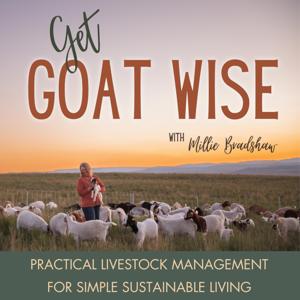
Are you serious about raising goats but tired of advice that doesn't hold up in real life? Are you adding goats to your ranch or homestead and realizing they require different infrastructure, nutrition, and management than other livestock? Do you want fencing, feeding, and production systems that work under pressure?
You're in the right place.
I'm Millie Bradshaw, Animal Scientist and rancher. I grew up in the commercial cattle world, earned a Master's Degree in Animal Science, and now run a forage-based meat goat operation integrated with cattle in the high desert. We've built the infrastructure, refined the genetics, managed the forage, and learned firsthand what works — and what fails — when you're responsible for animals in a demanding environment.
On Goat Wise, we talk fencing that actually contains goats, feeding and mineral strategies that make sense for your operation, genetics that match your environment and your goals, and the kind of steady decision-making that holds up when conditions aren't ideal. Production-minded livestock management for people who are in this for real.
If you're ready to build systems that last, welcome to Goat Wise.
Ranked by our users in the last 21 days

4,377 Listeners

2,315 Listeners
976 Listeners
802 Listeners

209 Listeners
1,786 Listeners
2,018 Listeners

121 Listeners
778 Listeners
112 Listeners

75 Listeners
1,019 Listeners
233 Listeners
18 Listeners

10,619 Listeners