
Sign up to save your podcasts
Or

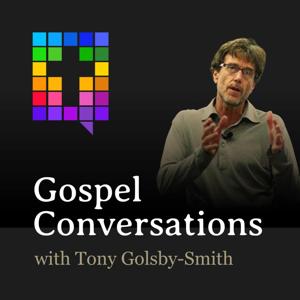


How broad are God's plans? Tony shares his life story: from his childhood in Fiji to becoming a teacher and then, to everyone's surprise, a strategy consultant to some of Australia's largest corporations. He began to see God working everywhere and this led him to ultimately discover Christ's Cosmic Redemption—which is good news for the entire cosmos!
Video:
https://youtu.be/8fq7xvqQoHQ
Slides:
https://www.slideshare.net/gospelconversations/my-journey-into-christs-cosmic-redemptiontony-golsbysmith-217420845
iTunes, Spotify, and SoundCloud:
https://GospelConversations.com/podcast
Social Media:
https://Facebook.com/GospelConversations
https://Twitter.com/GospelConvers
https://YouTube.com/user/GospelConversations
Website:
https://GospelConversations.com
Mailing List:
http://eepurl.com/guDp4n
Brad Jersak (Feb 14th), Esther Lightcap Meek, Rikk Watts, Tony Golsby-Smith, Ron Winestock, & Leisa Aitken will help us explore "Knowing and Mystery"—2020 theme. Talks will include:
—Is Design the new theology?
—What is the Gospel's offer of hope to a postmodern world?
—Will Artificial Intelligence save humanity or make us obsolete?
—Loving to Know
—Mystery in the Quantum world
—What were Maximus the Confessor and Origen's views on Mystery?
Video:
https://youtu.be/_w2BkOKbWdk
iTunes, Spotify, and SoundCloud:
https://GospelConversations.com/podcast
Social Media:
https://Facebook.com/GospelConversations
https://Twitter.com/GospelConvers
https://YouTube.com/user/GospelConversations
Website:
https://GospelConversations.com
Gerard Manley Hopkins only lived a short life and he never published a single poem during his lifetime. However, this intense and brilliant Jesuit priest revolutionised forever how poetry was written and laid the foundations for twentieth-century poetry. He is arguably the greatest religious poet of all time, and yet some psychiatrists also believe that nobody wrote about depression with such penetrating insight as he did. He was a true manic genius. The theory of ‘inscape’ underpinned lots of his poetic philosophy and inspired such greats as Tolkien. In this talk, Tony will open up the wondrous world of Hopkins for us.
Sarah will extend our series on Poetry and Faith by taking us into the world of Samuel Taylor Coleridge, the great philosopher and poet of Romanticism, who lived at the tumultuous time of the French Revolution abroad and the Industrial Revolution at home. In the face of this tumult, Coleridge and the Romantics championed humanity, the imagination and the mystery of Nature as the source of all meaning. Coleridge, a troubled Anglican spirit, found the origin of humanity’s imagination in the great ‘I AM’ of God.
Robin's final talk in our series explores perhaps the most significant question of all: "How does a belief in universal salvation influence my life and service in the world—including things like evangelism, counselling, and taking funerals?" Robin is a pastor as well as a theologian, and he brings a wealth of practical experience to this huge question. Does universal salvation mute the gospel and just make us melt into a kind of uncritical pantheism? Robin argues that universal salvation, far from muting our voice in the world, amplifies our voice, and the many ways through which we can bless the world.
In this third talk of our Hope and Hell conference, Robin paints a sweeping picture of the story of salvation beginning with creation and ending with the eschaton. He then poses the significant question—which fits best into this picture—hell or universal salvation? This talk is quite awe-inspiring—not because it advocates universal salvation (which it does) but even more because it stretches our horizons beyond individual redemption into the purpose of the cosmos. In developing his theme, Robin draws heavily on the magnificent Patristic fathers and their grand conception of the irresistible goodness of God.
Universal salvation raises the critically important question of how we read the Bible—or ‘hermeneutics’. That is what Robin covers in this talk. He sweeps us through a big landscape in three succinct waves—each bigger than the one before. Firstly he confronts the foreground question of biblical texts—and he makes the point that everybody has problems here. How do we reconcile God’s love with his omnipotence? He then moves onto slightly broader terrain—we need the read texts in their context BUT the meaning of the texts will often be bigger than even the author intended or realised. And finally, he finishes with a new horizon of interpretation—the future. He talks about the ‘trajectories’ of the biblical canon, which stretch beyond themselves for future generations—like ours—to articulate. He uses the development of the doctrine of the Trinity as an example. So this talk is as much about how we read the Bible as how we do or don’t find ‘universal salvation’ in the Bible.
This is the second talk from our Hope and Hell conference.
Slides:
https://www.slideshare.net/gospelconversations/hermeneutics-and-hell-by-robin-parry
Tony introduces Rev Dr Robin Parry by explaining what Gospel Conversations is all about—expanding our view of God and that means inquiring into mystery. One of the best ways to inquire is to map out the landscape of a debate—and that is exactly what Robin does in this marvellous talk. He gives us a birds-eye view of the long debate over universalism. But he goes further—and he gives us a map to navigate the territory. He defines what universalism is and is not. He explains the different pathways that have led many orthodox Christians to consider it seriously—Bible, experience, patristics, and ‘gospel logic’. This takes a lot of confusion and heat out of the debate and gives us a clear view of the topic. But it also hints at a bigger view of God, and a broader view of Christian thinking. Robin gives us the gift of years of learning and thought in one hour.
This is the first talk from our Hope and Hell Conference.
Sarah’s talk is a celebration of the glory in the mundane. That is the theme of the two wondrous Gwen Harwood poems that Sarah takes us through. But this leads naturally onto a view of the incarnation—the ultimate revealing of glory in the mundane. And Gwen Harwood pursued this glory in the mundane as a woman and mother—which leads her (and Sarah) to advocate a distinctly feminine view of incarnation and Christ. A view that Sarah brilliantly touches on in Luke’s gospel where the gentle domestic view of the women—and the mothers—seems a deliberate counterpoint to the chest-beating imperialism of the male disciples. This gorgeous talk is a work of art and will reward repeated listening.
This is the first talk in our Great Poets on the Mystery of Faith series.
Anyone who is not shocked by Quantum Theory has not understood it.
—Niels Bohr, father of Quantum Theory
Ron gives us a crash course in Quantum Theory and explains why it has profound implications for our understanding of reality and Creation's everlasting significance.
Slides:
https://www.slideshare.net/gospelconversations/how-to-design-an-eternal-universequantum-theory-implications
Video:
https://youtu.be/N1Mg2yzeGQk
iTunes:
https://podcasts.apple.com/au/podcast/gospel-conversations/id878549160
Spotify:
https://open.spotify.com/show/2GBc4WgSRu75WDiJLM2NGh
Website:
https://www.gospelconversations.com/topics
Facebook:
https://www.facebook.com/GospelConversations
Twitter:
https://twitter.com/GospelConvers
From the publisher's feed

5,716 Listeners
572 Listeners

14,279 Listeners
4,427 Listeners

1,475 Listeners

291 Listeners

34 Listeners

3,296 Listeners

867 Listeners

2,053 Listeners
352 Listeners

577 Listeners

16 Listeners
85 Listeners

16 Listeners