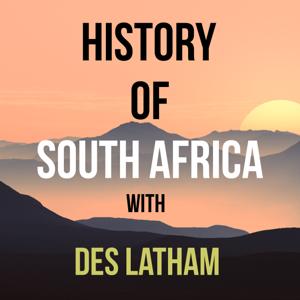
History of South Africa podcast

History of South Africa podcast

Download on the App Store
  • Favorites

    94

    Followers

  • Typical duration

    21 min

    per episode

Based on Podcast App listening data

History of South Africa podcast episodes

  • Episode 155 - The Eastern Cape economy surges and the Americans visit Port Natal as tension rises
    Welcome back to the History of South Africa podcast with me your host, Des Latham - it’s episode 155 and the Cape economy is growing in leaps and bounds.

    The years between 1840 and 1843 were a fascinating mix of economic development and military endeavour.
    We will be returning to the arrival in Port Natal aka Durban of Captain Smith and his 263 men and unfortunately, there’s going to be fisticuffs, bullets, death and traitorous acts.
    But it is true that the most significant development in South Africa after 1835 was the expansion of agricultural production. Luckily for us, an organisation called eGSSA, founded in 2004, is the virtual branch of the Genealogical Society of South Africa, and provides a virtual home for everyone from the beginner to the most advanced family historian.
    And buried in their digital archives are digitalised copies of the Cape Frontier Times, a publication that began it’s life in Grahamstown in 1840. In between notices about births, marriages and deaths, that are known by old school editors as hatches, matches and dispatches, is a great deal of material about money, commodities, the economy.
    Americans had also just discovered what was known as Cape Gum. This weeps from a tree known as Acacia Karoo or the Karoo thorn, or if you’re into Latin, the Vachellia karroo. What was going on as well was the genesis of an African peasant producer of agricultural goods — and these producers of food would become very important as our story progresses through the 19th Century.
    Moving along.
    You heard last episode how Cape Governor, Sir George Napier, the one-armed veteran of the peninsular wars against Napoleon, had signed an order for Captain Thomas Smith and his 263 to march to Port Natal, and seize the valuable port for the British.
    That of course, was going to be opposed by the Boers. Adding fuel to the propaganda fire apart from the Volksraads decision in Pietermaritzburg to kick amaZulu out of southern Natal and the midlands, was the sudden an unexpected arrival in Port Natal of an American ship called the Levant.
    22 min
  • Episode 154 - The Swellekamp grifter and Captain Smith marches from the Umgazi River to Port Natal
    This is episode 154 and the amaBhaca people under chief Ncapayi have just raided the Boers along the upper Bushman’s river and near their new town of Weenen.

    Joining the Bhaca were the San raiders you heard about in episode 152. The area around the Umzimvubu River had been unstable ever since the amaBhaca fled to the region during Shaka’s time, and the amaBhaca now lived west of the amaPondo who were ruled by chief Faku ka Ngqungqushe. It’s important to note that both the amaMpondo and the amaBhaca used to live further north in Natal before Shaka’s fractious wars began and led to the movement of the people known as the Mfecane.
    The amaPondo did not trust the amaBhaca, calling them thieves. The arrival of the Boers in Natal meant they had a powerful new possible ally — but they quickly learned that the Boers were not to be trusted either as you’re going to hear in this episode.

    Faku regularly communicated with the Voortrekkers, and now that the amaBhaca had made the fatal decision to steal more than 700 head of cattle from the trekkers near Weenen, along with 50 horses, the Volksraad in Pietermaritzburg had had enough.

    They met in November and ordered Andries Pretorius and commandant Hendrik Stephanus Lombard to lead a commando of 260 Boers to extract maximum revenge from the amaBhaca. Chief Fodo of the Nlangwini who lived between the Bhaca and the Boers had also been raided, so he and about a hundred of the Nlangwini warriors joined the Boer commando seeking their own form of restitution.
    In the ensuing attack, 26 men, ten women and four children were killed, and the boers seized 3 000 cattle as well as 2 000 sheep. The numbers have been contested over the years, but the fact that women and children died was confirmed.
    However, it was their decision to seize at least 17 of the amaBhaca children they said had been orphaned in the attack that was going to lead to a great deal of interest by the anti-slavery lobby in the Cape — and in England.
    Chief Faku wrote a letter around this time to Governor Sir George Napier, expressing his fear that he would be next, that the Boers were seizing livestock and children willy nilly south of the Umzimvubu River, and that matters could not continue and begged to be placed under the protection of the British Government.
    on August 2nd 1841, the Raad took the rather unwise decision to force all these amaZulu squatters off the farms. It went further, ruling that none had any right to claim any part of Natal at all.
    They should be removed, resolved the Volksraad, to the tract of land between the Umtamvuna River and the Umzimvubu River. ON the surface, this appeared to be a reasonable suggestion, the land is excellent here, enough water and good soils. However, no-one had bothered to ask the local African clans what they thought of this basically, forced removal and furthermore, someone already lived there.
    On August 21st, Lord John Russell instructed the Governor to make arrangements for the reoccupying of Port Natal.
    This is where Captain Smith would make his appearance and the coming march overland to Port Natal was going to be arduous indeed.
    25 min
  • Episode 153 - Dr Livingstone disembarks and Pretorius and Potgieter bury the hatchet
    1840 was a leap year, and in November David Livingstone had left Britain for Africa. His story of exploration and commitment is extraordinary. While he would go on to become better known for his attempts at finding the source of the Nile River in east Africa, it was his formative phase of life at mission stations in southern Africa that we’re interested in.

    Born on 19 March 1813 in Blantyre, Scotland, he was the second of seven children and employed at the age of ten in the towns’ cotton mill. This was way before rules about these things, and this ten year-old worked twelve hours days as a piecer, who’s job it was to lay broken cotton threads on the spinning machines.

    He was drawn to the teachings of local evangelist, Thomas Burke. He studied medicine, and then was ordained as a minister of the church at the Charing Cross Medical School. A chance meeting with south African Scots missionary Robert Moffat in London was to change his life.

    Moffat was running the London Missionary Society’s station at Kuruman, and Livingstone asked him if he “would do for Africa” as in survive.

    “I said he would” Moffat wrote later, “if he would not go to an old station, but would advance to unoccupied ground, specifying the vast plain to the north where I had sometimes seen in the morning sun, the smoke of a thousand villages where no missionary had ever been…”

    Forgive my pathetic attempt at a Scots accent.

    Young David Livingstone was going to take that to heart over the next few decades and would become known as the greatest missionary in Africa, even though the truth is he converted only one person to Christianity.

    He left England for the Cape in November 1840, and spent most of his time on board studying Dutch and seTswana. Joining him on board was someone else we’re going to hear quite a bit about in coming episodes, another LMS missionary called William Ross.

    You know how everything connects one way or another.

    So we have Livingstone and Ross sailing to southern Africa - imbued with the concepts of evangelical christianity with it’s core message Influenced by revivalistic teachings in the United States, Livingstone entirely accepted the proposition put by Charles Finney, Professor of Theology at Oberlin College, Ohio, that "the Holy Spirit is open to all who ask it".

    For Livingstone, this meant a release from the fear of eternal damnation. And being an earnest young man, he felt that folks should hear about this. Initially he wanted to go to China, but the looming first Opium War led to the London Missionary Society directors deciding southern Africa was safer.

    Livingstone and Ross landed in Simon’s Bay in March 1841 after a stop off in Brazil. Livingstone stayed at Dr Philip’s home in Cape Town. Philip spoke quite a bit about how he believed in the policy that all people were equal before God and the law and Livingstone believed that too.

    Clearly then Livingstone was not going to be welcomed by the Boers and British settlers most of whom by now definitely did not believe this message. Livingstone sailed up the coast to Algoa Bay in May and then he took a two month ox-wagon trek along with William Ross to the Kuruman Mission. There he immersed himself in Tswana life and trekked more than a thousand kilometres to Mabotse in modern day Botswana which is near Zeerust.
    The Boers in Pietermaritzburg had gone through a combination of good and bad. In 1839 more than half a dozen people had died when a candle tipped over in one of the houses there, burning down 13. The blaze was made worse by the gunpowder stores in most of the houses, and the fire was so intense, it set fire to nearby wagons.
    Hendrick Potgieter based on the high veld had still not reconciled with Andries Pretorius - but things were about to change.
    20 min
  • Episode 152 - The amaTola San raiders of the Drakensberg: Horses, plant meds and the Chacma Baboon
    This is episode 152, we’re going to dig into a story that is not often told — the amaTola San raiders of the Drakensberg. They emerged by the end of the third decade of the 19th Century as a result of a mish-mash of forces at play on the veld.

    And what a remarkable story this is so hold onto your horses! Literally as it would appear.

    What has been re-discovered recently is the identification of a plethora of mounted frontier raiding groups and how these had impacted the interior of Southern Africa, and in particular, the mountains north-east of the Cape Colony.

    Certain frontier raiding groups often referred to simply as ‘Bushmen’ were really comprised of members from many formerly distinct ethnicities, and included the progeny from subsequent inter-marriage.

    Cultural and ethnic mixing, the advent of the horse, the increased access to guns and ammunition, and the need for identity to adapt to these changes, resulted in a volatile mix indeed.

    There were freed slaves, Khoesan, San, and English soldiers who’d gone AWOL, as well as descendants of former VOC soldiers who were Swedish, German, Swiss, and Dutch.

    There’s a correlation here with the American Frontier experience, where men and sometimes women, armed with muskets, bows, and spears, wearing feathered headgear or wide-brimmed trekboer hats and riding horses, raided their neighbours for cattle and horses or exchanged these valuable resources for corn, tobacco, dogs and alcohol, much like other nineteenth century frontiers.

    There the roaming bandits were the Jumanos, the Lakota, the Metis, all became seminal in the B-grade Western movies of the 1950s.

    South Africa’s bandits and raiders were arraigned across a large area, but perhaps the most interesting were those living in the amaTola mountains, a mixture of people who were on the fringes of society.

    Because horses were only introduced to the Drakensberg in the 1830s and production of hunter-gatherer rock art in that region had almost entirely ceased by the 1880s, horse paintings are comparatively tightly pinpointed in time, unlike virtually all other categories of images in southern African rock art.

    San paintings of this time reveal quite an astonishing fact, these people had a mixed material culture, the paintings who San and others who were not San working together, carrying firearms, riding horses with their dogs running alongside, carrying spears and bows, and importantly, dancing their trance dances.

    The area I’m addressing lies between the Mzimvubu River and the Tina River, across the central Drakensburg in other words, across both sides of the escarpment, stretching from Giants Castle in modern Kwa-Zulu Natal to Mount Fletcher in the Eastern Cape and Matsaile inside Lesotho.

    Glancing at a map, and tracing folks living in this area in 1840 you’d find the Voortrekkers arraigned inland from Port Natal, around Pietermaritzburg, and up to the headwaters of the Umgeni, the Mooi River and Bushman’s River just below Giant’s Castle.
    From here the San Raiders controlled the landscape, along the ridges of the Drakensberg south westerly to Mount Fletcher, in the slopes above the Senqu River or the headwaters of the Orange Riverif you prefer.

    This overlooked where the Bhaca lived, south east of them, the amaMpondo, further south the Mpondomise, then further the amaThembu, to their east and south the amaXhosa could be found and to their south, the English settlers in Albany. I hope you can feel the proximity of these amaTola raiders because everyone in these areas were somewhat fearful of the gangs of men on horses.

    The San raiders were based in that mountain redoubt between Giant’s Castle and Mount Fletcher and they were surrounded by enemies but also prospective allies. This mountain redoubt was getting a bad name, and soon would be identified on maps from the 1840s onwards as nomansland.

    27 min
  • Episode 151 - The polymath Sir John Herschel, his free school system and other 1840 interconnections
    Episode 151 and we’re into the 1840s - and its time to analyse some issues. One is education, the other, roads.

    Given our crisis in education these days, its perhaps another of our historical ironies that state funded schooling was offered by 1839 and 1840 in the Cape, something that was unparalleled at the time except for Prussia and a handful of New England states in America.

    No-where else in the world at the time could state funded free education be found.

    Yes, you heard that right, South Africa was an early adopter of free education.

    Another growing phenomenon at this moment was the building of roads, something that was sorely required in a region as vas as southern Africa. After the Sixth Frontier war of 1834-5, municipal government began to develop, and a new Legislative Council was struggling to make sense of the existing political system.

    All members of the council were appointed by the Governor, and only gained the right to alter the Charters of Justice, or the law, in 1844. Christoffel Brand, editor of die Zuid Afrikaan, and Robert Godlonton editor of the Grahamstown journal, both talked of an elective assembly. Godlonton added that he preferred to see the Eastern Cape achieve independence from the Cape.

    These erstwhile journalists were merely repeating conversations that were taking place across the British Empire in the fourth decade of the 19th Century. In Australia for example, the 1840s were years of conflict, as British settlers increasingly moved out away from towns seeking new farmland, First Nations fought back and resisted this expansion. Violence ensued.

    Squatters, who leased large pastoral lands from the colonial governments in New South Wales, Tasmania, Victoria and into Queensland and South Australia, increasingly gained political and economic influence. They became wealthy off the land leased at low rates, stocking them with thousands of sheep, with their fleeces sold into the British market. Many squatters, with time and money, stood for election to parliament to set the laws and rules in their favour. Wool was also going to become the Cape’s main resource shortly.

    The gloom of the trekkers leaving the province had been replaced by an economic upturn — the Cape Colony finances were in a much healthier condition than they had been ten years earlier.

    Governor D’Urban, who’d left for home, had earlier launched a campaign to simplify the fiscal system and by 1840 the campaign had begun to bear fruit. The collection of taxes by Colonial Secretary John Montagu resulted in the Cape finally wiping off its public debt and re-paying the British government in full.

    Customs revenues were rising, the slave compensation fund had helped, and the delivery of stores during the Sixth Frontier war bolstered imports, while exports grew. Wine farms had experienced a drop in sales starting in 1825, but wool had largely replaced this commodity.

    Merino sheep had been acclimatised in Albany district around Grahamstown just before the war of 1834, and suddenly there was a lot of money to be made farming these animals for their wool. Within ten years, by the 1850s, wool would outstrip all other Cape exports put together. Just like in Australia.
    To his credit, Sir George Napier wanted to improve this situation and following a report prepared by Colonial Secretary John Bell for his predecessor D’Urban, Napier turned to a fascinating man called Sir John Herschel.

    He was a famous astronomer, who was collaborating with Thomas Maclear, the Cape Astronomer Royal at the private observatory at Claremont near Cape Town. And this of course, is why we call Observatory Observatory.

    Loved by the students, loathed by their parents, a place of excellent entertainment to this day, Obs is a seminal party centre, characterised by the smell of cannabis on Lower Main Street.
    Sir John Herschel had a cunning plan. He began to develop a system that bore his name, whereby two classes of schools were recognised.
    23 min
  • Episode 150 - Dingana assassinated near Ghost Mountain and the cultural appropriation tale of the toyi-toyi
    For those who’ve lasted the journey thus far, thank you for listening. The number of downloads is approaching 1 and a quarter million, which by itself is quite a shock.

    Adding to the selfserving histrionics, Episode one of this series has just made to Spotify’s fourth most listened to podcast in South Africa for 2023. More gasps of disbelief.

    When I began this enterprise in February 2021 it was a giant leap into a possible abyss, a leap into the unknown, and possibly a foray into catastrophe. One person’s historian is another person’s spin doctor you could say.

    As 2024 beckons, I need to mention that my site, desmondlatham.blog has a donation panel. The hosting services are not free and so far I’ve tried to avoid mentioning moolah — its base and depraved. However, debasing and depraving is required as the cost of all of this has to be covered some how.

    So you’ll see a donate button on desmondlatham.blog, click on there and there’s a Paypal QR code on the page. If you’d prefer to EFT or something, send me an email at [email protected].

    With that slightly odious begging bowl moment out of the way, back to our tale.

    We’re going to hear about Dingana’s death, It’s late January 1840, and word reached the Voortrekker BeesKommando that Dingana had been defeated at amaQongqo, he was on the run.

    Although commandant Andries Pretorius believed this was true, the Boers wanted to follow up on the amaZulu King’s defeat to deal with the remnants of his army. AS you know, Ndlela kaSompiti the general had paid for the defeat with his life, Dingana had him killed but the surviving army was still out there, on the flat lands west of the Lebombo Mountains.

    But by throwing Ndlela’s body out for the wild dogs, the jackals, the hyenas and the vultures, Dingana had broken the tradition of burying respected elders and royalty. Many of his own followers took exception to this act and realised that his behaviour belied his weakness, so more decided to throw in their lot with Mpande kaSenzangkhona.

    On 3rd February, 220 Boers detached from the BeesKommando for a quick recon towards the Pongolo river after being informed that Dingana’s general Nongalaza was chasing Ndlela’s shattered impi south. Maybe they’d catch these warriors in a pincer, there were reportedly around 3000 still alive and unhurt — at least 2000 others had either died or were wounded and no longer a threat.

    Hundreds of warriors were indeed in the vicinity, heading back home towards the Mfolozi from the Pongola River, but this was summer and summers are often characterised by thick mist in the valleys. It was under cover of this mist belt that that warriors managed to avoid the Boers, hiding in the kloofs and caves and inside the dense riverine bush.
    A small group of men and women were caught in a cave, the men were killed, the women seized.
    Then 250 burghers were mounted up in a larger commando and headed north east from the White Mfolozi to the Pongola river to join up with Nongalaza’s amaZulu.
    They met up with Nongalaza on the 5th February, who told them that Dingana had made it across the Pongola River and was fleeing into amaSwazi country with a few close adherents and his mother and some sisters.

    He was headed towards the Lubombo Mountains. Now anyone who has travelled here will know of the Ghost mountain, the combination of blunt hills and thick sub-tropical bush, the sandy trails and possibly, the ghostly stories.
    When he realised that Nongalaza’s men had turned around, he stopped with his retinue at a small hilll south of the Lubombo Mountains called Hlathikhulu. Peering at these mountains in February 1840 was Dingana, who took stock as he settled in to a makeshift royal residence on the forested slopes. His isigodlo was put in place and he named this eSankoleni, a place of seclusion, the secluded spot.
    This was his last place, and instead of seclusion, it was going to be a place of execution.
    23 min
  • Episode 149 - Mpande defeats Dingana at the Battle of amaQongqo and Bhibhi the beautiful is killed
    This is episode 149 and Mpande kaSenzangakhona and the Boers are going after Dingana.

    We’re entering the 1840s where momentous events would continue to shape South Africa’s future.

    After Shaka’s death in 1828 his half-brother and murderer, Dingana, was supposed to usher in stability. Instead, Dingana embroiled the AmaZulu in one war after another, trying to defeat Mzilikazi of the amaNdebele, fightign the baTlokwa, the amaSwazi, the Boers, and now, his own Royal line.

    By ordering Mpande’s assassination, he had set off a chain of events that was going to boomerang on him and the coming Zulu Civil War had been in the offing for some time.

    He’d also set off his own demise by failing to kill Mpande, who then fled across the Thukela River with over 17 000 adherents and about 35 000 cattle.

    Mpande had met Voortrekker leader Andries Pretorius and negotiated with the Voortrekkers as the man they now called “The Reigning Prince of the Emigrant Zulus”. A Boer deputation of 28 men under the leadership of F Roos had visited him at his homestead not far from Port Natal in October 1839, where he offered to pay them the cattle owed by Dingana, over 19 300, and ceded the bay of St Lucia to the Boers.

    Mpande also promised not to undertake any military activity without Voortrekker leader Andries Pretorius’ knowledge.

    Then as if to reinforce his power, he turned a blind eye to the killing of a much feared induna called Mpangazitha kaMncumbatha who was of the amaNdwandwe. Zwide’s people.

    Mpangazitha had become an influential and brutal induna operating alongside Dingana, and one day he was killed in full view of the trekkers.

    This shocked the visiting Boers, who watched as the induna was dragged, then beaten by successive men armed with fighting sticks, his blue robe spattered with blood as he was bludgeoned to death.

    Mpande later said he didn’t order this killing, Mpangazitha had brought it on himself by his bullyboy tactics — the other induna just had enough of this egotistical man who’d committed a long list of human rights abuses against other people’s over the past decade.

    Live by the sword, die by the knobkerrie I guess.

    By Christmas, however, the British were gone from the garrison at Port Natal, Captain Jervis had sailed away with the British administration now mistakenly of the belief that the violence in Natal had dissipated.

    Then Dingana sent a famous message to the Boers in Pietermaritzburg by the end of 1839, trying to discredit Mpande.

    “He is not a man…” the messengers said “…he has turned away his face, he is a woman. He was useless to Dingana his master, and he will be of no use to you. Do not trust him, for his face may turn again…”
    Coming from a man as pernicious as Dingana was rather hypocritical.
    Ndlela’s impi on paper at least, looked the better of the two. Dingana had pulled together the top notch amabutho, the iziNyosi, the uDlambedlu, the imVoko which had remnants of the umKulutshane regiment. They’d been joined by the uKhokhoti, who’d also been at the Battle of Blood River/Ncome.

    Mpande’s general Nongalaza led amabutho like the imiHaye who’d joined up with remnants of the imVoko who’d switched sides as well as the uZwangendaba who were a bit like a mercenary division drawn from the homesteads called the umLambongwenya, uDukuza and isiKlebhe.

    Mpande’s army included the veterans iziMpohlo, formed during Shaka’s time, these were older men, scarred in battle and seeking one more victory before they’d retire to their imizi.

    Not only were Mpande’s men feeling more optimistic, they knew that somewhere to their west the Voortrekkers were heading their way. Between these two organisations, most warriors fighting for Mpande were convinced they were going to win.

    The canny Mpande had pulled off a diplomatic move of note. Had he waited for the Boers to arrive, he would have lost face — by striking first he was waging war without the muskets and the horses.
    25 min
  • Episode 148 - The AmaZulu routed by amaSwazi Widow Bird warriors and Mpande’s exodus
    This is episode 148 and there’re negotiations afoot between Dingana and the Voortrekkers, at the behest of Captain Henry Jervis who led the small detachment of British troops based at Port Natal.

    Their role was to stabilise the Natal region after a year of extreme violence, the Voortrekkers and the AmaZulu king Dingana were fighting tooth and nail.

    Jervis as you heard was one of the characters in our history that crop up here and there and are able to act as neutral arbitrators between different factions.

    Gambusha the trusted inceku sent by Dinanga had arrived at the British camp on 23 February 1839 and said that the AmaZulu were on the brink of ruin and would accept any terms that Jervis would propose.

    Gambusha also asked for the British to consider allying themselves with the AmaZulu to oppose the Voortrekker expansion, Dingana wanted British protection. Jervis could not do this, saying that his role was to act as a go-between and could not take sides. Gambusha took that message back to the Zulu king.

    On the 23rd March two inceku called Gikwana and Gungwana returned to Port Natal with 300 of the Boer horses they had captured in the year of fighting as a sign of good faith. Voortrekker leader Andries Pretorius then arrived as you heard, calling himself the “Grand Commandant of the Right Worshipful the representative assembly of the South African Society at Natal.”

    Had business cards been a thing back in 1839 that title wouldn’t fit on one side.

    Nevertheless, peace talks were now underway. Eventually the terms were agreed — that Dingana would return all the muskets, horses, sheep and 19,300 cattle he’d taken from the trekkers and allow them to live unmolested south of the Thukela River.

    IN turn, the Boers would assist the Zulu should they come under attack.

    It was also agreed that from now on, all AmaZulu emissaries who crossed the Thukela River should carry a white flag indicating who they were, and that those found without this pass would be shot on sight. Pretorius also demanded that Dingana should send a messenger directly to him in Pietermaritzburg when they were ready to hand over the cattle and other goods. The British were to be left out of future meetings.
    The problem for Dingana, is that he was now trying to carve out new territory that was in the name of the Swazi king Sobhuza the First. And the reason why it was a problem was the Swazi could fight like the amaZulu.

    And yet, Dingana was also using Pretorius’ final demand as part of his political strategy, because when men married, they would have to be given land for their homesteads. By occupying vast tracts of Swazi land, Dingana would also be reinforcing his own political power, colonising new vistas for the Zulu.

    There was another reason why Dingana was focusing on the amaSwazi, a people whom the AmaZulu looked down on. Attacking them would be part of an ihlambo, a washing of the spears, a purification ceremony bathed in blood marking the end of the period of mourning set off by the humiliation of being defeated by the Boers.
    This washing of the spears would mean the evil spirits that caused the defeat, the umnyama, the evil influence, would be pushed away into the territory of the foe.The Swazi now faced a amaZulu invasion which began in the winter of 1839, a far more threatening action than any of the previous raids. This was an attack of colonial occupation by four Amabutho, the umBelebele, the uNomdayana, umKulutshane and the imVoko. Klwana kaNgqengele led these regiments, a man from one of the most powerful chiefly houses, the Buthelezi.
    It was Mpande kaSenzangakhona who was going to change the equation.

    Dingana’s half-brother had been in hiding after another attempt on his life by the capricious Zulu king, and in September 1839 he had fled across the Thukela River with 17 000 people, and 25 000 head of cattle.
    25 min
  • Episode 147 - Coloured enters the lexicon in 1838 as Captain Jervis reports his coal find
    Cape Town was burgeoning — and trade was starting to pick up. There was also a paradox, the real effects of the emancipation of slaves back in 1834 was only really felt in 1838 because it was in that year the 38 000 slaves were finally allowed to leave their masters.

    The abolition of slavery led to the creation of several private commercial banks, which then offered cheap credit to wage-labour employers. The British parliament allocated £20 million as compensation for those who had previously owned slaves and were now stripped on their erstwhile ‘property’ in inverted comma’s — to be shared out across it’s territories.

    Of the twenty million, £1,247 000 was allocated to the Cape.

    Though a certain proportion of this money got stuck in Great Britain in the hands of agents as we’ve heard in previous episodes, the amount that arrived in the Cape Colony, mainly in 1836–37, quintupled the sum of money in circulation.

    This in turn caused a raising of prices, it was inflationary, and also led to increased labour costs.
    Some of the money was invested in new banks, as well as providing capital to build new houses around the Cape. One of these was the Eastern Province Bank which launched in 1838 in Grahamstown - which went on to become Barclay’s Bank, and during the sanctions period of apartheid, it morphed into First National Bank.

    Compensated emancipation at the Cape was a major social rupture, ending as it did 182 years of legal slavery, changing the legal status of these 38 000 people.

    The slave-like apprenticeship period that followed emancipation in 1834 had now expired. Khoi, and other members of the free black community continued to work mostly in farm
    employment, although a few became market gardeners or joined the small but growing artisanal class in the villages of the Western Cape.’

    Emancipation at the Cape freed slaves into the category "free black," which encompassed all people of colour native to the Western Cape: "Hottentots" was the colonial term for the Khoi and "Bushmen" the colonial term for the San, "Bastards" were those who had a white father, Khoi mother and "Bastard Hottentots" were those who had a slave father and Khoi mother.

    By the time of emancipation, the slave population of the Western Cape was predominantly
    creole, including descendants of slaves brought from the west and east coasts of Africa, Madagascar, India, and the Dutch East Indies, and children born of a slave mother and a free father.

    The close cultural and social relations between Khoisan and slaves and the incorporation of the Khoisan into the Cape colonial economy, also contributed to the heterogeneous culture of the rural poor at this stage.

    The introduction of "prize negroes," who had been "rescued" from other nations' slave ships by the British and brought to the Cape from 1808 to 1815 and then again in the 1830s to remedy the labor shortage in the Western Cape, also served to increase the polyglot nature of the rural poor of the Western Cape.

    This diversity of geographical and cultural origins affected the emergence of an official racial terminology to cover all of these groups to simplify matters.

    Thus while the category of "free black" continued to be used into the 1840s in government correspondence regarding labor legislation. But from 1837 the statistical Blue Books began listing people of Khoi and San descent, free blacks, “prize negroes," and freed people under the category “Coloured."

    The slave owners were a leisure class and now slaves were free, it was the start of the fourth decade of the 19th Century. The slaves had the skills, the leisure class, did not, and now this leisure class really needed the new banks.
    So the abolition of slavery resulted in the liquidation of at substantial portion of the capital that had been invested in the individuals who were enslaved.
    28 min
  • Episode 146 - The Battle of oPathe where Bhongoza and Hans Dons earn oral history stripes
    Andries Pretorius had won a major encounter with the Zulu army, which was now in full retreat and the way to emGungungundlovu was wide open. A day after the Battle on the 17th December 1838, Commandant General Pretorius had two Zulu captives brought before him. According to Voortrekker records, he gave them a piece of white calico with his name written on it in black ink, and told them to take it to Dingana. They should inform the king that the trekkers were approaching and that he should sue for peace, and to send messengers back to start negotiations and they should carry this cloth.

    Ndlela kaSompisi the general had ordered messengers on ahead of the Amabutho who were now force marching back to the east, to the Great Place. The izinceku advisors rushed back warning Dingana that he should evacuate his beloved emGungundlovu as the Voortrekkers were on their way — his army had suffered a terrible defeat.

    Msiyana kaMhlana who led the imVoko Amabutho regiment had told the izinceku that the king should make for the south side of the drift across the white Mfolozi, to a place called emVokweni.

    IT was one of his larger homesteads, and gave him the option to make a loop north if pursued.
    It was a day later that another messenger hurried up to Dingana and told him as he hunkered down at emVokweni that Pretorius and his WenKommando had arrived at the Mhlatuze River, and was about to cross. The Zulu king ordered that his beloved emGungundlovu be raised to the ground, along with two other large amaKhanda nearby.
    On the morning of the 20th they saw emGungundlovu in the distance, wreathed in smoke, much of it still burning. It was a vast complex, the fire would burn for days. About half an hours ride away, they stopped once more and formed a laager near the place of death, KwaMatiwane. At that point they were unaware that the bones of their comrades were lying in the open only a short distance away.

    The trekkers began to loot what they could from the smoky ruins of Dingana’s great place, and there was a great deal that had survived the fire. First however, they were determined to find out where the colleagues lay.
    One of the men found Retief’s leather briefcase and peered inside. This is where the story is disputed by some historians because the Boers pulled out a document, the treaty apparently ceding Natal to the trekkers.

    I have explained how this document is of historical interest, but utterly irrelevant in the debate about land in Natal. Dingana as you know by now, had signed it to pacify Retief, to lull him into his final meeting where the Zulu king had managed to convince the Boers to leave their guns outside, only to be murdered.
    It was a chance discovery on Christmas Day that almost brought calamity to this WenKommando.

    Pretorius was suffering from the wound he’d received at the Battle of Blood river, but was alert enough to interrogate a man who’d been discovered hiding close to their camp at emGungundlovu.

    This was no ordinary man however, he was a decoy. Bongoza kaMefu of the Ngongoma people had realised that the trekkers were after the king’s cattle, and their determination to seize the property booty of this entire campaign could be their undoing.

    Bongoza approached Dingana and suggested a plan to lure the Kommando onto the thornbush veld around the White Mfolozi, where they’d be susceptible to ambush. Nzobo kaSompithi who had rejoined the king’s main retinue agreed.
    23 min

About History of South Africa podcast

From the publisher's feed

A series that seeks to tell the story of the South Africa in some depth. Presented by experienced broadcaster/podcaster Des Latham and updated weekly, the episodes will take a listener through the…

Best of History of South Africa podcast

Ranked by our users in the last 21 days

More shows like History of South Africa podcast

The History Hour by BBC World Service

The History Hour

586 Listeners

Dan Snow's History Hit by History Hit

Dan Snow's History Hit

4,762 Listeners

The Money Show by Radio 702

The Money Show

33 Listeners

The Jordan B. Peterson Podcast by Dr. Jordan B. Peterson

The Jordan B. Peterson Podcast

33,483 Listeners

The Diary Of A CEO with Steven Bartlett by DOAC

The Diary Of A CEO with Steven Bartlett

8,560 Listeners

The Gareth Cliff Show by The Gareth Cliff Show

The Gareth Cliff Show

68 Listeners

BizNews Radio by BizNews

BizNews Radio

19 Listeners

True Crime South Africa by Killer Audio Creations

True Crime South Africa

169 Listeners

Honest Money by Warren Ingram

Honest Money

12 Listeners

SMWX by Sizwe Mpofu-Walsh

SMWX

9 Listeners

MoneywebNOW by Moneyweb Radio

MoneywebNOW

8 Listeners

Real Dictators by NOISER

Real Dictators

5,255 Listeners

Short History Of... by NOISER

Short History Of...

2,842 Listeners

The Corder Report by Dan Corder

The Corder Report

7 Listeners

History of South Africa podcast by Desmond Latham

History of South Africa podcast

12 Listeners