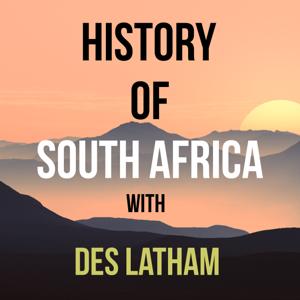
History of South Africa podcast

History of South Africa podcast

Download on the App Store
  • Favorites

    94

    Followers

  • Typical duration

    21 min

    per episode

Based on Podcast App listening data

History of South Africa podcast episodes

  • Episode 115 - Hintsa becomes a hostage and the Mfengu become British
    It's early 1835 and Cape Governor Benjamin D’urban an his 2000 men were winding their way through the AMatola mountains, searching for Maqoma and Thyali’s warriors. The going was tough albeit the scenery sublime.

    These glorious mountains were going to lead to one of the more inglorious moments in British military history. By early April 1835 the Boer commandos, Scots 72 highlanders, English settler corps, and the Cape Khoe regiment were trying to dislodge the amaXhosa from their mountain fastness. The strange army of men who distrusted each other, this marching formation of mutual suspicion, began to seize Xhosa cattle and raze their homesteads.

    Most of the engagements were unremarkable, the Xhosa refusing to stand and fight against overwhelming odds, the British troops becoming frustrated. IT was a stalemate broken here and there by bizarre incidents.

    Like the clash on April 7th where one of the Scots highlander officers emerged from battle with an assegai stuck out of his back. A soldiers remarked “There’s ane of them things sticken’ in ye, sir!” To his shock.

    Still, they believed the Xhosa were retreating eastwards to the Kei, towards their regent, Hintsa. In terms of their food and resources, the amaXhosa had suffered hugely, most of their cattle had been taken, they had very little food.

    What was anathema to the warriors had also been observed - the British had shot women and children.

    Unable to come to close quarter fighting, the men of the empire had resorted to opening fire on the homes and into the bushes indiscriminately, also firing their canon into the huts.

    This was not how the Xhosa fought a war.

    The amaxhosa were taking note about how the British treated women and children when fighting, and that was not good news for British women and children in the future.

    Colonel Harry Smith spurred his horse across the Kei River at Noon on the 15th April 1835. It was the first time that the British army or a colonial army had entered the country of Gcaleka and the first time that they'd aimed at their king, Hintsa.

    So in April 1835, the Mfengu chiefs approached Smith’s soldiers, and swore allegiance to the British, now and in the future. A remarkable event really.
    24 min
  • Episode 114 - The British clamber up the slopes of the Amatolas chasing Xhosa ghosts and the mysterious Mfengu
    We’re going to hear about a man called John Ayliff - a man who has gone down in the annals of South African history about as mixed as a box of smarties.

    His mission station at Butterworth across the Kei River had been a place of refuge for the Mfengu people - a mysterious group of refugees who had left northern Zululand during the times of Zwide - and over the next twenty years had been buffeted from place to place like the chosen people of Israel, finally arriving in the green rolling hills alongside Butterworth mission where they heard the biblical messages from men in black like Ayliff - and these resonated.

    Weren’t they of the same - these people who’d been kicked out of their land by the Zulu pharaoh and then sent from pillar to post, first into the hinterland through what we know as the Free State today, then down the side of the Basutho, finally wedged alongside Hintsa; of the Gcaleka.

    The amaXhosa chief gave them protection, thousands eventually settled, the Ngwane people had found their home.

    But things were unstable - next door in the Ceded territories, Albany, the former Zuurveld, along the Amatola’s, in the Kei River ravines, the British and the Rharhabe Xhosa were fighting the Sixth frontier war. The Mfengu however were in danger.
    It was ugly, in Grahamstown in March 1835. Military reinforcements had arrived, the Xhosa had retreated, the hotheads in the town became noisy, a powerful mixture of hatred, connivance and corruption.

    Ah yes, dear friends, that old South African tradition - now fully restored by our latest government. Corruption. It rolls off the tongue like a rolling blackout does it not?
    The settlers who had found their voice gathered and looked with decided laser like focus on the recently vacated Xhosa land, particularly the watered slopes of the Amatola Mountains.

    Holden Bowker wanted this land - and wrote later that

    “It was far superior to other parts .. far too good for such a race of runaways as the …blacks…”

    He used a pejorative term here. Even though they were on a war footing, the Grahamstonians decided to light their lamps, shining in the Eastern Cape dark as a sign of their confidence that the amaXhosa had been beaten.
    After many weeks of hesitation, Sir Benjamin D’Urban finally decided it was time to move into the Amatolas in force. You’ve heard how Colonel Smith had been bush there already, but it was this much bigger army that the British thought was required to finally subjugate the Xhosa.

    He arrived at the Base Camp of Fort Willshire on 28th March 1835, then the lumbering wagons rolled off towards the Amatolas on the 30th - his convoy stretching five miles which was quite mad because the Amatolas were only 20 miles away.
    26 min
  • Episode 113 - Guerrilla warfare throws up a challenge while Jannie Hostage and Ou Blouberg plan their escape
    It’s early 1835 and globally, quite a few fascinating things are going on. For one, America’s National Debt was Zero dollars - for the first and last time in it’s history. It’s president Andrew Jackson survived an assassination attempt in January of that year, also the first but not the last.

    Mauritius had banned slavery on the 1st February 1835 as South Africa had done in December 1834.

    The British began their counter attacks on the Xhosa chiefs who’d invaded across the ceded territories, into the Cape, and wreaked so much havoc - the Sixth Frontier War was rumbling on.

    Another major event had been brewing for some time. The trekboers had been chafing under the rule of the English and each new law that was supposed to protect the Khoekhoe from abuse, then the ban on slavery, led to the Dutch decedents recoiling seeing these as actions designed to destroy their way of life.

    It was a litany of abuse as far as the Boers were concerned, including the horror of the Slagter’s Nek rebellion, the bungled hanging of the rebels, the use of English as the official language, they were under siege, it was all too much and these were the push factors.

    But there was the pull factor - those distant landscapes, those far-off mountains that seemed to beckon to the youngsters and those with adventure in mind - this beckoned towards adventurers like an African Medusa. The fact that the land was occupied was of secondary importance, and like Medusa, was imbued with malice and risk.

    By 1830 the echo of the hills yonder became an obsession for some of the trekboers.

    1930 was also the year that the 19 year-old Karel Trichardt met with Hintsa between the Kei and Bashee rivers and asked him for land - and was awarded a 90 year lease on 101 square kilometers near the Kei River. This was not what the British had intended with their segregation of the Colony and the Xhosa areas across the Kei. Trichardt in particular was going to be a thorn in the English side.There were two of the three missionaries still operating amongst the Xhosa, but even these eventually fled. John Brownlee who was safe at his mission station on the Buffalo river, alongside Dyani Tshatshu’s Tinde people, found that they turned against him. Tshatshu himself came to Brownlee one night and said the Tinde were going to war against the British, calling on the missionary to join him. Brownlee said he could not, other missionaries heard about this in Grahamstown and sent wagons to get him out - he refused.
    He and his family were going to pay for his stubbornness.
    22 min
  • Episode 112 - Hand-to-hand fighting along the Great Fish River
    The Sixth frontier war was ablaze and now Harry Smith was in Grahamstown rearranging the military furniture.
    He wasn’t there for long. As a man of action he was determined to chase down the amaXhosa who had begun to retire back east across the Fish River by the end of the first week of January 1835, driving thousands of cattle, sheep and horses before them.

    The dithering Colonel Somerset was busy trying to secure the road between Grahamstown and Port Elizabeth, and by the end of the first week of January a separate force of 400 armed volunteers had raided Thyali’s Great Place and torched the entire homestead.

    Way beyond the Kei River, Hintsa glowered as he received reports of his amaXhosa chiefs and their successes against the settlers. For some time he had hesitated in taking up arms against the British and the trekboers who were inexorably moving towards him, but it was now time to make a choice.

    Hintsa had tried his best to stay out of the encroaching settler cross hairs - telling the British since they’d taken control of the Cape in the early 1800s that he wanted to be friends. He remained neutral during the quarrels between the Rharhabe Xhosa and the British, he’d stopped the Xhosa youngsters fighting against the British in 1819, only to see Nxele the Wardoctor attack Grahamstown. But he’d known for some time that the menace was approaching, land was the treasure and the approaching settlers wanted his land.

    Things weren’t a simple matter however - remember that he had hated Nqgika the Rharhabe regent and that had fractured a Xhosa response to the colonial expansion. But Now Nqgika was dead and Hintsa’s chiefs were calling for him to get more involved in this Frontier War.

    ON the other side, Harry Smith’s Peninsular buddy, Major William Cox of the 75 Regiment was leading the charge towards him. Hintsa was told of the destruction wrought on Thyali’s Great Place, his fortress had been torched. Kraals had been burned to within a mile of the missionaries station run by another William, a Chalmers this time. If you recall last episode, Chalmers had written letters in support of Maqoma and Thyali offering peace terms. These were promptly rejected by Harry Smith.

    This put the missionaries in a rather invidious position, they were now more associated with the colonial government than ever. When Chalmers worked up the courage and approached Maqoma with Harry Smith’s rejection of his peace plan, open hostility was the response.

    Thyali moved further into the Amatolas after his Great Place was torched, and Chalmers tried to get another message to the amaXhosa chief in what he described as the “lurking place”.

    Meanwhile, the amaXhosa wave that had washed across the frontier lost momentum. The energy sapping last three weeks had been driven by frustration and anger that had boiled over in the years of ignominy, and like all wars driven by revenge, when the emotion is sapped, the morale tends to wither.
    At first, Harry Smith was to counter attack in the classic tradition - trying to entice his enemy out of their lair, then defeating their army in one large scale full frontal battle. Smith planned open ground fighting making the warriors emerge from their mountain and thick bush retreats.

    But the amaXhosa had learned a thing or two about fighting the British and they weren’t going to be sucker punched like this.
    22 min
  • Episode 111 - Harry Smith arrives in panic-stricken Grahamstown in January 1835 and stiffens settler spines
    ON December 21st 1834 at least ten thousand warriors under Maqoma and Thyali swept all before them as they raided deep into the Cape colony, across a wide front.

    Fort Beaufort and Fort Willshire were the main centre of British operations to the north of Grahamstown as the war began. Fort Beaufort was particularly strategic because of its proximity to the Kat River Settlement.

    The amaXhosa avoided attacking this Settlement but that was going to change. They were hoping that the Khoekhoe would rise up alongside the amaXhosa and defeat the settlers, but the Khoekhoe and the amaXhosa had a far longer tradition of competition over land and resources. This was far more deeply etched into the narrative of both people’s than the simple colour of skin debate.

    Smaller centres such as Bathurst and Salem closer to the coast were also coming under attack, situated between Grahamstown and the sea, or a possible escape route for the settlers and the Boers who could not keep fighting inland. When the British had established the 1820 Settlers, they had densely parcelled these farms together as a forward barriers against the Xhosa who may advance across the Fish River.

    And now the amaXhosa were advancing across the Fish River but over the last 14 years, the military presence and preparation here had dwindled and the settler unpreparedness for war was almost total. Betrand Bowker wrote scathingly of how the settlers of the Lower Albany region had “scarcely any guns and most of them who did, did not know how to shoot … just us brothers and a few others…”
    So it was on the sixth day that Sir Harry Smith galloped into town, his 600 mile epic ride at an end but his mission just beginning.

    When he’d passed a rider hurrying to Cape Town from the frontier, he read the letters and was horrified to read Somerset’s suggestions that Grahamstown be abandoned. When he arrived in that town on the evening of the 6th, he noted the chaotically arranged barricades and he thought it a helpless muddle.

    He was fresh enough to fight a battle, and his eyes were waspishly alert as Noel Mostert notes - what he saw struck him as ridiculous - so ridiculous that he almost burst out laughing as he rode through town such was the higgledy piggedly nature of the sandbags et al.

    He didn’t laugh out aloud because watching him were men and women - the settlers - who’d lost family members and who’d lost everything. The town was overcome with melancholy, with consternation. But what made Smith really angry was the unmilitary appearance of the settlers, who he said were “shuffling about like an Irish mob at a funeral…” their firearms slung about their bodies, swords stuffed into belts.
    24 min
  • Episode 110 - Sir Harry Smith, his petite guerriere espagnole Lady Smith and the revenge of the amaXhosa
    The Sixth Frontier war had started on 21st December 1834 and this would be a dirty affair - a calamity for the amaXhosa.

    When it began Hintsa the Xhosa regent did not join in, but something that was first called Maqoma’s war was eventually to be known as Hintsa’s war because of what happened to him.

    The amaxhosa were assaulting the frontier across a wide region from the Winterberg down to Algoa Bay. The English settlers fled to the towns of Bathurst, Grahamstown, Fort Beaufort, Salem. The Boers had setup laagers or entered the towns, the entire frontier was aflame.

    Governor D’Urban had left it too late to travel to the frontier to intelligence gather, and now there was a full-blown war on the go. The entirely unanticipated invasion of the Colony had unleashed widespread panic and confusion in the Albany, Somerset and Uitenhage districts and the amaxhosa had inflicted significant damage on the settlements.

    As you heard last episode, the missionaries were left alone by the rampaging Xhosa - who differentiated between an enemy and a friend.

    Back in Cape Town, Sir Benjamin D’Urban was in a panic of his own. It was at this moment that he turned to one of the most extraordinary men of the age, Colonel Henry George Wakelyn Smith.
    He'd fought with the Duke of Wellington in Spain where he met his wife who gave her name to Ladysmith.
    Juana Maria de lost Dolores de Leon was only 14 when he met her.
    Harry Smith was 24, and within two weeks they were married and basically from then on, she never left his side. I suppose you could say there was only a ten year age difference, but this was 1812. Juana, aka Lady Smith, travelled with Harry in the camps, from battle scene to battle scene, witnessing his fighting at close hand, each battle praying her beloved “Enrique” would emerge unscathed. And each battle he did indeed.

    Back on the frontier, the shock of the amaXhosa invasion had utterly popped the Settler smugness bubble. The fact that the amaXhosa were not intimidated by the empire and colonial power was frightening to men and women who were afraid of their own bureaucrats. The Settlers had been totally indifferent to the suffering of the amaXhosa on the frontier - and for that they were now paying a heavy price.
    23 min
  • Episode 109 - Maqoma’s war begins as the amaXhosa invade the Colony in December 1834
    It’s December 1834 - the Second of December to be more precise. The British had just emancipated the slaves at the Cape, although real freedom was still some months off as the colonial office decreed that all should first work as apprentices to improve skills before they were set free.

    On the frontier, a sequence of unfortunate events were to take place which provided the spark that ignited a war. Albany Civil Commissioner in Grahamstown Captain Campbell was a man of the colonies, a settler with their interests at heart although ostensibly in the pay of the empire. Andries Stockenstrom who was one of the more astute frontier experts had left the Cape at the very moment that his deft touch was sorely needed when it came to the amaXhosa.

    Tensions had also been growing between the British officials of the Cape bureaucracy and settlers about how to treat the amaXhosa and Khoekhoe.

    The British thought they’d been quite clever over the past few months. They had restricted the flow of gunpowder to the frontier just in case the Boers became even more rambunctious about the coming emancipation - but all the British really managed by doing this is to reduce the colonists firepower on the eve of the Sixth Frontier War.

    The Cape authorities were trying to limit the supply of muskets and gunpowder to burghers on the frontier because they heard that many of these were supplying weapons to the amaXhosa. Which is true, but for every action there’s an equal reaction as you’re going to hear.

    Back in England, incidents and accidents, events and fires had shocked the nation and the small colony of the Cape was hardly on the radar of the ruling folks and the citizens.

    In October of 1834, the British Houses of Parliament or the Palace of Westminster as it was known, had been destroyed by fire - both the House of Commons and the House of Lords of the British Parliament had gone up in flame.

    Maqoma’s mother Notonto heard about the planned hostilities and walked the thirty kilometres from her house to her son’s to remonstrate and warn him against fighting the British. She had seen too many of her people dying in previous wars against the empire - but Maqoma was beyond reason.
    23 min
  • Episode 108 - Mzilikazi empties the lower Vaal, Sir Benjamin D’Urban arrives and slaves are emancipated
    A new Governor was in town, the Cape Sheriff, and he was another Peninsular Campaign Veteran called Sir Benjamin D’Urban.

    In July 1832 Frontier military commander Colonel Henry Somerset went on leave - his father the former governor Lord Charles had died in 1831 and Henry had to head back to the old country to sort out the extensive estate.

    Andries Stockenstrom, his nemesis, was also going to leave the frontier in 1833, first to London where he tried to lobby the government to give him more authority - and when the Colonial authorities refused - he sailed back to his ancestral land - Sweden.

    We should feel a pang of pity for Stockenstrom, his father had been assegai’d to death by the amaxhosa and his only son, an infant, had just died of illness in South Africa. The mental anguish had driven him away from his beloved frontier, and his adopted territory.

    Another character of the moment arrived in Grahamstown in July 1832 - Colonel Richard England. He was supposed to keep things sunning smoothly while Henry Somerset returned home.

    Colonel England was not going to run things smoothly, for he immediately stepped up the patrols following up on cattle rustled by the amaXhosa, and thus increased tension.

    As you know, these raids were supposed to be organised and focused, all they really did was commit the same crime in return - often rustling amaXhosa cattle from villages that had nothing to do with the theft. Their chiefs were first in line when patrols returned and had the most to lose from thieving - other chiefs further away knew this and used them as cover.

    The instability inland and along the coast was something to behold in the years between 1832 and 1835. South African history is cluttered with the the sound of bones being crunched by hyenas, eyeballs being feasted upon by vultures, and a cacophony of chaos.

    Forgive the histrionics, but I’m sure you’ll agree once you’ve heard what happened over the next five years. For those who would blame one side or another exclusively, there’s bad news. Everyone was involved in some kind of nefarious activity it was just a matter of the degree of nefariousness, or your support for one side or the many others.
    IN 1832 Mzilikazi sent an impi northwards, all the way across the Limpopo and into Shona territory in modern day Zimbabwe. The Zulu heard about this, and Dingane thought it an ideal moment to teach the former Khumalo chief a lesson. The Zulu Regent ordered Ndlela kaSompisi along with a large Zulu army to raid Mzilikazi’s territory centred on the Magaliesberg mountains west of Pretoria, at a place called Dinaneni - or Wonderboompoort as we call it today.

    During fierce fighting close to the Apies River, Ndlela took on Mzilikazi himself in a right royal battle.
    In November 1833, while Henry Somerset was away dealing with papa Charle’s will and trust, Colonel England arrived in Fort Beaufort to drive Maqoma and his people away from the Mankazana River, below the scenic Anatola mountains. England was more a colonial’s man - a fundamentalist if you like.

    A two year drought had placed more pressure on the settlers and the amaxhosa. Colonel England didn’t care - and another empire deployee called Colonel Thomas Wade appeared who made matters even worse.
    27 min
  • Episode 107 - Dr Andrew Smith, his mysterious Dingane expedition and a bit of XGaoXna- Knysna
    The small settlement of Port Natal had hardly grown by 1830. Dingane had moved his ikhanda which he named uMgungundlovu to the eMakhosini valley, close to Singonyama or Lion hill, just south of the White Umfolozi River.

    The traders around Port Natal by now had mostly married Khoekhoe or AmaZulu women and were part of the Zulu landscape, but by 1834, colonial authorities were going to become far more interested in this part of southern Africa.

    By now Charles Maclean aka John Ross was in his late teens - he’d arrived as a 9 year-old, Thomas Halstead had arrived as a 14 year-old in 1825, also living close to the port was were John Cane, Nathanial Isaacs and Henry Ogle.

    Only one dwelling in the port looked vaguely European, the fort and none had what could be called furniture. Most of the structures were the Zulu beehive design, and the traders wore a combination of Zulu costumes and basic garments sewn from skins, with homemade straw hats. The whites had taken local wives or concubines, known as iziXebe, some had Khoisan wives and servants.

    The traders had paid lobola for the women, handing over goods and cattle to the bride’s father to pay him for his loss of labour in the family units because it was the women who did most of the work in AmaZulu society.
    Cape Governor Sir Lowry Cole received a report that the Americans had been trading with the Zulu and seemed to be the vanguard of a possible attempt at seizing this area for themselves. Cole wrote to the Colonial Office saying “how embarrassing such a neighbour might eventually prove…” to the Cape.
    So he turned to Scottish assistant Staff Surgeon at the Cape garrison, Dr Andrew Smith. There are few official expeditions in the history of South Africa about which less is known than that of Dr Andrew Smiths’ visit to Dingane in 1832. The real motive for the expedition was never outlined, and its a black hole in the South African Archives, as well as the Public Record Office in London. No official report exists.
    While this was causing some excitement, things were happening at a place called Knysna.
    The good Ship Knysna was built in the Knysna lagoon starting in 1826 when her keel was laid, and she sailed on her first voyage with a cargo of timber for Cape Town in July 1831. The Knsyna was still sailing around the English coast in 1873.
    25 min
  • Episode 106 - Rustling along the Amatolas in 1830 and Dingane’s black liver
    So here we are - 1830.

    Maqoma had been ejected from his beloved region below the Amatola mountains of the Eastern Cape, to be replaced by the new Khoekhoe dominated Kat River Settlement - a buffer zone for a buffer zone.

    It was a time of punitive patrols sent forth by the British to search for rustled cattle, across the Fish River, into amaXhosa territory. Known as the Patrol System, or the Reprisal System, based on the Spoor Law these all described a process where patrols would follow the tracks of stolen cattle. The military patrols were a combination of the British and Khoekhoe cavalry which would seize the same number of cows stolen from settlers farms from the first amaXhosa settlement they came across.

    Whether the people living within were guilty or not. The authorities supposition was that it was impossible that the people living in the kraal to be unaware as the rustled animals were led past their homes - so they were treated as accessories.

    The Kat River Settlement had not ended the turbulence along the frontier, because this reprisal system increased tension. The British believed they had no other choice because of the amaXhosa’s intransigence about the frontier, the 1820 settlers distrusted both the British officials and the amaXhosa, and the Khoekhoe.

    As I’ve mentioned, a frontier is a zone of intersection of cultures with those presuming to be the most developed culture alienating itself from the others. By June 1831, Andries Stockenstrom was firefighting along this frontier, while his nemesis, Colonel Henry Somerset, was setting the region aflame.

    Somerset began to blur the lines between a patrol and a commando which was to have repercussions for everyone on this frontier. Henry and Andries continued to quarrel about all of this - because the final sanction for any commando rested on Andries Stockenstrom’s shoulders, but Somerset had evaded this chain of command, this organogram, by bypassing Andries and appealing directly to the Governor Sir Lowry Cole. Henry was British, the Governor was British, Stockenstrom was a Swedish-Dutch Boer.

    You can see where this is going.

    AS I’ll explain next episode, affairs on the frontier were sinking even faster and deeper into a muddied scene of ignorance, brutality and reactive consequences as the gestures of what Noel Mostert calls “limited military minds” were to show.

    But now its time to leap back on our trusty trekboer pony, and ride to Port Natal where the traders were learning to deal with the new Zulu king, Dingane.

    The first traders who met Dingane were afraid of him. He had piercing eyes, keen and quick, nothing escaped him it appeared. Isaacs met him and said that he was quelled by the Zulu kings “piercing and penetrating eyes” which he rolled in moments of anger.

    Dingane’s Zulu accent was Qwabe, he spoke in the amalala style, the one that Shaka had joked about so much, calling himself Dingane, whereas the official pronounciation amongst Zulu perfectionists was Dingana.

    This is what his amantungwa purists would have said, Dingana - behind his back of course. Within a few months, the colonists were describing Dingane as weak, cruel, indolent, capricious, and even more prone to human blood than the monster Shaka.
    23 min

About History of South Africa podcast

From the publisher's feed

A series that seeks to tell the story of the South Africa in some depth. Presented by experienced broadcaster/podcaster Des Latham and updated weekly, the episodes will take a listener through the…

Best of History of South Africa podcast

Ranked by our users in the last 21 days

More shows like History of South Africa podcast

The History Hour by BBC World Service

The History Hour

586 Listeners

Dan Snow's History Hit by History Hit

Dan Snow's History Hit

4,762 Listeners

The Money Show by Radio 702

The Money Show

33 Listeners

The Jordan B. Peterson Podcast by Dr. Jordan B. Peterson

The Jordan B. Peterson Podcast

33,483 Listeners

The Diary Of A CEO with Steven Bartlett by DOAC

The Diary Of A CEO with Steven Bartlett

8,560 Listeners

The Gareth Cliff Show by The Gareth Cliff Show

The Gareth Cliff Show

68 Listeners

BizNews Radio by BizNews

BizNews Radio

19 Listeners

True Crime South Africa by Killer Audio Creations

True Crime South Africa

169 Listeners

Honest Money by Warren Ingram

Honest Money

12 Listeners

SMWX by Sizwe Mpofu-Walsh

SMWX

9 Listeners

MoneywebNOW by Moneyweb Radio

MoneywebNOW

8 Listeners

Real Dictators by NOISER

Real Dictators

5,255 Listeners

Short History Of... by NOISER

Short History Of...

2,842 Listeners

The Corder Report by Dan Corder

The Corder Report

7 Listeners

History of South Africa podcast by Desmond Latham

History of South Africa podcast

12 Listeners