
Sign up to save your podcasts
Or

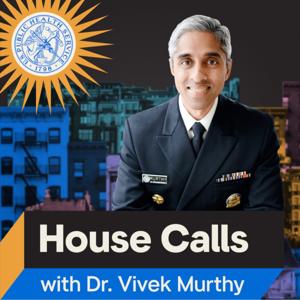


Based on Podcast App listening data
In this special episode, Dr. Murthy sits down with Sara Bareilles, Grammy award-winning singer-songwriter and actress, and Celia Keenan-Bolger, Tony award-winning singer and actress. You may know more about them as performers than you do about their experiences with mental health, but this conversation will change that.
As two very good friends who are warm, funny, and genuine, this conversation is an intimate portrait of their friendship and its importance to mental health. Their conversation explores questions many of us have on our minds: How do you prioritize friendship when the world demands us to be so productive? What does it mean to show up for one another? And how do you overcome questions of self-worth and find the courage to speak openly about your mental health?
As you listen, we hope you feel their friendship effect, too. Sara Bareilles closes out the episode with a surprise performance.
This episode was recorded LIVE in New York. Special thanks to the 92NY for hosting.
(03:55) How did Sara Bareilles and Celia Keenan-Bolger meet and become good friends?
(08:33) How can we make friends and have healthy social lives as we get older?
(18:03) Is there a difference between the way men and women make friends in middle age?
(25:54) How do Sara Bareilles and Celia Keenan-Bolger create the space for friendship in a world that’s always asking them to be more productive?
(33:24) How do Sara Bareilles and Celia Keenan-Bolger balance online activity with real-world friendships?
(44:02) Where did Sara Bareilles and Celia Keenan-Bolger find the courage and clarity to speak openly about their mental health?
(52:41) How have Sara Bareilles and Celia Keenan-Bolger dealt with feelings about lack of self-worth when they arise?
(01:02:19) What are some of Dr. Murthy’s and his guests’ favorite lyrics?
(01:12:52) A special performance by Sara Bareilles
We’d love to hear from you! Send us a note at [email protected] with your feedback & ideas. For more episodes, visit www.surgeongeneral.gov/housecalls.
Sara Bareilles, Singer-Songwriter & Actress
Instagram: @sarabareilles
X: @SaraBareilles
Facebook: @sarabareilles
Celia Keenan-Bolger, Actress & Singer
Instagram: @celiakb
About Sara Bareilles and Celia Keenan-Bolger
Sara Bareilles has received three Tony® Award nominations, most recently in 2023 for her performance as ‘The Baker’s Wife’ in Stephen Sondheim and James Lapine’s Into the Woods – three Primetime Emmy® Award nominations and nine GRAMMY® Award nominations. On Broadway, she composed music and lyrics for Waitress, and stepped into the lead role both on Broadway and in the West End. Most recently, she starred in the filmed live-capture of Waitress: The Musical, which ran for two weeks in theatres nationwide in December 2023. Her other musical theater credits include a song on the Tony Award-nominated score for SpongeBob SquarePants and Emmy Award-nominated appearance as Mary Magdalene in NBC's “Jesus Christ Superstar Live.” Bareilles produced original music and executive-produced the musical drama series “Little Voice,” teaming up with Jessie Nelson, J.J. Abrams and Apple. She also plays Dawn Solano on the Emmy-nominated musical comedy series “Girls5eva”, the third season of which premieres in March 2024 on Netflix.
Celia Keenan-Bolger is an actress and singer. She won the Tony Award for Best Featured Actress in a Play for portraying Scout Finch in To Kill a Mockingbird (2018). She has also been Tony-nominated for her roles in The 25th Annual Putnam County Spelling Bee (2005), Peter and the Starcatcher (2012), The Glass Menagerie (2014), and her most recent role in Mother Play (2024). Other credits - Broadway: The Cherry Orchard, Les Misérables. Off-Broadway: The Oldest Boy, Merrily We Roll Along, A Small Fire. Select Film/TV: “The Gilded Age,” “Bull,” “Louie,” “The Good Wife,” “Nurse Jackie,” “Good Behavior,” “Elementary". Tony Award, Outer Critics Circle, three Drama Desk Award wins.
As a parent, have you ever worried about whether you’re doing a good enough job? Do you feel the pressure to be perfect? Have you felt drained by the demands of parenting?
In this deeply personal conversation, the Surgeon General (and dad of 2) and psychologist Dr. Aliza Pressman put the spotlight on parent mental health. Dr. Pressman changes the conversation from trying to be the perfect parent to growing as a parent. To help our kids’ mental health, we also need to prioritize and care for parent mental health.
Drawing from her research, Dr. Pressman offers reassuring approaches to help parents find self-compassion and stay regulated so kids can better regulate themselves. She also shares how to turn moments when things go wrong into moments for repair and growth in parent-child relationships.
The conversation ends with a parenting Q&A, hosted by Dr. Murthy and surprise Q&A co-host Kate Bowler!
(04:00) What challenges does Aliza Pressman see parents facing today?
(05:00) Why can it feel difficult to talk about the joys of parenting?
(07:55) What’s the upside of being an imperfect parent?
(10:15) How does parent mental health influence kids?
(12:49) What does Dr. Murthy see in his own parents parenting journey?
(18:55) What is self-regulation and how do we cultivate it?
(30:47) Why do parents feel exhausted and drained these days?
(34:21) Can we get clear on the goal of parenting?
(43:44) How does Aliza handle the flow of news and information to herself and her kids?
(50:38) What are 5 ways to help children become resilient people?
(57:30) Parenting Q&A with the Surgeon General & Kate Bowler
We’d love to hear from you! Send us a note at [email protected] with your feedback & ideas. For more episodes, visit www.surgeongeneral.gov/housecalls.
Dr. Aliza Pressman, Psychologist & Author
Instagram: @raisinggoodhumanspodcast
Facebook: @raisinggoodhumanspodcast
Substack: @dralizapressman
About Dr. Aliza Pressman
What is our purpose, both individually and collectively? What lies in the balance of who we are now and who we will become?
In Part Two of this episode, the Surgeon General and Shankar Vedantam, host of “Hidden Brain,” go deep into conversation about our individual and national quest for meaning and purpose.
This episode becomes deeply personal as both host and guest reveal their family’s hopes for coming to America, and the unimaginable ways in which those dreams were realized. They find themselves asking where else on earth has what America can offer? And how can we remember and reinforce our ideals at moments the noise becomes too great?
(03:23) How can we encourage young people to dream about the future?
(09:21) How can we bring freshness and curiosity to our daily lives?
(11:57) What does it mean to be a tourist in our own lives?
(15:28) What is the power of having purpose in our lives?
(22:39) What’s the difference between goals and purpose?
(25:39) How would Dr. Murthy bolster America’s sense of purpose?
(28:58) What is the enormous possibility that the United States offers?
(30:16) What story of America did Dr. Murthy see in the crowd at his swearing in ceremony?
(32:51) Who are Shankar Vedantam’s Unsung Heroes?
We’d love to hear from you! Send us a note at [email protected] with your feedback & ideas. For more episodes, visit www.surgeongeneral.gov/housecalls.
Shankar Vedantam, Host, “Hidden Brain” Podcast
Instagram: @hiddenbrain
X: @hiddenbrain
Facebook: @hiddenbrain
About Shankar Vedantam
Shankar Vedantam is the host and executive editor of the Hidden Brain podcast and radio show. Shankar and NPR launched the podcast in 2015, and it now receives millions of downloads per week, and is regularly listed as one of the top 20 podcasts in the world. The radio show, which debuted in 2017, is heard on more than 425 public radio stations across the United States.
Vedantam was NPR’s social science correspondent between 2011 and 2020, and he spent 10 years as a reporter at The Washington Post. From 2007 to 2009, he was also a columnist, and wrote the Department of Human Behavior column for the Post.
Vedantam and Hidden Brain have been recognized with numerous journalism awards, including the Edward R Murrow Award, and honors from the American Association for the Advancement of Science, the Society for Personality and Social Psychology, the International Society of Political Psychology, the Society of Professional Journalists, the National Association of Black Journalists, the Austen Riggs Center, the American Psychoanalytic Association, the Webby Awards, the Pennsylvania Associated Press Managing Editors, the South Asian Journalists Association, the Asian American Journalists Association, the Pennsylvania Newspaper Association, the American Public Health Association, the Templeton-Cambridge Fellowship on Science and Religion, and the Rosalynn Carter Mental Health Journalism Fellowship.
In 2009-2010, Vedantam served as a fellow at the Nieman Foundation for Journalism at Harvard University.
Shankar Vedantam speaks internationally about how the “hidden brain” shapes our world and is the author of two non-fiction books: The Hidden Brain: How our Unconscious Minds Elect Presidents, Control Markets, Wage Wars and Save Our Lives, published in 2010, and Useful Delusions: The Power and Paradox of the Self-Deceiving Brain published in 2021, an exploration of deception’s role in human success.
Have you ever had a moment when you’ve wanted to reach out to someone you haven’t seen in awhile, but something stops you, like the worry you’ll say the wrong thing? Or have you had the experience of assuming that someone who disagrees with you must also dislike you?
It turns out, our mind can play tricks on us that make it harder to connect.
Shankar Vedantam, host and creator of the podcast ”Hidden Brain” joins the Surgeon General for a two-part conversation that travels across science and deeper philosophical questions about life.
In this first conversation, Shankar explains the “hidden brain,” the part of the mind that function outside of our awareness, making unconscious decisions and judgments. They ponder the paradox of how social anxieties keep us from connecting, but how acts of connection and kindness have far greater impact and power than most of us realize.
Offering both science and personal stories, Shankar and Dr. Murthy help us work through our fears of connecting. And help us close the gap between our values, like kindness, and our actions.
(04:04) How does Shankar Vedantam describe the origins of the Hidden Brain podcast?
(06:18) How can we understand if our hidden brain is helping us?
(08:34) How does our hidden brain keep us from connecting with other people?
(14:04) What does it mean to express gratitude to someone else?
(18:39) How has Dr. Murthy cultivated his sense of kind and warmth?
(24:20) How can we tell a better story about the nature of our humanity?
(29:36) How did Shankar Vedantam become a translator of science?
(33:12) How do listeners respond to the Hidden Brain podcast?
(36:12) How are ideas for Hidden Brain podcast episodes developed?
We’d love to hear from you! Send us a note at [email protected] with your feedback & ideas. For more episodes, visit www.surgeongeneral.gov/housecalls.
Shankar Vedantam, Host, “Hidden Brain” Podcast
Instagram: @hiddenbrain
X: @hiddenbrain
Facebook: @hiddenbrain
About Shankar Vedantam
Shankar Vedantam is the host and executive editor of the Hidden Brain podcast and radio show. Shankar and NPR launched the podcast in 2015, and it now receives millions of downloads per week, and is regularly listed as one of the top 20 podcasts in the world. The radio show, which debuted in 2017, is heard on more than 425 public radio stations across the United States.
Vedantam was NPR’s social science correspondent between 2011 and 2020, and he spent 10 years as a reporter at The Washington Post. From 2007 to 2009, he was also a columnist, and wrote the Department of Human Behavior column for the Post.
Vedantam and Hidden Brain have been recognized with numerous journalism awards, including the Edward R Murrow Award, and honors from the American Association for the Advancement of Science, the Society for Personality and Social Psychology, the International Society of Political Psychology, the Society of Professional Journalists, the National Association of Black Journalists, the Austen Riggs Center, the American Psychoanalytic Association, the Webby Awards, the Pennsylvania Associated Press Managing Editors, the South Asian Journalists Association, the Asian American Journalists Association, the Pennsylvania Newspaper Association, the American Public Health Association, the Templeton-Cambridge Fellowship on Science and Religion, and the Rosalynn Carter Mental Health Journalism Fellowship.
In 2009-2010, Vedantam served as a fellow at the Nieman Foundation for Journalism at Harvard University.
Shankar Vedantam speaks internationally about how the “hidden brain” shapes our world and is the author of two non-fiction books: The Hidden Brain: How our Unconscious Minds Elect Presidents, Control Markets, Wage Wars and Save Our Lives, published in 2010, and Useful Delusions: The Power and Paradox of the Self-Deceiving Brain published in 2021, an exploration of deception’s role in human success.
What is hope and why is it so powerful?
For writer Rebecca Solnit, hope is a commitment to possibility in the face of uncertainty. While many of us react to the unknown with anxiety or worry, Rebecca sees the opposite: that inherent to unpredictable circumstances is the possibility people can take action and to come together to create change.
In this conversation, Rebecca Solnit and the Surgeon General discuss why hope is necessary. They look back at communities formed in response to disasters, like 9/11 and hurricanes, and how hope and connection are inextricably linked. A historian, Solnit points to milestones like the fall of the Berlin Wall in which people’s actions, sometimes incremental, led to unforeseen outcomes.
In facing the massive uncertainty of climate change, Solnit offers why she is hopeful. Rather than fall to despair, she points that humans, throughout history, have seen the possibility to intervene and take action. And THAT is what Solnit calls hope.
(04:34) Why can disasters be so powerful for uniting communities?
(11:16) Why do some types of disasters bring people more together than others?
(16:55) How do you advise young people who feel despair about climate change?
(27:21) How can the way we remember history’s great social changes contribute to hope or hopelessness?
(31:28) How does social media contribute to loneliness and isolation?
(37:45) Has tech convinced us that living efficiently is more important than living in person?
(47:33) How does Rebecca Solnit make herself feel better when she gets down?
(48:35) What does the Surgeon General do to feel better when he is down?
We’d love to hear from you! Send us a note at [email protected] with your feedback & ideas. For more episodes, visit www.surgeongeneral.gov/housecalls.
Rebecca Solnit, Writer
X: @rebeccasolnit
X: @nottoolate_hope
About Rebecca Solnit
Writer, historian, and activist Rebecca Solnit is the author of twenty-five books on feminism, environmental and urban history, popular power, social change and insurrection, wandering and walking, hope and catastrophe. She co-edited the 2023 anthology “Not Too Late: Changing the Climate Story from Despair to Possibility”. Her other books include “Orwell’s Roses”; “Recollections of My Nonexistence”; “Hope in the Dark”; “Men Explain Things to Me”; “A Paradise Built in Hell: The Extraordinary Communities that Arise in Disaster”; and “A Field Guide to Getting Lost”. A product of the California public education system from kindergarten to graduate school, she writes regularly for the Guardian, serves on the board of the climate group Oil Change International, and in 2022 launched the climate project Not Too Late (nottoolateclimate.com).
What lessons does life’s uncertainties offer? Kate Bowler’s stage IV cancer diagnosis ushered her into a world of fear and pain. Living in 60-day increments, her future held no promises. Angry about losing the life she had created, the love of family, friends, and her faith community helped Kate forge a new type of strength—learning to lean on others. This conversation between the nation’s doctor and Kate Bowler illuminates how we find truth and beauty within the uncertainties of life.
(05:07) How did Kate Bowler’s cancer diagnosis at age 35 affect her life?
(09:32) Where did Kate Bowler navigate the uncertainty of her illness?
(12:02) How did Kate Bowler re-define strength?
(14:26) How did Kate Bowler’s community support her during her most acute phase of illness?
(17:23) How can other families build a village for their children?
(20:27) How has Kate Bowler’s health precarity changed how she thinks about life?
(25:56) How can we encourage our kids to strive in a healthy way?
(29:38) What is the message of Kate Bowler’s most recent book?
(31:37) When Kate Bowler was ill, how did others seem to expect her to fix her life?
(34:43) How did Kate Bowler’s experience with cancer impact her faith?
(39:15) When is the last time Kate Bowler laughed uncontrollably?
(40:49) Kate Bowler closes with a blessing.
We’d love to hear from you! Send us a note at [email protected] with your feedback & ideas. For more episodes, visit www.surgeongeneral.gov/housecalls.
Kate Bowler, Writer & Professor
Instagram: @katecbowler
X: @katecbowler
Facebook: @katecbowler
About Kate Bowler
Kate Bowler, Ph.D. is a 4x New York Times bestselling author, award-winning podcast host, and professor at Duke University. She studies the cultural stories we tell ourselves about success, suffering, and whether (or not) we’re capable of change. She wrote the first and only history of the American prosperity gospel—the belief that God wants to give you health, wealth, and happiness—before being unexpectedly diagnosed with stage IV cancer at age 35. While she was in treatment and not expected to survive, she wrote two New York Times bestselling memoirs, Everything Happens for a Reason (and Other Lies I’ve Loved) and No Cure For Being Human (and Other Truths I Need to Hear). After years of being told she was incurable, she was declared cancer-free. But she was forever changed by what she discovered: life is so beautiful and life is so hard. For everyone.
Kate is determined to create a gentler world for everyone who wants to admit that they are not “living their best life.” She hosts the Everything Happens podcast where, in warm, insightful, often funny conversations, she talks with people like Malcolm Gladwell, Tig Notaro, and Archbishop Justin Welby about what they’ve learned in difficult times. Author of seven books including Good Enough, The Lives We Actually Have, and her latest, Have a Beautiful, Terrible Day!, she lives in Durham, North Carolina, with her family and continues to teach do-gooders at Duke Divinity School.
In this special Q&A episode, the Surgeon General sits down with his long-time medical school mentor, Dr. Rachel Naomi Remen, to talk about their journeys to becoming healers. Dr. Remen is the creator of a medical training course called “The Healer’s Art,” which Dr. Murthy took as a medical student.
As a follow-up to their House Calls episode “Can We All Be Healers?”, the pair decided to reunite and field questions from medical students and other healthcare trainees, including: How do you stay compassionate in the tough environment of the healthcare system? How do you get through career disappointments? And how can we lean our relationships to help us?
Tune in for wisdom and stories from two of our country’s most compassionate healers.
(04:08) What hardships did Dr. Remen face on her road to becoming a physician healer?
(07:57) On dealing with Dr. Remen’s heartbreak of not matching for a residency
(10:46) How did Dr. Remen stay true to her humanity during the taxing time of medical training?
(14:52) Where does Dr. Remen turn when she feels burned out?
(17:05) How does Dr. Remen cope with the reality that doctors can’t always heal?
(20:04) How can the act of healing heal the healer?
(27:54) How does Dr. Remen find hope in difficult times?
(34:08) How do cats and social connection help Dr. Remen?
(38:32) What advice does Dr. Remen offer doctors?
We’d love to hear from you! Send us a note at [email protected] with your feedback & ideas. For more episodes, visit www.surgeongeneral.gov/housecalls.
Dr. Rachel Naomi Remen, Physician & Teacher
Facebook: @rachelnaomiremen
About Dr. Rachel Naomi Remen
Rachel Naomi Remen, MD is Clinical Professor Emeritus of Family and Community Medicine at the UCSF School of Medicine and Professor of Family Medicine at Wright State University Boonshoft School of Medicine in Ohio. In 1991, she founded the Remen Institute for the Study of Health and Illness (RISHI) a national training institute for physicians, nurses, medical students, nursing students, veterinarians and other health professionals who wish to practice a health care of compassion, meaning, service and community. She is an internationally recognized medical educator whose innovative discovery model course in professionalism, resiliency and relationship-centered care for medical students, The Healer’s Art, is taught at more than 90 American medical schools and schools in seven countries abroad. Her bestselling books “Kitchen Table Wisdom” and “My Grandfather’s Blessings” have been published in 23 languages and have millions of copies in print.
In recognition of her contribution to medicine and medical education, she has received numerous awards including three honorary degrees, the prestigious Bravewell Award as one of the earliest pioneers of Integrative Medicine and Relationship Centered Care. In 2013, she was voted the Gold-Headed Cane award by UCSF School of Medicine for excellence in embodying and teaching the qualities and values of the true physician. Dr. Remen has a 70-year personal history of chronic illness, and her work is a potent blend of the perspectives and wisdom of physician and patient.
What does it mean to show up for someone?
What does it mean to sit with another person’s pain?
And if we are hurting, why can it be so difficult to ask for help?
Part of being human is learning how to accompany people through hard times. Yet our culture looks at pain as a sign of imperfection, and vulnerability a sign of weakness. In this conversation, the Surgeon General and Rabbi Brous share in how the opposite is, in fact, true: vulnerability and pain can be extraordinary sources of strength and healing. Drawing from both professional and personal moments, Dr. Murthy and Rabbi Brous delve into why the simple act of showing up for each other — an intrinsic power we all possess — is so powerful and healing. And why it is so needed now, especially in these times when the world can feel despairing and lonely.
(00:03:21) In a challenging world, how can we find moments of light?
(00:06:23) How would Rabbi Sharon Brous describe the state of our spirit?
(00:10:14) What does it mean to show up in one another’s lives?
(00:15:30) How can we help people who are struggling?
(00:27:29) How do we show up for others when we ourselves are in pain?
(00:42:17) How can we get more comfortable asking others for help?
(00:47:31) When did Rabbi Brous know she would walk the life path she’s walking?
(00:53:23) What do you does Rabbi Sharon Brous do in moments of despair?
(01:01:54) Did we used to be better at showing up for one another?
(01:07:22) Rabbi Sharon Brous offers a blessing.
We’d love to hear from you! Send us a note at [email protected] with your feedback & ideas. For more episodes, visit www.surgeongeneral.gov/housecalls.
Sharon Brous, Rabbi & Author
Instagram: @sharonbrous
Twitter: @sharonbrous
Facebook: @rabbisharonbrous
About Rabbi Sharon Brous
Rabbi Sharon Brous is the senior and founding rabbi of IKAR, a Jewish community that launched in 2004 to reinvigorate Jewish practice and inspire people of faith to reclaim a soulful, justice-driven voice. Her 2016 TED talk, “Reclaiming Religion,” has been viewed by more than 1.5 million people. She is the author of the recently published book, “The Amen Effect: Ancient Wisdom to Heal Our Hearts and Mend Our Broken World."
In 2013, Brous blessed President Obama and Vice President Biden at the Inaugural National Prayer Service, and in 2021 returned to bless President Biden and Vice President Harris, and then led the White House Passover Seder with Second Gentleman Doug Emhoff. In 2023, she led a Hanukkah lighting with the Vice President and Second Gentleman. She was named #1 on the Newsweek/The Daily Beast list of most influential Rabbis in America, and has been recognized by The Forward and Jerusalem Post as one of the fifty most influential Jews.
Brous is in the inaugural cohort of Auburn Seminary‘s Senior Fellows program, sits on the faculty of REBOOT, and serves on the International Council of the New Israel Fund and national steering committee for the Poor People’s Campaign.
A graduate of Columbia University, she was ordained by the Jewish Theological Seminary and lives in Los Angeles with her husband and three children.
Do you have times when you miss your loved ones and just want to feel more connected?
Maybe a friend or family member is sick and you can’t connect in person. Maybe you’re traveling or are away for school. I know I have these moments. And when I do, I have a meditation I turn to, one that helps me feel loved and more connected. It only takes a few minutes, but it has the power to change my day. In this special episode of House Calls, I share it with you.
Any feedback or ideas? Share them with us at [email protected].
For more episodes, visit www.surgeongeneral.gov/housecalls.
Can spirituality enhance our mental health?
That is the question that psychologist and researcher Dr. Lisa Miller has pursued through her career. During her clinical internship after graduate school, she observed how while some of her patients had symptoms of major depression that required medication, other patients carried a sadness that carried life’s big questions: What is the purpose of life? Is there a larger meaning to existence? Decades later, Lisa has found that each of us has an “awakened brain,” neural circuitry that enables a human’s natural capacity for spiritual awareness.
In this conversation, Lisa and the Surgeon General delve into the science that explains spirituality’s protective effects on mental health. They also discuss the universal human need for an inner life that connects us to something greater than ourselves, and offer a few meditation practices to support the awakened brain.
(02:00) Introductory Guided Meditation
(08:43) What is spiritual health?
(15:04) How does Dr. Lisa Miller define spirituality?
(18:18) Why does spirituality protect our mental health?
(20:55) What are some practices to build spiritual health?
(24:40) What is the awakened brain?
(26:56) Are there particular stages of life when spiritual seeking spikes?
(30:03) What is an Awakened Campus?
(32:44) Why don’t college campuses focus more on spiritual well-being?
(34:26) How Dr. Miller’s spiritual crisis as a young person become her life’s work.
(45:55) What are the core elements of spirituality?
(53:12) Where has Dr. Miller found the support for spiritual exploration?
(59:58) How can parents build a spiritual foundation with their children?
We’d love to hear from you! Send us a note at [email protected] with your feedback & ideas. For more episodes, visit www.surgeongeneral.gov/housecalls.
Dr. Lisa Miller, Psychologist
Instagram: @dr.lisamiller
About Dr. Lisa Miller
Lisa Miller, Ph.D., is the New York Times bestselling author of “The Spiritual Child” and “The Awakened Mind: The New Science of Spirituality and our Quest for the Inspired Life.” She is a professor in the Clinical Psychology Program at Teachers College, Columbia University. She is the Founder and Director of the Spirituality Mind Body Institute, the first Ivy League graduate program and research institute in spirituality and psychology, and has held over a decade of joint appointments in the Department of Psychiatry at Columbia University Medical School. Her innovative research has been published in more than one hundred peer-reviewed articles in leading journals, including Cerebral Cortex, The American Journal of Psychiatry, and the Journal of the American Academy of Child and Adolescent Psychiatry.
Dr. Miller is Editor of the Oxford University Press Handbook of Psychology and Spirituality, Founding Co-Editor-in-Chief of the APA journal Spirituality in Clinical Practice, an elected Fellow of The American Psychological Association (APA) and the two-time President of the APA Society for Psychology and Spirituality. A graduate of Yale University and University of Pennsylvania, where she earned her doctorate under the founder of positive psychology, Martin Seligman, she has served as Principal Investigator on multiple grant funded research studies. Dr. Miller speaks and consults around The Awakened Brain and The Spiritual Child for the US Military, businesses (including tech, finance, HR and sales), personal development, faith based organizations, schools and universities, and for mental health and wellness initiatives.
From the publisher's feed
Ranked by our users in the last 21 days

43,852 Listeners

38,016 Listeners

43,359 Listeners

1,219 Listeners

729 Listeners
10,502 Listeners

111,799 Listeners
5,108 Listeners
14,353 Listeners

3,340 Listeners

15,882 Listeners

2,042 Listeners

10,532 Listeners

19,254 Listeners
4,284 Listeners