
Sign up to save your podcasts
Or

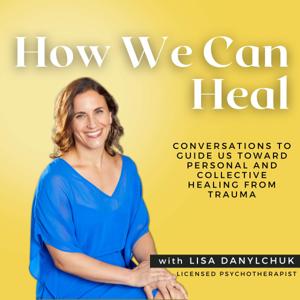


In this episode of How We Can Heal, Lisa Danylchuk pauses to a look back at where we've been during Season One. So, come with us as we select some of our favorite moments. We started with Gabby Bernstein, where we talked about trauma, dissociation, and what it means to have Happy Days. We go on to hear from Kris Carr, Suzanne O'Brien, Guy MacPherson, Kira Willey, Tricia Huffman, Heather Hall, Rosita Cortizo, Christine Forner, Delia Ginorio, Dui Turner and Meghan Zipin. It has been an absolute pleasure to interview all of these experts and share their sincere stories about "how we can heal."
Season two launches July 5th. In the meantime, you’ve got a bit to catch up, re-listen to your favorite episodes, and share your thoughts with me at howwecanheal.com/podcast
Next season we’ll be covering topics like trauma-informed yoga, the intersection of service work and economy, and so much more.
Support the show
The tragedy in Uvalde, TX, that claimed the lives of 19 students and two teachers has many people feeling confused, angry, and deeply sad. Licensed psychotherapist and founder of the Center for Yoga and Trauma Recovery Lisa Danylchuk has an open conversation discussing how you and why people may be feeling this traumatized and what they can do to help. "We just go into shutdown and overwhelm in the face of a really massive disaster. And that's actually biologically wired. It's supernormal. So if you're there just know. That's okay. And you're a human being with a nervous system," Lisa explains. In this bonus episode, she also interviews her producer and former TV broadcaster Christine O'Donnell who reported on the Sandy Hook tragedy on how she copes with traumas and triggers.
Support the show
Today on How We Can Heal Podcast, Lisa Danylchuk and Meghan Zipin talk about how yoga helps address stress caused by extreme events. Boston Marathon is one of the major world marathon events hosted annually. But aside from being a world event, the Boston Marathon became even more famous because of what happened in 2013. Here, Meghan shares her first-hand experience of the 2013 Boston Marathon Bombing, what she struggled with in having PTSD, and what trauma-informed yoga means to people like her whose lives are penetrated by trauma.
Meghan Zipin on defining PTSD
After what took place during the 2013 Boston Marathon, everything seemingly changed right after for Meghan. Everything that happened before that was no more the custom in her daily life. It may have not impacted Meghan physically—but it affected her emotionally and mentally. From there on, constantly feeling jumpy became her routine.
A constant hyper-vigilance and alertness perpetuated Meghan’s default body state. It interrupted her sleep at night. And because of the stress that the event perpetuated into her system, Meghan found it difficult to throw herself into anything that she couldn’t gauge as ‘predictable.’ The disorder she experienced became a pattern. And before she knew it, Meghan was already experiencing PTSD beyond what she could fully grasp about her condition.
About Meghan Zipin:
Experienced Owner and emerging writer with a demonstrated history of working in the health wellness and fitness industry. Skilled in Business Planning, Market Research, Management, Healthcare, and Business Relationship Management. Strong healthcare services professional with an MBA focused in Management and Leadership from Boston College - Carroll School of Management.
Outline of the episode:
● [02:11] How Meghan found yoga
● [05:45] Yoga served as something that anchored me
● [10:09]Yoga does a great job at helping us recognize how we can shift gears
● [15:09] Meghan Zipin on the struggle to admit to having PTSD
● [20:11] People with PTSD can’t identify and name what they’re going through
● [27:18] The concern for ‘touch’ in trauma-informed yoga
● [32:02] How Meghan transitions her clients from one move to another during yoga sessions
● [38:17] You never really know what someone is going to walk away with after yoga sessions
● [41:57] Meghan Zipin on using intake forms with clients
● [48:30] What gives Meghan Zipin hope?
Resources:
Website: https://www.meghanzipin.com/
LinkedIn: https://www.linkedin.com/in/meghan-delaney-zipin-51851a35/
Instagram: https://www.instagram.com/mismegs82/?hl=en
Don’t forget to enroll by May 24th for the Yoga for Trauma Online Training Program:
http://howwecanheal.com/y4t/
Tell Me About You! I want to get to know the How We Can Heal Audience and how I can make the show even better. Tell me about you here: https://forms.gle/14s7XpU8WmhuPgrGA
Support the show
Today on How We Can Heal Podcast, Lisa Danylchuk, and Dui Turner talks about how yoga impacted her life as a woman in the military and her students' life on a bigger picture. As someone in her 40s, who's been in service for 25 years, Dui helps us understand how yoga can be carried through everything, how she champions women's inclusion and leadership, and about her upcoming book that talks about the science, the art, and the you of teaching yoga in the military.
Yoga in Context
"Yoga is a spectrum," Dui describes. It's a practice that welcomes and loves everyone that joins despite their background and knowledge of yoga. Whether you're in it for the exercise or for the fullness of the spiritual experience, yoga embraces everything in between in order for everyone to fully benefit from the practice, no matter what they aspire to achieve from doing it.
With that being said, this is why trust is critical between a yogi and a student. A yogi is cautious about how they relate to students, and they strive to create safe spaces for everyone in their class. Whether a student is someone completely new to physical wellness or from the military trying to address trauma and stress, a yogi works best knowing that an approach to teaching yoga is not a one size fits all; it adjusts to each individual.
About Dui Turner:
Duilia is an officer in the United States Air Force and a veteran of two major conflicts. She is also the founder of Integrative World, a community focusing on promoting healthy approaches and techniques to support balanced lifestyles. She has studied a variety of healing arts including Tai Chi, Qi Gong, sound therapy, meditation, and Yoga. She has also contributed to various yoga blogs, public talks and Yoga for Veterans trainings.
Dui completed the "Yoga Philosophy Intensive Course" offered by the AC Foundation in Hawaii. She has earned 200-hr and 500-hr Yoga certifications specializing in Yoga for veterans coping with Post-Traumatic Stress (PTS). She is a Transformative Coach, Certified Reiki Master and Health Coach. She is a member of the International Association of Yoga Therapists and the American Association of Drugless Practitioners. She holds a B.S. in Meteorology and a MBA in Global Management.
Outline of the episode:
● [02:06] Yoga pulled me in from Tai-chi
● [06:44] How does yoga fit in the life of a military woman?
● [12:35]Everybody in my generation has lost friends
● [19:56] Yoga is a spectrum, and it embraces everything in between
● [24:56] What is a yoga practice for? For life!
● [33:39] Dui Turner on women's inclusion and leadership
● [42:24] We're in an era of women's firsts'
● [48:25] The practices that Dui relies on every day
● [55:08] Breathing goes with you everywhere
● [01:01:47] A book for yoga teachers in the military setting
Resources:
Website: https://www.integrativeworld.com/
MIND YOUR CLASS, Book by Duilia Mora Turner:
https://www.integrativeworld.com/book-mind-your-class
Breaking Barriers Podcast: https://www.audible.com/pd/Podcast/B08K57HG8N
Support the show
Today on the How We Can Heal Podcast, Lisa Danylchuk sits with Delia Ginorio to unfold the realities of working in the field of violence interception. In her experience and the experiences she's listened to, healing clearly is a journey. For everyone, it is lifelong work. In this talk, Delia shares the limitations and boundaries she sets for herself in survivor restoration. She also speaks on the areas she struggles at in work, how she determines when to work and when to walk away, and the pieces that give her hope to continue every day.
Victims sometimes become perpetrators
For Delia Ginorio, the Director of the Survivor Restoration Program at the San Francisco Sheriff's Department, resources and support programs for survivors and victims of abuse and trauma are always critical. This helps survivors process what they've experienced and to have a platform where they can be heard. In her experience in the field, not having these can carry adverse effects on a survivor.
As Delia recalls her younger years, she puts into the picture how vital support is for abuse and trauma victims. Growing up with trauma, Delia identifies herself as a furious young woman. She carried so much anger that it wouldn't be hard for her to be aggressive to anyone. She was just waiting for somebody. If not for the direction she was taken to in her current career, Delia, in her own words, 'could easily be in prison right now.'
About Delia Ginorio:
Delia Ginorio is the Survivor Restoration Program Director for the San Francisco Sheriff's Department (SFSD) and a nationally recognized expert in criminal justice reform and approaches. Ms. Ginorio is a key leader in the award-winning Resolve to Stop the Violence Project (RSVP).
Outline of the episode:
● [02:03] One to three sessions are nothing in therapy
● [08:46] Honoring Delia Ginorio's late mother
● [14:21]Victims sometimes become perpetrators
● [19:01] Delia Ginorio's limitations on animal abuse cases
● [27:14] Violence isn't the answer
● [32:42] Delia Ginorio – The hardest population for me to work with
● [38:19] It's healing and powerful for a survivor to share their stories and be heard
● [43:11] It's easier to stay angry than to be deeply sad and hurt
● [49:06] How does Delia find the balance between doing her work and not doing it
● [55:07] But even some of the folks I thought were never going to change are my coworkers today!
Resources:
DV Hotline #'s in San Francisco
Woman Inc: (877) 384-3578
La Casa de las Madres: (877)503-1850
Riley Center: (415) 255-0165
SF Woman Against Rape: (415) 647-7273
Five Keys Schools and Programs
Community Works West – Justice Demands Humanity
RSVP Video Clip:
Resolve to Stop the Violence: Innovator's Focus
Domestic Violence Support and Resources
You are not alone. 24/7 help is available if you need support. Reach out for help if your partner or someone in your life is:
Putting you down
Hurting you
Threatening you
Making you feel afraid
In an emergency, call 911
If it is not safe to call 911, you can text 911.
24-hour National Domestic Violence Hotline
Call 1-800-799-7233 anytime.
More Resources: https://bit.ly/3wiWZ2R
Support the show
Today on How We Can Heal Podcast, Lisa Danylchuk and Christine Forner break down dissociation, mindfulness, and securefulness. Even before becoming a therapist, Christine had always been exposed to trauma work. As she words it, Christine is someone whose more centered when around other people's challenges. Today, Christine helps us understand what securefulness means, the challenges to mindfulness and dissociation, why she believes mindfulness is our parent brain as humans, and much more.
Dissociation and Mindfulness – Two Different Sides
Christine, during the interview, describes how she's come to realize the polarity of dissociation and mindfulness as two opposing brain and body states. For her, dissociation is both concrete and abstract. The same thing with mindfulness. When a person is dissociative or mindful, either way, they'll experience feeling altered in the beginning. They think differently, hence why they're both in polar states.
Because they're two different points from two parallel extremes, aiming for the other while currently in the opposing state can often create a challenging transition. When a person is dissociated, a therapist suggesting mindfulness as an initial aid to the issue may seem like someone waking up a patient in the middle of open-heart surgery.
About Christine Forner:
Christine Forner, B.A., B.S.W., M.S.W., R.S.W., has over thirty-five years of experience working with individuals with Trauma, Post Traumatic Stress Disorders, Traumatic Dissociation, Developmental Trauma, and Dissociative Disorders.
Christine started her career as a public educator for a sexual assault center, moving to a domestic violence center, and eventually was drawn to working at a feminist-based organization that focused on long-term counseling for women at a very low fee. It was here that she began her passion for working with individuals who experience traumatic dissociation.
Starting her own private practice in 2011, she has specialized training in EMDR, Ego State Therapy, Meditation, and Mindfulness for severely traumatized people and is a certified Sensorimotor Psychotherapist. Receiving a degree in both Woman's Studies and Social Work, Christine has a unique background that helps individuals understand that much of human suffering is a side effect of an enormous number of traumatic experiences.
Christine teaches locally and at an international level on dissociation, complex trauma, the intersection of dissociation and mindfulness, as well as the role that misogyny and the patriarchy play in the origination and perpetuation of complex trauma dissociation, and the many layers of psychopathy.
Christine has won several Presidential awards, a Mid-Life career award, and is an International Society for the Study of Trauma and Dissociation Fellow. She was the President of the International Society for the Study of Trauma and Dissociation in 2019, served on the board of the ISSTD since 2010, and was the ISSTD treasurer from 2012 to 2017.
Outline of the episode:
● [03:37] Getting exposed to trauma at the age of 16
● [05:33] My clients taught me how to be a therapist
● [11:59]When and how did Christine get into mindfulness?
● [18:00] When we're in a dissociative state…
● [24:01] What does mindfulness feel like for someone whose extremely dissociative?
● [30:37] Mindfulness is a relational thing
Resources & Articles Mentioned:
https://bit.ly/3y79iSr
Support the show
Today on How We Can Heal Podcast, Lisa Danylchuk talks to Dr. Rosita Cortizo about her approach to helping women and moms heal internally through simple and subtle ways. For Dr. Rosita, a mother must know how to take care of herself. And that covers all aspects of well-being. But how can one mom start when there's just so much asked for from mothers? Dr. Rosita shares how volunteer work opened her to her current field of specialty, how trauma affects motherhood and womanhood, and why it's all-important for everyone to learn about how they got into this world.
Mothers – what place do you have in this world?
Even with the current generation's awakening to more open discussions on mental health, it's surprising to see how most people are still very unfamiliar with anything that has to do with therapy. No matter how necessary, some say, therapy is still very inaccessible for some. And mothers are not alien to the issue. For Dr. Rosita, economic concerns are one of the leading factors; a mother's responsibilities are number two.
In her experience, Dr. Rosita cites a straight entry point that can change how moms look at therapy as a whole: it's through education. Moms need to understand that it's essential to feel good about themselves. How a mother feels will impact how others feel in her care. Dr. Rosita teaches moms that they are the 'queens' of their bodies and children. If a mother doesn't feel good about herself, she cannot teach her children how they can feel good about themselves—let alone self-care and self-love.
About Dr. Rosita Cortizo:
Rosita Cortizo, originally from Panama City, Panama, in South America, currently works as a high-risk, multicultural, bilingual prenatal and perinatal clinical psychologist for women's health services working with female adults and children.
Dr. Cortizo has worked in Public Health in Southern California with pregnant women at high risk with multiple diagnoses, traumatic stress, dissociative processes, and relational crisis for more than 30 years.
She holds licenses as both clinical psychologist (2001) and marriage family therapist (1998); and earned a Master of Arts in Psychology with a specialty in Chemical Dependency (1993) in San Diego, California. She is EMDRIA Certified, an Approved EMDR Consultant, and the 2021 ISSTD President.
Outline of the episode:
● [02:58] What volunteer work opened Dr. Rosita Cortizo to
● [05:33] I wanted to see how far my volunteer work would go
● [10:10]Treating trauma in public health was nothing like in the textbooks
● [15:00] Birth is a painful conversation!
● [20:29] In what avenue does Dr. Rosita Cortizo begin to work on a mother's interpersonal healing
● [25:56] Moms need to learn self-soothing so their children can learn it too
● [31:02] Why it definitely helps to get to know your patients more personally
● [35:30] Compare then despair
● [44:03] It's who, not how!
● [50:35] Dr. Rosita Cortizo – I want to be a hand for all moms!
Website: http://www.rositacortizo.com/
More Resources: https://howwecanheal.com/prioritizing-trauma-healing-for-pregnant-women-with-doctor-rosita-cortizo/
Support the show
Today on How We Can Heal Podcast, Lisa Danylchuk talks to Dr. Heather Hall about the different staggering studies that show the factors that affect trauma and dissociation and how some psychiatric practices disserve the treatment of trauma. Should trauma treatment be treated like checking boxes off a list? Dr. Heather helps us understand the ethnic density effect, how neighborhood environments affect dark-skinned immigrants in London, and how support systems can never be overlooked in treating trauma patients.
How Attachment Works
By definition, Dr. Heather Hall describes attachment as 'the process by which trauma transcends' from one generation to another. For example, on parenting. If one is raised in an abusive and neglective environment, it'd be almost natural for that person to not have any substantial model of how a parent should adequately be to a child. In this type of situation, a disorganized attachment can develop.
If a person experiences this kind of attachment, insecurities can and may most definitely affect their approach to raising children. From being raised in trauma, this person will then be exposed to another phase of trauma wherein they will not be able to function ideally in the face of a child they can't connect with. In effect, the person with this kind of attachment will also expose the child to the same disorganized attachment.
About Dr. Heather Hall:
Dr. Hall is a board-certified adult psychiatrist. She has over thirty years of experience. She combines expertise in psychopharmacology and psychotherapy to develop treatment plans tailored to each patient. Before establishing her private practice, Dr. Hall was an associate clinical professor of psychiatry at UCSF and UC Davis.
She is currently on the board of directors of the International Society for the Study of Trauma and Dissociation and specializes in treating complex trauma. In addition, she is the co-chair of the ISSTD's Public Health Committee and chair of the Annual Conference Committee. Dr. Hall is a graduate of Smith College in Northampton, MA.
She completed her medical training at Drexel University in Philadelphia, PA, and her psychiatric training at The Institute of Pennsylvania hospital.
Outline of the episode:
● [02:28] What drew Dr. Heather to becoming an MD Psychiatrist?
● [07:14] Some psychiatrists ignore a patient's trauma history
● [12:31]It's hard to be in a system that's not trauma-informed
● [18:02] A good portion of the homeless are trauma survivors
● [24:03] Voter turnout affects psychoses for darker-skinned immigrants in areas in London
● [31:46] With no trauma history, assessing symptoms may turn out like checking boxes off the list
● [37:09] The different factors that can affect a patient-psychiatrist connection and vice versa
● [43:07] From 'what's wrong with you?' to 'what happened to you?'
● [50:53] The importance of close contacts that are educated on how trauma history affects people
● [56:31] Dr. Heather Hall – on checking your patient's coping mechanisms
Website: https://www.heatherhallmd.org/
For Publications by Dr. Heather Hall: https://howwecanheal.com/dissociation-schizophrenia-and-systemic-racism-with-dr-heather-hall/
Support the show
Tricia Huffman is a podcast host, speaker, Manager of Integrity to Grammy Award-winning artists, and founder of Your Joyologist. While living out her first dream as a touring sound engineer, she saw that everyone, including the people we think “have it all,” often doesn’t feel fulfilled and fights doubts, worries, and compares themselves to others daily. With her unique background and knowledge in self-care and wellness, she first created her Joyology to keep artists healthy, grounded, and inspired in body and mind while on tour. She now spreads her mission to claim joy daily via her empowering social media posts, real talk podcast, coaching work, product line, and Own Your Awesome daily inspiration app, and everything that she does.
She is based in Los Angeles, where she is raising her strong-willed, independent, creative daughters and F-ing the shoulds while claiming joy daily.
You can learn more about Tricia and her work at triciahuffman.com, @_triciahuffman, yourjoyologist.com, and @yourjoyologist, and subscribe to her Claim It! Podcast.
Full Transcript Available Here
Support the show
Today on How We Can Heal Podcast, Lisa Danylchuk welcomes Kira Willey as she discusses how she incorporates music, yoga, and mindfulness for very young children. Kira has had over a decade plus years of experience in music, mindfulness, and teaching kids. Today, Kira shares her story behind how she started on this path, how she perceives energy, and what for her mindfulness is and what mindfulness is not.
Music – it's where I need to be
While working in a previous parent and child program, Kira spotted this ad about children's yoga training for teachers in the workplace. Admittedly, Kira wasn't 100% into it at that time. Nevertheless, by looking at the ad, Kira knew that it was something she would do. The training also didn't come cheap. Yet, Kira had a go with it anyway. Mentally, Kira already had some part of the thing planned out in her head. Once she gets the certificate, she was certain she'd incorporate music into her teaching.
Kira's love for music can be understood very easily in this interview. Bringing her guitar everywhere was not an issue for Kira. To her, 'it was like a crutch.' So she's very comfortable handling it. What she's not comfortable with, however, is being in a room with 25 six-year-olds. For Kira, music is so easy to love. It makes brains light up, and it influences everyone's energy. And even though there's science behind that, Kira believes you don't need Science to experience it.
About Kira Willey:
Kira Willey is the author of six children's mindfulness books: Peaceful Like a Panda, the Mindfulness Moments for Kids board book series, and the bestselling Breathe Like a Bear. Her books have been translated into 18 languages and sold more than 260,000 copies around the world.
As a kids' yoga and mindfulness expert with nearly two decades of teaching experience, Kira has spoken on the TEDx stage, trained thousands of kids' yoga teachers, and is the creator of Rockin' Yoga training and school programs, as well as her Rockin' Yoga membership, a thriving community of educators bringing mindful practices to children.
As a children's music artist, Kira has released six albums of yoga & mindfulness songs for kids, which have won Parents' Choice Gold and numerous other industry awards. Her songs have been streamed more than 35 million times, and her hits include "Colors," which was featured in a worldwide Dell ad campaign.
Kira is also the creator and host of two kids' TV programs, "Breathe With Me" and "Fireflies Yoga," which air on PBS affiliates nationwide.
Outline of the episode:
● [02:34] From sports to yoga
● [06:24] Kira Willey – on working in music, earning less, and still loving it
● [11:30]There's nothing better than creating with others
● [15:13] How did music, yoga, and teaching kids come about for Kira?
● [21:03] Songs for channeling scattered energy
● [26:09] Mindfulness doesn't have to be sitting on a cushion with a candlelit
● [31:40] Do you have time for mindfulness? You should!
● [35:52] Kira Willey – on working with parents
● [46:26] You can do almost anything that you're already doing—mindfully
● [48:47] What gives Kira Willey hope?
Resources:
Website: https://kirawilley.com/home
Kira is offering How We Can Heal listeners free children's mindfulness and music resources! Head here to grab all the goods:
Support the show
From the publisher's feed
A podcast to share deep conversations about How We Can Heal from life’s toughest circumstances.
46e25130-c4e4-11f0-b994-d9ed1c1b3183

43,324 Listeners

2,520 Listeners

1,661 Listeners

116 Listeners

1,849 Listeners