
Sign up to save your podcasts
Or



Based on Podcast App listening data
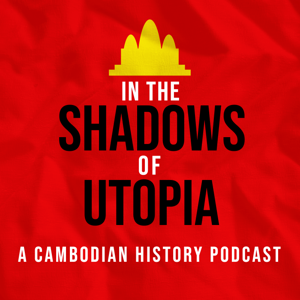
After Angkor was abandoned, the Khmer court moved south to the Mekong and spent the next four centuries surviving. By the eighteenth century, Cambodian kings were being installed and removed by Bangkok or Hue, and sometimes paying tribute to both at once. This is the part of Cambodian history that almost nobody covers, and it sets the terms for everything that follows.
Time Period Covered: 1431 – 1800
How did the Khmer go from a civilisation which dominated most of mainland Southeast Asia to a reduced vassal state of either the Siamese or the Vietnamese? Why did the capital move from Angkor? And why are the Vietnamese the 'hereditary enemy' of the Khmer?
In this episode, Lachlan covers the 'middle period' or 'dark ages' — the move south, the courts at Longvek and Oudong, and the slow closing of the vice between Siam to the west and Vietnam to the east.
The second half is a brief history of Vietnam: the long march south, the Trinh and the Nguyen, and a political culture built on entirely different foundations to the Khmer one. This eastern neighbour plays a vital role in the story of the region in the 20th century, and no history of the Khmer Rouge works without it.
Sources
David Chandler A History of Cambodia
Christopher Goscha Vietnam: A New History
What was Angkor actually like to walk through? What really happened to the Khmer Empire, and why is the standard version wrong? Was Angkor ever actually "lost"?
Time Period Covered: 1296 – 1600 CE
In 1296, a Chinese diplomat named Zhou Daguan stepped off a boat at Angkor, stayed eleven months, and wrote down what he saw — the palace, the markets, the food, the gossip. His account is the only surviving eyewitness description of the city at its height. A century and a half later the capital moved south, and Europeans would eventually decide the city had been 'lost'. It hadn't, and what actually happened took the better part of a century of new science to work out.
Watch the full 5 hour documentary on YouTube
Sources
Chandler A History of Cambodia
Coe and Evans Angkor and the Khmer Civilization
Hendrickson, Stark and Evans (eds) The Angkorian World
Tully A Short History of Cambodia
Zhou Daguan trans. Peter Harris A Record of Cambodia
Penny et al Geoarchaeological evidence from Angkor reveals a gradual decline.
Zhao et al Hydroclimate and Paleoenvironmental Variability from the Tonle Sap Lake Basin 2024
Carter Alison in Cambodia (blog) SOSORO Museum of Economy and Money Phnom Penh
https://www.shadowsofutopia.com/
How do you build the largest city in the medieval world? What does it actually take to construct Angkor Wat? And what happens when the greatest king in Khmer history dies and leaves an empire stretched to its limits?
Time period covered: 802 – 1296 CE
In this episode, Lachlan traces the rise of the Khmer Empire from Jayavarman II's ceremony on Phnom Kulen to the death of Jayavarman VII, the most prolific builder in Angkorean history. The three-step blueprint of the early kings — waterworks, ancestral temple, state temple. The building of Yasodharapura and the East Baray. The interlude at Koh Ker and why it failed. The mystery of Suryavarman I's blood oath and the patronage networks that held the empire together.
We cover Suryavarman II and the construction of Angkor Wat in detail — the labour, the materials, the corbelled architecture, the astronomical alignments, and the sheer organisational achievement of moving and placing millions of tonnes of stone. Then Jayavarman VII: the Cham sacking, the comeback, the building programme that outstripped every king before him combined, and the contradiction at the heart of his reign between compassion and extraction.
Sources
Chandler: A History of Cambodia
Coe and Evans: Angkor and the Khmer Civilization Hendrickson
Stark and Evans (eds): The Angkorian World
Tully: A Short History of Cambodia
Who are the Khmer people, and where did they come from?
Why does almost everything written about early Cambodia need to be revised?
Time period covered: Pre-history – 850 CE
In this episode, Lachlan introduces the landscape, the people, and the deep history of the Khmer civilisation before the era of god-kings. The monsoon cycle that defines everything. The animist world of spirits and sacred hills that underlies all the religions that come later. We examine what archaeology and inscriptions actually tell us about the pre-Angkorean period, and why the old frameworks of Funan and Chenla (borrowed from Chinese chronicles and repeated for a century) don't quite hold up. The episode ends on Phnom Kulen, the sacred mountain, where Jayavarman II performs a ceremony declaring him the universal monarch: Devaraja.
Watch The Full YouTube Documentary Here: https://youtu.be/RfEnSrw-hMU
On the 17th of April, 1975, the Khmer Rouge took Phnom Penh. By midday they were emptying it. Two million people were marched out of the city at gunpoint, told the Americans were about to bomb, and that they could come home in three days. Phnom Penh stayed almost empty for the next four years.
How would you react to being forced out of your home at gunpoint, ordered to leave everything behind, and told to walk for days into the countryside toward a fate nobody would explain? And that was only the beginning.
Time period covered: 1969–1979
This first episode covers the fall of Phnom Penh, the evacuation of the city, and the discovery of the S-21 prison by the Vietnamese army in January 1979. It includes the recollections of Jim Laurie, Elizabeth Becker, Al Rockoff and Dith Pran, who were there. Under the Khmer Rouge, something like one in five Cambodians died in under four years. This series is a detailed narrative history of Cambodia and an attempt to explain how that happened. This episode is an introduction to the events themselves, before the series goes back to the beginning of Cambodian history to work out why.
Re-recorded and expanded in 2026.
Sources
Pin Yathay, Stay Alive, My Son
Haing Ngor with Roger Warner, Survival in the Killing Fields
Jon Swain, River of Time
Jim Laurie, The Last Helicopter
Elizabeth Becker, When the War Was Over
Roland Neveu, The Fall of Phnom Penh
David Chandler, A History of Cambodia; Brother Number One; Voices from S-21
Philip Short, Pol Pot: The History of a Nightmare
Ben Kiernan, The Pol Pot Regime
Nayan Chanda, Brother Enemy
Testimony before the Extraordinary Chambers in the Courts of Cambodia
Interview with Dith Pran, 1983, American Archive of Public Broadcasting
www.shadowsofutopia.com
From the publisher's feed
Ranked by our users in the last 21 days

11,408 Listeners

3,189 Listeners
582 Listeners

57 Listeners
8,308 Listeners

15,581 Listeners
5,227 Listeners
1,419 Listeners

540 Listeners

3,365 Listeners

15,589 Listeners

15,896 Listeners

2,437 Listeners

144 Listeners

1,095 Listeners