
Sign up to save your podcasts
Or



Based on Podcast App listening data
President Trump and President Putin's back-door deal to release hundreds of thousands of tonnes of Russian diesel into international markets has revitalized the Kremlin's war effort and left President Zelenskyy incandescent. Is the US president sacrificing Ukraine in the hope that it will help him in the midterms? Can Europe bridge the gap in support? And can Ukraine survive another winter under Russian attack?
Bronwen Maddox is joined by Orysia Lutsevych, deputy director of the Russia and Eurasia Programme and head of the Ukraine Forum at Chatham House; General Sir Richard Barrons, former commander of the Joint Forces Command in the UK Armed Forces and a senior consulting fellow with our International Security Programme; and Sharon Hudson-Dean, associate fellow with Chatham House's US and North America Programme.
Produced by Podmasters for Chatham House, with thanks to Stephen Farrell and Sara Seth.
Comment | After Trump's Russian diesel deal, will Europe give Ukraine the support it needs?
Comment | Why the US midterms are a rare foreign policy election
Research paper | Why a 'whole-of-society' model is essential for Ukraine's recovery
Magazine issue | The World Today autumn issue
Academic Journal | International Affairs
Audio | Africa Aware🎧
Audio | The Climate Briefing🎧
Follow Independent Thinking on your favourite podcast apps.
The rightward movement in democracies in Europe and beyond shows little sign of slowing. Germany has elected its first far-right regional government in Saxony-Anhalt. In France, voter anger with Emmanuel Macron puts the Rassemblement National's Marine Le Pen in pole position for the presidency. In Spain, Pedro Sánchez called a snap election in an attempt to mobilise the beleaguered left around Spain's housing crisis. And Flávio Bolsonaro's success in the first round of Brazil's presidential elections suggests a second round of anti-woke, pro-Trump bolsonarismo is on the cards. What is driving politics to the populist right? And what does it mean for global security, stability and efforts to preserve what's left of the rules-based order?
Bronwen Maddox is joined by Grégoire Roos, director of our Europe and Russia and Eurasia Programmes; Nic Lawley, special adviser to the director of Chatham House; and Dr Christopher Sabatini, director of our Latin America Programme.
Produced by Podmasters, with thanks to Sara Seth and Stephen Farrell.
Explore Chatham House's latest work:
Comment | Sánchez's gamble: This 'all-in' election will have international impact
Comment | Brazil's presidential election is more than just another polarized contest
Comment | Brazil's Amazon rainforest is at risk if Bolsonaro wins – but its low-carbon economy is here to stay
Magazine issue | The World Today autumn issue
Academic Journal | International Affairs
Audio | Africa Aware🎧
Audio | The Climate Briefing🎧
Follow Independent Thinking on your favourite podcast apps.
The Iranian-backed Houthi rebels' capture of Yemen's port city of Mocha means that Iran now effectively controls two crucial waterways in the region – the Bab al-Mandab Strait to the Red Sea and thus the Suez Canal, as well as the Hormuz Strait. Why has this simmering conflict exploded again? What do Iran and the Houthis want? How serious is this potential blockade for world trade and energy supply? And could the Houthis become a regional power, in economic terms even more powerful than Iran?
Bronwen Maddox is joined by director of Chatham House's Middle East and North Africa Programme, Dr Sanam Vakil; Horn of Africa specialist Ahmed Soliman; and Yemen and Gulf specialist, Farea Al-Muslimi, who joins us from Jordan.
Produced by Podmasters, with thanks to Sara Seth and Stephen Farrell.
Explore Chatham House's latest work:
Comment | New energy and trade routes could bypass Hormuz and change the Middle East. But major challenges remain
Magazine article | Farea al-Muslimi: 'I wrote my own death statement 5 times'
Comment | Escaping the Hormuz trap: What should an agreement to reopen the Strait look like?
Magazine issue | The World Today autumn issue
Audio | Africa Aware🎧
Audio | The Climate Briefing🎧
Follow Independent Thinking on your favourite podcast apps.
President Donald Trump welcomes Xi Jinping to Washington with the US-China dynamic in a moment of historic flux. China is rising economically and militarily, while the US is mired in the Iran war, alienating allies and pursuing Trump's unpredictable trade and tariff disputes.
What do the two leaders want from this meeting, and will they get it? Can they reconcile their differing economic powers, the competition for critical minerals, and their radically contrasting visions for artificial intelligence.
And in the longer term: who will dominate the 21st century? Does Xi really want to retake Taiwan for China before his time in power ends? Or is the US-Chinese dynamic more complex and perhaps less alarming?
To unpick these threads Bronwen Maddox is joined by three experts from Chatham House's Asia-Pacific Programme: programme director Ben Bland, senior research fellow Dr Yu Jie and associate fellow Dr Bill Hayton.
Produced by Podmasters, with thanks to Sara Seth and Stephen Farrell.
Explore Chatham House's latest work:
Magazine article | What the West fails to grasp about China's strategy to lead the world
Comment | Trump–Xi summit: Why the US and China should not underestimate each other
Comment | China is weathering the Hormuz energy crisis. But copying its model comes with risks
Magazine issue | The World Today autumn issue
Audio | Africa Aware🎧
Audio | The Climate Briefing🎧
Follow Independent Thinking on your favourite podcast apps.
A call by leaders of the tech giants on the frontier of Artificial Intelligence to 'slow the pace' of its development has sparked debate over the risks associated with AI.
Does AI represent an existential threat, and if so, how urgent are the warnings? Or can humanity harness this powerful technology to our benefit?
Our experts discuss the implications for international security, from cyber to the increasing use of AI in today's conflict zones, and the dynamics of the race toward the cutting edge – not only among industry competitors, but also in the realm of geopolitics.
Bronwen Maddox is joined by Dr Marion Messmer, director of our International Security Programme, and Alex Krasodomski, director of our Digital Society Programme.
Produced by Podmasters, with thanks to Sara Seth and Stephen Farrell.
Explore Chatham House's latest:
Magazine article | UK's armed forces can keep control of their AI kill switch – here's how
Magazine article | 'We are at a moment of peril with AI ... The sooner [it is regulated], the better'
Policy paper | How AI could change the world
Magazine issue | The World Today autumn issue
Audio | Africa Aware🎧
Audio | The Climate Briefing🎧
Follow Independent Thinking on your favourite podcast apps.
Twenty five years ago the deadliest terrorist attacks in human history, on 11 September 2001, saw 2,977 people killed in New York, Washington, and aboard the planes hijacked by 19 members of Al-Qaeda.
An immediate response followed with the US-led 'war on terror', which saw Western forces occupy Afghanistan and Iraq, and two decades of military operations across the Middle East and beyond.
We look back over a quarter of a century to examine the longer-term consequences of 9/11.
We examine how US foreign policy and military power changed perceptions of America and its allies. We look at the consequences for a Middle East still riven by conflict. And we discuss how the focus on counterterrorism left the US positioned to deal with a new multipolar era in which it faces challenges from Russia and the rise of China.
This week's episode is hosted by Laurel Rapp, director of Chatham House's US and North America Programme, standing in for Bronwen Maddox.
She is joined by General Sir Richard Barrons, a senior consulting fellow with the International Security Programme. Also by Farea Al-Muslimi, a research fellow at Chatham House's Middle East and North Africa Programme. And by Jason Burke, International Security Correspondent of the Guardian.
Produced by Podmasters, with thanks to Stephen Farrell.
About Independent Thinking
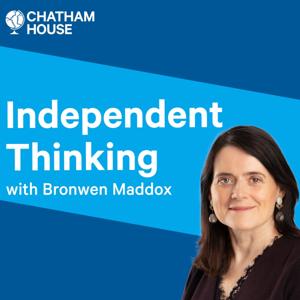
Independent Thinking is a weekly international affairs podcast hosted by our director Bronwen Maddox, in conversation with leading policymakers, journalists and Chatham House experts providing insight on the latest international issues.
More ways to listen: Apple Podcasts and Spotify.
Explore our other Chatham House podcasts.
The United Nations convenes for its 81st General Assembly next week amid turmoil around the world that it seeks to bring together. The conflicts in Iran, Ukraine and Gaza, and the US, China and Russia's undermining of the rules-based international order cast a shadow over UNGA. Can the organization renew itself for a dangerous multipolar world? Or is it doomed to the same fate as the League of Nations?
Bronwen Maddox discusses the UN's present and future with Heather Hurlburt, associate fellow with our US and North America Programme; Marc Weller, head of our Global Governance and Security Centre; and Zizette Darkazally, associate fellow with our Middle East and North Africa Programme.
Produced by Podmasters, with thanks to Sara Seth and Stephen Farrell.
Explore Chatham House's latest:
Research paper| What Haitians want from the next phase of UN and international support
Comment | Can the UN close the global AI gap?
Policy paper | What the Burnham government should do in its foreign policy
Magazine issue | The World Today summer issue
Audio | Africa Aware🎧
Audio | The Climate Briefing🎧
Follow Independent Thinking on your favourite podcast apps.
It's been a tumultuous year in the Middle East – and it's far from over. Six months after the US and Israel launched their offensive against Iran, the conflict continues to disrupt trade, energy and food security. President Trump struggles to escape a deadlock that threatens to seriously damage him in the American mid-term elections. Meanwhile, Gaza remains locked in a humanitarian crisis despite a ceasefire, while Israel faces growing political division ahead of an October election that will determine Benjamin Netanyahu's fate. As leaders wrestle with security, alliances and the fallout from multiple conflicts, we discuss the future of a troubled region.
Bronwen Maddox is joined by director of Chatham House's Middle East and North Africa Programme, Dr Sanam Vakil; associate professor in politics and international relations at UCL, Dr Julie Norman; and Israeli politician and journalist, Ksenia Svetlova.
Produced by Podmasters for Chatham House, with thanks to Sara Seth and Stephen Farrell.
Explore Chatham House's latest work:
Policy paper| What the Burnham government should do in its foreign policy
Comment | Should Egypt join the Mecca Pact?
Comment | Nigeria will need more than a bigger army to tackle security challenges
Magazine issue | The World Today summer issue
Audio | Africa Aware🎧
Follow Independent Thinking on your favourite podcast apps.
The climate crisis has seldom been dramatized so vividly as in the summer of 2026. Apocalyptic fires, widespread droughts and drained rivers in Europe made clear a worsening situation that even the most fervent denier can't wave away. But is there the necessary time, commitment and technology to slow or reverse the climate spiral – even in the face of a US administration that is committed to fossil fuels? How do the two approaches of mitigation and adaptation translate into real life on the ground? And is there any good news amid the smoke and gloom?
Bronwen Maddox is joined by water and climate specialist Dr Beatrice Mosello and sustainability expert Dr Patrick Schröder from Chatham House, and special guest Oliver Morton, The Economist's planetary affairs correspondent.
Produced by Podmasters for Chatham House, with thanks to Sara Seth and Stephen Farrell.
Explore Chatham House's latest work:
Comment | Wildfires and extreme heat show climate change is now Europe's biggest security threat
Video | Burning questions facing Burnham
Comment | Melting ice and power shifts: Europe and Canada should seize their Arctic moment
Magazine issue | The World Today summer issue
Audio | Africa Aware🎧
Audio | The Climate Briefing
Follow Independent Thinking on your favourite podcast apps.
Britain's new prime minister Andy Burnham is not known for his interest in foreign affairs, but foreign affairs are eternally and often unforgivingly interested in Britain.
What should Burnham and his new foreign secretary Ed Miliband prioritise on the global front? How can they balance the urgent demands of defence, climate action, resetting relations with the EU and Britain's place in the wider world? And who is going to pay for it all?
To discuss what should be on Burnham and Miliband's to-do lists, Bronwen Maddox is joined by Olivia O'Sullivan, director of Chatham House's UK in the World Programme, and Owen Jenkins, research director for Africa, the Middle East and North Africa, and Asia-Pacific.
Produced by Podmasters, with thanks to Stephen Farrell and Sara Seth.
Explore Chatham House's latest:
Video | Burning questions facing Burnham
Comment | Why Carney's pipeline gamble is a bad bet for Canadian taxpayers
Comment | Zambia's election: President Hichilema must preserve his country's democratic reputation
Magazine issue | The World Today summer issue
Audio | The Climate Briefing🎧
Audio | Africa Aware🎧
Follow Independent Thinking on your favourite podcast apps.
From the publisher's feed
Ranked by our users in the last 21 days
101 Listeners
153 Listeners

124 Listeners

65 Listeners

100 Listeners
20 Listeners

136 Listeners

67 Listeners

22 Listeners

3,054 Listeners

474 Listeners

845 Listeners
124 Listeners
101 Listeners

142 Listeners