
Sign up to save your podcasts
Or



Based on Podcast App listening data
General David Petraeus rose to prominence for his role in the Iraq War. He was credited with implementing a counterinsurgency strategy that helped to stabilise the country and reduce violence, earning him widespread praise and recognition as one of the most effective military commanders of his generation. And from September 2011 until November 2012 he served as director of the CIA. In this episode the BBC’s International Editor Jeremy Bowen speaks to the four star General about his understanding of the legacy of the Iraq war 20 years on, and the effect that this has had on US foreign policy today.
This series was produced by Farah Jassat and Catharine Hughes, with editing and artwork from Catharine Hughes. Music is by Lesfm. Excerpts featured in this episode are from The Telegraph.
Learn more about your ad choices. Visit podcastchoices.com/adchoices
Carl Erik Fisher is a psychiatrist, bioethicist and recovering alcoholic who has spent years tracing the history of addiction. His new book is The Urge: Our History of Addiction, a sweeping study of the issue and an urgent call for a more expansive, nuanced and compassionate view of one of society's most difficult challenges. In conversation with Carl is physicist, oceanographer and science presenter, Helen Czerski.
We’d love to hear your feedback and what you think we should talk about next, who we should have on and what our future debates should be about. Send us an email or voice note with your thoughts to [email protected].
At Intelligence Squared we’ve got our own online streaming platform, Intelligence Squared+ and we’d love you to give it a go. It’s packed with more than 20 years’ worth of video debates and conversations on the world’s most important topics as well as exclusive podcast content. Tune in to live events, ask your questions or watch on-demand, totally ad-free with hours of discussion to dive into. Visit intelligencesquaredplus.com to start watching today.
Learn more about your ad choices. Visit podcastchoices.com/adchoices
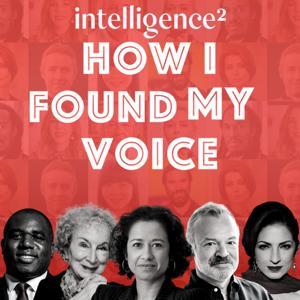
Over lunch in his house in Oxford, bestselling author Philip Pullman speaks to broadcaster Samira Ahmed about the moments of his childhood and youth that shaped and inspired his unique storytelling. This episode is part of our series How I Found My Voice, hosted by Samira Ahmed. If you like this episode do check out the entire series.
Learn more about your ad choices. Visit podcastchoices.com/adchoices
Samira Ahmed speaks to best-selling author Kate Mosse. Together they discuss her life and career, the success of her historical fiction novels - including Labyrinth which won Best Read of the Year at the 2006 British Book Awards - and her contribution to the recognition of female writers. The recording for this episode took place in February 2021.
Learn more about your ad choices. Visit podcastchoices.com/adchoices
For this week's Sunday Debate, we're dipping back into the archive to 2014, when we gathered a panel of expert historians to debate whether Britain was right to fight in the First World War, a tragedy that laid the foundations for decades of destructive upheaval and violence across Europe. To debate the issue, we invited leading historians Margaret MacMillan, Max Hastings, John Charmley and Dominic Sandbrook to an event hosted by journalist, columnist and national security expert, Edward Lucas.
We’d love to hear your feedback and what you think we should talk about next, who we should have on and what our future debates should be about. Send us an email or voice note with your thoughts to [email protected].
At Intelligence Squared we’ve got our own online streaming platform, Intelligence Squared+ and we’d love you to give it a go. It’s packed with more than 20 years’ worth of video debates and conversations on the world’s most important topics as well as exclusive podcast content. Tune in to live events, ask your questions or watch on-demand, totally ad-free with hours of discussion to dive into. Visit intelligencesquaredplus.com to start watching today.
Learn more about your ad choices. Visit podcastchoices.com/adchoices
Samira Ahmed speaks to model and actress Emily Ratajkowski. Together they discuss her rise to fame after appearing in the music video for the controversial song ‘Blurred Lines’, as well as the fraught relationship between feminism, capitalism, and exploitation. The recording for this episode took place in September 2021.
Learn more about your ad choices. Visit podcastchoices.com/adchoices
Carlo Rovelli is one of the world’s best-known scientists. A theoretical physicist, his books have sold over two million copies around the world. He recently came to Intelligence Squared to talk about his favourite scientist, the little-known Greek philosopher Anaximander, whose ideas, articulated over two millennia ago, lay the foundations for cosmology, physics, geography, meteorology, and biology. It's the subject of Rovelli's book, Anaximander: And the Nature of Science, now being published in English for the first time. In conversation with the award-winning historian Tom Holland, Rovelli shows how Anaximander opened up a path that we are still on today: one that requires us to accept the provisional nature of our knowledge and allows us to challenge, rebel against and create new images of our world.
We’d love to hear your feedback and what you think we should talk about next, who we should have on and what our future debates should be about. Send us an email or voice note with your thoughts to [email protected].
At Intelligence Squared we’ve got our own online streaming platform, Intelligence Squared+ and we’d love you to give it a go. It’s packed with more than 20 years’ worth of video debates and conversations on the world’s most important topics as well as exclusive podcast content. Tune in to live events, ask your questions or watch on-demand, totally ad-free with hours of discussion to dive into. Visit intelligencesquaredplus.com to start watching today.
Learn more about your ad choices. Visit podcastchoices.com/adchoices
Ever since the discovery of DNA scientists have been on a quest to understand the secrets of the human genome. This quest has not only involved analysing the role genes play in making us who we are – the history of genetics has also been shaped by a desire to explore how far our genes can be altered or enhanced.
In 2012, the discovery that a molecule known as CRISPR could be programmed to add and remove elements of DNA marked a huge leap forward, transforming research into treatments for diseases as varied as cancer, Alzheimer’s, sickle cell and HIV, as well as many rare genetic conditions.
In this conversation, recorded at the Francis Crick Institute in London, our panel explores the urgent ethical questions that these advances have unleashed. Chaired by Dr Guddi Singh, the panel featured Tom Whipple, Science Editor at The Times, Shani Dhanda, an award-winning disability activist and inclusion specialist, Dr Güneş Taylor, postdoctoral research scientist at the Francis Crick Institute, and Jimi Olaghere, one of the first people in the world to take part in a life-changing clinical trial using gene therapy to treat sickle cell disease.
In this episode (Part II) the panel responds to questions from the audience on the real life implications of gene editing, and the role society should play in regulating the field. If you missed part one of this conversation, please go back and listen now.
The event was organised to coincide with a free exhibition at the Francis Crick Institute, London called ‘Cut and Paste,’ exploring the future and ethics of gene editing. The exhibition runs until December 2023. Visit https://www.crick.ac.uk/CutandPaste to find out more.
Learn more about your ad choices. Visit podcastchoices.com/adchoices
Ever since the discovery of DNA scientists have been on a quest to understand the secrets of the human genome. This quest has not only involved analysing the role genes play in making us who we are – the history of genetics has also been shaped by a desire to explore how far our genes can be altered or enhanced.
In 2012, the discovery that a tool known as CRISPR could be programmed to add and remove elements of DNA marked a huge leap forward, transforming research into treatments for diseases as varied as cancer, Alzheimer’s, sickle cell and HIV, as well as many rare genetic conditions.
In this conversation, recorded at the Francis Crick Institute in London, our panel explores the urgent ethical questions that these advances have unleashed. Chaired by Dr Guddi Singh, the panel featured Tom Whipple, Science Editor at The Times, Shani Dhanda, an award-winning disability activist and inclusion specialist, Dr Güneş Taylor, postdoctoral research scientist at the Francis Crick Institute, and Jimi Olaghere, one of the first people in the world to take part in a life-changing clinical trial using gene therapy to treat sickle cell disease.
In this episode (Part I) the panel explores questions such as: what diseases should we try to cure? How should these be prioritised? What assumptions shape perceptions of disability? Where does the line between editing and enhancing fall? And ultimately who gets to decide?
The event was organised to coincide with a free exhibition at the Francis Crick Institute, London called ‘Cut + Paste,’ exploring the future and ethics of gene editing. The exhibition runs until December 2023. Visit www.crick.ac.uk/CutandPaste to find out more.
Learn more about your ad choices. Visit podcastchoices.com/adchoices
Samira Ahmed speaks to Academy Award-nominated actor Jude Law. They speak about his life and career, skipping school to go to the cinema in London as a teenager, his foray into acting, and the wide range of characters he’s covered in his career, from Dr. John Watson to the Pope.
Learn more about your ad choices. Visit podcastchoices.com/adchoices
From the publisher's feed
Ranked by our users in the last 21 days

303 Listeners

4,107 Listeners

2,141 Listeners

882 Listeners

5,486 Listeners

297 Listeners

836 Listeners

121 Listeners

905 Listeners

2,537 Listeners
27 Listeners

136 Listeners

6 Listeners
3 Listeners

2 Listeners

1 Listeners

3,043 Listeners

474 Listeners

2,452 Listeners

333 Listeners
0 Listeners

4 Listeners

0 Listeners
4 Listeners
0 Listeners
9 Listeners

0 Listeners
2 Listeners
0 Listeners
0 Listeners