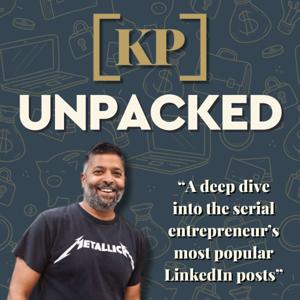
KP Unpacked

KP Unpacked

Download on the App Store

KP Unpacked episodes

  • Don't Just Show Results, Tell the Story

    What happens when execution isn't enough to raise capital?

    In this episode of KP Unpacked, KP Reddy and Nick tackle a critical founder mistake: obsessing over traction while forgetting to sell the vision. Inspired by a portfolio company struggling to fundraise despite excellent execution, they unpack why venture capital demands storytelling (not just proof points) and why construction tech founders in particular fall into the "show me" trap when they should be in "tell me" mode.

    The conversation spans SaaS market dynamics (why KP canceled Salesforce mid-contract), the psychology of software loyalty (people love Excel, tolerate Salesforce), and why personalization unlocks joy in enterprise tools. Then they pivot to fundraising fundamentals: Elon Musk could pitch on outcomes alone but chooses to tell the Mars story. Why? Because investors back energy, mission, and vision, not spreadsheets.

    Key topics covered:

    • Why KP canceled Salesforce after prepaying for the year and what that signals about SaaS churn in 2026
    • The difference between software people love (Excel, Milwaukee Tools) vs. software they tolerate (Salesforce, SAP)
    • Why usage data won't show up in earnings until 2027 and why the market is pricing in fear, not facts
    • Application layer thesis: why natural language interfaces will replace system-of-record UX entirely
    • The critical founder error: pitching what you've done instead of where you're going
    • Show me vs. tell me: how to know when investors need vision, not validation
    • Why Elon Musk still tells the Mars story despite decades of execution proof
    • The hustler/hacker co-founder dynamic and why two hackers never raise capital
    • Why construction tech founders index too hard on substance and struggle with showmanship
    • How to separate customer narratives (narrow, fact-based) from investor narratives (expansive, visionary)
    • The modern equivalent of "nice office space": swag stores, media presence, and dinner party bragging rights

    If you're a founder who's executing well but struggling to raise, an investor trying to understand why traction isn't translating to term sheets, or an operator wondering why personalization matters more than features, this episode will reset your fundraising strategy.

    Listen now.

    54 min
  • Deflation Is the Point of Innovation

    What if getting cheaper is actually the goal?

    In this episode of KP Unpacked, KP Reddy and Nick unpack why AI-driven deflation isn't something to fear, it's the entire point of innovation. From Davos narratives to Elon's predictions to the Grok CEO's commentary, deflation is becoming the dominant framework for understanding AI's economic impact. But construction, housing, healthcare, and education have resisted this trend for decades. Why?

    KP walks through live AI experiments: writing 150 job descriptions in 30 minutes, automating recruiting workflows, and why corporate acquisitions like Consigli (AECOM) and Datagrid (Procore) are really about speed-to-market and talent acquisition, not just technology. The breakdown? These deals are cultural change plays disguised as product acquisitions and the real value is in people who are "in it" 24/7, not just using ChatGPT for poems.

    Key topics covered:

    • Why deflation is a core first principle of innovation and why construction has resisted it
    • The real structure behind the Consigli acquisition: talent, change agents, and customer pull-through
    • Why Procore bought Datagrid for speed, not capability. Bulletproofing AI takes time
    • How MCP servers are hackable and why proof-of-concept to production still requires curing time
    • KP's live experiment: 150 job descriptions written and posted in 30 minutes using Claude Cowork
    • Why CEOs who subordinate AI strategy should resign, you can't delegate this
    • The Canvas Robotics acquisition by JLG and what industrialized robotics mean for wall finishing costs
    • Why 30% of every building ends up in the dumpster and how AI + robotics finally solve it
    • The talent arbitrage game: why companies can't hire$5M individual contributors but can acquire them
    • Safety improvements in construction: 96 deaths at Hoover Dam vs. today's job sites

    If you're a founder wondering whether your product roadmap is fast enough, an investor trying to understand why acquisitions are spiking, or an operator who thinks "using ChatGPT" counts as AI adoption, this episode will reset your expectations for 2025.

    Listen now.

    45 min
  • Construction Is Now the World's Bottleneck

    This episode is a reality check for anyone who thinks construction is just catching up to tech. It's not. Construction is now leading it.

    In this episode of KP Unpacked, KP Reddy and Nick make the case that design and construction have become the single most important constraint on technological progress. Data centers can't get built fast enough. Housing can't scale. Power generation is racing to keep pace. And for the first time in history, construction is facing technology-driven upgrade cycles, not aesthetic ones.

    But this isn't just macro. KP walks through live experiments with Claude Cowork and Claude Code: automating LinkedIn grooming, generating $7K in Substack revenue, replacing million-dollar consulting contracts, and sending 1,000 personalized emails in under an hour. The breakthrough? AI agents don't need APIs anymore. They're reading screens and controlling desktop applications, which means on-screen takeoff, Revit, and legacy construction software are suddenly vulnerable.

    Key topics covered:

    • Why on-screen automation could kill 50+ construction tech startups in the next year
    • How AI agents control your desktop by watching and clicking, not integrating via API
    • Real experiments: LinkedIn automation, competitive analysis, email campaigns, vibe modeling in Excel
    • Why construction is the bottleneck for AI infrastructure, housing supply, and energy distribution
    • The shift from trickle-funding to big bets: why seed rounds should be $15–25M for real problems
    • How to get surgical about ICP definition using AI-powered research
    • The 48-hour email delay hack: protecting your time when automation makes you too efficient
    • Why sales-oriented, variable-comp businesses are ideal for AI leverage right now

    If you're a founder building in AEC, an investor trying to understand where capital should flow, or an operator wondering whether your software strategy is already obsolete, this episode will reframe how you think about the next five years.

    Listen now.

    47 min
  • The Friction Test: Quit or Keep Going

    This episode is a gut check for founders heading into 2026.

    In this episode of KP Unpacked, KP sits down with Nick to unpack a question every builder eventually faces: are you pushing through healthy friction or slamming into an immovable wall? From startup shutdowns to lifestyle businesses to full resets, they explore how to make clearer decisions when time (not money) is the real constraint.

    This conversation spans the very practical (how founders are using AI tools daily to replace entire workflows) to the deeply strategic (why AI adoption has become a diligence filter) to the speculative-but-serious (how autonomy, robotics, and AI in the physical world could reshape where and how we live).

    If you’re a founder, operator, or investor trying to decide whether to grind, pivot, or quit, this episode will sharpen your judgment.

    Key topics covered

    • The “friction test”: how to tell the difference between productive resistance and a dead end
    • Why time should be treated as capital and how that reframes shutdown decisions
    • AI as a new baseline skill: why hours per day in tools like Claude are now table stakes
    • How non-technical founders are building real products from scratch using AI
    • Why AI adoption is becoming a red-flag test in founder diligence
    • Real-world AI in high-stakes environments (including life-or-death decision-making)
    • Eliminating “thought mind work”: how automation reduces stress and extends founder longevity
    • Big bets on the physical future: autonomous vehicles, robotics, VTOLs, space hotels, and living farther from cities without the commute tax

    If you’re navigating 2026 planning and wondering whether to double down or walk away this episode is for you.

    Listen now.

    46 min
  • Construction Is the Last Automation Frontier

    This is our final episode of the year, and we’re ending it with the kind of conversation AEC needs more of.

    In this episode of KP Unpacked, KP sits down with Dr. Barry Clark (CTO) to connect the dots from “physical startups” (robots sewing denim) to what comes next: robots + humans coexisting on jobsites, AI-driven motion control, and a coming wave of materials + manufacturing innovation that could reshape how we design and build.

    If you’re a founder, operator, or AEC leader wondering what’s real vs. vaporware, this one will sharpen your lens.

    If you truly meant “last podcast of 2035,” just swap the year, but “final episode of the year” keeps it accurate either way.


    Key topics covered

    • From robotics in apparel to robotics in construction: why “physical startups” are back
    • Why construction is the hardest automation environment (unstructured, bespoke, constant pivots)
    • AI’s impact on robotics: from brittle logic to learning systems that handle “unknown unknowns”
    • Digital twins + simulation: getting cheaper, more practical, closer to daily use
    • KP’s thesis: a materials renaissance for AEC—and the real bottleneck (commercial scale)
    • What “motion control” actually means (path planning + actuator control)
    • The missing layer: orchestration across people + robots on live jobsites
    • A hard truth: project tools often become archives, not systems that drive behavior

    Guest bio
     Dr. Barry Clark is KPR’s CTO with a background in mechanical engineering, optimal control, computer vision, and automation, spanning robotics startups and large-scale automated assembly (including server assembly and software-defined manufacturing).

    33 min
  • Uber For Building: Why Transparency Wins

    If you want to understand the future of construction, look at your phone. In this episode of KP Unpacked, KP Reddy and Nick explain why the next major shift in AEC will mirror the moment Uber replaced the taxi. Not because of sci-fi tech, but because of something simpler: total transparency.

    Today’s owners operate in a black box. Schedules slip, change orders land without context, and updates lag behind reality. KP and Nick argue that the construction company that embraces real-time visibility will dominate the next decade.

    From jobsite cameras and drone data to cultural shifts inside design and engineering teams, this episode lays out what it takes to build the first truly transparent construction firm and why owners will reward it.

    Highlights

    1) The Uber analogy

    •  Real-time tracking vs radio silence
    •  Why transparency became a competitive weapon
    •  How expectations changed overnight once riders saw the truth

    2) Transparency on the jobsite

    • Daily visibility instead of weekly reporting
    • Drone imagery, progress photos, and time-stamped reality
    • Owners checking job status as easily as tracking a car

    3) Culture as the real blocker

    •  The fear of showing mistakes in real time
    •  Old school habits inside design and engineering teams
    •  Why new firms may adopt transparency faster than incumbents

    4) Incentives and stress

    •  Why most GCs do not actually want surprise change orders
    •  How hiding small issues snowballs into major delays
    •  Transparency as the ultimate stress reliever for teams

    5) The technology already exists

    • Reality capture, project management, AI context layers
    • Why this is a full stack shift, not a point solution
    • The first GC to commit wins disproportionate market share

    If you believe construction is overdue for its Uber moment, this episode shows why transparency wins and how the industry gets there.


    Ready to go deeper on modern AEC leadership and operations?

    Join the KPR Co Q1 Event for hands-on sessions with founders, operators, and owners.

    50 min
  • The Silent Killer of Startups: Broken Boards

    Founders, if your board meetings feel pointless, this one’s for you. Rethink the people shaping your company’s future.

    Private company boards should drive growth, not block it. Yet too often, they become performative, disengaged, or simply wrong for a company’s stage. In this episode of KP Unpacked, KP Reddy and Nick unpack what makes boards work — and why so many founders get them wrong.

    They break down the difference between governance and guidance, how private equity’s rigor reshapes accountability, and why boards need to evolve just like product or operations. From “dead board members” to mismatched corporate execs, this episode is a blueprint for building a board that adds real value.

    Highlights

    1) What Makes a Bad Board

    •  Unengaged board members: the silent signal of a dying organization
    •  Corporate mindsets in startup spaces: when governance eclipses problem solving
    •  Analysts and placeholders: why some seats are signs investors have checked out

    2) Building the Right Board

    •  Functional expertise over resume shine: the power of one domain expert who actually adds value
    •  Founders as architects of their board: setting expectations, structure, and chemistry
    •  Evolving governance: how Series A and B boards should look different from pre-seed

    3) Dynamics and Chemistry

    •  Why founder board trust breaks when communication stops between meetings
    •  The “honeymoon” effect of early boards and how to keep engagement alive
    •  How to fix board structure without burning relationships

    4) The Private Equity Pattern

    •  Pattern recognition through repetition: why PE backed AEC boards outperform
    •  Experience as leverage: what seasoned investors see that most founders miss

    5) Real Talk on Board Power

    •  Why many investors lose interest when companies plateau and how founders can counter it
    •  The hidden tension of “board coups” and replacing founders
    •  How ego defines leadership longevity from Larry Ellison to Bill Gates

    If you’ve ever left a board meeting wondering what the point was, this one’s for you. Learn how to build a board that keeps you accountable and scales with your business.

    Join the KPR Co Q1 Event to connect with founders and investors shaping the next generation of AEC growth.

    Register for the Owner Training Webinar happening on Nov 20th to go deeper into leadership, governance, and scaling for the real world.

    47 min
  • We Don’t Really Finish Projects. We Abandon Projects.

    AEC leaders, operators, and innovators, this one matters. Listen now and fix your closeout before it burns value.

    The closeout process is where most projects quietly fail. In this episode of KP Unpacked, the #1 podcast in AEC, KP Reddy and Nick pull back the curtain on why handovers break, why owners get stuck with the bill, and how to design for decades instead of deadlines. 

    From BIM’s broken promise to the CapEx vs OpEx split, this is a hard reset on how AEC should finish work.

    Highlights

    1) Documentation and data

    • BIM vs reality: digital models did not eliminate banker boxes or fragmented handovers
    • Documentation as asset value: warranties, submittals, service records as the true owner’s manual
    • Modern handover standard: digitize everything, make it queryable, and keep data portable across owners

    2) Incentives and ownership structure

    • CapEx vs OpEx: split mindset drives short-term choices that hurt operations
    • Incentives and warranties: tie first five years of maintenance to designers and contractors
    • Design–Build–Operate: operating accountability changes what gets built

    3) Operations and economics

    • Maintenance economics: lifecycle costs can exceed build costs and should change design choices
    • Manufacturers and feedback loops: lost warranty visibility and how direct data ties prevent waste

    4) Process and workflows

    • Decentralized workflows: hundreds of contributors, no single system, and why forcing one platform fails at closeout

    5) Owner playbook

    • Set closeout requirements early, enforce data standards in contracts, and involve operations from day one.

    After months of conversations with Owners and Owner Reps, we have launched our Owner Training Series to help you fix what breaks between design, build, and handover. Learn how to manage risk, enforce better closeouts, and align your teams for long-term success.

    2nd Webinar is on Nov 20th.

    Enroll now and get the replay of first one → https://kpreddy.co/owner-training-series

    49 min
  • Why Curiosity Beats Connections in Startups

    If meritocracy starts at a web form, do you still need warm intros or just relentless curiosity?

    Track3D founder/CEO NK Chaitanya joins KP for a field-level riff on founder-led sales, learning on job sites, and why doing the unscalable early creates durable moats later. We unpack how a cold application turned into a partnership, why “works on day one” beats roadmap theater, and how automating the boring parts brings joy back to building. NK also breaks down Track3D’s $10M Series A, the tech vs distribution dance, and what it really takes to earn a customer’s time.

    Highlights

    • One front door: meritocracy via a website form (and why it works)
    • Founder in steel-toes: two years on sites to earn insight (and trust)
    • Tech moat vs distribution moat: when to swing between them
    • Design partners > pilots: time commitment beats small checks
    • “It has to work now”: MVPs that are job-ready, not demo-ready
    • Why this industry hates being sold to and how to sell by serving
    • Doing the unscalable early to make scale possible later
    • Founder-led sales past $1M (and why the founder stays in the room)
    • Automate the drudgery, protect the joy: AI that frees real work
    • Immigrant advantage: beginner’s mind as a superpower

    Learn more about KPR Co Mastermind Groups here!

    Upcoming KPR Co events

    • Owners’ Training Series: practical moves for owners and owner’s reps
    41 min
  • Would You Like Fries With Your Engineering

    If you can ship a site plan with one click, do you still need the degree or just better prompts?

    Director of Innovation Brandon Blackberg (RTM Engineering) joins KP for a fast, practitioner-level riff on how AI is reshaping civil and structural work. We cover the “McDonald’s vs gourmet” future of delivery, why generalists win in a systems world, and how to avoid getting locked into someone else’s feature stack. We also talk vibe coding, token bills, and what KP would do if he started a firm tomorrow.

    Highlights 

    • Why entry-level engineers will start closer to “junior-plus” with AI at their fingertips
    • Generalist thinking vs narrow specialization when failures are system level
    • Rethinking drawings and phases when iteration is cheap
    • Time and materials, lump sum, and the real impact of token costs
    • Multi-LLM strategies to avoid platform lock-in
    • Guardrails that keep creativity alive and production safe
    • Build vs buy: when an internal tool beats a vendor, and when it doesn’t
    • Career paths that don’t look like ladders: engineering, coding, sales

    Learn more about KPR Co Mastermind Groups here!

    Upcoming KPR Co events

    • Owners’ Training Series Kickoff: practical moves for owners and owner’s reps
    • Vibe-a-Thon: vibe coding for non-coders, prizes included
    • 9th Annual KPR Summit: the room where AEC’s next moves get decided
    47 min

About KP Unpacked

From the publisher's feed

KP Unpacked explores the biggest ideas in AEC, AI, and innovation, unpacking the trends, technology, discussions, and strategies shaping the built environment and…
More shows like KP Unpacked

The McKinsey Podcast by McKinsey & Company

The McKinsey Podcast

388 Listeners

Odd Lots by Bloomberg

Odd Lots

1,980 Listeners

The a16z Show by Andreessen Horowitz

The a16z Show

1,089 Listeners

The Daily by The New York Times

The Daily

111,865 Listeners

Up First from NPR by NPR

Up First from NPR

56,449 Listeners

The Diary Of A CEO with Steven Bartlett by DOAC

The Diary Of A CEO with Steven Bartlett

8,527 Listeners

The Indicator from Planet Money by NPR

The Indicator from Planet Money

9,532 Listeners

The Charlie Kirk Show by Charlie Kirk

The Charlie Kirk Show

65,461 Listeners

The Shawn Ryan Show by Shawn Ryan

The Shawn Ryan Show

46,104 Listeners

All-In with Chamath, Jason, Sacks & Friedberg by All-In Podcast, LLC

All-In with Chamath, Jason, Sacks & Friedberg

10,190 Listeners

Huberman Lab by Scicomm Media

Huberman Lab

29,207 Listeners

The Ezra Klein Show by New York Times Opinion

The Ezra Klein Show

15,904 Listeners

The Zweig Letter by Zweig Group

The Zweig Letter

10 Listeners

The Tucker Carlson Show by Tucker Carlson Network

The Tucker Carlson Show

15,960 Listeners