
Sign up to save your podcasts
Or



What happens when AEC firms ban Claude because they don't know where their project data goes?
In this episode of KP Unpacked, KP Reddy and Nick unpack the regression happening across construction firms: people disconnecting Claude, companies banning enterprise AI tools, and employees carrying two laptops (work and personal) to keep building with tools their firms won't approve. A 3,000-person AEC firm just banned Claude entirely. The result? Everyone's using personal instances on company time, and the firm loses all institutional knowledge being built in those sessions.
But the deeper conversation is about IP anxiety in project-based industries. In AEC, there is no enterprise, the project is the enterprise. If you're a civil engineer on the Tesla factory and Tesla says "don't share our data with LLMs," how do you even comply when Claude's connected to your email? The answer: firms are hitting pause out of fear, not strategy. Meanwhile, KP delivered his first Zero RFI keynote at Building Transformations, and the feedback was split. Some GCs realized Zero's tools could drive risk to zero, which raises an existential question: if owners don't need insurance against risk anymore, why hire a general contractor?
Key questions answered:
If you're an AEC firm struggling with data privacy policies while employees build workarounds, wondering whether blocking AI tools protects you or puts you further behind, or trying to understand what happens when risk mitigation becomes automated, this episode will force you to ask whether hitting pause feels safe, or just delays the inevitable.
Listen now.
What is it about watching a machine tape drywall that creates visceral discomfort in ways software automation never did?
In this episode of KP Unpacked, KP Reddy and Nick dissect the emotional response to physical AI versus digital AI. Nick's Okibo robotics video got 300K views and sparked a firestorm: half celebrating reduced construction costs, half horrified that "they're coming for the physical jobs too." The backlash reveals something deeper. People feel guilt about blue-collar displacement in ways they never did about white-collar knowledge work. Why? Because physical labor was supposed to be the fallback when AI took everything else.
KP counters with the mop thought experiment: would you pay your house cleaner more to scrub floors by hand without tools? Of course not. So why do we romanticize construction labor that breaks backs when better tools exist? The conversation moves from a software engineer quitting over AI coding adoption (identity crisis around lost craft) to whether nostalgia will create retro coding communities the way vinyl and Japanese stationery stores preserve analog experiences. Then they pivot to the scarcity flip: intelligence is now abundant and cheap, but transformers have 18-month backlogs. A startup building next-gen transformers would have been laughed out of Shadow Ventures three years ago. Today? Immediate funding.
Key questions answered:
If you're grappling with why automation feels different when it's visible, wondering whether nostalgia creates business opportunities in a post-scarcity world, or trying to understand why transformer companies suddenly matter more than SaaS startups, this episode will challenge how you think about the emotional response to technology displacing human work.
Listen now.
What if tracking how much AI your team uses tells you more than tracking their hours?
In this episode of KP Unpacked, KP Reddy and Nick reveal a controversial management shift happening at Zero RFI: KP monitors enterprise Claude analytics and reaches out to employees with low token usage, not high spenders. The new performance metric isn't billable hours or output volume. It's curiosity, commitment to learning, and willingness to experiment. Someone burning through credits is building, iterating, testing limits. Someone avoiding the tools is resisting change. And if the CEO isn't in the top third of token usage on their team, they're failing at leadership.
The conversation unpacks Zero RFI's first internal hackathon: seven hours, cross-functional teams pulled out of silos, non-engineers shipping production code by end of day. One team built a preventative maintenance prediction system for a business they knew nothing about. Another deployed a Slack-to-Notion content aggregation engine an hour after presenting. The philosophy? More is better until better is better. Give people space, support, and freedom to build. Then track whether they're actually using it. Nick raises the scar tissue transfer problem: how do senior execs pass decades of decision-making lessons to junior associates without endless meetings? The answer lives in skills files, transcribed Notion calls, and treating Claude as a training partner, not just a task executor.
Key questions answered:
If you're managing a team wondering whether to limit AI spend or incentivize experimentation, trying to scale institutional knowledge beyond senior leadership, or questioning what productivity measurement looks like when timesheets become irrelevant, this episode will reframe how you think about performance in an AI-first organization.
Listen now.
What happens when speed to completion collapses from quarters to days, and your planning cycles become obsolete overnight?
In this episode of KP Unpacked, KP Reddy and Nick process life after the Zero RFI launch while unpacking why every startup metric that mattered five years ago just became irrelevant. From PE firms opening San Francisco offices because "you can't remote control this from New York" to one company going from $1M to $61M ARR in six months, the conversation reveals why ARR, CAC, LTV, and 30-60-90 day plans are all anchored to a time domain that no longer exists.
KP argues repeatable process is the fastest path to mediocrity when Claude can generate specialized workflows on demand. Why optimize for quarterly goals when proof-of-concept to revenue can happen in a week? Why build sales pipeline methodology when the only metric that matters is cash trending up or down? Nick counters with the shift happening in venture diligence: Craft Ventures' SaaS formula (meet these metrics, get funded) is dead, Workday's CTO just quit to be an individual contributor at Anthropic, and services businesses are suddenly attractive again because institutional knowledge stays in the AI, not employees' heads.
Key questions answered:
If you're still planning in quarters while competitors ship in days, tracking vanity metrics instead of cash, or wondering why your playbook from 2020 feels obsolete in 2026, this episode will force you to ask whether your time domain is calibrated to reality, or anchored to a world that already moved on.
Listen now.
What happens when everyone's AI agents start talking to each other—and you're stuck without any?
In this episode of KP Unpacked, KP Reddy and Nick process the Zero RFI launch aftermath - from 3,500 resumes in 24 hours to a top-tier VC introducing themselves like KP's never heard of them. But the real conversation pivots to what happens when everyone deploys AI agents: cognitive overload, the spy-vs-spy escalation of automation, and why construction's suicide crisis gets worse when information flows faster but judgment disappears.
KP breaks down why engineering firms are drowning in RFIs that should just say "read the damn drawings" (but legal won't allow it), why text messages with no context create work handoffs disguised as communication, and why the people automating everything on X probably don't have real jobs. Nick counters with diligence innovation—using Claude Code for VC code review, building Slack analysis tools to measure founder leadership styles, and whether term sheets should include MCP server access to accounting systems. The through-line? Defense agents, offense agents, and the realization that humans should only handle judgment and exceptions—but the magnitude of those decisions just went exponential.
Key questions answered:
If you're drowning in notifications wondering when AI actually helps, a VC trying to figure out what diligence looks like in 2025, or a founder posting fake demos on X hoping no one notices, this episode will force you to ask whether your agents are creating leverage—or just more work for someone else's agents to handle.
Listen now.
What happens when a VC flips to the founder side and raises $13.8M to fix the biggest broken relationship in construction?
In this episode of KP Unpacked, KP and Nick finally reveal what's been hiding in plain sight across 20+ podcast episodes: Zero RFI, KP's human-first AI-scaffolded platform company purpose-built to modernize the construction industry at scale. After spending two years in conversation with General Catalyst – not shopping decks, just iterating on conviction – KP was handed $13.8M and a mandate to solve the asymmetry of information that leaves owners helpless: architects billing by the hour, contractors burying change orders in in 400-notifications floods, and buildings delivered 80% over budget.
The reveal unpacks everything: why Zero RFI and why now? why Zero RFI isn't SaaS (it's people backed by AI toolboxes), why scaling means buying 50-person firms rather than chasing enterprise sales, and why the owner's rep model is the only position with enough leverage to actually drive industry change. KP breaks down why BIM failed owners 15 years ago, why most construction projects run 80% over budget (McKinsey data, not hyperbole), and why his biggest technical risk is Anthropic releasing features that render what his team just built obsolete. The through-line? Technology has created deflation in virtually every other industry – construction remains the exception, and Zero RFI might finally be the answer.
Key questions answered:
If you're an owner tired of 80% budget overruns and zero accountability, a VC wondering what happens when your partner becomes a founder, or a startup trying to crack owner distribution, this episode reveals the playbook for leveraging AI scaffolding to fix construction's most broken relationship.
Listen now.
What if the biggest crisis in construction isn't AI adoption, it's that we hand over $100M assets with no instruction manual?
In this episode of KP Unpacked, KP Reddy sits down with David Niewiadomski, former Turner Construction executive turned Shadow Ventures operator, to answer a haunting question: if your building could talk, what would it say? The answer isn't pretty. "You don't do scheduled maintenance. You didn't check the caulk joints before the warranty expired. You take me for granted." Dave spent 17 years in the contractor trenches, pre-con, estimating, project management, and walked away to solve the data handoff problem that makes every asset transfer feel like buying a car with no owner's manual.
The conversation weaves between tactical AI workflows (how to automate bid leveling in two weeks, why Claude told KP he was "out of his depth" and should call Barry) and systemic industry failures. Why do cars come with organized manuals regardless of manufacturer, but $100M buildings get handed over with incomplete data scattered across expired Procore servers? Why don't architects visit existing hospitals before designing new ones? Why do facilities teams get involved after walls are already placed? And why, when KP's uncle kept every oil change receipt in a three-ring binder to maximize car resale value, don't we track building maintenance the same way?
Key topics covered:
If you're an owner frustrated by incomplete building handoffs, a contractor wondering where AI automation starts, or a facilities manager tired of inheriting broken systems with zero documentation, this episode will make you realize the problem isn't innovation, it's that we never solved basic organization.
Listen now.
If contractors get 50% more efficient with AI, who captures the margin improvement?
In this episode of KP Unpacked, KP Reddy and Nick tackle a question that went viral in construction circles: with all these AI companies raising capital to serve contractors, will owners and developers actually see lower costs? Or will GCs pocket the efficiency gains and maintain pricing power? The conversation spirals into economic theory, prisoner's dilemma dynamics, and why the WebMD playbook might predict construction's AI future.
But the deeper thread is about what happens when an entire conservative industry, one built on stability, 401Ks, and predictable careers, gets blindsided by deflationary technology moving too fast to adapt. KP shares observations from an M&A conference where 200 AEC executives think AI is "ChatGPT helping me pack for trips," while tracking former firm owners coming off PE non-competes who could launch AI-native competitors overnight. Nick introduces a viral economic report painting a bleak 2028 scenario where AI delivers on all its promises but unemployment hits 10.2% and the S&P drops 40%.
Key topics covered:
If you're a contractor wondering whether to pass AI savings to clients, an owner trying to figure out when pricing pressure arrives, or a knowledge worker in a conservative industry watching the future unfold too fast, this episode will challenge every assumption about who wins when technology moves faster than adaptation cycles allow.
Listen now.
Why are corporate knowledge workers structurally prohibited from learning the most important skill of the decade?
In this episode of KP Unpacked, KP Reddy sits down with Nona Black, Head of People, to unpack why hiring 36 people feels harder than running 36 Mac minis with Claude Cowork and why that's both a joke and a serious question. From Delta Airlines innovation leadership to startup chaos, Nona brings the corporate perspective on what happens when IT departments become the biggest barrier to workforce evolution.
The conversation spans the tactical (how Claude holds your ADHD thoughts while you context-switch), the structural (why engineers need to collapse into product roles and talk to customers), and the philosophical (should we expect new hires to show up AI-fluent, or is that unfair?). KP argues that medium-level AI competency means you've automated something frustrating in your workflow not just asked ChatGPT about the weather. Nona counters that most people in corporate America don't have access, incentive, or permission to build that skill, which creates a massive disadvantage for anyone not in a startup environment.
Key topics covered:
If you're a knowledge worker wondering whether to stay in corporate or jump to a startup, a leader trying to figure out how to hire for AI fluency, or an IT department blocking progress in the name of risk management, this episode will challenge how you think about access, aptitude, and the future of work.
Listen now.
What matters after decades of building, losing, and rebuilding?
In this episode of KP Unpacked, KP Reddy turns 55, and Nick uses the milestone for a lightning round conversation exploring career highs, crushing losses, and the philosophy that's shaped three decades of entrepreneurship. From living in a truck eating 19-cent tuna to running a VC fund, KP reflects on the moments that actually stuck and why they weren't the trophy wins.
The conversation moves between tactical and existential. KP explains how Claude Cowork is now his nurse practitioner (drafting insurance appeals, scheduling appointments, analyzing x-rays), why he runs four Mac Studios doing different jobs while he unpacks office furniture, and why the future of CRM is taking people to lunch instead of data entry. But the deeper thread is about identity: why his worst fear (going back to zero) doesn't actually scare him, why his family has more confidence in him than he has in himself, and why the 2008 financial crisis validated the self-doubt that still drives him today.
Key topics covered:
If you're navigating what success looks like after the wins, trying to lead without micromanaging while operating at full speed, or wondering whether your worst-case scenario is actually that bad, this episode will reframe how you think about ambition, fear, and what matters most.
Listen now.
From the publisher's feed
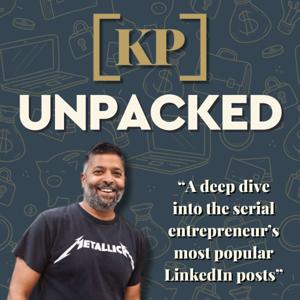
KP Unpacked explores the biggest ideas in AEC, AI, and innovation, unpacking the trends, technology, discussions, and strategies shaping the built environment and…
388 Listeners

1,980 Listeners

1,089 Listeners

111,865 Listeners

56,449 Listeners

8,527 Listeners

9,532 Listeners
65,461 Listeners
46,104 Listeners

10,190 Listeners

29,207 Listeners

15,904 Listeners
10 Listeners
15,960 Listeners