Learning Chinese through Stories

Learning Chinese through Stories

Download on the App Store
  • Favorites

    314

    Followers

  • Typical duration

    10 min

    per episode

Based on Podcast App listening data

Learning Chinese through Stories episodes

  • 2.1.19A 故事《怀素写字》
    How did monk Huaisu become a famous calligrapher? What are the most important rules to follow when practicing Chinese character writing? Check out this story now. 古时候有个叫怀素的和尚。他从小就喜爱写字,是个好学上进的孩子。 怀素写字非常认真。他总是先看清字的形状,记住字的笔顺,再一笔一画照着写。这样,怀素的字进步很快。 传说当时纸贵,怀素就找来一块木板当纸用。他写呀写呀,日子一长,木板竟被写穿了。 怀素长大以后,成了有名的书法家。
    3 min
  • 1.3.19B 故事解读《一次比一次有进步》
    次 cì Noun, time(s) 一次,once 两次,twice 三次,three times 第一次,the 1st time 第二次,the 2nd time 第三次,the 3rd time 比 bǐ Comparison word 他比我高,he is taller than me. 第二次比第一次好,the 2nd time is better than the 1st time. 进步 jìnbù Noun, improvement; verb, to improve 菜园 càiyuán Noun, vegetable garden 冬瓜 dōngguā Noun, winter melon 躺 tǎng Verb, to lie down 地 dì Noun, ground; floor 地上, on the ground; on the floor 茄子 qiézi Noun, eggplant 挂 guà Verb, to hang 枝 zhī Noun, branch \ 枝上,on the branch 屋檐 wūyán Noun, eave 不一样 bù yíyàng Noun, difference; adj, different; 点头 diǎntóu Verb, to nod (one's head) 摇头, to shake head 仔细 zǐxì Adv, carefully; adj, careful 发现 fāxiàn Verb, to discover 皮 pí Noun, skin 细 xì Adj, thin 毛 máo Noun, hair 柄 bǐng Noun, handle; the handle of an eggplant 刺 cì Noun, thorn
    15 min
  • 1.3.19A 故事《一次比一次有进步》
    Practice makes perfect, you always do things better than before if you try one more time! That is also what swallow mom said to her swallow baby. Yícì bǐ yícì yǒu jìnbù Càiyuán lǐ ,dōngguā tǎng zài dì shàng ,qiézi guà zài zhī shàng 。 Wūyán xià ,yànzi māma duì xiǎo yànzǐ shuō :"nǐ dào càiyuán qù ,kànkan dōngguā hé qiézi yǒu shénme bù yíyàng ?"xiǎo yànzi qù le ,huílái shuō :"māma ,māma ,dōngguā dà ,qiézi xiǎo !" Yànzi māma shuō :"nǐ shuō de duì 。nǐ néng bú néng zài qù kànkan ,hái yǒu shénme bù yíyàng?"xiǎo yàn zi yòu qù le ,huílái shuō :"māma,māma ,dōng guā shì lǜ de ,qié zi shì zǐ de !"yànzǐ māma diǎn diǎn tóu ,shuō :"hěn hǎo, kě shì nǐ néng bù néng zài qù zǐxì kànkan ,tāmen hái yǒu shénme bù yíyàng?" Xiǎo yànzi yòu qù le ,huílái gāoxìng de shuō :"māma ,māma ,wǒ fāxiàn dōngguā de pí shàng yǒu xì máo ,qiézi de bǐng shàng yǒu xiǎo cì !"yànzi māma xiào le ,shuō :"nǐ yícì bǐ yícì yǒu jìnbù !" 一次比一次有进步 菜园里,冬瓜躺在地上,茄子挂在枝上。 屋檐下,燕子妈妈对小燕子说:"你到菜园去,看看冬瓜和茄子有什么不一样?"小燕子去了,回来说:"妈妈,妈妈,冬瓜大,茄子小!" 燕子妈妈说:"你说得对。你能不能再去看看,还有什么不一样?"小燕子又去了,回来说:"妈妈,妈妈,冬瓜是绿的,茄子是紫的!"燕子妈妈点点头,说:"很好,可是你能不能再去仔细看看,他们还有什么不一样?" 小燕子又去了,回来高兴地说:"妈妈,妈妈,我发现冬瓜的皮上有细毛,茄子的柄上有小刺!"燕子妈妈笑了,说:"你一次比一次有进步!"
    3 min
  • 1.2.21 诗歌《四季》
    This is a short poem about four season. In the poem, each season is represented by a plant, animal or a symbol. Those plants, animals and symbols will introduce what season it is. 四季 sìjì Noun phrase, four seasons 草 cǎo Noun, grass 芽 yá Noun, bud 尖 jiān Adj, pointed; sharp at the tip 小鸟 xiǎo niǎo Noun, little bird(s) 春天 chūntiān Noun, spring 荷叶 hé yè Noun, lotus leaf 圆 yuán Adj, round 青蛙 qīngwā Noun, frog 夏天 xiàtiān Noun, summer 谷穗 gǔ suì • Noun, beard of a cereal spike 弯 wān Adj, curved; bent Verb, to bend 鞠躬 jūgōng Verb, to bow 秋天 qiūtiān Noun, autumn 雪人 xuěrén Noun, snowman 肚子 dùzi Noun, belly 挺 tǐng Verb, to protrude 顽皮 wánpí Adj, naughty 冬天 dōngtiān Noun, winter 诗歌《四季》 草芽尖尖,他对小鸟说:"我是春天。" 荷叶圆圆,他对青蛙说:"我是夏天。" 谷穗弯弯,他鞠着躬说:"我是秋天。" 雪人大肚子一挺,他顽皮地说:"我就是冬天。"
    2 min
  • 2.1.18 笑话《餐巾纸》
    So a lot of public restrooms in China do not provide toilet paper. Have it ever happened to you that you just had a number 2 but could not find any toilet paper? Check out how this witted Chinese guy handled the emergency... Worksheet questions for this story can be found under the tab "练习题Worksheet" on http://www.learningchinesethroughstories.com 今天上厕所忘带纸了,好在我够机智,打电话说:喂,给我来份外卖啊!外卖小哥说:"好的,请问先生您的地址在哪?"我说:"就在你家店的东边的公厕右手边的第三个坑,记得多带点餐巾纸啊... ——摘自http://www.mahua.com/tags/jingdianxiaohua/ 餐巾纸 cānjīnzhǐ Noun, napkins 白纸,paper 卫生纸,toilet paper 好在 hǎo zài Adv, fortunately 够 gòu "够+adj" means "…enough" 够聪明,smart enough 够了!"Enough!" 机智 jīzhì Adj, witted 份 fèn Measure word for "food delivery" 外卖 wàimài Noun, food delivery 小哥 xiǎo gē Noun, young male who works as delivery guy 地址 dìzhǐ Noun, address 公厕 gōngcè Noun, public restroom Short for 公共厕所 坑 kēng Noun, toilet stall; hole
    11 min
  • 1.3.18B 故事解读《小猫钓鱼》
    Worksheet questions for this story can be found under the tab "练习题Worksheet" on http://www.learningchinesethroughstories.com 带 dài Verb, to take (along with oneself) 河边 hé biān Noun phrase, river bank; river side 蜻蜓 qīngtíng Noun, dragonfly 捉 zhuō Verb, to catch (animals) 空手 kōngshǒu empty hands; with hands empty 蝴蝶 húdié Noun, butterfly 气人 qì rén (this) makes me mad; a complaint to say when one is getting pissed Or 气死人了!气死我了! 着 zháo Resultative particle word, verb +着 means one is able to complete the action with success 一会儿 yí huì 'er Noun phrase, a short period of time; (do something) for a little bit of time When 一会儿 is used consecutively, it usually means one cannot focus on one task. Instead, he/she keeps getting distracted by doing something else. 三心二意 sānxīn'èryì Chengyu, three hearts and two minds. It means someone is of two minds and cannot focus on one task. 一心一意,wholeheartedly.
    12 min
  • 1.3.18A 故事《小猫钓鱼》
    This fable story is about whether one should multitask or not. Kitty went fishing with her mom and she failed to get any fish, even the small ones. Her mom concluded that it was because she could not focus on one task at one time. Worksheet questions for this story can be found under the tab "练习题Worksheet" on http://www.learningchinesethroughstories.com 猫妈妈带着小猫在河边钓鱼。 一只蜻蜓飞来了,小猫看见了,就去捉蜻蜓。蜻蜓飞走了,小猫空着手回到河边,看见妈妈钓着了一条大鱼。 一只蝴蝶飞来了,小猫看见了,又去捉蝴蝶。蝴蝶飞走了,小猫还是空着手回到河边, 看见妈妈又钓着了一条大鱼。 小猫说:"真气人!我怎么一条小鱼也钓不着。" 猫妈妈看了看小猫说:"钓鱼就钓鱼,不要一会儿捉蜻蜓,一会儿捉蝴蝶。三心二意,怎么能钓到鱼呢?" ——摘自人教版语文课本
    4 min
  • 2.2.14B 故事解读《惊弓之鸟》
    Worksheet questions for this story can be found under the tab "练习题Worksheet" on http://www.learningchinesethroughstories.com 古时候 gǔ shíhòu Noun phrase, ancient times 有名 yǒumíng Adj, well-known 射箭 shèjiàn Verb, to shoot an arrow; noun, archery 能手 néngshǒu Noun, a person who is skilled at something 郊外 jiāowài Noun, suburb 打猎 dǎliè Verb, to hunt; noun, hunting 猎人,hunter 大雁 dàyàn Noun, wild goose 远处 yuǎn chù Noun, a faraway place 近处,a nearby place 鸣 míng Verb, (birds) make noise 指 zhǐ Verb, to point 弓 gōng Noun, bow 掉 diào Verb, to fall 本事 běnshì Noun, skill; ability; capability 很有本事 means someone has a lot of connections and can always make things happen. 取 qǔ Verb, to fetch 取钱,withdrawl money 弦 xián Noun, string 响 xiǎng Noun, sound; verb, to ring 拍 Pāi Verb, to flap (wings) 翅膀 chìbǎng Noun, wing(s) 忽然 hūrán Adv, suddenly 半空 bànkōng Noun, mid air 大吃一惊 dàchīyìjīng Verb, to be astonished 吃了一惊;很吃惊 受伤 shòushāng Verb, to get injured 更加 gèngjiā Adv, even more (+adjective) 奇怪 qíguài Adj, strange; weird 悲惨 bēicǎn Adj, miserable 伤口 shāngkǒu Noun, wound 愈合 yù hé Verb, (wound) to heal 作痛 zuò tòng Verb, to feel the pain 同伴 tóngbàn Noun, company; companion 孤单 gūdān Adj, lonely 失群 shī qún Verb phrase, to be away from the group; adj, solitary 拼命 pīnmìng Verb phrase, to risk one's life; adv, desperately 使劲 shǐjìn Verb phrase, to exert one's full strength 裂开 liè kāi Verb, to split open
    28 min
  • 2.2.14A 故事《惊弓之鸟》
    While hunting at suburb, Genglei, a well-known archer from Wei told the king that he could get a flying wild goose without using an arrow. The king did not believe it until he saw what really happened... Worksheet questions for this story can be found under the tab "练习题Worksheet" on http://www.learningchinesethroughstories.com 更羸(léi)是古时候魏(wei4)国有名的射箭能手。 有一天,更羸跟魏王到郊外去打猎。一只大雁从远处慢慢地飞过来,边飞边鸣。更羸指着大雁对魏王说:"大王,我不用箭,只要拉一下弓,这只大雁就能掉下来。" "是吗?"魏王信不过自己的耳朵,问道,"你有这样的本事?" 更羸说:"请让我试一下。" 更羸并不取箭,他左手拿弓,右手拉弦(xian2),只听得嘣(beng1)的一声响,那只大雁直往上飞,拍了两下翅膀,忽然从半空里直掉下来。 "啊!"魏王看了,大吃一惊,说:"真有这样的本事!" 更羸笑笑说:"不是我的本事大,是因为我知道,这是一只受过箭伤的鸟。" 魏王更加奇怪了,问:"你怎么知道的?" 更羸说:"它飞得慢,叫的声音很悲(bei1)惨(can3)。飞得慢,因为它受过箭伤,伤口没有愈(yu4)合,还在作痛;叫得悲惨,因为它离开同伴,孤单失群,得不到帮助。它一听到弦响,心里很害怕,就拼命往高处飞。它一使劲,伤口又裂开了,就掉了下来。" ——摘自人教版语文课本三年级下册
    5 min
  • 2.3.7B 故事解读《掌声》
    文静 wénjìng Adj, quiet (describe girls only) 默默 mòmò Adv, silently 一角 yìjiǎo Noun, one corner 角落, corner 早早 zǎozǎo Adv, early We don't say晚晚 for late. 小儿麻痹症xiǎo'ér mábì zhèng Polio 患有小儿麻痹症or 得了小儿麻痹症 落下 làoxià Verb, a problem was caused by a disease and it never goes away 腿脚落下了残疾 (her) legs and feet were left handicapped because of the disease 残疾 cánjí Adj, handicapped 残疾人,handicapped people 愿意 yuànyì Verb, to be willing to do… 姿势 zīshì Noun, posture 轮流 lúnliú Verb, to take turns 讲台 jiǎngtái Noun, teacher's stage 舞台,stage 轮到 lún dào Verb phrase, (the turn) goes to …; it is someone's turn 轮到你了! It is your turn! 目光 mùguāng Noun, sight 一齐 yìqí Adv, altogether 投向 tóuxiàng Verb phrase, (eyes) look towards 立刻 Lìkè Adv, immediately Or 马上 调 diào Verb, assign (someone to work at…) 把王老师调到这个学校来。Assign Wanglaoshi to this school. 情况 qíngkuàng Noun, situation 犹豫 yóuyù Adj, hesitant 慢吞吞 màn tūn tūn Verb, slowly 吞吞吐吐,to mutter and mumblr 眼圈 yǎnquān Noun, circles of eyes 注视 zhùshì Verb, to watch with respect 一摇一晃 yìyáo yíhuàng Verb phrase, to stagger 站定 zhàn dìng Verb phrase, to stand still 一刻 yíkè Noun, that exact moment 这一刻,this moment 那一刻,that moment 骤然间 zhòurán jiān Adv, suddenly 响起 xiǎngqǐ Verb phrase, (a sound) starts to raise 掌声 zhǎngshēng Noun, applause 热烈 rèliè Adv, warm; enthusiastic; heartily 持久 chíjiǔ Adj, long-lasting 泪水 lèishuǐ Noun, tears 流 liú Verb, to flow 渐渐 jiànjiàn Adv, gradually 平息 píngxī Verb, to settle; to quieten 镇定 zhèndìng Verb, to calm down; adj, calm 情绪 qíngxù Noun, emotion 讲述 jiǎngshù Verb, to tell/ narrate (a story) 普通话 pǔtōnghuà Noun, mandarin Chinese 动听 dòngtīng Adj, beautiful (voice, music, story and others) 深深 shēn shēn Adv, deeply 鞠躬 jūgōng Verb phrase, to take a bow 鞠了一躬,to take a bow; 三鞠躬,to take the third bow 从那以后 cóng nà yǐhòu From then on 像……似的 xiàng……shì de Seem like…; look like… 圆圆的月亮像盘子似的。The round moon looks like a plate. 忧郁 yōuyù Adj, sad; upset; gloomy 甚至 shènzhì Adv, even 联欢会 liánhuān huì Noun, celebration party 来信 láixìn Verb, (someone) sends a letter 永远 yǒngyuǎn Adv, forever 歧视 qíshì Verb, to discriminate 极大 jí dà Adj, very big 鼓励 gǔlì Verb, to encourage 鼓起勇气 gǔ qǐ yǒngqì Verb, to pluck up one's courage; to summon up one's strength 微笑 wēixiào Verb, to smile 面对 miàn duì Verb, to face 生活 shēnghuó Noun, life

    33 min

About Learning Chinese through Stories

From the publisher's feed

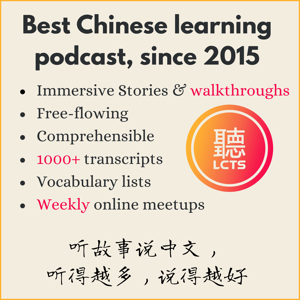
Using more than 99% target language, LCTS听故事说中文 creates authentic and immersive Chinese language podcast. It covers a wide range of topics and proficiency levels(Novice, Intermediate, Advanced). Every…

Best of Learning Chinese through Stories

Ranked by our users in the last 21 days

More shows like Learning Chinese through Stories

Learn Mandarin Chinese  - Chinese Audio Lessons by Melnyks Chinese

Learn Mandarin Chinese - Chinese Audio Lessons

624 Listeners

All Ears English Podcast by Lindsay McMahon and Michelle Kaplan

All Ears English Podcast

2,274 Listeners

Coffee Break Chinese by Coffee Break Languages

Coffee Break Chinese

167 Listeners

Speak Chinese Naturally -Learn Chinese (Mandarin) by Speak Chinese Naturally

Speak Chinese Naturally -Learn Chinese (Mandarin)

98 Listeners

Chillchat (Learn Chinese and Chill) by Chilling Chinese

Chillchat (Learn Chinese and Chill)

219 Listeners

ChinesePod - Beginner by ChinesePod LLC

ChinesePod - Beginner

95 Listeners

大鹏说中文 - Speak Chinese with Da Peng by Da Peng

大鹏说中文 - Speak Chinese with Da Peng

41 Listeners

ChinesePod - Intermediate by ChinesePod LLC

ChinesePod - Intermediate

75 Listeners

聊聊东西 - Talk to Me in Chinese by Candice X

聊聊东西 - Talk to Me in Chinese

76 Listeners

Listening Time: English Practice by Sonoro |  Conner Pe

Listening Time: English Practice

554 Listeners

MaoMi Chinese by MaoMi Chinese

MaoMi Chinese

56 Listeners

TeaTime Chinese 茶歇中文 by Nathan Rao

TeaTime Chinese 茶歇中文

86 Listeners

Sunhuyn Podcast by Sunhuyn

Sunhuyn Podcast

62 Listeners

五分钟中文 5 Minute Chinese by The Lone Mandarin Teacher

五分钟中文 5 Minute Chinese

13 Listeners

TED中文 by TED

TED中文

17 Listeners