
Sign up to save your podcasts
Or



Based on Podcast App listening data
Officials from Hamas and Israel have come together on the initial framework of a ceasefire agreement. In the first phase, Israeli and Palestinian hostages will be released next week. Other details, such as disarmament of Hamas, governance of Palestine, and the removal of Israeli forces from the Gaza Strip remain to be seen. President Trump celebrated the agreement and pronounced “lasting peace” in the Middle East, but is that premature?
Political violence on the left continues to be a focus of the Trump administration in the wake of Charlie Kirk’s killing. The White House has accused massive anti-ICE protests of being connected to large networks of left-wing nonprofits and donors. Is there legitimacy to those claims? Or is the administration silencing any opponents?
Global superstar Bad Bunny was announced as the halftime entertainment for this season’s Super Bowl. The artist, whose music is predominantly in Spanish, previously avoided touring in the USA after concerns that his concerts would be targeted by ICE raids. In response to the announcement, Homeland Security Secretary Kristi Noem said that ICE would be present at the NFL’s signature event. But are agents there for law enforcement or other motives?
The federal government shut down this week, leaving thousands of federal employees furloughed. Families who depend on WIC and SNAP could also be at risk if the shutdown prolongs. Since President Trump took office, thousands of federal employees have faced layoffs or resigned themselves. Conversations around a government shutdown brewed in March, but the final straw for Democrats may have been in August. That was when Russell Vought, director of the Office of Management and Budget, said the House of Representatives would withhold $4 billion previously allocated for foreign aid. Trump blames Democrats for the shutdown. Which party will get their desired outcome here?
Ezra Klein, a New York Times opinion writer, said that a shutdown may be exactly what Democrats need to regain power of the legislative branch. But could it jeopardize the party’s political future?
Also this week, President Trump and Defense Secretary Pete Hegseth gathered global military leaders in Quantico, Virginia, sharing their visions for the newly-named Department of War. This comes after 200 National Guard troops were sent to Portland, Oregon because Trump said the city looked like “World War II.” How do active and retired military members feel about orders to enforce the law in American cities?
Since taking office, President Trump has vowed to seek political vengeance on his opponents. He followed up on this by asking Attorney General Pam Bondi to prosecute former FBI Director James Comey, New York Attorney General Letitia James, and Democratic Senator Adam Schiff. Senator Ted Cruz expressed concerns that all this could potentially impact the GOP down the line. How has political retribution defined our current era of politics?
President Trump has advised pregnant mothers to stop taking Tylenol because he believes it could lead to autism in children — despite no scientific proof. Similarly, Health and Human Services Secretary RFK Jr. strongly opposes vaccines, and claims they’re also linked to autism. He says that moms who share this belief have been silenced and marginalized. Is the pushback on vaccines a reaction to how regulatory agencies like the CDC handled the COVID-19 pandemic?
This week, a listener asked the Left, Right, and Center panel how to navigate conversations with people we deeply disagree with.
After the assassination of right-wing activist Charlie Kirk, both Republicans and Democrats called for unity and understanding — but polarizing rhetoric has continued to escalate. President Trump, Vice President JD Vance, and other White House officials have vowed to target the “radical left” for being politically violent. Democratic officials have warned that the White House may try to use the assassination to suppress speech. Those fears may have been realized when ABC was threatened over late-night host Jimmy Kimmel’s comments about conservatives’ reaction to Charlie Kirk’s killing. Brendan Carr, the chairman of the Federal Communications Commission, pressured the network to pull Kimmel off the air indefinitely. How do Americans feel about a government agency censoring speech that they don’t agree with? Whose responsibility is it to turn down the temperature when it comes to rhetoric and polarization?
David Greene worked with country singer Ketch Secor of the band Old Crow Medicine Show to produce a music documentary called Louder Than Guns. Greene spent time with Secor, touring across the country and hearing Americans’ reflections on gun violence and gun rights. When FOX News host Trey Gowdy said that Americans should have a conversation about preventing more gun violence, his fellow conservatives said he should be ashamed. How do we stop talking past each other during conversations about guns and create an open dialogue?
Are Americans too enraged by each other to ever experience unity? This week, a listener asked Left, Right and Center about America’s history of political violence and if our panel thinks anything has changed.
Charlie Kirk, a conservative activist and commentator, was shot and killed while hosting an event at Utah Valley University on Wednesday. Utah Governor Spencer Cox says it was a political assassination. Kirk, 31, co-founded the conservative youth organization, Turning Point USA, when he was 18. His visit to Utah Valley University was the kick-off for his “American Comeback Tour,” during which he planned to host political debates on college campuses across the country. President Trump announced Kirk’s death on Truth Social, and later said his death was a result of “radical left political violence.” A string of political violence has broken out in America over the past few years, from the January 6, 2021 insurrection to two assassination attempts on President Trump. What’s the path to ending political violence and the extreme rhetoric that leads to it?
As for overseas conflicts, President Trump claims he’s stopped several of them, such as Thailand and Cambodia’s, and Armenia and Azerbaijan’s. But as war continues in Gaza and Ukraine, is Trump’s strategy to bring global peace effective? Do Democrats have better ideas?
This week, a listener asked Left, Right, and Center about three problems he thinks the left struggles with. Our panel discusses those issues and whether they can be solved.
The Trump administration announced that it will withhold $5 billion in foreign aid that Congress had already allocated. The “pocket rescission” is Office of Management and Budget Director Russell Vought’s latest move to give the executive branch control over America’s spending. House Democrats call it an unlawful attack on Congress’ power of the purse. The Trump administration has also imposed tariffs and selected U.S. attorneys without congressional approval. How can Congress take back its power? Will Democrats and Republicans work together to prevent a shutdown before federal funding runs out at the end of the month?
The Johnson Amendment (1954) allowed the IRS to remove tax-exempt status from charitable organizations and churches if they endorsed political candidates. Although some outspoken faith leaders disregarded the rule and received no retribution from the IRS, the Trump administration has now created an official carve-out for churches to endorse candidates and keep their tax-exempt status. Proponents of the Johnson Amendment, like including the 1,000 nonprofits that signed a community letter supporting nonpartisanship, believe that the law prevented churches from becoming political agents manipulated by anonymous donors’ tax-free gifts. Others, like the National Religious Broadcasters, say the Johnson Amendment infringed on their First Amendment rights. Will this new leeway degrade the role of churches as nonpartisan centers of community?
Third Way, a left-wing think tank, released a memo urging Democrats to leave behind language they believe repels voters. The list includes words such as “privilege,” “systems of oppression,” “birthing person,” and “Latinx.” The right has expressed disdain with “wokeness” and language policing.
Progressives adopted these terms to be more inclusive and empathetic, but are they having the opposite effect?
National Guard troops have been on the streets of Washington D.C. for about two weeks, and in June, they were deployed to Los Angeles during anti-ICE protests. Now, President Trump is threatening to send them to Chicago, which he calls a “killing field.” Some Americans are embracing Trump’s expanded use of the National Guard, while others call him a dictator. According to the Chicago Police Department, homicides have dropped by 31% and shootings by 36% compared to last year, but do lower crime rates actually make Americans feel safer? Will militarized streets bring more security or just the semblance of it?
People in Eagle Pass, Texas, say they feel safer after state and federal officials worked to limit illegal crossings in the border community. But in places like Los Angeles, ICE raids have left some Americans anxious and worried for local immigrants. As President Trump brings his promises on immigration to fruition, will the idea of safety be different in communities like these?
Transgender athletes competing in amateur sports became a lightning rod for debates on LGBTQ+ rights and inclusivity. President Trump captured the fervor of those debates during the election and with several executive orders upon his return to the White House. His administration has sought to sort competitors by their biological sex rather than how they identify. Those who support the ban see it as a way to protect children, but does one group’s sense of safety have to be at the expense of another?
President Trump says he wants to end mail-in voting and voting machines. The Constitution outlines that state governments manage their elections, but in a post on Truth Social, Trump said that the states simply serve as agents for the federal government. "They must do what the Federal Government, as represented by the President of the United States, tells them, FOR THE GOOD OF OUR COUNTRY, to do," he wrote. Any change to the way Americans vote would need congressional approval. The president has already pushed to solidify a Republican majority in Congress by supporting the redrawing of congressional maps in Texas. That new map could add another five seats for the GOP in the House.
Could the president use that majority to end voting by mail? What are the implications of this for American democracy and states’ rights over elections?
National Guard troops are still patrolling the streets of Washington D.C.
When Vice President JD Vance, Defense Secretary Pete Hegseth, and White House Deputy Chief of Staff Stephen Miller visited National Guard troops at D.C.’s Union Station, they faced protestors shouting, “Free D.C.” Miller heckled the activists and said they would compel the administration to ramp up their efforts. Is Trump's use of National Guard troops simply a temporary demonstration of power, or should Americans be concerned that militarized cities will become the norm?
In a room full of merchandise near the Oval Office, shelves are lined with “Trump 2028” hats. President Trump gifted some of them to world leaders. The possibility of running for a third term is something Trump has teased since the early days of his second term. Is he just trolling, or should Americans take it seriously?
President Trump promised to address crime in Washington, D.C. following an attack on a former DOGE employee. This week, the president put his plan into action. He ordered the deployment of 800 National Guardsmen to patrol the District. The guardsmen will be joined by members of a number of federal agencies. Is there more to the president’s decision than enforcing law and order?
The president will shift his focus from D.C. to Anchorage, Alaska and a meeting with Russian leader Vladimir Putin. The two leaders are scheduled to discuss possible next steps towards an end to the war in Ukraine. Can president Trump negotiate peace without conceding to Russian demands?
The Trump administration has worked to push America’s cultural institutions further to the right. But can that shift expand past the halls of power? Is American society really growing more conservative?
President Trump fired the commissioner of the Bureau of Labor Statistics (BLS), Erika McEntarfer, after the organization released its July jobs report. Trump claimed that several reports under McEntarfer had been manufactured to hurt him and his economic agenda. But will the firestorm around the jobs report hurt the credibility of the next commissioner?
A pair of House members have called out their respective parties in the last week. Republican Marjorie Taylor Greene and Democrat Sarah McBride shared their critiques on how the parties were spurning voters. Will anyone else in Congress listen?
It may be hard to believe, but journalists mess up too. KCRW responds to a listener's comment calling out a critical mistake as we continue to discuss ways to restore journalistic credibility.
From the publisher's feed
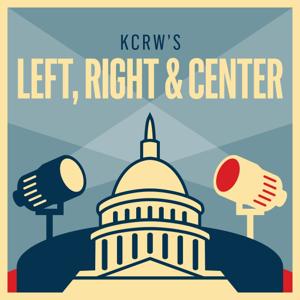
Left Right & Center is for listeners who feel like people on the other side of the political divide are on Mars. David Greene pieces together the big picture by inviting people from…
You might not always agree – you might even get angry – but you’ll know why you feel the way you do. No knee-jerk reactions or name calling. This show doesn’t promise easy answers or warm fuzzies; it promises more clarity for the chaotic political era we’re all living through.
Ranked by our users in the last 21 days

25,950 Listeners

579 Listeners

9,168 Listeners

8,488 Listeners

4,075 Listeners

3,481 Listeners

1,281 Listeners
623 Listeners

669 Listeners

1,108 Listeners

537 Listeners

153 Listeners

112,234 Listeners

737 Listeners
1,907 Listeners

7,114 Listeners

5,714 Listeners

3,932 Listeners

3,364 Listeners

16,209 Listeners

10,852 Listeners

457 Listeners
422 Listeners

598 Listeners