
Sign up to save your podcasts
Or



Send us your feedback!
Most people are, in effect, falling off one side of the horse, whilst pushing their torso towards his midline on the other side.
My most dramatic story about this concerns a Grand Prix rider, whose horse’s apparent problem with piaffe turned out to be her problem.
There are 3 particularly important points on the boards, and thinking about these can help you transmit force more effectively from your back to your front, as you link them together with an imaginary series of bolts. These also change how your arms connect to your core, how your diaphragm might or might not be 'level', and how your pelvis can have more or less lightness and narrowness.
I also explore how you can imagine your boards from top to bottom, using this to clarify and strengthen them.
Send us your feedback!
The idea of ‘positive tension’ is very new in the horse world, but I am no longer the lone voice crying in the wilderness!
As well as force absorption, we need force transmission, which enables the most important ‘myofascial lines’ in the body to ‘play a note’ in the same way that only a well-tensioned guitar string can play a note. This puts more ‘ping’ into each step, taking away the trudging heaviness of a 'soggy' net.
I offer some images to help you discover how to firm up your soggy places, and tell a story of how a soggy ‘unstuffed’ horse can lead to a soggy unstuffed rider, and how change in one of them changes the other.
We then review the ‘boards exercise’, which shows you how to increase the tone and stability in your torso.
Send us your feedback!
One of the biggest over-views of the work I do would be to consider it the re-discovery and re-creation of the ideal shapes our bodies would make.
We can think of both human and horse torsos as rectangles that have become distorted into’C’ curves, or parallelograms, and that have, in addition, become twisted.
I compare the learning process to making a quilt, where different pieces get sown together, progressively making a larger whole in which various patterns become clear.
This leads me to talk about our ‘inner quilt’, the fascial net, which is a three dimensional spider's web of connective tissue, permeating our muscles, tendons and ligaments, our organs (along with the slings, bags and straps that hold them in place) and even our bones. The pulls within this can lead to restrictions in movement, and chronic pain. But the fascial net is also the source of our feel sense, and as we unravel it, the changes we create can benefit us in life as well as riding.
Send us your feedback!
I'm back after a long break from podcasts!
I'm sharing the stories of three riders who were all very different types of learners, using strategies that worked more or less well for creating change.
One of the stories introduces the idea of 'un-believing' things you have previously been told and have taken for granted - simply assuming that you must be doing the right thing because you are attempting to embody words you’ve been told.
Each of the stories has a moral, and I’ll let you decide what that moral is, and how relevant it is to your own learning! The stories also beg the question of how much coaches and trainers expect riders to learn and improve in lessons, and how much they ‘go through the motions’ without expecting much change to happen.
Send us your feedback!
We do two more exercises, as I encourage you to realise the immense value of the off-horse exercises that are part of my approach to learning and coaching. We then revisit some more of the common traps in learning, before focussing in on ‘flow’. This experience/brain state more than doubles your rate of learning, and makes it so much more fun. That fun is based on brain chemistry of small wins, and that in turn is based on noticing. I finish by quoting T. S. Eliot: ‘We shall not cease from exploration, and the end of all our exploring will be to arrive where we started, and to know the place for the first time.’ This is my wish for you.
Send us your feedback!
I was right all of those years ago when I thought there was something my teachers weren’t telling me! But this is innate in the human condition, where we pass through conscious competence before we become unconscious of our incompetence, and no longer have words to describe our skill. My aim is to stay conscious enough to remember feelings and words, and to leave a trail for others to follow. This podcast contains my main tips for enhancing your learning, beginning with ‘seek out good information’…
Send us your feedback!
We have talked about asymmetry patterns being rotational, but it can be more helpful - and with some riders more accurate - to think of one third of the body being sheared forward, whilst the other is sheared back. This distinction suggests some new pushes and pulls on the saddle (or furniture) which help to mitigate it. It also leads us to think about how we transition from ‘turning like a bus’ to ‘bend’. A lot is presupposed in the concept of ‘bend’, which is so often misrepresented like a simple skill rather, than the sophisticated strategy it really is.
Send us your feedback!
One of my pupils broke her upper arm in a fall, and damaged her wrist and elbow. After surgery and recuperation she returned to riding, and found herself with a total reversal in her asymmetry! This very rarely happens, and the story of how we worked with it is illuminating. It also provides a good review of the basic principles of how an asymmetrical human interacts (for good or ill) with an asymmetrical horse!
Send us your feedback!
Many riders spend their life stuck in ‘one side on/one side off’. Others ‘ping-pong’ between right on/left off and left on/right off. Few people discover how to get ‘both sides on’ consistently. Once they have this, they can learn how to make a wider, higher, more supportive long back muscle on the side where the horse would only have a ‘sloping roof’. We do an exercises to show you how this profound level of influence works, and another to get you clearer about the anatomy of your underneath, and the part of it that sits across those long back muscles.
Send us your feedback!
Most people have a strength differential between their two boards, and don’t address this well - so as the weaker one becomes stronger, the stronger one gets in on the act and also gets stronger! But ‘bad sides’ do eventually become ‘good sides’, leaving the rider very confused. Ideally any asymmetry fix would involve both sides of the body, but the rider’s limited ‘brain space’ might make this impossible for a long time.
The horse has two boards and three thirds just like the rider. If he were symmetrical, sitting on him would be like sitting on an oil drum, but he may have one long back muscle that’s like a flat roof whilst the other is like a sloping roof. The issues of steering are not yours alone - the sloping roof temps your seat bone on that side to slide away from the midline.
From the publisher's feed
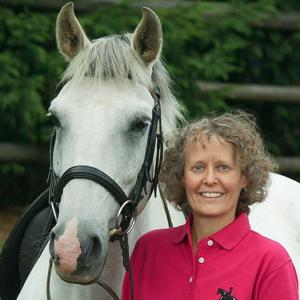
MARY WANLESS presents crucial information on how the Ride With Your Mind approach to Rider Biomechanics can transform your learning, your riding, and possibly your life.
Out…
In these podcasts, Mary talks about her journey to date, her key discoveries, and some pivotal moments. She illuminates her key points with metaphor and story, and, at times, presents insights derived from sports psychology.
Prepare to be entertained, to learn, to become curious, and to understand a little (or maybe a lot) more about your interaction with your horse. Check out these podcasts, and visit www.dressagetraining.tv for information about their vast library of online courses and webinars, presented by Mary and her Ride With Your Mind colleagues.
Ranked by our users in the last 21 days
107 Listeners

8 Listeners

6,603 Listeners
348 Listeners
448 Listeners
30 Listeners
25 Listeners
213 Listeners

48 Listeners

75 Listeners

18,831 Listeners
89 Listeners

35 Listeners

49 Listeners
70 Listeners