
Sign up to save your podcasts
Or



Based on Podcast App listening data
In today’s episode, we talk with special educator Katie Overstreet, who responded to a social media post with unwavering belief in her students and a can-do attitude. Her response stood out to us for so many reasons… such as the tangible ways she removes barriers for her students and her use of scaffolding techniques to support access to rigorous texts and tasks.
Katie’s candid conversation illuminates the transition to high quality instructional materials and why teachers and students can ‘trust the process.’
Visit OUR WEBSITE to subscribe to our newsletter and podcast! https://www.literacypodcast.com/
Connect with Melissa & Lori:
Looking for more literacy support and resources? Explore all of our podcast episodes, free listening guides, and classroom tools at literacypodcast.com.
Interested in bringing Melissa & Lori Love Literacy to your school or event? Email us at [email protected].
Natalie Wexler once said that parents are the sleeping giants in this reading science movement. The parents in Minneapolis Public Schools are awake and ready! They are passionate, informed advocates who developed a coalition of families willing to speak out and say, “Our kids deserve access to structured literacy. Less than 50% of students read at grade level.” Thus, the MPS Academics Advocacy Group was born. Recently, the superintendent of schools, a proponent of balanced literacy approaches, almost lost his job over the state of literacy in Minneapolis. Read more about it and watch it here.
However, the article that caught our attention was posted in The 74, titled A New Kind of Curriculum Night: Armed With Protest Signs and Data, Diverse Group of Minneapolis Parents Demands Better Reading Instruction for Their Kids. Listen to learn about what’s happening in the Minneapolis Public School system for students and families.
Visit our website and subscribe to our newsletter.
Follow us!
Looking for more literacy support and resources? Explore all of our podcast episodes, free listening guides, and classroom tools at literacypodcast.com.
Interested in bringing Melissa & Lori Love Literacy to your school or event? Email us at [email protected].
Sheeba Jacob’s blog post caught our attention when she wrote, “While I could see myself in some of these books because of universal experiences like grief and love, limiting the reading experience to a few specific voices subconsciously taught me that only certain voices mattered.”
Two things are true: Texts are at the core of literacy instruction with our students, and the world is our school. How can we engage students by helping them see themselves and the world through texts? Sheeba’s Achieve the Core blog post, titled Helping Our Students See Themselves and the World Through the Books They Read in Our Classrooms: The impact of text selection on students, shares tips that educators can consider and implement.
A few tips include “...a) getting to know who they [students] are and what they care about, b) providing them mirrors of who they are and windows into other worlds through the literature they read, and c) engaging them in conversations about the world around them and the events impacting humanity. Ask them what they want to read about, allow them to question injustices occurring throughout the world, have them write autobiographies about their lives, celebrate their stories and larger histories, make their identities come alive in class the way schools should do for students.”
Additional resource mentioned:
Sheeba’s Spotify EP Let the Magic In
Visit OUR WEBSITE to subscribe to our newsletter and podcast! https://www.literacypodcast.com/
Connect with Melissa & Lori:
Looking for more literacy support and resources? Explore all of our podcast episodes, free listening guides, and classroom tools at literacypodcast.com.
Interested in bringing Melissa & Lori Love Literacy to your school or event? Email us at [email protected].
In this episode, Lindsay Kemeny, 2nd grade teacher, gives a deep dive into her evidence-based, small group instruction time. Her journey to the science of reading was necessary and life altering. It led her to clarity on structured, systematic approaches to teaching reading. She discusses informal and formal assessments, how she uses data to determine small groups, and center options for practicing reading and writing. Her best advice? KEEP. IT. SIMPLE!
After reading this recent blog by Tim Shanahan, we couldn’t resist asking her about sound walls and how her students use them in her classroom. She shares, “The sound wall is not the main event in my classroom… structured literacy is the main event. The sound wall is a reflection of what’s happening in the classroom.”
We discussed the following resources:
Visit our website and subscribe to our newsletter.
Follow us!
Looking for more literacy support and resources? Explore all of our podcast episodes, free listening guides, and classroom tools at literacypodcast.com.
Interested in bringing Melissa & Lori Love Literacy to your school or event? Email us at [email protected].
In this episode we talked with UnboundED’s Brandon White and Alice Wiggins about the Equitable ELA Instruction Concept Paper.
In our conversation, we’ll discuss effective and equitable instruction and the most efficient path to access it. This requires us, as educators, to do three things:
Alice mentions this scaffolding resource - head to our website and click on We Recommend to download it.
Visit OUR WEBSITE to subscribe to our newsletter and podcast! https://www.literacypodcast.com/
Connect with Melissa & Lori:
Looking for more literacy support and resources? Explore all of our podcast episodes, free listening guides, and classroom tools at literacypodcast.com.
Interested in bringing Melissa & Lori Love Literacy to your school or event? Email us at [email protected].
Kory Jensen is a 4th grade teacher in Colorado, obsessed with learning more about reading science! He read The Knowledge Gap by Natalie Wexler… which set him off to learn more about knowledge building.
On today’s podcast, he talks about how background knowledge impacts his students’ comprehension and engagement (spoiler alert: they love going deep into topics!). He provides real-life examples and ways to supplement knowledge on topics through experiences, experiments, texts, videos, and more. Kory’s optimism shines through and we can’t get enough of his lifelong learner spirit. “When you build knowledge and give students opportunities to learn, you’ll be impressed by what they can do.” Thanks, Kory!
Visit OUR WEBSITE to subscribe to our newsletter and podcast! https://www.literacypodcast.com/
Connect with Melissa & Lori:
Looking for more literacy support and resources? Explore all of our podcast episodes, free listening guides, and classroom tools at literacypodcast.com.
Interested in bringing Melissa & Lori Love Literacy to your school or event? Email us at [email protected].
Today we talk with author and professor Dr. Morgan Polikoff. His first book, Beyond Standards: The Fragmentation of Education Governance and the Promise of Curriculum Reform, provides insights along the rocky road of standards in education. The goal of the standards movement is consistency, as page 39 states, “consistency in instruction across classrooms, across grades, across schools and districts. Consistency that ensures that all students receive instruction that is high quality…” Morgan is an advocate for high quality curriculum in every classroom, as a first step in implementing education reform.
Visit our website and subscribe to our newsletter.
Follow us!
Looking for more literacy support and resources? Explore all of our podcast episodes, free listening guides, and classroom tools at literacypodcast.com.
Interested in bringing Melissa & Lori Love Literacy to your school or event? Email us at [email protected].
Francine Grannell and John Lawrence, leaders from Skaneateles School District, share how they narrowed their focus to strategically support teachers and students with year one Wit & Wisdom ELA implementation. Educators used NY State Briefs (like this one on Complex Texts) to understand and thoughtfully engage in research-based practices within the curricula.
District and school leaders provided wraparound strategic support for teachers: professional learning communities, horizontal and vertical planning time, and collaboration and resources. In turn, teachers felt more empowered to discuss deeper questions than ever before. They held strong with a “trust the process” mantra, modeled a learner-mindset, and reflected on their successes and challenges to grow stronger heading into year two.
Visit OUR WEBSITE to subscribe to our newsletter and podcast! https://www.literacypodcast.com/
Connect with Melissa & Lori:
Looking for more literacy support and resources? Explore all of our podcast episodes, free listening guides, and classroom tools at literacypodcast.com.
Interested in bringing Melissa & Lori Love Literacy to your school or event? Email us at [email protected].
Mitchell Brookins, education consultant extraordinaire (and one of the moderators of the wildly popular Facebook group Science of Reading - What I Should Have Learned in College) talks with us about this article, titled Teaching Reading to African American Children: When Home and School Language Differ by Julie A. Washington and Mark Seidenberg.
We know that reading depends on spoken language. How do language variants affect how we teach reading to African American students? What are key features of African American English (AAE)? How does AAE differ from General American English (GAE)? How do we utilize this information as practitioners to empower our students? Listen and learn with us!
Visit our website and subscribe to our newsletter.
Follow us!
Looking for more literacy support and resources? Explore all of our podcast episodes, free listening guides, and classroom tools at literacypodcast.com.
Interested in bringing Melissa & Lori Love Literacy to your school or event? Email us at [email protected].
“I just thought kids learned how to read… and my daughter didn’t. She could identify 4 letters by the end of kindergarten .” Katie Hickerson's daughter, Cora, went from a joyous little one to a child with lots of big feelings after starting school, saying she felt stupid.
Katie pulled Cora out of school to be homeschooled - providing structured literacy instruction alongside rigorous tutoring through the International Dyslexia Association. In less than two years, Cora went from meeting a 1% reading benchmark to 92% and was back to herself - full of joy, laughter, and confidence.
How can parents (and educators) support the reading science movement? Listen and learn!
Visit OUR WEBSITE to subscribe to our newsletter and podcast! https://www.literacypodcast.com/
Connect with Melissa & Lori:
Looking for more literacy support and resources? Explore all of our podcast episodes, free listening guides, and classroom tools at literacypodcast.com.
Interested in bringing Melissa & Lori Love Literacy to your school or event? Email us at [email protected].
From the publisher's feed
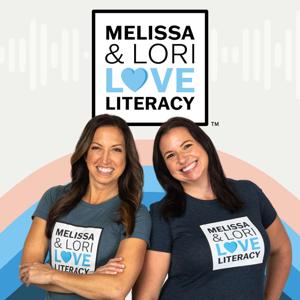
Melissa & Lori Love Literacy® is a science of reading podcast for teachers who want to understand how reading really works and what that means for classroom instruction.
Each month,…
Ranked by our users in the last 21 days
57 Listeners
640 Listeners
49 Listeners
206 Listeners
205 Listeners
132 Listeners
61 Listeners
7,716 Listeners
82 Listeners

25 Listeners

50 Listeners
176 Listeners
44 Listeners
41 Listeners

54 Listeners