
Sign up to save your podcasts
Or

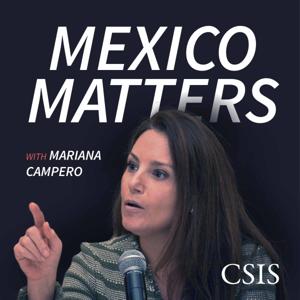


In this episode, Mariana speaks with Juan Carlos Baker, former USMCA negotiator and Director General for North America at the Ministry of the Economy, about the impact tariffs have had on Mexico and how they have served President’s Trump goal of curbing the flow of fentanyl into the U.S. They also discuss why 83% of Mexican exports are currently being exempted from tariffs, the consequences of the U.S. signing agreements with Japan, Europe, South Korea before its largest trading partner, and the unintended (or intended) consequences for North American automobile manufacturers who are still subject to 25% tariffs. They also offer a factual description behind Chinese exports and investments in Mexico and on how Mexico has been in breach of USMCA.
In this episode, Mariana speaks with former Supreme Court Minister, Jose Ramon Cosío about the implications of the judicial constitutional reform pushed by President Claudia Sheinbaum and passed by Mexico’s Congress. The reform effectively kills the independence of all local, state, and federal judges as they now must go through elections like any other local, state, or federal politician. Under the new laws, approximately 2,000 judges have been fired and are being replaced by those recently elected out of a pool of approximately 7,700 candidates. Mariana and Jose also discuss the likelihood of the new laws benefiting organized crime organizations, foreign governments, or specific interest groups—or any other group with enough resources to support specific candidates. They speak about how these new laws are also a reversal to the rule of law and how the lack of certainty will hurt Mexico’s attractiveness as an investment destination, both national and international.
In this episode, Mariana speaks with Dr. Ryan Berg, director of the Americas Program at CSIS, about China’s increased presence in Latin America, transforming itself from a distant economic partner into a central player in Latin America’s trade, infrastructure, and key strategic technology sectors.
They also discuss how the new Trump Administration appears to be abandoning a policy of strategic neglect and is turning its attention towards the region. In addition, they discuss how Latin American countries don’t want to pick between the two biggest world economies and how the US can solve this dilemma by offering private-public partnerships in key strategic sectors.
Lastly, they analyze how various Latin countries are following the US in raising tariffs to protect their own industries from Chinese overcapacity, and why Mexico must live up to its commitment and start tracking Chinese investment in the country, particularly in sensitive areas to maintain the trust of the Trump Administration.
In this episode, Mariana speaks with Alan Bersin, former U.S. Attorney for the Southern District of California and US Border Czar under President Obama and Luis Rubio, a leading Mexican political analyst, Chairman of the think tank Mexico Evalua. They discuss the impact of President Trump’s migration policies at the border and on the Mexican side, analyze the potential benefits of designating Mexican cartels as terrorist organizations, and discuss the need to increase security cooperation between the two countries. They also speak about the importance for the Mexican government to take a proactive approach in the issues of migration, security, and trade when negotiating with the United States and break down the many challenges that the Sheinbaum Administration is facing—externally and internally—to create the conditions for the country to grow.
In this episode, Mariana speaks with Pedro Pullen Parente, a remarkable Brazilian public servant and businessmen. Pedro was previously Minister of Planning, Chief of Staff, Minister of Mines and Energy under President Cardoso. He was also the CEO of Petrobras, ran Bunge Brazil, and was the CEO of BRF, one of the world’s largest food companies
Mariana and Pedro speak about the pros and cons of Brazil’s protectionist economic model. The model might serve as a vision for President Trump as high tariffs, local content requirements, and many other non-market barriers have allowed Brazil to protect its manufacturing sector and jobs while also lowering competitiveness and protecting vested interests.
They also discuss how choosing between the United States and China may not be beneficial to countries like Brazil as well as the likelihood that Brazil might benefit from the current trade war as increased food productivity in the country will allow it to increase supply. However, they emphasize how the only way for Brazil to reach its potential is to focus on removing its own internal barriers to competition and free markets, not the other way around.
In this episode, Mariana speaks with Luis de la Calle, renowned economist, former NAFTA negotiator and the CEO of CMM Asociados. They discuss the future of globalization, the current perceptions on trade, the potential consequences for North America—and the world—of imposing tariffs, and what can Mexico do to help more Mexican producers comply with USMCA. They also discuss the recent popularity surge of Mexican president, Claudia Sheinbaum, and what she needs to do to put her country (not her party) first.
In this episode, Mariana speaks with Kevin Brady, former U.S. Rep. (R-TX) and Chairman of the House Ways and Means Committee, and Kenneth Smith Ramos, former USMCA Chief negotiator for Mexico, about the shift in Washington away from free trade, President Trump’s use of tariffs as leverage to solve the fentanyl and border security crises, and the potential consequences of starting a trade war within North America by imposing 25% tariffs on Mexico and Canada. They also speak about the importance for Mexico to satisfy the US’s security demands and to comply with its own energy and other trade commitments in order to allow for a more successful 2026 review of USMCA. Finally, they discuss the importance for collaboration between the United States and Mexico to reduce the power of organized crime and address China’s growing presence in the region.
In this episode, Mariana speaks with Dr. Hamre, President and CEO of CSIS and Seth Jones, President of the Defense and Security Department at CSIS. They discuss the role America has had historically in the world and why it might be entering a new epoch of parochialism. They also speak about the world that President Trump has inherited and how its competition with China is playing out in Latin America and elsewhere. They analyze the importance for America to protect and strengthen its borders, the advantages and disadvantages of sending troops to the southern border, and designating cartels as terrorist organizations. Finally, they speak about the importance of increasing security and economic cooperation with Mexico.
In this episode, Mariana speaks with Vanda Felbab-Brown, a senior fellow in the Strobe Talbott Center for Security, Strategy, and Technology in the Foreign Policy program at Brookings. She is the director of the Initiative on Nonstate Armed Actors. She is also the co-director of the Brookings series on opioids: “The Opioid Crisis in America: Domestic and International Dimensions.
They discuss the unprecedented epidemic caused by the synthetic drug revolution and the role that Mexican cartels have played in driving this crisis, bankrolled by Chinese money laundering organizations. They also discuss what concrete actions the Mexican government should take to reduce the flow of narcotics and migrants across the border, and dive into how the Mexican cartels, aided by misguided policies, corruption, and weak judicial institutions, now control large swaths of Mexico’s territory. Finally, they speak about the importance of U.S. and Mexican cooperation to regain the Mexican territory from organized crime.
In this episode, Mariana speaks with Alan Stoga, Chairman of the Tallberg Foundation and Host of the New Thinking for a New World podcast, about the importance of the U.S. elections, the state of U.S. politics and about the difference in trade, migration and economic policies of the two candidates. They also discuss the impact of the different policies could have in Mexico and the space Mexico’s new President, Claudia Sheinbaum, will have to navigate under each of the two candidates.
From the publisher's feed
251 Listeners

4,110 Listeners

601 Listeners
143 Listeners
206 Listeners
717 Listeners

111,799 Listeners
2 Listeners
153 Listeners

6 Listeners
108 Listeners
463 Listeners

85 Listeners
17 Listeners
1,075 Listeners
1 Listeners
141 Listeners

22 Listeners
25 Listeners
4 Listeners

472 Listeners
2 Listeners

5 Listeners
47 Listeners
139 Listeners

0 Listeners
13 Listeners
9 Listeners