
Sign up to save your podcasts
Or

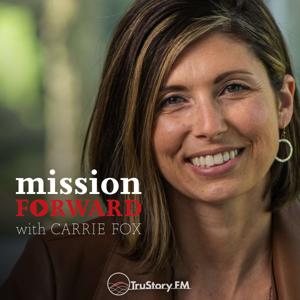


When we started this season of Mission Forward, we wanted to go back to our roots. We are, after all, a communications firm. It seems only right that we spend a little time talking about communications.
And so, we began our journey to meet ten people influencing and shaping how we communicate at scale for social change. Authors, journalists, and designers sat down with us to share their journey against the headwinds of change, illuminating how they use the tools of their craft to change minds and influence markets for action.
This week on the show, producer Nimra Haroon joins Carrie Fox to review lessons learned over the course of this season, distilling for you the highlights of ten interviews that plumb the depths of our field. It is a bittersweet close to this chapter of the podcast as we break the holidays and the new year, but we will return in 2022 with season five, and a new collection of conversations to help you move your mission forward.
Our cup runs over with gratitude to Ashton Lattimore, Tim Hykes, Najma Robers, Greg Galle, Grady Powell, Houston Kraft, Eleni Stamoulis, Rae Oglesby, and Dan Buettner, along with each representative of their teams who helped to bring this season of interviews to fruition. Thank you to all — guests, production partners, and listeners alike — for making this podcast such a rewarding journey for us to undertake.
Dan Buettner is a National Geographic Fellow and multiple New York Times best-selling author and joins us this week to share his work researching and documenting Blue Zones around the world.
A Blue Zone is a geographically-defined and confirmed area of extreme longevity. Specifically, Okinawa, Japan; Sardinia, Italy, Nicoya, Costa Rica; Ikaria, Greece; and Loma Linda, California, boast populations that live the longest and are the healthiest people in the world. What makes them live so long? Dan and his team of demographers have spent years researching these Blue Zones, documenting how these populations live and work.
“We're spending $18 trillion a year on largely avoidable diseases. That number just keeps going up,” says Buettner. “We know these populations have a fraction of the heart disease, diabetes, cancer, and dementia. “Why don't we focus on trying to set up our cities and our workplaces so they look more like a Blue Zone?”
That’s precisely what he and his team are doing now, working to create healthy communities across the United States, beginning with Albert Lea, Minnesota, where they built the foundation for the Blue Zones Projects.
The Blue Zones books are inspirational for crafting better, healthier homes and workplaces, and we're thrilled to have Dan Buettner on the show this week to talk about his latest book, The Blue Zones Challenge: A 4-Week Plan for a Longer, Better Life.
This week on the show, we welcome a storyteller with a passion for social justice, equity, and service. That makes her a triple threat with a particularly astute eye on how the stories we tell can unintentionally move to separate us. Rae Oglesby started her career in broadcasting, working at CNN producing stories across Atlanta and South Carolina, before transitioning to non-profit marketing and communications.
Today, Rae is VP of Communications at UpTogether, a poverty-focused non-profit dedicated to lifting those in underrepresented communities in poverty into the middle class by helping families to invest in themselves. It is a movement, a platform, and most importantly accelerates the initiative that people in historically undervalued communities are taking to improve their lives and to move up together.
“It’s not about us as, as an organization,” says Rae. “It's not about what we are doing, but it is about the community. It is about our members. We're very much focused on relationships and not transactions. We understand that we need to take the time to get to know people who we are engaging with. We need to talk to them. We need to also recognize that communication is a two-way street, which means that we need to listen as well.”
This is not a story about charity. It’s a story about empowerment, about allowing communities to stop seeing themselves as others, but as valuable contributors in the effort to lift one another out of poverty. Rae offers powerful insights into how other non-profits might paint a stronger picture of those they serve by communication with intention. We’re honored to have this time with her and to share her story with you this week.
We welcome one of our own to Mission Forward this week: inclusivity advocate and graphic designer, Eleni Stamoulis. She joined the Mission Partners team in 2017 and since that time, she has been involved in an extraordinary array of client and partner projects. In brand refreshes and rebrands, website redesigns, and all kinds of mission-critical campaign elements, her voice has become welcome counsel for ensuring that the projects that we take on at Mission Partners are as inclusive and accessible as possible.
We talk about Eleni’s journey as a designer and the traumatic brain injury that sent her on her path of growth and life-long learning. We talk about the power of design to transform ideas and beliefs. As she says, design isn’t just about what’s on the page. It’s about everything around us that is designed to affect change. We’re grateful that Eleni is using design to affect change for good.
She is deep into the final stages of her own MFA, where her thesis is focused on the experiences of Black, Brown, and Latinx students in design education. As such, she’s currently performing a research project that aims to understand the role race plays in the educational experience of graphic design students in the United States. Are you a design student or educator? Visit EleniStamoulis.com today and submit your response. She promises it won’t take more than 10-15 minutes of your time. Click the link to learn more!
Along the way, Eleni recommended some fantastic resources we’d like to amplify:
Houston Kraft is a professional speaker, author, curriculum designer, and kindness advocate whose book, Deep Kindness: A Revolutionary Guide for the Way We Think, Talk, and Act in Kindness, has inspired millions to examine the difference between nice and kind and why specifically deep kindness is not only a revolutionary act, but a necessary one.
Kraft is also the co-founder of Character Strong, which develops training programs and curricula for effective, sustainable school culture change. To date, his work has reached more than 1 million students and their teachers.
There is something special at the intersection of Houston Kraft’s initiatives, something we’ve forgotten along our journey toward building bigger, better, faster organizations and teams. To us, it appears that Houston has given us a profound reminder that social-emotional learning benefits the whole person; at Character Strong, it’s for the school kids, and with Deep Kindness, we realize it’s for us big kids, too.
Thanks to Houston and his team for creating the time for this conversation. We’re honored to offer it to our Mission Forward community.
This week we welcome Grady Powell, founder of Openfields, a social impact consulting firm committed to helping leaders imagine and implement a more creative and just future. He is also co-founder of Capita, a nonpartisan think tank working to build a better future for children and families.
Following up on last week’s conversation with Greg Galle about communicating the impossible, this week, we take on the world of what’s possible in communications and strategy. We talk with Grady about what it means to work in social impact, how he helps leaders think differently about the actions of their organizations, and how to take ideas to the next level for a more just business environment.
Grady’s work at Openfields and Capita sits at the intersection of research, public policy, social innovation and design and we’re thrilled to be able to bring this conversation to you all this week. Our deepest thanks to Grady Powell and his team for making this conversation happen.
Greg Galle comes to us this week with an approach to addressing culture that begins with our brains. We live with certain neurological realities, he says, “these are how we learn things, the synaptic connections that are created, and that has sort of trapped us.”
In his book Think Wrong, Greg argues that the way we solve problems is broken. The extent to which they’re broken depends on our cultural realities. “How do we disrupt culture?” He asks. “Because cultures are self-preserving and that's great if you have a good, healthy culture, but if you're trying to create change, or even trying to improve or strengthen a culture, there will always be a natural resistance.”
Greg is the co-founder of strategy firm Solve/Next. As author of the book Think Wrong, he celebrates over 30 years of experience thinking wrong about leadership, planning, and decision-making. His book is used around the world and across all sectors, from global corporations to individuals running local non-profits.
This week on the show, we talk to Greg about how we trick our brains, and how we trick our cultures and our communities, into exploring new possibilities and departing from the status quo. We’re so grateful to Greg for his participation this week as we all continue to move our Mission Forward.
On this week’s show, we are thrilled to introduce you to Najma Roberts, Senior Director of Communications and Equity at Democracy Fund, a private foundation that champions the people and organizations who defend democracy, while challenging our political system to be more open and just. Najma joined the organization in 2018 and ever since, she’s been guiding this powerhouse philanthropy to be even more intentional and direct in its own commitments to justice and equity, while helping advance the organization’s mission and vision. But Najma brings more to the conversation than just her last several years. She’s well aware of the responsibility that a communicator has to speak truth to power, with love. Having worked with her now for more than 10 years, I can say honestly that leading with love is one of her greatest strengths.
In every stage of her career, Najma has been strong advocate for communications and the role that communicators play in how organizations demonstrate collective values, commitment to equity and justice. She is an expert when it comes to engaging institutional leaders, created trusted and open spaces, and challenging the status quo in favor of fresh thinking. And this week on Mission Forward, she’s going to help the rest of us do the same. We’re honored to welcome her to the show.
From the publisher's feed

441 Listeners
8 Listeners

21 Listeners

37 Listeners

38 Listeners

12 Listeners
100 Listeners

4 Listeners
2 Listeners

8 Listeners

0 Listeners

69 Listeners

6 Listeners

0 Listeners

5 Listeners

8 Listeners

0 Listeners

0 Listeners
2 Listeners