
Sign up to save your podcasts
Or



“In an age of seeming isolationism, where some countries tend to isolate, this is such a great way to bring people together. When you're doing music and the arts, all those barriers just fall away. People are just collaborating and having fun. It’s such a bridge-building endeavor. I don't mean that to sound cheesy either, because I just think it is really amazing. They end up being ambassadors who go back to their own country and say, “Wow, I had a great time at this festival in America or in the Netherlands.” It ends up being one more step in our way, with our organization, of trying to connect people together in an age when so many people seem to want to hide out and not connect. We’re big advocates of connecting, and that’s another great reason why I think we love to do this. too.”
Today’s guests are composer Robert Paterson and violinist Victoria Paterson, the visionary duo behind Mostly Modern Festival & Projects, an organization dedicated to celebrating music by living composers through performance, education, and community outreach.
Robert’s work is known for its rhythmic energy, emotional range, and inventive themes—from environmentalism and mythology to technology and modern relationships. Based in Saratoga Springs and NYC, he’s been recognized with numerous honors, including the Classical Recording Foundation’s Composer of the Year at Carnegie Hall and a Grammy® for Three Way. His music is performed by major orchestras and ensembles across the globe and regularly featured on NPR. He is the co-founder and Artistic Director of the Mostly Modern Festival, which takes place in both Saratoga Springs and the Netherlands.
Victoria has built a multifaceted career across classical, Broadway, and commercial music, performing everywhere from Carnegie Hall to The Today Show. As General Director of Mostly Modern Projects, she leads year-round programming that brings music into hospitals, public parks, and senior centers, while also mentoring emerging artists across the country.
Episode Website
Season 3 of Business & Society focuses on CEOs, Sustainability & Environmental Solutions
Business & Society is a limited series co-hosted by Bruce Piasecki.
“ I've lived in Philadelphia for about 16 years. The book itself was inspired by my time spent in the Kensington neighborhood of Philadelphia interviewing a lot of the people that I met there, both longtime residents of the neighborhood and also people who were transient, a lot of people struggling with addiction and a lot of women doing sex work to fund their physical addiction to opioids. You find out about their past, their road into addiction, their aspirations, their fears. I began to lead free writing workshops at an organization named St. Francis Inn, which is a longstanding food service organization in the community. They had a women's day shelter where I taught. I was really able to connect with people within the community on a quite personal level and loved my experiences in Kensington. And I still go, I'm still quite close with a number of the community workers, people who run free healthcare clinics. All of it ultimately informed the writing of Long Bright River.”
Liz Moore is the author of the New York Times bestselling novel Long Bright River, which was one of Barack Obama’s favorite books of the year, and has been made into a Peacock series starring Amanda Seyfried. Set against the opioid crisis and a string of mysterious murders, it’s a love story between two very different sisters and their path to recovery. Moore is winner of the 2014-2015 Rome Prize in Literature. Her other books include The God of the Woods, Heft, and The Unseen World.
Episode Website
www.creativeprocess.info/pod
Instagram:@creativeprocesspodcast
We are privileged to present the voices of individuals dedicated to effecting change and mitigating the harm inflicted upon our precious planet. These are individuals deeply committed to the core values that drive positive transformation. Thank you for tuning in to our episodes and for your ongoing dedication to stewarding our planet, not just on Earth Day but throughout the year. We can’t save the planet overnight, but by acting mindfully, we can create a better future. Let’s make Every Day, Earth Day!
Composer MAX RICHTER on Nature's Sonic Landscape
Founder of PETA INGRID NEWKIRK on the Shared Traits between Humans and Animals
JULIAN LENNON (Musician and Founder of White Feather Foundation) on Balancing Our Relationship with Mother Earth
BERTRAND PICCARD (Explorer, Aviator of 1st Round-the-World Solar-Powered Flight) discusses his adventures and how climate change will change our quality of life
CARL SAFINA (Author and environmentalist) on the Miracle of Life on Earth
NAN HAUSER (Whale Researcher, President, Center for Cetacean Research & Conservation) on How a Whale Saved her Life
U.S. Poet Laureate ADA LIMÓN on Embracing Hope Amid Environmental Uncertainty
Environmental Writer DAVID FARRIER on Evaluating Our Environmental Legacy
Grammy & Emmy Award-winning Sound Engineer CYNTHIA DANIELS on The Role of Art and Compassion in Transforming Society
Economist ODED GALOR on Education's Role in Addressing Climate Change
President of EarthDay.ORG KATHLEEN ROGERS on Advocating for Global Environmental Education
Lead Author of IPCC 6th Assessment Report JOELLE GERGIS on Learning from Historical Climate Data
Fmr. Prime Minister’s Strategy Unit Director SIR GEOFF MULGAN on Imagining a Circular Future for Society
Free Solo Climber of 200+ of the World’s Tallest Skyscrapers ALAIN ROBERT on The Consequences of Overproduction on the Planet
Director of Climate Hazards Center, UC Santa Barbara CHRIS FUNK on Adapting to a Two-Degree World
Environmental Writer DAVID FARRIER Stretching Time and Empathy for Future Generations
Author of Finding the Mother Tree DR. SUZANNE SIMARD on Trees: Advanced Communicators of the Natural World
“Most Influential Living Philosopher” PETER SINGER on the Ethical Imperative to Respect Animal Life
Fmr. Exec. Director, Greenpeace Int'l, Special Envoy for Int'l Climate Action, German Foreign Ministry JENNIFER MORGAN on the Importance of Resilience in Advocacy
To hear more from each guest, listen to their full interviews.
Episode Website
www.creativeprocess.info/pod
Instagram:@creativeprocesspodcast
“I'm really interested in the relation between performance and ritual. Where do those two separate?”
Richard Sennett grew up in the Cabrini Green housing project in Chicago, attended the Juilliard School in New York, and then studied social relations at Harvard. Over the last five decades, he has written about social life in cities, changes in labour, and social theory. His books include The Performer: Art, Life, Politics, The Hidden Injuries of Class, The Fall of Public Man, The Corrosion of Character, The Culture of the New Capitalism, The Craftsman, and Building and Dwelling. Sennett has advised the United Nations on urban issues for the past thirty years and currently serves as member of the UN Committee on Urban Initiatives. He is the Centennial Professor of Sociology at the London School of Economics and former University Professor of the Humanities at New York University.
“I want to show what is kind of the basic DNA that people use for good or for ill. What are the tools they use, if you like, of expression that they use in the creative process?”
Episode Website
www.creativeprocess.info/pod
Instagram:@creativeprocesspodcast
“We look at creative work as though the very creative process itself is something good. These are tools of expression, and like any tool, you can use them to damage something or to make something. They can be turned to very malign purposes, for instance, in the operas of Wagner. So I wanted to do this set of books, I want to show what is kind of the basic DNA that people use for good or for ill. What are the tools they use, if you like, of expression that they use in the creative process?”
Richard Sennett grew up in the Cabrini Green housing project in Chicago, attended the Juilliard School in New York, and then studied social relations at Harvard. Over the last five decades, he has written about social life in cities, changes in labour, and social theory. His books include The Performer: Art, Life, Politics, The Hidden Injuries of Class, The Fall of Public Man, The Corrosion of Character, The Culture of the New Capitalism, The Craftsman, and Building and Dwelling. Sennett has advised the United Nations on urban issues for the past thirty years and currently serves as member of the UN Committee on Urban Initiatives. He is the Centennial Professor of Sociology at the London School of Economics and former University Professor of the Humanities at New York University.
Episode Website
www.creativeprocess.info/pod
Instagram:@creativeprocesspodcast
“When I was working at the Times and the Times Magazine, on one Tuesday morning, the towers fell. September 11, 2001. The magazine had a 10-day lead time, so it was a weekly that was essentially 10 days old by the time it came out. We came to work and realized the world had changed, and the entire process, the magazine had been made for over a hundred years, had to be thrown out the window. We had to create a new magazine in 36 hours that would in some way speak to this very different, scary, and interesting world we were now in. In those 36 hours, we usually would take months to produce a magazine. If you take all of its aspects, it’s a long journey. However, we made a magazine in 36 hours that, in some ways, was the best magazine I ever made because of the urgency of the moment.”
Adam Moss was the editor of New York magazine, The New York Times Magazine, and 7 Days. As editor of New York, he also oversaw the creation of five digital magazines: Vulture, The Cut, Daily Intelligencer, Grub Street, and The Strategist. During his tenure, New York won forty-one National Magazine Awards, including Magazine of the Year. He was an assistant managing editor of The New York Times with oversight of the Magazine, the Book Review, and the Culture, and Style sections, as well as managing editor of Esquire. He was elected to the Magazine Editors’ Hall of Fame in 2019. He is the Author of The Work of Art: How Something Comes from Nothing.
Episode Website
www.creativeprocess.info/pod
Instagram:@creativeprocesspodcast
" I think the narrative structure of those story ballets, which were some of the biggest stories of my childhood. I grew up watching Swan Lake. Giselle, La Bayadère, these were stories that were as present to me as anything that I read. Those story ballets are often split in two parts in a way. You have the White Swan and the Black Swan. In Giselle, you have the young girl and then you have the shade, the kind of ghost who comes to haunt her, her lover. Very similar in La Bayadère. And the structure of this novel is in two parts and it's two versions, in a way, of the same character. And now that you said it, I wonder if in some way, without realizing it, that narrative structure had really seeped into my brain."
Katie Kitamura is the author five novels, most recently Audition and Intimacies, which was named one of the New York Times 10 Best Books of 2021, longlisted for the National Book Award and the PEN/Faulkner Award, and a finalist for a Joyce Carol Oates Prize. She is a recipient of the Rome Prize in Literature, fellowships from the Cullman Center and the Lannan Foundation, and many other honors. Her work has been translated into twenty-one languages. She teaches in the creative writing program at New York University.
Episode Website
www.creativeprocess.info/pod
Instagram:@creativeprocesspodcast
“What I meant when I said there is no AI is that I don't think we serve ourselves well when we put our own technology up as if it were a new God that we created. I think we confuse ourselves too easily. This goes back to Alan Turing, the main founder of computer science, who had this idea of the Turing test. In the test, you can't tell whether the computer has gotten more human-like or the human has gotten more computer-like. People are very prone to becoming more computer-like. When we're on social media, we let ourselves be guided by the algorithms, so we start to become dumb in the way the algorithms want us to. You see that all the time. It's really degraded our psychologies and our society.”
Jaron Lanier is a pioneering technologist, writer, and musician, best known for coining the term “Virtual Reality” and founding VPL Research, the first company to sell VR products. He led early breakthroughs in virtual worlds, avatars, and VR applications in fields like surgery and media. Lanier writes on the philosophy and economics of technology in his bestselling book Who Owns the Future? and You Are Not a Gadget. His book Dawn of the New Everything: Encounters with Reality and Virtual Reality is an inventive blend of autobiography, science writing, and philosophy. Lanier has been named one of TIME’s 100 most influential people and serves as Prime Unifying Scientist at Microsoft’s Office of the CTO—aka “Octopus.” As a musician, he’s performed with Sara Bareilles, Philip Glass, T Bone Burnett, Laurie Anderson, Jon Batiste, and others.
Episode Website
www.creativeprocess.info/pod
Instagram:@creativeprocesspodcast
Episode Website
www.creativeprocess.info/pod
Instagram:@creativeprocesspodcast
“AI is obviously the dominant topic in tech lately, and I think occasionally there's AI that's nonsense, and occasionally there's AI that's great. I love finding new proteins for medicine and so on. I don't think we serve ourselves well when we put our own technology up as if it were a new God that we created. I think we're really getting a little too full of ourselves to think that. This goes back to Alan Turing, the main founder of computer science, who had this idea of the Turing test. In the test, you can't tell whether the computer has gotten more human-like or the human has gotten more computer-like. People are very prone to becoming more computer-like. When we're on social media, we let ourselves be guided by the algorithms, so we start to become dumb in the way the algorithms want us to. You see that all the time. It's really degraded our psychologies and our society.”
Jaron Lanier is a pioneering technologist, writer, and musician, best known for coining the term “Virtual Reality” and founding VPL Research, the first company to sell VR products. He led early breakthroughs in virtual worlds, avatars, and VR applications in fields like surgery and media. Lanier writes on the philosophy and economics of technology in his bestselling book Who Owns the Future? and You Are Not a Gadget. His book Dawn of the New Everything: Encounters with Reality and Virtual Reality is an inventive blend of autobiography, science writing, and philosophy. Lanier has been named one of TIME’s 100 most influential people and serves as Prime Unifying Scientist at Microsoft’s Office of the CTO—aka “Octopus.” As a musician, he’s performed with Sara Bareilles, Philip Glass, T Bone Burnett, Laurie Anderson, Jon Batiste, and others.
Episode Website
www.creativeprocess.info/pod
Instagram:@creativeprocesspodcast
Photo credit: Michael Springer
Peter Weller is a renowned theater and Hollywood actor. His performances in films such as RoboCop and Naked Lunch garnered him much critical and commercial success over the years. His television acting and directing credits include Sons of Anarchy, Dexter, and 24. Unbeknownst to most, Weller has spent decades honing his appreciation for the visual and musical arts through his studies of the Renaissance era. Earning a Master's in Roman architecture from Syracuse University before moving on to a PhD in Renaissance Art from UCLA. Dr. Weller has just written a book, Leon Battista Alberti in Exile: Tracing the Path to the First Modern Book on Painting.
“Art transcends time and culture—the beauty of it. People worry about the world now. I remind them to go live in 1968, a time of preparing to go to the moon while people died for their beliefs. This is a difficult time in a republic that’s supposed to be free, but music was leading the way. It’s actually harmonious, transcending culture and time. That might be the greatest gift of our transcendence.”
Episode Website
www.creativeprocess.info/pod
Instagram:@creativeprocesspodcast
From the publisher's feed
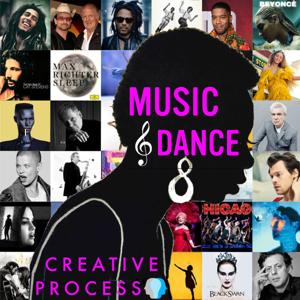
Music & Dance episodes of the popular The Creative Process podcast. To listen to ALL arts & creativity episodes of “The Creative Process · Arts, Culture & Society”, you’ll find our main podcast on Apple: tinyurl.com/thecreativepod, Spotify: tinyurl.com/thecreativespotify, or wherever you get your podcasts!
Exploring the fascinating minds of creative people. Conversations with writers, artists & creative thinkers across the Arts & STEM. We discuss their life, work & artistic practice. Winners of Oscar, Emmy, Tony, Pulitzer, leaders & public figures share real experiences & offer valuable insights. Notable guests and and organizations include: Pacific Northwest Ballet, Pilobolus Dance Company & Five Senses Festival, Harvard Dance Center, Songwriters Hall of Fame, Carter Burwell, John Powell, Edmar Castaneda, Kovacs, Marcelo Zarvos, Paulo Szot (Chicago, South Pacific), Jill Johnson (Ballet Frankfurt, The Forsythe Company), Mario Alberto Zambrano (Juilliard Dance), Nano Stern, Michael Daugherty, Bright Sheng, François Clemmons (Mister Rogers’ Neighborhood, Harlem Spiritual Ensemble), Rick Carnes (Songwriters Guild of America), Peter Boal, Noelani Pantastico, Itamar Kubovy, Jonah Bokaer Choreography & The Hudson Eye, Renée Jaworski, Matt Kent, Trish Sie (Pitch Perfect 3), Emily Kent, Seán Curran (NYU Tisch School of the Arts), Carolyn Waters Broe (Four Seasons Orchestra), Yuval Sharon, Aaron P. Dworkin (Sphinx Organization), Lorenda Ramou (Onassis Cultural Center), Terry Radigan, among others.
The interviews are hosted by founder and creative educator Mia Funk with the participation of students, universities, and collaborators from around the world. These conversations are also part of our traveling exhibition. www.creativeprocess.info
For The Creative Process podcasts from Seasons 1 2 3, visit: tinyurl.com/creativepod or creativeprocess.info/interviews-page-1, which has our complete directory of interviews, transcripts, artworks, and details about ways to get involved.
27,977 Listeners
276 Listeners
3 Listeners
149 Listeners
26 Listeners

26 Listeners
55 Listeners
55 Listeners
48 Listeners
35 Listeners

7 Listeners
89 Listeners

125 Listeners
33 Listeners
13 Listeners
7 Listeners
18 Listeners
40 Listeners
81 Listeners
11 Listeners
35 Listeners
2 Listeners
3 Listeners