
Sign up to save your podcasts
Or



Nos cerveaux sont-ils saturés ? Nos ancêtres du paléolithique avaient-ils plus de temps libre que nous ? Pourquoi cherchons-nous systématiquement à remplir les moments vides ?
Dans cet épisode nous verrons en quoi faire des choses absolument pas productives est essentiel à notre santé et à notre bien-être.
Cet épisode est dédié à Alexandre Astier, pour toute l’inspiration qu’il suscite chez moi en général, et pour m’avoir rappelé à la fin de son spectacle L’Exoconférence, l’importance de lever le nez et regarder les étoiles.
Son instagram : https://www.instagram.com/aastieroff/
Astier, Alexandre. L'Exoconférence. Spectacle, Regular & Rain Dog Productions, 2014.
Pour rejoindre l'écosystème Néo Chasseur Cueilleur : https://www.instagram.com/neo_chasseur_cueilleur/
Chaîne YouTube : https://www.youtube.com/@NeoChasseurCueilleur
Posez vos questions sur la boîte vocale Néo Chasseur Cueilleur :
https://www.speakpipe.com/NeoChasseurCueilleur
Musique originale et création sonore par Olaaf BRENTOT
Générique d’ouverture : Burn Out Party
Générique de fin : When Bodies Speak
Sources :
· Xie, L., Kang, H., Xu, Q., Chen, M. J., Liao, Y., Thiyagarajan, M., et al. (2013). Sleep drives metabolite clearance from the adult brain. Science, 342(6156), 373–377.
· Diekelmann, S., & Born, J. (2010). The memory function of sleep. Nature Reviews Neuroscience, 11, 114–126.
· Tversky, A., & Kahneman, D. (1974). Judgment under uncertainty: Heuristics and biases. Science, 185(4157), 1124–1131.
· Lee, R. B. (1968). What hunters do for a living, or, how to make out on scarce resources. In R. B. Lee & I. DeVore (Eds.), Man the Hunter. Aldine.
· Lee, R. B. (1979). The !Kung San: Men, Women, and Work in a Foraging Society. Cambridge University Press.
· Sayre, M. K., Anyawire, M., Paolo, B., Mabulla, A. Z. P., Pontzer, H., Wood, B. M., & Raichlen, D. A. (2023). Lifestyle and patterns of physical activity in Hadza foragers. American Journal of Biological Anthropology, 182(3), 340–356.
· Raichlen, D. A., Pontzer, H., Zderic, T. W., Harris, J. A., Mabulla, A. Z. P., Hamilton, M. T., Wood, B. M., & Lieberman, D. E. (2020). Sitting, squatting, and the evolutionary biology of human inactivity. Proceedings of the National Academy of Sciences, 117(13), 7115–7121.
· Dyble, M., Thorley, J., Page, A. E., Smith, D., & Migliano, A. B. (2019). Engagement in agricultural work is associated with reduced leisure time among Agta hunter-gatherers. Nature Human Behaviour, 3, 792–796.
· Raichle, M. E., MacLeod, A. M., Snyder, A. Z., Powers, W. J., Gusnard, D. A., & Shulman, G. L. (2001). A default mode of brain function. Proceedings of the National Academy of Sciences, 98(2), 676–682
· Greicius, M. D., Krasnow, B., Reiss, A. L., & Menon, V. (2003). Functional connectivity in the resting brain: A network analysis of the default mode hypothesis. Proceedings of the National Academy of Sciences, 100(1), 253–258.
· Baird, B., Smallwood, J., Mrazek, M. D., Kam, J. W. Y., Franklin, M. S., & Schooler, J. W. (2012). Inspired by distraction: Mind wandering facilitates creative incubation. Psychological Science, 23(10), 1117–1122.
· Csikszentmihalyi, M. (1990). Flow: The Psychology of Optimal Experience. Harper & Row.
· Conard, N. J., Malina, M., & Münzel, S. C. (2009). New flutes document the earliest musical tradition in southwestern Germany. Nature, 460, 737–740.
· Quiles, A., Valladas, H., Bocherens, H., Delqué-Količ, E., Kaltnecker, É., van der Plicht, J., et al. (2016). A high-precision chronological model for the decorated Upper Paleolithic cave of Chauvet-Pont d’Arc, Ardèche, France. Proceedings of the National Academy of Sciences, 113(17), 4670–4675.
· Aujoulat, N. (2004). Lascaux : le geste, l’espace et le temps. Seuil.
· Le Quellec, J.-L. (2022). La caverne originelle : Art, mythes et premières humanités. La Découverte.
Hébergé par Acast. Visitez acast.com/privacy pour plus d'informations.
Pourquoi vaut-il mieux faire soi-même qu’acheter ? Comment nos ancêtres étaient en réalité des artisans ultra qualifiés ? Quels sont les impacts bénéfiques du bricolage sur le cerveau ?
Dans cet épisode, nous allons explorer pourquoi fabriquer soi-même certains objets du quotidien peut apporter bien plus, au final, qu’un simple objet.
Cet épisode est dédié à Rune Malte Bertram-Nielsen, dont les vidéos bushcraft au Danemark ne cessent de m’inspirer.
À découvrir là : https://www.youtube.com/@BertramCraftAndWilderness
Tuto Boomerang : À venir !
Posez vos questions sur la boîte vocale Néo Chasseur Cueilleur :
https://www.speakpipe.com/NeoChasseurCueilleur
Pour rejoindre l'écosystème Néo Chasseur Cueilleur : https://www.instagram.com/neo_chasseur_cueilleur/
Chaîne YouTube : https://www.youtube.com/@NeoChasseurCueilleur
Musique originale et création sonore par Olaaf BRENTOT
Générique d’ouverture : The Long Hunt Ends
Générique de fin : When Bodies Speak
Sources :
· Cnesco. (2016). Comment l’école amplifie-t-elle les inégalités sociales et migratoires ? Rapport scientifique. Conseil national d’évaluation du système scolaire.
· Vrignaud, P. (2016). L’évolution des intentions d’orientation et du choix professionnel au cours du collège. Contribution au rapport du Cnesco sur les inégalités scolaires.
· Harmand, S., Lewis, J. E., Feibel, C. S., et al. (2015). “3.3-million-year-old stone tools from Lomekwi 3, West Turkana, Kenya.” Nature, 521, 310–315.
· Semaw, S., Rogers, M. J., Quade, J., et al. (2003). “2.6-Million-year-old stone tools and associated bones from OGS-6 and OGS-7, Gona, Afar, Ethiopia.” Journal of Human Evolution, 45(2), 169–177.
· Stout, D., & Chaminade, T. (2007). “The evolutionary neuroscience of tool making.” Neuropsychologia, 45(5), 1091–1100.
· Stout, D., Toth, N., Schick, K., & Chaminade, T. (2008). “Neural correlates of Early Stone Age toolmaking: technology, language and cognition in human evolution.” Philosophical Transactions of the Royal Society B, 363(1499), 1939–1949.
· Malafouris, L. (2021). “How does thinking relate to tool making?” Adaptive Behavior, 29(2), 107–121.
· Lombard, M., & Phillipson, L. (2010). “Indications of bow and stone-tipped arrow use 64,000 years ago in KwaZulu-Natal, South Africa.” Antiquity, 84(325), 635–648.
· Backwell, L. R., Bradfield, J., Carlson, K. J., Jashashvili, T., Wadley, L., & d’Errico, F. (2018). “The antiquity of bow-and-arrow technology: evidence from Middle Stone Age layers at Sibudu Cave.” Journal of Archaeological Science, 92, 289–303.
· Hamm, J. (Ed.). (1992–2008). The Traditional Bowyer’s Bible, Vols. 1–4. Bois d’Arc Press.
· Talamo, S., et al. (2025). “Boomerang and bones: Refining the chronology of the Early Upper Paleolithic at Obłazowa Cave, Poland.” PLOS ONE, 20(6), e0324911.
· Langley, M. C., et al. (2016). “A 600-year-old boomerang fragment from Riwi Cave, South Central Kimberley, Western Australia.” Australian Archaeology, 82(3), 285–294.
· Wurz, S., et al. (2019). “A functional investigation of southern Cape Later Stone Age artefacts resembling aerophones.” Journal of Archaeological Science: Reports, 24, 693–711.
· Norn, M. (1996). “Eskimo snow goggles in Danish and Greenlandic collections.” Meddelelser om Grønland, Man & Society, 23, 1–71.
· Bukhave, E. B., Creek, J., & Huniche, L. (2025). “The effects of crafts-based interventions on mental health and well-being: A systematic review.” Australian Occupational Therapy Journal, 72(1), e70001.
Hébergé par Acast. Visitez acast.com/privacy pour plus d'informations.
Donne-t-on trop d’attention, de compliments ou de jouets à nos enfants ? Comment les chasseurs cueilleurs s’occupent de leur mini sapiens ? Pourquoi les enfants n’écoutent-ils pas ce qu’on leur dit ?
Dans cet épisode, nous allons voir comment les sociétés traditionnelles, non occidentales, gère l’éducation et la socialisation de leurs enfants, afin que nous puissions nous en inspirer.
Cet épisode est dédié à Michaeleen Doucleff, dont je recommande l’excellent ouvrage Chasseur Cueilleur Parent, éditions LEDUC, 2021.
Pour rejoindre l'écosystème Néo Chasseur Cueilleur : https://www.instagram.com/neo_chasseur_cueilleur/
Musique originale et création sonore par Olaaf BRENTOT
Générique d’ouverture : The Long Hunt Ends
Générique de fin : When Bodies Speak
Sources :
· Henrich, J., Heine, S. J., & Norenzayan, A. (2010). The weirdest people in the world? Behavioral and Brain Sciences, 33(2-3), 61-135.
· Doucleff, M. (2021). Hunt, Gather, Parent: What Ancient Cultures Can Teach Us About the Lost Art of Raising Happy, Helpful Little Humans. Avid Reader Press.
· Hewlett, B. S., & Lamb, M. E. (Eds.). (2005). Hunter-Gatherer Childhoods: Evolutionary, Developmental, and Cultural Perspectives. Transaction Publishers.
· Hrdy, S. B. (2009). Mothers and Others: The Evolutionary Origins of Mutual Understanding. Harvard University Press.
· Kramer, K. L., & Veile, A. (2018). Infant allocare in traditional societies. Physiology & Behavior, 193, 117-126.
· Crittenden, A. N., & Zes, D. A. (2015). Food Sharing among Hadza Hunter-Gatherer Children. PLOS ONE, 10(7), e0131996.
· Crittenden, A. N., Conklin-Brittain, N. L., Zes, D. A., Schoeninger, M. J., & Marlowe, F. W. (2013). Juvenile foraging among the Hadza: Implications for human life history. Evolution and Human Behavior, 34(4), 299-304.
· Hagen, R. V., van der Ploeg, J., & Minter, T. (2016). How do hunter-gatherers learn? The transmission of indigenous knowledge among the Agta of the Philippines. Hunter Gatherer Research, 2(4), 389-413.
· Gaskins, S. (2000). Children’s daily activities in a Mayan village: A culturally grounded description. Cross-Cultural Research, 34(4), 375-389.
· Rogoff, B. (2003). The Cultural Nature of Human Development. Oxford University Press.
· Coppens, A. D., Silva, K. G., Ruvalcaba, O., Alcalá, L., López, A., & Rogoff, B. (2014). Learning by observing and pitching in: Benefits and processes of expanding repertoires. Human Development, 57(2-3), 150-161.
· Briggs, J. L. (1998). Inuit Morality Play: The Emotional Education of a Three-Year-Old. Yale University Press.
· Lancy, D. F. (2015). The Anthropology of Childhood: Cherubs, Chattel, Changelings (2nd ed.). Cambridge University Press.
· Mueller, C. M., & Dweck, C. S. (1998). Praise for intelligence can undermine children’s motivation and performance. Journal of Personality and Social Psychology, 75(1), 33-52.
· Henderlong, J., & Lepper, M. R. (2002). The effects of praise on children’s intrinsic motivation: A review and synthesis. Psychological Bulletin, 128(5), 774-795.
Hébergé par Acast. Visitez acast.com/privacy pour plus d'informations.
Quel est le meilleur moment pour se lancer dans un projet ? Comment les chasseurs cueilleurs paléolithiques géraient les aléas de la vie ? Y a-t-il un secret pour réussir ce qu’on entreprend ?
Épisode spécial avec un conte immersif au sein d’un groupe de chasseurs cueilleurs du paléolithique supérieur.
Pour rejoindre l'écosystème Néo Chasseur Cueilleur : https://www.instagram.com/neo_chasseur_cueilleur/
« Aern, le pêcheur qui ne voulait pas pêcher »
Conte écrit et lu par Olaaf BRENTOT
Musique originale et création sonore par Olaaf BRENTOT
Générique d’ouverture : The Long Hunt Ends
Générique de fin : When Bodies Speak
Sources :
· Friston, Karl. “The Free-Energy Principle: A Rough Guide to the Brain?” Trends in Cognitive Sciences, vol. 13, no 7, 2009, p. 293-301.
· Behrens, Timothy E.J., Mark W. Woolrich, Mark E. Walton et Matthew F.S. Rushworth. “Learning the Value of Information in an Uncertain World.” Nature Neuroscience, vol. 10, 2007, p. 1214-1221.
· Browning, Michael, et al. “Anxious Individuals Have Difficulty Learning the Causal Statistics of Aversive Environments.” Nature Neuroscience, vol. 18, 2015, p. 590-596.
· Genet, Jessica J. et Matthias Siemer. “Flexible Control in Processing Affective and Non-Affective Material Predicts Individual Differences in Trait Resilience.” Cognition and Emotion, vol. 25, no 2, 2011, p. 380-388.
· Épictète. Manuel (Enchiridion), Ier-IIe siècle apr. J.-C.
· Mallory, J.P. et Douglas Q. Adams. The Oxford Introduction to Proto-Indo-European and the Proto-Indo-European World. Oxford University Press, 2006. (Racine indo-européenne de l’ours : h₂ŕ̥tḱos).
Hébergé par Acast. Visitez acast.com/privacy pour plus d'informations.
Sommes-nous réellement des animaux sociaux ? Comment la vie en société a-t-elle favorisé l’évolution des chasseurs cueilleurs du paléolithique ? Est-ce que vivre seul est dangereux pour un être humain ?
Dans cet épisode nous verrons comment nous pouvons améliorer notre bien-être en cultivant nos liens sociaux et en se sentant intégré et épanoui au sein de notre clan.
Cet épisode est dédié à tous les membres de mon clan – le Clan des Ours – et en particulier à Claire Maoui-Laugier AKA Maoui Poppins, énergéticienne de talent.
Son site Internet : https://www.clairemaoui.energy/
Son compte Instagram : https://www.instagram.com/maouipoppins/
Pour rejoindre l'écosystème Néo Chasseur Cueilleur : https://www.instagram.com/neo_chasseur_cueilleur/
Livre : Jean M. Auel, Le Clan de l’Ours des Cavernes (tome 1 de la saga Les Enfants de la Terre).
Musique originale et création sonore par Olaaf BRENTOT
Générique d’ouverture : The Long Hunt Ends
Générique de fin : When Bodies Speak
Sources :
· Holt-Lunstad, J., Smith, T. B., Baker, M., Harris, T., & Stephenson, D. (2015). Loneliness and social isolation as risk factors for mortality: A meta-analytic review. Perspectives on Psychological Science, 10(2), 227–237.
· Dunbar, R. I. M. (1998). The social brain hypothesis. Evolutionary Anthropology, 6(5), 178–190.
· Dunbar, R. I. M. (1992). Neocortex size as a constraint on group size in primates. Journal of Human Evolution, 22(6), 469–493.
· Hrdy, S. B. (2009). Mothers and Others: The Evolutionary Origins of Mutual Understanding. Harvard University Press.
· Tomasello, M. (2014). A Natural History of Human Thinking. Harvard University Press.
· Boyd, R., & Richerson, P. J. (2009). Culture and the evolution of human cooperation. Philosophical Transactions of the Royal Society B, 364(1533), 3281–3288.
· Nowak, M. A. (2006). Five rules for the evolution of cooperation. Science, 314(5805), 1560–1563.
· Hill, K., Barton, M., & Hurtado, A. M. (2009). The emergence of human uniqueness: Characters underlying behavioral modernity. Evolutionary Anthropology, 18(5), 187–200.
· Apicella, C. L., Marlowe, F. W., Fowler, J. H., & Christakis, N. A. (2012). Social networks and cooperation in hunter-gatherers. Nature, 481(7382), 497–501.
· Gurven, M. (2004). To give and to give not: The behavioral ecology of human food transfers. Behavioral and Brain Sciences, 27(4), 543–559.
· Trinkaus, E., & Zimmerman, M. R. (1982). Trauma among the Shanidar Neandertals. American Journal of Physical Anthropology, 57(1), 61–76.
· Carter, C. S. (2014). Oxytocin pathways and the evolution of human behavior. Annual Review of Psychology, 65, 17–39.
· Insel, T. R. (2010). The challenge of translation in social neuroscience: A review of oxytocin, vasopressin, and affiliative behavior. Neuron, 65(6), 768–779.
· Eisenberger, N. I., Lieberman, M. D., & Williams, K. D. (2003). Does rejection hurt? An fMRI study of social exclusion. Science, 302(5643), 290–292.
· Gautney, J. R., & Holliday, T. W. (2015). New estimates of hunter-gatherer population density and global population at the Last Glacial Maximum. Journal of Archaeological Science, 53, 643–653.
Hébergé par Acast. Visitez acast.com/privacy pour plus d'informations.
Pourquoi accumulons-nous tant de choses chez nous ? Quels liens les chasseurs cueilleurs du paléolithique entretenaient-ils avec les objets ? Est-ce que tout ce que nous possédons a un impact sur notre cerveau ?
Dans cet épisode nous verrons comment nous pouvons aménager notre intérieur pour gagner en bien-être, en s’inspirant de nos ancêtres préhistoriques.
Cette épisode est dédié à toutes les personnes avec qui j’ai eu la chance de partager un bout de route lors de mes roadtrips.
Pour rejoindre l'écosystème Néo Chasseur Cueilleur : https://www.instagram.com/neo_chasseur_cueilleur/
BirdNET : https://apps.apple.com/fr/app/birdnet/id1541842885
PlantNet : https://apps.apple.com/fr/app/plantnet/id600547573
Musique originale et création sonore par Olaaf BRENTOT
Générique d’ouverture : The Long Hunt Ends
Générique de fin : When Bodies Speak
Sources :
Hébergé par Acast. Visitez acast.com/privacy pour plus d'informations.
Sommes-nous réellement faits pour la monogamie ? Pourquoi est-ce si difficile de trouver l’âme sœur ? Comment l’évolution humaine impacte-t-elle encore aujourd’hui nos chances de séduire ?
Dans cet épisode, nous allons voir à quel point notre histoire évolutive préhistorique joue encore un rôle très important dans le choix d’un ou d’une partenaire, et comment se servir de ses données pour accroitre notre potentiel de séduction.
Cet épisode est dédié à Thérèse Hargot, diplômée de philosophie, thérapeute de couple et sexologue.
Retrouvez son podcast LOVECARE sur toutes les plateformes et suivez-là sur :
https://www.instagram.com/theresehargot
Pour rejoindre l'écosystème Néo Chasseur Cueilleur : https://www.instagram.com/neo_chasseur_cueilleur/
Musique originale et création sonore par Olaaf BRENTOT
Générique d’ouverture : The Long Hunt Ends
Générique de fin : When Bodies Speak
Sources :
· Charles Darwin, The Descent of Man, and Selection in Relation to Sex, 1871
· Malte Andersson, Sexual Selection, Princeton University Press, 1994
· David Buss, “Sex differences in human mate preferences: Evolutionary hypotheses tested in 37 cultures”, Behavioral and Brain Sciences, 1989
· David Buss, Evolutionary Psychology: The New Science of the Mind, 2019 (édition récente)
· Wendy Wood & Alice Eagly, “Biosocial construction of sex differences and similarities in behavior”, Psychological Bulletin, 2012
· Sarah Blaffer Hrdy, Mother Nature: Maternal Instincts and How They Shape the Human Species, 1999
· Sarah Blaffer Hrdy, Mothers and Others: The Evolutionary Origins of Mutual Understanding, 2009
· Stephen Beckerman et al. “The Multiple Paternity Hypothesis”, Proceedings of the National Academy of Sciences (PNAS), 2007
· Robert Walker et al. “Evolutionary history of partible paternity in lowland South America”, PNAS, 2010
· Bernard Chapais, Primeval Kinship: How Pair-Bonding Gave Birth to Human Society, 2008
· Joseph Henrich et al. “The puzzle of monogamous marriage”, Philosophical Transactions of the Royal Society B, 2012
· Peter Kappeler & Carel van Schaik, Primate Social Systems, 2002
· Richard Wrangham, The Goodness Paradox, 2019
· Samuel Stearns, The Evolution of Life Histories, 1992
· Elizabeth Bruch & Mark Newman, “Aspirational pursuit of mates in online dating markets”, Science Advances, 2018
· Gareth Tyson et al. “A First Look at User Activity on Tinder”, 2016
· Judith Burkart et al. “Cooperative breeding and human cognitive evolution”, Evolutionary Anthropology, 2009
Hébergé par Acast. Visitez acast.com/privacy pour plus d'informations.
Pourquoi nos gels douches sont-ils parfois très mauvais pour la peau ? Comment nos ancêtres chasseurs cueilleurs se lavaient-ils ? Et si on apprenait simplement… à mieux se laver ?
Dans cet épisode, on va voir pourquoi notre façon moderne de nous laver pourrait bien être en décalage avec la nature même de notre peau.
Cet épisode est dédié à Christophe Mercier Thellier, hygiéniste et microbiologiste.
https://www.instagram.com/christophemercierthellier
Pour rejoindre l'écosystème Néo Chasseur Cueilleur : https://www.instagram.com/neo_chasseur_cueilleur/
Musique originale et création sonore par Olaaf BRENTOT
Générique d’ouverture : The Long Hunt Ends
Générique de fin : When Bodies Speak
Sources :
· Kenneth Todar, « The Normal Bacterial Flora of Humans », Todar's Online Textbook of Bacteriology.
· Docteur Françoise Rodhain, La peau, la beauté et le temps, Cherche Midi, 2017, p. 17
· Grice EA, Segre JA. The skin microbiome. Nature Reviews Microbiology, 2011.
· Byrd AL, Belkaid Y, Segre JA. The human skin microbiome. Nature Reviews Microbiology, 2018.
· Sanford JA, Gallo RL. Functions of the skin microbiota in health and disease. Seminars in Immunology, 2013.
· Lambers H et al. Natural skin surface pH is on average below 5. International Journal of Cosmetic Science, 2006.
· Proksch E et al. The skin: an indispensable barrier. Experimental Dermatology, 2008.
· Korting HC, Braun-Falco O. The effect of detergents on skin pH and barrier function. Clinical Dermatology, 1996.
· Ananthapadmanabhan KP et al. Cleansing without compromise: the impact of cleansers on the skin barrier. Dermatologic Therapy, 2004.
· Voegeli R. The effect of washing and detergents on skin barrier function. Journal of Wound Care, 2008.
· Clemente JC et al. The microbiome of uncontacted Amerindians. Cell, 2015.
· Blaser MJ, Falkow S. What are the consequences of the disappearing human microbiota? Nature Reviews Microbiology, 2009.
· Schnorr SL et al. Gut microbiome of the Hadza hunter-gatherers. Nature Communications, 2014.
· Strachan DP. Hay fever, hygiene, and household size. BMJ, 1989.
· Rook GA. Regulation of the immune system by biodiversity. Proceedings of the National Academy of Sciences, 2013.
· Yegül F. Baths and Bathing in Classical Antiquity. MIT Press.
· Fagan GG. Bathing in Public in the Roman World. University of Michigan Press.
· Nielsen I. Thermae et Balnea: The Architecture and Cultural History of Roman Public Baths. Aarhus University Press.
· Vigarello G. Le propre et le sale : l’hygiène du corps depuis le Moyen Âge. Seuil.
· Classen C, Howes D, Synnott A. Aroma: The Cultural History of Smell. Routledge.
· Lister J. On the Antiseptic Principle in the Practice of Surgery. The Lancet, 1867.
· Pasteur L. Études sur les germes et la fermentation.
· Koch R. Investigations into the etiology of infectious diseases.
· Basketter DA et al. Skin sensitization and irritants in cosmetics. Contact Dermatitis.
· Scientific Committee on Consumer Safety (SCCS). Opinions on methylisothiazolinone
Hébergé par Acast. Visitez acast.com/privacy pour plus d'informations.
Pourquoi a-t-on autant besoin de nature ? Sommes-nous devenus une espèce qui vit en captivité volontaire ? Quelle est la différence entre être spectateur et être acteur de la nature ?
Dans cet épisode, on va parler de notre rapport à la nature, de ses bienfaits, des effets du manque et proposer quelques activités pour renouer avec notre essence profonde, notre nature ancestrale et retrouver notre place dans la nature…
Cet épisode est dédié à Félix D’Aligny, journaliste et fondateur de Sauvage Média – Art de vivre :
https://www.youtube.com/@Sauvagemedia_officiel
Interview Alexandra Lamy @ Les Lueurs : https://youtu.be/wQI5pCJAD5c?si=EpArYYMoVM6xNIf2
Pour rejoindre l'écosystème Néo Chasseur Cueilleur : https://www.instagram.com/neo_chasseur_cueilleur/
Musique originale et création sonore par Olaaf BRENTOT
Générique d’ouverture : The Long Hunt Ends
Générique de fin : When Bodies Speak
Sources :
Hébergé par Acast. Visitez acast.com/privacy pour plus d'informations.
Et si le manque de sommeil avait les mêmes effets que l’alcool ? Comment dormaient nos ancêtres du paléolithique ? Et pourquoi notre rythme moderne perturbe-t-il autant notre sommeil ?
Dans cet épisode, on va parler du sommeil, de son rôle, des effets du manque et livrer quelques astuces ancestrales pour retrouver un sommeil de rêve…
Cet épisode est dédié à Gilles Laurent, vétérinaire et docteur en neuroéthologie, directeur du Max Planck Institute for Brain Research.
Pour rejoindre l'écosystème Néo Chasseur Cueilleur : https://www.instagram.com/neo_chasseur_cueilleur/
Musique originale et création sonore par Olaaf BRENTOT
Générique d’ouverture : The Long Hunt Ends
Générique de fin : When Bodies Speak
Sources :
Hébergé par Acast. Visitez acast.com/privacy pour plus d'informations.
From the publisher's feed
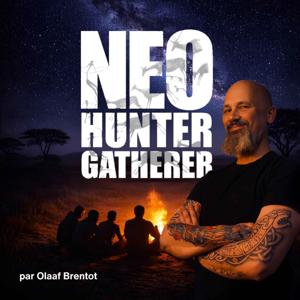
Et si nous n’étions pas faits pour vivre comme nous vivons aujourd’hui ?
Pendant des millions d’années, l’être humain a évolué en tant que chasseur-cueilleur. Notre corps, notre cerveau, nos…
Dans ce podcast, j’explore ce que notre mode de vie moderne a mis de côté : notre alimentation, notre rapport au temps, au mouvement, à la nature, aux autres… et à nous-mêmes.
À travers des réflexions accessibles, nourries par la paléoanthropologie, la biologie et mes expériences personnelles, je vous invite à découvrir ce que j’appelle le mode de vie Néo Chasseur Cueilleur : une manière d’habiter le monde moderne tout en restant fidèle à ce que nous sommes profondément.
Un podcast pour celles et ceux qui cherchent à mieux comprendre leur vraie nature… et à vivre un peu plus en accord avec elle.
Hébergé par Acast. Visitez acast.com/privacy pour plus d'informations.