
Sign up to save your podcasts
Or



Based on Podcast App listening data
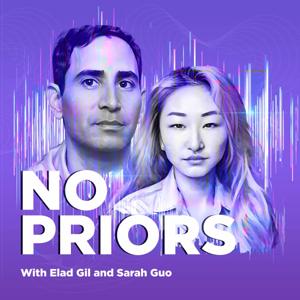
We’re looking back on 2023 and sharing a handful of our favorite conversations. Last year was full of insightful conversations that shaped the way we think about the most innovative movements in the AI space. Want to hear more? Check out the full episodes here:
Sign up for new podcasts every week. Email feedback to [email protected]
Follow us on Twitter: @NoPriorsPod | @Saranormous | @EladGil | @reidhoffman l @alyssahhenry l @ilyasut l @mustafasuleyman l @DaphneKoller l @arthurmensch l @MrJensenHuang
Show Notes:
(0:00) Introduction
(0:27) Ilya Sutskever on the governance structure of OpenAI
(3:11) Alyssa Henry on how AI can small business owners
(5:25) Mustafa Suleyman on defining intelligence
(8:53) Reid Hoffman’s advice for co-working with AI
(11:47) Daphne Koller on probabilistic graphical models
(13:15) Noam Shazeer on the possibilities of LLMs
(14:27) Arthur Mensch on keeping AI open
(17:19) Jensen Huang on how Nvidia decides what to work on
AI doomerism and calls to regulate the emerging technology is at a fever pitch but today’s guest, Reid Hoffman is a vocal AI optimist who views slowing down innovation as anti-humanistic. Reid needs no introduction, he’s the co-founder of PayPal, Linkedin, and most recently Inflection AI which is building empathetic AI companions. He is also a board member at Microsoft and former board member at OpenAI. On this week’s episode, Reid joins Sarah and Elad to talk about the historical case for an optimistic outlook on emerging technology like AI, advice for workers who fear AI may replace them, and why it’s impossible to regulate before you innovate. Plus, some predictions.
Aside from his storied experience in technology, Reid is an author, podcaster, and political activist. Most recently, he co-authors a book with GPT 4 called Impromptu: Amplifying Our Humanity Through AI.
Sign up for new podcasts every week. Email feedback to [email protected]
Follow us on Twitter: @NoPriorsPod | @Saranormous | @EladGil | @alyssahhenry
Show Notes:
(0:00) Reid Hoffman’s birdseye view on the state of AI
(3:37) AI and human collaboration in workflows
(5:23) What’s causing AI doomerism
(12:28) Advice for whitecollar workers
(16:45) Why Reid isn’t retiring
(18:25) How Inflection started
(22:06) Surprising ways people are using Inflection
(25:34) Western bias and AI ethics
(30:58) Structural challenges in governing AI
(33:15) Most exciting whitespace in AI
(35:00) GPT 5 and Innovations coming in the next two years
(44:00) What future should we be building?
AI tools are helping small business owners manage their businesses, so they can stay focused on the aspects of their business they love to do. This week on No Priors, Sarah and Elad are joined by Alyssa Henry, an executive at some of the most impactful companies from Microsoft to Amazon. Most recently she was the CEO of Square. She led Square’s team as they were very early adopters of a consumer-facing product that used GPT-2 and have continued to incorporate AI into their offerings. On today’s episode, they talk about the whitespace within e-commerce for AI and lessons from the prior generation of infrastructure.
Alyssa recently retired from being longtime CEO of Square, within Block. Before that she was a vice president of AWS running, amongst other things, the storage products, or the digital storage bucket for the world. And before AWS, she ran order management software at Amazon Retail and started her tech career at Microsoft. She remains on the boards of Intel, Confluent and was previously on the board of Unity.
Sign up for new podcasts every week. Email feedback to [email protected]
Follow us on Twitter: @NoPriorsPod | @Saranormous | @EladGil | @alyssahhenry
Show Notes:
(0:00) Alyssa’s experience and career trajectory
(2:30) Transition from engineer to manager
(4:09) AI implementation at Square
(7:46) Small business AI applications
(12:14) Latent demand for content generation
(15:04) The origin story of Square’s GPT-2 products
(16:54) Consolidating ecommerce workflows
(18:46) How will AI change cloud services
(23:07) Hyperscaler foundation models and the AI land grab
(25:16) Enterprise demand for open source models
(28:08) Startups in the AI semiconductor space
(31:02) Scale up architectures vs scaling out
(34:32) What’s next for Alyssa
(36:08) What Elad and Sarah are excited about in 2024
AI is the new UI for enterprise customers, according to Clara Shih, the CEO of Salesforce AI. Salesforce released Einstein, now called Einstein GPT, in 2016, making it an early example of how beneficial AI can be when embedded in enterprise software. This week on No Priors, Sarah and Elad talked with Clara about what the evolution of AI in enterprise looks like, how Salesforce is adoption AI across the organization, and the onboarding process for companies looking to integrate AI into their workflow, plus the challenges of pricing for AI services.
Clara Shih is the Chief Executive Officer of Salesforce AI where she leads the AI efforts across Salesforce including AI co-pilot and agent platform, model development, go-to-market growth, adoption, partnerships, ecosystems, and secure responsible AI. Before that was the CEO of Salesforce Service Cloud She is also the co-founder and previous CEO of Hearsay Systems. She is also on the Board of Directors at Starbucks.
Show Links:
Sign up for new podcasts every week. Email feedback to [email protected]
Follow us on Twitter: @NoPriorsPod | @Saranormous | @EladGil | @clarashih
Show Notes:
(0:00) Clara’s Background
(0:50) From cloud services to AI
(3:25) Internal Model Development vs Open Source
(5:20) The Co-Pilot Approach
(8:50) Enterprise AI Adoption
(10:54) The future of Enterprise AI
(13:23) Cross-team collaboration
(14:40) AI is the new UI
(19:11) Structuring the Dataset
(21:25) What’s next for generative AI in Enterprise
(23:18) Pricing challenges in AI
(26:30) Startups and AI
(28:22) Collaboration in AI Industry
OpenAI’s leadership has taken us all on a rollercoaster so it’s great timing for another host-only episode. This week Sarah and Elad get into what has been going on at OpenAI and what the turbulent leadership changes tell us about the importance of good intent and good incentives when building these influential companies. They also talk about innovative products coming out of Pika Labs, why people are moving away from diffusion models to LLMs, and how, in AI investing, the ASP is the opportunity.
Sign up for new podcasts every week. Email feedback to [email protected]
Follow us on Twitter: @NoPriorsPod | @Saranormous | @EladGil
Show Notes:
(0:00) Recapping the OpenAI saga
(9:56) AI video products
(16:14) Moving from Diffusion Models to LLMs
(19:47) The beneficial margins of AI investing
The future of tech is 25-person companies powered by AI agents that help us accomplish our larger goals. Imbue is working on building AI agents that reason, code and generally make our lives easier. Sarah Guo and Elad Gil sit down with co-founders Kanjun Qiu (CEO) and Josh Albrecht (CTO) to discuss how they define reasoning, the spectrum of specialized and generalized agents, and the path to improved agent performance. Plus, what’s behind their $200M Series B fundraise.
Kanjun Qiu is the CEO and co-founder of Imbue. Kanjun is also a partner at angel fund Outset Capital, where she invests in promising pre-seed companies. Previously, Kanjun was the co-founder and CEO of Sourceress, a machine learning recruiting startup backed by YC and DFJ. She was previously Chief of Staff to Drew Houston at Dropbox, where she helped scale the company from 300 employees to 1200.
Josh Albrecht is the CTO and co-founder of Imbue. He also invests in other founders via his fund, Outset Capital. He has published machine learning papers as an academic researcher; founded an AI recruiting company that went through YC and a 3D injection molding software company that was acquired; helped build Addepar as an early engineer; and served as a Thiel Fellow mentor. He started programming as a kid and began working professionally as a software engineer in high school.
Show Links:
Sign up for new podcasts every week. Email feedback to [email protected]
Follow us on Twitter: @NoPriorsPod | @Saranormous | @EladGil | @Kanjun | @JoshAlbrecht
Show Notes:
(00:00) - Introduction to Imbue
(04:55) - The Spectrum of Agent Tasks
(08:43) - Specialization and Generalization With Agents
(13:03) - Code and Language in AI Agents
Open Source fuels the engine of innovation, according to Arthur Mensch, CEO and co-founder of Mistral AI. Mistral is a French AI company which recently made a splash with releasing Mistral 7B, the most powerful language model for its size to date, and outperforming much larger models. Sarah Guo and Elad Gil sit down with Arthur to discuss why open source could win the AI wars, their $100M+ seed financing, the true nature of scaling laws, why he started his company in France, and what Mistral is building next.
Arthur Mensch is Chief Executive Officer and co-founder of Mistral AI. A graduate of École Polytechnique, Télécom Paris and holder of the Master Mathématiques Vision Apprentissage at Paris Saclay, he completed his thesis in machine learning for functional brain imaging at Inria (Parietal team). He spent two years as a post-doctoral fellow in the Applied Mathematics department at ENS Ulm, where he carried out work in mathematics for optimization and machine learning. In 2020, he joined DeepMind as a researcher, working on large language models, before leaving in 2023 to co-found Mistral AI with Guillaume Lample and Timothee Lacroix.
Show Links:
Sign up for new podcasts every week. Email feedback to [email protected]
Follow us on Twitter: @NoPriorsPod | @Saranormous | @EladGil | @ArthurMensch
Show Notes:
(0:00) - Why he co-founded Mistral
(4:22) - Chinchilla and Proportionality
(6:16) - Mistral 7b
(9:17) - Data and Annotations
(10:33) - Open Source Ecosystem
(17:36) - Proposed Compute and Scale Limits
(19:58) - Threat of Bioweapons
(23:08) - Guardrails and Safety
(29:46) - Mistral Platform
(31:31) - French and European AI Startups
Each iteration of ChatGPT has demonstrated remarkable step function capabilities. But what’s next? Ilya Sutskever, Co-Founder & Chief Scientist at OpenAI, joins Sarah Guo and Elad Gil to discuss the origins of OpenAI as a capped profit company, early emergent behaviors of GPT models, the token scarcity issue, next frontiers of AI research, his argument for working on AI safety now, and the premise of Superalignment. Plus, how do we define digital life?
Ilya Sutskever is Co-founder and Chief Scientist of OpenAI. He leads research at OpenAI and is one of the architects behind the GPT models. He co-leads OpenAI's new "Superalignment" project, which tries to solve the alignment of superintelligences in 4 years. Prior to OpenAI, Ilya was co-inventor of AlexNet and Sequence to Sequence Learning. He earned his Ph.D in Computer Science from the University of Toronto.
Show Links:
Sign up for new podcasts every week. Email feedback to [email protected] Follow us on Twitter: @NoPriorsPod | @Saranormous | @EladGil | @ilyasut
Show Notes:
(00:00) - Early Days of AI Research
(06:51) - Origins of Open Ai & CapProfit Structure
(13:46) - Emergent Behaviors of GPT Models
(17:55) - Model Scale Over Time & Reliability
(22:23) - Roles & Boundaries of Open-Source in the AI Ecosystem (28:22) - Comparing AI Systems to Biological & Human Intelligence (30:52) - Definition of Digital Life
(32:59) - Super Alignment & Creating Pro Human AI
(39:01) - Accelerating & Decelerating Forces
Cyber Security is going to change significantly in the era of AI, according to Ryan Noon, cofounder of Material Security, a security company that makes cloud-based Google and Microsoft email a safe place for sensitive data. Elad Gil and Ryan talk about how Material Security started to use LLMs, potential security threats from AI hacks, and the role of the government in securing the Internet. Ryan also shares his advice for founders.
Ryan co-founded Material Security in 2017 after seeing high profile email hacks in the 2016 Presidential election. Previously, he led various engineering teams at Dropbox after it acquired his first company, Parastructure. Prior to Parastructure, he led engineering at a data analysis company spun out of Stanford by DARPA. He holds both an MS in Computer Networks and Security and a BS in Computer Science from Stanford.
Show Links:
Sign up for new podcasts every week. Email feedback to [email protected]
Follow us on Twitter: @NoPriorsPod | @Saranormous | @EladGil | @InternetMeme
Show Notes:
(00:00) - How 2016 Election Hacking Inspired Ryan to Start Material Security
(05:00) - Generative AI Use Cases in Cyber Security & Fine Tuning
(11:36) - Predictions on Effective Threat Levels from AI Hacks
(14:45) - Democracy, the Department of Defence, DARPA and Cyber Security
(20:14) - Is there room for startups in the Cyber Security industry?
(26:40) - New Challenges On Horizon After 7 Years as Cofounder
(32:30) - Advice to Founders
As the Lead for Generative AI in the Office of the CTO for Google Cloud, Kawal Gandhi has a unique vantage point on enterprise AI rollout. Sarah Guo and Elad Gil sit down with Gandhi this week to discuss his insights on how enterprises can effectively invest in AI development, the importance of TPUs, and Google’s internal AI applications. Plus, when will email get more intelligent?
Kawal Gandhi has worked at Google for nearly a decade in search and ad roles before focusing on the development and marketing of AI tools.
Show Links:
Sign up for new podcasts every week. Email feedback to [email protected]
Follow us on Twitter: @NoPriorsPod | @Saranormous | @EladGil | @geeztweets
Show Notes:
(00:00) - Generative AI in Google Cloud
(09:05) - AI Adoption in the Enterprise
(13:31) - Multi-Modal AI Models
(16:19) - AI Adoption, return-on-investment, anti-patterns
(24:43) - Google's TPU and NVIDIA GPU shortage
(31:00) - Data Marketplace and Model Training
From the publisher's feed
Ranked by our users in the last 21 days

1,293 Listeners

534 Listeners

1,092 Listeners
437 Listeners

2,330 Listeners

222 Listeners

205 Listeners

312 Listeners

98 Listeners

546 Listeners

102 Listeners

478 Listeners

29 Listeners
140 Listeners
41 Listeners