OT Unplugged: Community of Practice Insights

OT Unplugged: Community of Practice Insights

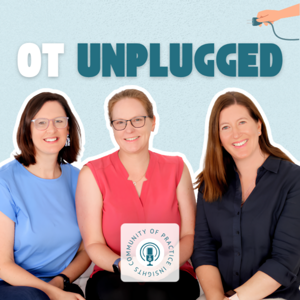
By Sarah Collison, Nikki Cousins and Alyce Svensk

A space for you to connect, reflect and stay up to date on OT practice and the evolving world of the NDIS.... more


Download on the App Store

Best of OT Unplugged: Community of Practice Insights

The most played episodes among Podcast App listeners.

  1. Number 1: S10 E9 - Sliding Doors: The Moments That Shape an OT Career

    Some moments in your OT career stay with you. A decision, a client or even a comment from someone else can change the direction of your career or the way you think about your role. This week, Sarah, Alyce and Nikki share some of their own ‘sliding doors’ moments, from career decisions that changed their direction to clinical experiences that reshaped how they understood their role as OTs. They also unpack recent NDIS developments around students on placement, functional capacity and changes approaching from 1 October. The career decisions that change everything Sometimes a career-defining decision starts with realising it is time to leave. Sarah reflects on the workplace experience that ultimately gave her the push to step away from a role she once thought she would never leave and start Verve OT. Alyce shares turning points of her own, including professional development that challenged the way she thought about clinical intervention and a period away from Occupational Therapy that ultimately led her back to the profession and into building her own practice. Looking back, neither could have known exactly where those decisions would lead. Sometimes it is only years later that you can see how one choice changed the trajectory of your career. When you can’t change the outcome Nikki shares the story of a man with rapidly progressing motor neurone disease who desperately wanted to leave hospital and return home. After considerable work to organise equipment and make his discharge possible, he made it home on a Friday afternoon and died the following day. At first, Nikki felt that everything they had done had made no difference. Her manager helped her see it differently: they could not change the fact that he was dying, but they had changed his experience by helping him spend that final time at home. That moment changed Nikki’s understanding of what making a difference can look like and influenced her later work in palliative and end-of-life care. It also highlights the role good supervision can play in helping OTs process difficult experiences and make sense of what they mean for their practice. The small things can be the big things Not every meaningful OT outcome looks impressive on paper. Nikki shares how one family still considers a simple toilet rail one of the most valuable things she has done for them, despite years of other intervention. Sarah recalls a client telling her that the biggest thing she had provided through a home modification process wasn’t the modification itself. It was hope that life might become easier. These moments are a reminder that OTs don’t always know which part of their work will matter most to someone. Particularly as service systems and funding models change, recognising these smaller wins can help keep the focus on what can make a meaningful difference for the person in front of us. Can you bill for students on placement under the NDIS? New NDIS guidance has raised fresh questions about students on placement. Earlier guidance stated that allied health students could deliver specific supports under supervision but that their work could not be directly claimed because placements were unpaid educational opportunities. The current NDIS guidance says allied health students and provisional psychologists can provide services under the supervision of a qualified allied health provider, with participant agreement. It also says service agreements should outline how the arrangement could provide greater flexibility, such as a lower hourly rate or additional service hours. What remains less clear is exactly how those services should be billed. The wording appears to have shifted again, but there is still enough ambiguity that providers will need to consider how they interpret and apply the guidance in practice. A changing definition of functional capacity A recent SDA matter prompted questions about how the amended definition of functional capacity is already being applied under the NDIS. The definition considers a person’s ability to undertake an activity without assistance from other people or assistive technology, with particular provisions around commonly used AT and assistance for children. This raises questions about what the definition could mean when considering the functional impact of disability. There is still more to unpack about how this will be applied in practice, particularly for OTs completing functional capacity assessments. It is an area to watch as further information becomes available. What’s changing from 1 October? There is plenty for allied health providers to have on their radar as 1 October approaches, including changes to classifications under the Health Professionals and Support Services Award and the upcoming ban on card surcharges. Thriving Kids activity is also expected to begin in New South Wales, although there are still questions around exactly how and when service pathways will roll out. For NDIS providers, there is also uncertainty around upcoming support determinations and what the high needs pathway will look like. With several changes happening at once, OTs and business owners will need to stay across further guidance as it becomes available. Key takeaways • Career-defining moments can come from unexpected decisions, challenges and clinical experiences • Good supervision can help OTs reflect on difficult experiences and shape their future practice • Small interventions can have a significant impact, even when they seem simple from an OT perspective • NDIS guidance around students on placement has changed again, but questions remain about how services can be billed • Changes to the definition of functional capacity may have implications for OTs completing functional capacity assessments • Several changes are approaching from 1 October, including award classifications, card surcharges and NDIS support determinations Links Guide to working as an allied health provider: https://www.ndis.gov.au/providers/working-participants/allied-health-professionals/guide-working-allied-health-provider

    43min
    Listen Later
  2. Number 2: S10 E8 - NDIS Support Lists: Simpler Categories, Bigger Questions

    The NDIS support lists have only been in place since October 2024, but another significant change may already be on the horizon. A new consultation is considering how NDIS supports should be defined, including proposals to reduce the number of support categories, simplify their descriptions and remove the replacement supports process. For OTs, some changes could make the rules easier to interpret. Others raise questions about what happens when an everyday product is also the simplest solution to a disability-related functional need. Why is the NDIS support list changing? The current support lists were introduced in October 2024 as transitional rules defining what participants can and cannot generally spend NDIS funding on. Feedback has highlighted several problems, including confusing categories, unclear descriptions and difficulties understanding replacement supports. The proposal is to reduce 36 support categories to 18 broader categories, with simpler purpose-based descriptions and examples. These categories are also being developed to align with new framework planning and the introduction of support needs assessments. Replacement supports could disappear One of the biggest proposed changes is the removal of the replacement supports process. Tablets, smartphones, smartwatches and accessibility or communication apps have been among the most commonly requested replacement supports. The proposal is for these types of supports to instead become stated supports where the relevant requirements are met. This could create a clearer pathway for some disability-related technology. The bigger question is what happens to other products currently considered through replacement supports. What happens to everyday products that solve disability-related problems? Mainstream products do not always have mainstream purposes. Consider a person with a spinal cord injury who can put clothing into a top-loading washing machine but cannot independently retrieve it. A front-loading machine could remove that functional barrier and allow them to complete their washing independently. Similar questions arise with robotic vacuum cleaners, food preparation appliances and other household products. Sometimes a readily available mainstream product is the simplest and most cost-effective way to address a functional need. Removing replacement supports could therefore have consequences beyond simplifying an administrative process. The detail of what remains fundable, and through which pathway, will matter. Some disputed supports could move firmly onto the ‘out’ list The consultation also identifies products and services where there has reportedly been confusion about whether they are NDIS supports. These include electronic noise-cancelling headphones, fencing and gates, hairstyling tools, hydrogen fuel and electric vehicle charging costs and scuba therapy. The proposal is to specifically exclude them. Noise-cancelling headphones are particularly relevant to OTs because they may be recommended to address sensory needs and support functional participation. This also highlights why looking only at the proposed funded categories does not tell us everything. A product might appear to fit within a broad support definition but still be unavailable if it is specifically excluded elsewhere. The new categories could make some OT roles clearer There are areas where the proposed definitions provide welcome clarity. The proposed therapy supports category specifically includes assessment by allied health professionals for support planning and review. It also captures assessment, prescription, implementation, adjustment and training in the use of assistive technology where required to support functional outcomes. Home modifications similarly include the design, planning, implementation and review of modifications, alongside maintenance and repair of disability-specific fixtures and modifications. Assistive technology categories are also being consolidated. While there would be fewer overarching categories, detailed descriptions would continue to sit beneath them, so fewer categories will not necessarily mean less complexity. These changes are part of a much bigger planning reform The support list changes cannot be considered separately from new framework planning. Under the future model, a support needs assessment will play a central role in determining a participant’s budget. The proposed support categories are being designed to align with this new approach. This means the practical impact of the support list will depend on more than which category a support sits within. It will also depend on how needs are assessed, how budgets are determined and how participants can use those budgets. Further consultation on the new framework planning rules should provide more detail about how these pieces will work together. Why OT input into the consultation matters Funding rules can appear straightforward on paper but work very differently when applied to someone’s actual function, environment and daily occupations. OTs regularly see where a mainstream product becomes an assistive solution, where a seemingly clear category creates ambiguity and where funding rules affect the practical options available to a participant. That experience can help identify unintended consequences before proposed rules become established practice. The consultation provides several ways to contribute, including making a submission, providing a video response, responding by email or requesting a phone call. Key takeaways for OTs * The NDIS is proposing to reduce 36 support categories to 18 broader categories * The replacement supports process could be removed * Some commonly requested technology may instead become stated supports where requirements are met * The future of other mainstream household products currently considered through replacement supports needs close attention * Electronic noise-cancelling headphones are among the supports proposed for specific exclusion * The new support list is being developed alongside new framework planning and support needs assessments These are still proposed changes. For OTs, now is the time to look beyond whether the new categories appear simpler and consider how they could work when applied to real functional needs and everyday recommendations. New Framework Planning and NDIS Supports Consultation: https://consultations.health.gov.au/disability-and-carers-group/nfp-ndis-supports/ OT Unplugged Competition Entry Form: https://www.verveotlearning.com.au/ot-unplugged-competition-sit-at-our-table

    45min
    Listen Later
  3. Number 3: S10 E7 - Less Fluff, More Function: Better NDIS OT Reports

    NDIS reporting is changing, but one question remains fundamental for Occupational Therapists: why are we including this information? Longer reports and more assessments do not automatically create stronger evidence. A useful NDIS OT report needs to demonstrate a participant’s functional needs, connect those needs to their goals and clearly explain why recommended supports are required. This means moving beyond clinical terminology and assessment scores towards evidence that helps the reader understand what everyday life actually looks like for the participant. Understand why the report is needed Before beginning an assessment, Occupational Therapists need to understand why the report has been requested and what decision it is intended to inform. A plan reassessment based on a change in circumstances requires evidence of a significant and ongoing change. This may involve changes to functional capacity, informal supports or broader life circumstances. That is different from a situation where a participant believes their existing plan was underfunded. Understanding this distinction early can help avoid spending valuable participant funding on a comprehensive assessment that does not address the issue at hand. Good onboarding is essential. Clarify what the report is for, what evidence already exists, who else is involved and what information is actually required. Show what function looks like in everyday life Once the purpose of the report is clear, the next priority is showing what the participant’s functional needs actually look like. Occupational Therapists understand terms such as dysregulation, co-regulation, executive functioning and fine motor difficulties. The person reading an NDIS report may not interpret those terms in the same way, so clinical terminology needs to be connected to specific, functional examples. If a participant became dysregulated during an assessment, what did that look like? What happened and what support did they require? If they have reduced fine motor coordination, how does this affect dressing, eating, handwriting or another meaningful activity? This is where both top-down and bottom-up thinking have a place. Identifying an impairment such as reduced grip strength, balance or fine motor coordination can provide valuable clinical evidence, but the report also needs to explain what that impairment means for everyday participation. Functional examples bring the reader into the assessment and make the impact of disability easier to understand. Choose assessments that add meaningful evidence With the functional picture established, consider what additional evidence is actually needed to support your clinical reasoning. Standardised assessments remain an important part of Occupational Therapy practice, but not every available assessment belongs in every NDIS report. Ask: what additional evidence will this assessment provide? A standardised assessment may validate observations, establish a baseline, support clinical reasoning or provide an outcome measure. In those circumstances, it can be extremely valuable. However, completing multiple assessments can consume significant participant funding without necessarily changing the recommendations. The same principle applies to presenting results. Pages of graphs, tables and scores can make a report longer without making it clearer. Often, the Occupational Therapist’s interpretation is more valuable. Explain what the assessment showed, whether it aligned with other evidence and how the findings informed your recommendations. Consider value for money Being selective about assessment also means considering how participant funding is being used. A useful question is whether you would feel comfortable asking someone to pay privately for everything you are proposing. This does not mean compromising evidence-based practice or avoiding comprehensive assessment when it is genuinely required. It means being intentional about what each component contributes. If observation, interview, existing reports and one carefully selected assessment provide sufficient evidence, adding several more assessments may not improve the outcome. Good clinical reasoning is demonstrated by choosing the right assessment methods and interpreting them well, not by using the greatest number of tools. Make recommendations specific and defensible The evidence gathered throughout the assessment should lead logically into clear recommendations. Simply stating that a participant requires a certain number of support worker hours leaves important questions unanswered. What will the support worker assist with? When is the assistance required? Is the support needed at home or in the community? Is it required during weekdays, evenings or weekends? These details demonstrate how the recommendation was calculated and why the support is necessary. Recommendations should also reflect the participant’s assessed needs rather than a provider’s rostering arrangements. If a participant requires one hour of assistance, the Occupational Therapist’s recommendation should reflect that need rather than being increased because of a provider’s minimum shift requirements. The aim is to make the connection between functional need, required support and recommendation as clear as possible. Stay within Occupational Therapy scope Specific recommendations also require Occupational Therapists to be clear about where their professional scope begins and ends. If an Occupational Therapist identifies a likely need for physiotherapy, speech pathology or another discipline and that professional is not yet involved, it may be appropriate to recommend funding for an assessment. Prescribing another profession’s ongoing therapy hours without their assessment is different. Support worker recommendations sit more directly within Occupational Therapy scope because assessing the assistance a participant requires to complete everyday activities is a core part of functional assessment. Know when a full reassessment isn’t necessary Providing strong evidence does not always mean completing another functional capacity assessment from scratch. If a comprehensive assessment was completed relatively recently and most of the participant’s function remains unchanged, an addendum or supplementary report may provide what is needed. The Occupational Therapist can explain what has been reassessed, identify what has changed and confirm which previous findings remain current. The original report can then accompany the supplementary evidence. This can provide the required information without unnecessarily using participant funding or repeating work that has already been completed. Better reports are not necessarily longer Every assessment, paragraph, graph and recommendation should earn its place in an NDIS OT report. Ask whether it helps explain the participant’s function, strengthens the evidence or supports the clinical reasoning behind a recommendation. The goal is not to create the longest report possible. It is to give the reader a clear and accurate picture of the participant’s everyday life and make the reasoning behind each recommendation easy to understand. Key takeaways for OTs ◆ Clarify why the report is being requested before beginning the assessment ◆ Keep everyday function at the centre of your evidence ◆ Use specific examples to translate clinical terminology into functional impact ◆ Choose assessments according to the meaningful evidence they add ◆ Interpret assessment findings rather than relying on pages of scores and graphs ◆ Make recommendations specific about what support is required, when and why ◆ Recommend according to the participant’s assessed needs rather than provider rostering requirements ◆ Stay within Occupational Therapy scope when discussing other health professionals’ services ◆ Consider an addendum or supplementary report when a full reassessment is unnecessary Links OT Unplugged Competition Entry Form: https://www.verveotlearning.com.au/ot-unplugged-competition-sit-at-our-table Australian Assistive Technology Conference (11 Nov - 13 Nov) https://www.arata.org.au/aatc/aatc-2026/

    49min
    Listen Later
  4. Number 4: S10 E5 - The NDIS Is Changing: Here’s What We Know

    The latest NDIS reforms bring another significant period of change for participants, families, OTs and providers. While legislation has progressed, many of the practical details still depend on rules, guidance and implementation processes that are yet to be developed. For OTs, the priority is understanding what has changed, what is coming and what remains uncertain – without trying to predict decisions before the details are available. New planning and support needs assessments One of the biggest changes ahead is the introduction of new framework planning and support needs assessments. There is still uncertainty about exactly how these assessments will translate into participant budgets and how complex supports such as assistive technology and home modifications will be considered. The role of professional evidence will also be important. Consultation feedback has highlighted the need for evidence from treating practitioners who understand a participant’s function and support needs over time. Testing of the iCAN tool is continuing, so there is still more to learn about how the assessment process will work in practice. Functional capacity assessments are also coming From 1 January 2028, access to the NDIS is expected to involve a standardised assessment of functional capacity. The reforms clarify that people can use common forms of assistance, such as glasses, hearing aids and walking sticks, during these assessments, while children can receive age-appropriate assistance. The bigger question is how a standardised assessment will capture the complexity of everyday function. Occupational performance is influenced by environment, equipment, assistance and context, making the implementation of these assessments particularly important for OTs to watch. Review rights could look different The introduction of support needs assessments may also change what happens when a participant disagrees with their budget. Rather than directly challenging the resulting level of funding, the review pathway described in the reforms may lead to another support needs assessment being completed. This raises questions about whether participants could find themselves repeating assessments when they believe their needs have not been adequately captured. Changes to unscheduled reassessments Participants will be able to request an unscheduled reassessment following a significant and ongoing change. Importantly, that change no longer needs to be ‘unanticipated’, which may better reflect the experiences of people living with complex or fluctuating disability. However, the timeframe remains significant. If the NDIA does not decide on a reassessment request within 90 days, it is treated as refused, allowing the participant to move to a review rather than repeatedly submitting reassessment requests. Greater clarity around parental responsibility The reforms also clarify the distinction between ordinary parental responsibility and additional support required because of disability. Parents are ordinarily expected to provide supervision, personal care, transport, emotional support and behaviour support. However, this does not include additional assistance a child requires because of their disability compared with a child of a similar age without disability. For paediatric OTs, clearly describing this difference in functional evidence will remain important. The NDIS must also consider potential harm to informal supports, family relationships and informal networks if disability-related support is not funded. Support determinations and critical supports The reforms introduce mechanisms that could allow broader funding changes to particular categories of support. However, protections have been included for critical supports such as assistance with personal care and medication, mobility equipment, vehicle modifications, certain consumables and specialist disability accommodation. Additional safeguards are intended for participants requiring continuous 24-hour care, including a plan variation pathway where broader funding changes could place their health or safety at risk. Compensation and NDIS eligibility From 1 January 2028, new applicants may not be eligible for the NDIS where their impairment results from a motor vehicle accident or work-related injury and another system provides compensation or benefits. Existing participants are expected to retain their current arrangements. There are still significant questions about what happens when another compensation system only covers some disability-related needs. Further rules are expected to clarify these situations, so OTs should be cautious about predicting how the provisions will apply to individual participants. The reforms also allow compensation to be considered when determining funding under new framework plans. Depending on the circumstances, an NDIS budget may be reduced to account for compensation a participant has received. ‘Appropriate treatment’ does not mean every treatment The reforms provide some useful clarification about the requirement to consider ‘appropriate treatment’ when determining whether an impairment is permanent. Participants are not expected to try every conceivable treatment. Treatment needs to be widely accepted and expected to significantly improve, reduce or manage the impact of the impairment. People are also not expected to undergo treatment that is unsuitable, carries significant risks or could cause major lifelong consequences. For OTs providing evidence, the focus should remain on the likely impact of appropriate and accepted treatment rather than whether every possible intervention has been attempted. NDIS support lists remain difficult to navigate Consultation feedback confirms what many participants and providers have experienced since the NDIS support lists were introduced. Only 15% of respondents said it was easy to understand what could be funded, while 68% found it difficult. Around 77% had experienced or heard about situations where the rules were interpreted differently. Feedback called for clearer ‘in’ and ‘out’ lists, greater flexibility around mainstream products and a simpler replacement supports process. These findings will help inform future changes, but there is still no clear picture of what the final arrangements will look like. What OTs can focus on now There are still many questions that cannot be answered. Participants may understandably want certainty about future plans and funding, but legislation is only part of the picture. Supporting rules and operational processes will determine how many of these reforms actually work in practice. For now, OTs can focus on strong functional documentation, clearly distinguishing disability-related needs and following reliable updates as implementation progresses. Being able to say ‘we don’t know yet’ is also important when the information simply is not available. Looking after yourself through ongoing change Working within constant uncertainty can take a toll. OTs may understand what someone needs while having limited control over whether those supports are ultimately funded, creating frustration, moral distress and burnout. Proactive wellbeing matters during periods of sustained change. For clinicians, business owners and teams, this might mean strengthening boundaries, creating space to discuss uncertainty and recognising that different people restore their energy in different ways. The goal is not to personally carry every change occurring within the NDIS. Staying informed matters, but so does maintaining the capacity to continue doing good work as the system evolves. Key takeaways for OTs • New planning, support needs assessments and functional capacity assessments will significantly change how NDIS access and budgets are determined. • The role of professional evidence remains important, but details about how it will interact with new assessments are still emerging. • Unscheduled reassessments no longer require a change to be unanticipated, although significant timeframes remain. • Paediatric OTs should clearly distinguish disability-related needs from age-expected parental responsibility. • Compensation, support determinations and review rights are important areas to watch as further rules are developed. • Consultation feedback confirms significant confusion remains around NDIS support lists and replacement supports. • Avoid predicting individual outcomes while implementation details remain unresolved. • Strong functional evidence, reliable information and proactive wellbeing will be important as the reforms roll out. Find Sarah on LinkedIn: https://www.linkedin.com/in/sarah-collison-verve-ot/ Connect with Nikki on LinkedIn: https://www.linkedin.com/in/nikki-cousins-action-ot-b5985126b/ Check out Alyce on LinkedIn: https://www.linkedin.com/in/alyce-svensk-the-ot-coach-australia/

    46min
    Listen Later
  5. Number 5: S10 E1 - Balancing Business, Billing and Burnout

    Taking a proper break without your business falling apart For many Occupational Therapists, taking time off is easier said than done. Whether you run a private practice or work as a sole trader, holidays often come with the feeling that work is waiting for you when you return. Without systems or support, time away can simply shift the workload rather than reduce it. Scheduling a buffer before and after leave can make returning to work much more manageable. Stepping away also offers perspective. It highlights where your business depends too heavily on you and reminds us of the value of having a supportive professional community to help navigate the ongoing changes within the NDIS. Navigating the new NDIS claiming codes Several weeks into the new NDIS claiming arrangements, many therapists are still working through how the updated item codes should be applied. While some providers have experienced few issues, others have encountered rejected invoices, confusion from plan managers and inconsistent interpretations of the new requirements. In many cases, the challenge appears to relate more to administrative processes than to the therapy itself. One of the biggest areas of uncertainty is distinguishing between telehealth and non-face-to-face supports. Rather than focusing only on whether an interaction occurred by phone or video, it can be more helpful to consider the clinical purpose of the interaction. If the therapist is delivering assessment, intervention, clinical reasoning or therapeutic decision-making, many clinicians would consider this a therapeutic service, regardless of whether it occurs face-to-face or remotely. Activities such as equipment research, report writing and administrative liaison may sit differently, but there are still situations where the guidance remains open to interpretation. Until further clarification is provided, accurate documentation and sound clinical reasoning remain essential. Clinical judgement still matters One of the recurring messages was that Occupational Therapists should not lose sight of their professional judgement. Many therapeutic interactions do not fit neatly into administrative categories. Conversations with parents, multidisciplinary case conferences and follow-up discussions often form an essential part of intervention, particularly for participants with complex support needs. Rather than becoming overwhelmed by coding decisions, clinicians should ensure they can clearly justify the service they provided, document it appropriately and accurately record the time involved. Are you actually billing for the work you do? Time tracking remains one of the most effective ways to understand whether your business is financially sustainable. Many therapists underestimate the amount of time they spend on reports, emails, clinical reasoning and other client-related tasks. Without measuring that time, it is easy to unintentionally underbill. Simple approaches such as keeping a written activity log, using timers or trialling time-tracking software can help clinicians better understand where their day is actually spent. Even completing a snapshot of your work over several days can provide valuable insight into your productivity and billing patterns. Understanding your own workflow also makes it easier to improve efficiency without compromising clinical quality. Technology can improve efficiency Artificial intelligence and productivity tools continue to evolve rapidly, offering opportunities to reduce administrative workload. Speech-to-text software, automated time tracking and AI-assisted documentation can all save time when used appropriately. However, any technology used within healthcare must also be considered through the lens of privacy, confidentiality and professional responsibility. Before adopting new software, clinicians should understand how client information is stored, processed and protected. Convenience should never come at the expense of participant privacy. Cybersecurity is becoming everyone's responsibility Cybersecurity is no longer only an issue for large organisations. Healthcare providers are increasingly becoming targets for cyber attacks because of the sensitive nature of health information. Recent examples across the healthcare sector demonstrate the importance of having strong security systems, staff training and clear response plans in place. As more clinical work becomes digital, Occupational Therapists need to remain vigilant about phishing emails, data breaches and the security of any software they introduce into their practice. Protecting participant information is becoming an increasingly important part of professional practice. Looking ahead The NDIS will continue to evolve, and with every change comes a period of uncertainty. While new claiming rules and technology can create additional complexity, the foundations of good occupational therapy remain unchanged. Strong clinical reasoning, accurate documentation, thoughtful business systems and supportive professional communities continue to be the best tools for navigating change with confidence. Key takeaways for OTs • Schedule genuine downtime before and after holidays rather than returning immediately to a full caseload. • Use your clinical reasoning when deciding how therapeutic interactions should be claimed and document your decisions clearly. • Track your time regularly to ensure you are billing accurately for the work you perform. • Explore technology that improves efficiency while carefully considering privacy and data security. • Review your cybersecurity practices and ensure your business has appropriate protections in place. • Stay connected with professional communities to share knowledge and navigate ongoing NDIS changes together.

    45min
    Listen Later

OT Unplugged: Community of Practice Insights episodes:

FAQs about OT Unplugged: Community of Practice Insights:

How many episodes does OT Unplugged: Community of Practice Insights have?

The podcast currently has 114 episodes available.

More shows like OT Unplugged: Community of Practice Insights

No Filter by Mamamia Podcasts

No Filter

626 Listeners

Conversations by ABC Australia

Conversations

777 Listeners

All In The Mind by ABC Australia

All In The Mind

770 Listeners

In The Dark by The New Yorker

In The Dark

28,313 Listeners

Mamamia Out Loud by Mamamia Podcasts

Mamamia Out Loud

559 Listeners

Chat 10 Looks 3 by Chat 10 Looks 3

Chat 10 Looks 3

234 Listeners

Australian Birth Stories by Sophie Walker

Australian Birth Stories

172 Listeners

The Diary Of A CEO with Steven Bartlett by DOAC

The Diary Of A CEO with Steven Bartlett

8,583 Listeners

Shameless by Shameless Media

Shameless

867 Listeners

money money money by Glen James

money money money

50 Listeners

The Quicky by Mamamia Podcasts

The Quicky

96 Listeners

Life Uncut by LiSTNR

Life Uncut

310 Listeners

Inherited by Shameless Media

Inherited

57 Listeners

Ideas at Play: An Occupational Therapy (OT) Podcast by Michele Alaniz & Lacy Wright

Ideas at Play: An Occupational Therapy (OT) Podcast

20 Listeners