
Sign up to save your podcasts
Or

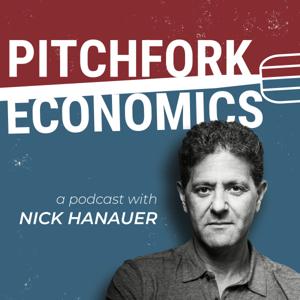


Based on Podcast App listening data
What do the internet and COVID vaccines have in common? Neither would be possible without the work of DARPA, a mission-focused federal agency responsible for funding research and development. Professor Mariana Mazzucato explains that our economy would be better off if more government agencies adopted DARPA’s mission-oriented approach.
This episode was originally released in May 2021. You can find the show notes and transcript for that episode here.
Mariana Mazzucato is a Professor in the Economics of Innovation and Public Value at University College London, where she is Founding Director of the UCL Institute for Innovation and Public Purpose. She is the author of three highly-acclaimed books: The Entrepreneurial State, The Value of Everything, and Mission Economy.
Twitter: @MazzucatoM
Mission Economy: https://marianamazzucato.com/books/mission-economy
It’s 2023. Here’s how we fixed the global economy: https://time.com/collection/great-reset/5900739/fix-economy-by-2023
DARPA’s early investment in COVID-19 antibody identification producing timely results: https://www.darpa.mil/news-events/2020-11-10
Website: https://pitchforkeconomics.com
Twitter: @PitchforkEcon
Instagram: @pitchforkeconomics
Nick's twitter: @NickHanauer
While most Americans know that our tax system advantages wealthy white families, not as many people realize how much it also actively disadvantages Black families. Tax law professor Dorothy Brown breaks down how racial inequality is built into U.S. tax policy and how we can try to fix it.
This episode was originally released in November 2021.
Dorothy A. Brown is professor of law at Emory University School of Law. She is a nationally recognized scholar in tax policy, race, and class and has published extensively on the racial implications of federal tax policy. She is the author of The Whiteness of Wealth: How the Tax System Impoverishes Black Americans — And How We Can Fix It.
Twitter: @DorothyABrown
The Whiteness of Wealth: https://bookshop.org/books/the-whiteness-of-wealth-how-the-tax-system-impoverishes-black-americans-and-how-we-can-fix-it/9780525577324
Black families pay significantly higher property taxes than white families, new analysis shows: https://www.washingtonpost.com/business/2020/07/02/black-property-tax/
Website: https://pitchforkeconomics.com/
Twitter: @PitchforkEcon
Instagram: @pitchforkeconomics
Nick’s twitter: @NickHanauer
What are the ethical limits of the market? How do we shift the balances of power back towards workers? What does true freedom really look like? Nick and Goldy explore these questions and more in a fascinating conversation with Philosophy Professor, Elizabeth Anderson.
This episode was originally released in September 2020.
Elizabeth Anderson is the Arthur F. Thurnau Professor and John Dewey Distinguished University Professor of Philosophy and Women’s Studies at the University of Michigan. She is the author of Private Government: How Employers Rule Our Lives (and Why We Don’t Talk About It), and a recipient of the 2019 MacArthur Fellowship.
Private Government: https://press.princeton.edu/books/hardcover/9780691176512/private-government
The philosopher redefining equality: https://www.newyorker.com/magazine/2019/01/07/the-philosopher-redefining-equality
Website: https://pitchforkeconomics.com
Twitter: @PitchforkEcon
Instagram: @pitchforkeconomics
Nick’s twitter: @NickHanauer
Business leaders can use their power and resources to make meaningful change, but should they? Ben Cohen and Jerry Greenfield, the founders of iconic ice cream brand Ben & Jerry’s, have navigated the landscape between business and activism since the 1970’s. They share their thoughts and experiences as well as their latest mission: ending qualified immunity.
This episode was originally recorded and released in April 2021.
Ben Cohen and Jerry Greenfield are the co-founders of Ben & Jerry’s Ice Cream. They’re also leaders of the Campaign to End Qualified Immunity, a police reform and criminal justice campaign.
Ben’s twitter: @YoBenCohen
https://campaigntoendqualifiedimmunity.org
Website: https://pitchforkeconomics.com
Twitter: @PitchforkEcon
Instagram: @pitchforkeconomics
Nick’s twitter: @NickHanauer
Nick and Goldy answer more of your questions! What’s the deal with cryptocurrency? How are people still saying that inflation was caused by the stimulus? Is capitalism better than market socialism? Plus some summer reading recommendations and an important podcast announcement.
If you have questions for a future AMA episode, leave us a voicemail at 731-388-9334.
Why This Computer Scientist Says All Cryptocurrency Should “Die in a Fire” https://www.currentaffairs.org/2022/05/why-this-computer-scientist-says-all-cryptocurrency-should-die-in-a-fire
Consumers deserve an inflation rebate (with Congressman Ro Khanna) https://pitchforkeconomics.com/episode/consumers-deserve-an-inflation-rebate-with-congressman-ro-khanna/
Website: http://pitchforkeconomics.com/
Twitter: @PitchforkEcon
Instagram: @pitchforkeconomics
Nick’s twitter: @NickHanauer
Chile has a proud tradition of protests, but the unrest of 2019 was different. More than a million people took to the streets to protest their nation’s vast inequality. The uprising made international news, unseated a neoliberal dictatorship, and led to the election of a new president—but did it also create lasting change? Chilean historian Marcelo Casals catches us up on the latest developments in Chile’s battle against neoliberalism.
Marcelo Casals is an independent scholar based in Santiago. He holds a PhD in Latin American history from the University of Wisconsin-Madison, and recently wrote an article for Dissent Magazine titled, ‘The End of Neoliberalism in Chile?’
Twitter: @Palquelea
The End of Neoliberalism in Chile? https://www.dissentmagazine.org/online_articles/the-end-of-neoliberalism-in-chile
Gabriel Boric: From student protest leader to Chile’s president: https://www.bbc.com/news/world-latin-america-59694056
‘Chile Woke Up’: Dictatorship’s Legacy of Inequality Triggers Mass Protests: https://www.nytimes.com/2019/11/03/world/americas/chile-protests.html
The texture piece is from 2019 and is courtesy of Gustavo de la Piedra, a listener from Santiago, Chile. The news clips are sourced from the news station France 24.
Website: http://pitchforkeconomics.com/
Twitter: @PitchforkEcon
Instagram: @pitchforkeconomics
Nick’s twitter: @NickHanauer
Millions of Americans lost their jobs because of the pandemic. While men have returned to their pre-pandemic level of employment, a million women are still missing from the workforce. Without access to paid maternity leave and affordable child care, women are choosing to stay home – or being forced to. It’s time for a more inclusive economic recovery. Reshma Saujani, the Founder of Girls Who Code and the Marshall Plan for Moms, has a plan to get us there.
Reshma Saujani is the founder of Girls Who Code and the Marshall Plan for Moms. She’s also an author of several books, her latest is called Pay Up: The Future of Women and Work (and Why It's Different Than You Think)
Twitter: @reshmasaujani
McKinsey - Meeting the challenge of moms’ ‘double double shift’ at home and work: https://www.mckinsey.com/featured-insights/sustainable-inclusive-growth/future-of-america/meeting-the-challenge-of-moms-double-double-shift-at-home-and-work
The Business Case for Child Care: https://marshallplanformoms.com/childcare-report/
Marshall Plan for Moms https://marshallplanformoms.com
Pay Up https://www.simonandschuster.com/books/Pay-Up/Reshma-Saujani/9781982191573
House Resolution 121 https://www.congress.gov/bill/117th-congress/house-resolution/121
Website: http://pitchforkeconomics.com/
Twitter: @PitchforkEcon
Instagram: @pitchforkeconomics
Nick’s twitter: @NickHanauer
What can the history of human progress teach us about modern inequality? In his new book, ‘The Journey of Humanity: The Origins of Wealth and Inequality,’ economist Oded Galor explores that question, as well as why human progress was stagnant for so much of history, if growth is still possible without ruining the planet, and what this all means for our future.
Oded Galor is a Professor of Economics at Brown University and the founding thinker behind Unified Growth Theory. He’s also the author of The Journey of Humanity: The Origins of Wealth and Inequality.
Twitter: @GalorOded
The Journey of Humanity https://www.penguinrandomhouse.com/books/679024/the-journey-of-humanity-by-oded-galor/
Website: http://pitchforkeconomics.com/
Twitter: @PitchforkEcon
Instagram: @pitchforkeconomics
Nick’s twitter: @NickHanauer
When it comes to crafting economic policy, cost-effectiveness, efficiency, choice, and competition have reigned supreme among policymakers for decades. Sociologist Elizabeth Popp Berman says that this style of economic reasoning—prioritizing efficiency above all else—makes good ideas seem like bad policy. She walks us through how that short-sighted style of thinking took hold in DC and explains when policymakers are right to lean on purely economic thinking—and when they should reject it in favor of prioritizing more fundamental values.
Elizabeth Popp Berman is a sociologist at the University of Michigan and the author of “Thinking Like an Economist: How Efficiency Replaced Equality in U.S. Public Policy”.
Twitter: @epopppp
Economics: Looking Back to Move Forward https://democracyjournal.org/magazine/64/economics-looking-back-to-move-forward
Thinking Like an Economist: How Efficiency Replaced Equality in U.S. Public Policy
https://press.princeton.edu/books/hardcover/9780691167381/thinking-like-an-economist
Website: http://pitchforkeconomics.com/
Twitter: @PitchforkEcon
Instagram: @pitchforkeconomics
Nick’s twitter: @NickHanauer
Reducing inequality is not only possible, but it’s actually happening all across the globe. Faiza Shaheen, the Inequality Program Lead at NYU, has been researching the conditions and policies that can lower inequality for years. She shares which countries have successfully done so, and speculates about whether the United States has a shot at joining them.
Dr. Faiza Shaheen is the Program Head for the Inequality and Exclusion Grand Challenge of the Pathfinders for Peaceful, Just and Inclusive Societies.
Twitter: @faizashaheen
Solutions to inequality https://medium.com/sdg16plus/solutions-to-inequality-962306388018
From Rhetoric to Action: Delivering Equality & Inclusion https://www.sdg16.plus/delivering-equality-and-inclusion
Website: http://pitchforkeconomics.com/
Twitter: @PitchforkEcon
Instagram: @pitchforkeconomics
Nick’s twitter: @NickHanauer
From the publisher's feed
Ranked by our users in the last 21 days

9,188 Listeners

10,714 Listeners

3,472 Listeners

1,982 Listeners

431 Listeners

1,198 Listeners

6,273 Listeners

6,103 Listeners

32,248 Listeners
545 Listeners

9,300 Listeners
627 Listeners

2,074 Listeners

15,886 Listeners

562 Listeners