
Sign up to save your podcasts
Or



Based on Podcast App listening data
How do you transform your practice from something that depends on you for everything, into something that grows with clarity and control on its own?
You've invested in equipment, hired good people, and are working hard; and yet, growth feels heavier than it should.
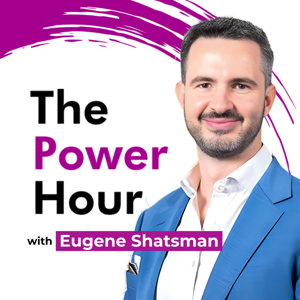
In this episode of Power Hour, Eugene Shatsman sits down with Jamie Rosin to talk about a systematic approach to practice growth.
The Eyecare BOSS System (Business, Optimization and Scalability System) is a structured operating framework built specifically for independent optometry practices that want to grow without chaos. Instead of relying on scattered ideas, reactive decisions, or owner-dependent execution, it organizes your entire practice around five integrated pillars:
Accountability, Revenue, People, Experience, and Data.
Jamie and Eugene take you through a strategic walkthrough of the system, revealing how your practice can eliminate bottlenecks, prioritize the highest-impact growth levers, develop leaders instead of managing personalities, improve patient satisfaction in measurable ways, and build a data-driven culture that predicts results before problems show up.
As the economics of practice ownership evolve, technology accelerates, and legislative conversations become more complex, who is shaping the future of optometry behind the scenes?
And what decisions are being made right now that could impact your practice next year?
In this episode of Power Hour, recorded live from the AOA Leaders Summit in St. Louis, Eugene Shatsman sits down with three of the American Optometric Association's elected leaders: Dr. Jacqueline M. Bowen (President), Dr. Teri K. Geist (President-Elect), and Dr. Terri A. Gossard (Vice President).
Together, they offer a firsthand look into what these leaders believe are the profession's biggest pressure points, and what they say the AOA is doing to protect, expand, and advance optometry heading into 2026.
People, Technology, and Strategy.
Three pillars that shaped how Dr. Solomon Gould built a scalable medical model, developed high-performing teams, and grew without sacrificing patient experience.
In this week's episode of Power Hour, Eugene sits down with Dr. Solomon Gould, Sr. Director of Eye Care at EssilorLuxottica, and a leader whose career spans nearly every side of optometry: private practice ownership, consulting, corporate environments, and large-scale operational growth.
He shares how to scale your practice without becoming the bottleneck, burning out the team, or losing what made your practice successful in the first place.
What if the biggest story in vision care right now isn't a new product, but a shift in patient behavior that could reshape 2026?
Today's episode is a little different (in the best way) because we're recording live from The Vision Council's Executive Summit. This is a conference filled with CEOs, founders, and eye care industry leaders who are here to network, but more importantly, to answer one big question:
What is actually happening in our industry right now, and what do we do next?
Joining Eugene on the show are Ashley Mills (CEO) and Alysse Henkel (VP of Research & Insights) from The Vision Council, and they're bringing something every practice owner should pay attention to: the data behind 2025.
Together, they break down what the data is revealing about patient spending, category performance, and the trade-offs consumers are making, and connect it to what practice owners should be thinking about for 2026. You'll also get a preview as to what's changing at Vision Expo Orlando 2026, and why the show is being designed to deliver more than excitement, it's being designed to deliver results.
2025 wasn't business as usual in optometry M&A.
Fewer buyers, more deal scrutiny, softer multiples, and a growing number of practice owners asking the same question: "Is my practice worth what I think it's worth?"
That's why this episode is perfectly timed for the start of 2026.
Eugene is joined by Anne Kavanagh (Founder & Managing Director) and Jason Preator (Managing Partner) from Kavanagh Consulting, two people who have seen more optometry practice transactions than almost anyone in the industry over the last decade. Their perspective is based on real deals, real outcomes, and patterns that repeat year after year.
Anne and Jason explain how the buyer landscape has evolved, who is actively acquiring practices right now, and how buyers are evaluating risk, structure, and long-term profitability.
Going from one location to two sounds exciting… until it's not.
The truth is, scaling a practice brings on a completely different level of complexity than just more patients or an increase in revenue; it's new operational pressure points, and a whole new set of problems that don't show up until you're already in motion.
In this listener-requested episode of Power Hour, host Eugene Shatsman speaks with two highly qualified professionals (Dr. Susan Lake, Optometrist at Eyecare Specialties, and Kevin Whaley-Stefany, Business Consultant at Autograph Eye LLC) who actually built and scaled multiple practices, and what it takes to succeed and scale in today's market.
If your optical felt different in 2025, you weren't imagining it.
Across the country, practices saw capture rates slip, exam-onlys rise, and patients walk out the door with a fresh refraction, buying absolutely nothing. We know this isn't temporary, so the Power Hour is not waiting it out, we're getting proactive.
This week, Eugeneand Kayla Ashlee, CEO of Spexy, collaborate againbecause she is obsessed (in all the best ways) with the real levers that move optical revenue. Unlike most conversations about capture rate, she helps her clients go far beyond pricing and "consumer sensitivity." Leveraging the data points from real practices she works with, Kayla breaks down human influence, retail science, merchandising psychology, and the subtle behaviors inside your practice that are pushing patients away instead of drawing them in.
In this episode of Power Hour, Eugene Shatsman sits down with Gary Gerber to explore why growth stalls when practices run on autopilot — and how revisiting the basics can unlock revenue, efficiency, and sustainability without adding complexity.
operationally, and financially—is where most practices struggle.
A Problem Most Practices Recognize
Many practices invest in advanced technology with good intentions—better care, differentiation, growth. Yet months later, the equipment is used inconsistently, reserved for rare cases, or quietly avoided because it disrupts flow.
Dr. Brujic explains why this happens so often:
The result is frustration—for clinicians, staff, and patients.
When close rates stall around 30–40%, most teams blame price. What if the real issue is what happens after the appointment?
Myopia management is no longer "up-and-coming." It's here, and it's big. In this episode of Power Hour, Eugene sits down with Matt Oerding, CEO & Founder of Treehouse Eyes, to unpack a market Matt describes as a untapped opportunity, and the uncomfortable reality behind it: even though a large share of optometrists say they offer myopia management, only ~4–5% of eligible kids are actually receiving treatment.
Matt explains that the myopia "adoption gap" isn't due to a lack of treatment options, but by execution: how consistently practices recommend, how the message is framed, and what happens after the parent says, "Let me think about it."
From the publisher's feed
Ranked by our users in the last 21 days

1,310 Listeners

2,440 Listeners

3,061 Listeners
102 Listeners
78 Listeners

15 Listeners

829 Listeners
20 Listeners
21 Listeners

1,602 Listeners

1,213 Listeners
18 Listeners
14 Listeners
0 Listeners
6 Listeners