
Sign up to save your podcasts
Or



Rob Farrow was an experienced marketing executive and his wife Christina Farrow was a successful professional wedding planner. They discovered there was no good software for wedding planner pros, so they decided to build software themselves. They invested their savings, built a loyal team, and started Aisle Planner to serve other wedding planner pros with a complete solution to power their businesses.
Aisle Planner grew slowly as they overcame huge obstacles, listened to their customers, and built world-class software that changed how events are managed. Aisle Planner is now the leading all-in-one software for wedding planners and event professionals with over 4000 customers.
After struggling through the COVID-19 shutdown several times, Rob and Christina decided to sell Aisle Planner to Fullsteam, a software holding company. They stayed for several years to meet their earn-out commitments and run the company with the same team.
Quote from Rob Farrow, co-founder of Aisle Planner"There's a very fine line between arrogance and ignorance. And somewhere in there is where I was living in this. When we started, I was so sure we would succeed that I ignored obvious signs of failure. I just believed wholeheartedly. I believe in myself, I believe in my wife, and I believe in our team.
"If you have that belief, you can achieve things. And I know that sounds very cliche, but you have to have that belief. If you're doing it for the right reasons, you'll have that belief. If you're doing it to get rich quick, you won't.
"There's a bunch of obstacles that you don't even know are coming our way. With that mindset of belief and just forging ahead, you're ready for any obstacle. They're not obstacles; they're just things you deal with."
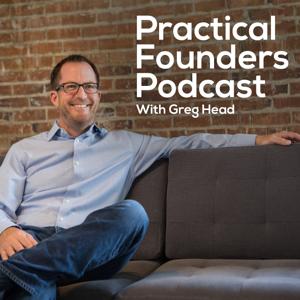
The Practical Founders PodcastTune into the Practical Founders Podcast for weekly in-depth interviews with founders who have built valuable software companies without big funding. Subscribe to the Practical Founders Podcast using your favorite podcast app.
Get the weekly Practical Founders newsletter and podcast updates at practicalfounders.com.Krista Morgan started her first tech company by raising funding and trying to grow very fast. When the company faced a big issue and failed, she learned that big funding was more of a problem than a help in the growth and wind-down processes.
Krista is now CEO and General Partner of Stage Fund, an early-stage private equity fund that makes control acquisitions of venture-funded SaaS companies that are stuck and need an alternative option to continue in a practical and profitable way.
In this expert episode, Krista explains:
"The game for practical startup founders is to find a way to make good decisions in the reality of today while still holding this big vision of the future. We can't just grow at all costs, and we can't just make all these big investments.
"There's this misconception that practical founders don't have a big vision of the future. Of course, they do. They're just thinking about it and getting there in a different way. And that's where we want to be.
"When I was founder of my first tech company, I thought money was always the answer. But money is usually NOT the answer. There is usually an answer, and maybe it takes money to get there, but it's not the magical thinking of, If I just had five more people, I'd be here. Maybe, or maybe you wouldn't. There's no guarantee on that."
LinksTune into the Practical Founders Podcast for weekly in-depth interviews with founders who have built valuable software companies without big funding. Subscribe to the Practical Founders Podcast using your favorite podcast app.
Get the weekly Practical Founders newsletter and podcast updates at practicalfounders.com.Ian Manners was a successful consultant for pharmaceutical companies in the US when he discovered a major problem that needed a software solution. Big pharma companies provide financial assistance funding for patients who require their drugs but struggle with high costs, but these funds are difficult to access and manage for patients and healthcare providers.
Ian and his cofounder created Vivor in 2014 to connect this financial assistance funding to patients through healthcare providers like hospitals, medical offices, and healthcare networks. The bootstrapped software startup grew slowly at first but eventually became profitable as it scaled up. Since inception, Vivor has helped over 100,000 patients receive over $2 billion in financial assistance to offset the high costs of prescriptions.
During the COVID crisis that hit the US healthcare industry, Ian decided to merge Vivor with TailorMed, a VC-funded competitor, in a cash and stock deal. He stayed on for two years during the transition and is now looking for his next entrepreneurial adventure in healthcare software.
Quote from Ian Manners, cofounder and former CEO of Vivor"The overall idea of merging our companies and having stock and some cash in our acquisition structure made sense for both parties. If the company that's acquiring your company is huge and they've got big cash reserves, they buy someone out. But if you're combining with another startup, that cash is precious. They don't want to spend all of it.
"So it really makes sense to do a combination of the two and to include equity in the deal. I think that part was absolutely a win-win, even when, as you're going through that process, you negotiate all the details.
"It's a huge bet for us to take equity as part of our deal, We became an investor in the company that bought us.. I think for anyone facing something similar, my advice would be to just slow down that part of it and really think about and digest the fact that you're becoming an investor in the combined company. "
LinksTune into the Practical Founders Podcast for weekly in-depth interviews with founders who have built valuable software companies without big funding. Subscribe to the Practical Founders Podcast using your favorite podcast app.
Get the weekly Practical Founders newsletter and podcast updates at practicalfounders.com.Dave Lambert and the team at Right Side Capital Management are the most active venture capital investors, having invested in over 2,000 startups since 2009.
Right Side Capital is a "pre-VC" institutional investor that operates very differently from traditional VCs: investing when SaaS companies have just a little revenue using a submission form on their website, then responding quickly and making investment decisions in a week. They also invest in practical SaaS founders with capital-efficient approaches who expect to sell their companies someday for less than $100M.
In this expert episode, Dave shares practical insights for SaaS founders who don't expect to play the big VC funding game:
"More often than not, at the stages that we're investing and someone has $4K, $8K, $20K MRR, the founders are still supremely confident and think they figured out their exact ICP and how it's going to grow in scale. They think, We're just going to take your money, and it's going to be straight up from here. And it never does, or almost never does.
"We're having conversations with founders where we're sharing, Hey, just so you know, 90% of our companies miss their revenue targets massively in their first year. So you should assume that you are going to as well.
"But guess what? They all spend exactly what they thought they were gonna spend or more, usually. Just know that that's gonna be the case and have a plan for where you're still alive if things don't go as expected."
LinksTune into the Practical Founders Podcast for weekly in-depth interviews with founders who have built valuable software companies without big funding. Subscribe to the Practical Founders Podcast using your favorite podcast app.
Get the weekly Practical Founders newsletter and podcast updates at practicalfounders.com.Todd Watson is the owner and CEO of Showit, a popular no-code website builder and platform for designers and photographers. Todd is a native of Phoenix, Arizona where he started as a videographer before joining a friend in 2007 to create a scrappy software business that made inexpensive photo-presenting and sharing tools for photographers.
The Showit company was created when Todd took one of their two products and half the small team in 2010 to spin off Showit as an independent business. The small revenue from the small customer base and his own savings allowed them to rewrite Showit for the cloud and then continue their fanatic customer focus to keep growing every year—without any outside funding.
Now Showit is used by 50,000 designers, photographers, and small businesses as their website platform using its elegant "Photoshop-like" no-code visual builder. The Showit company is growing quickly every year and is profitable, yet Todd has no interest in taking outside funding or selling his beloved company.
LinksTune into the Practical Founders Podcast for weekly in-depth interviews with founders who have built valuable software companies without big funding. Subscribe to the Practical Founders Podcast using your favorite podcast app.
Get the weekly Practical Founders newsletter and podcast updates at practicalfounders.com.Erin Fletter had a long career in the restaurant business before starting an after-school enrichment program to teach kids how to cook at her daughters' school in 2011. Her cooking program became popular, and she improved and expanded it to become a paid program called Sticky Fingers Cooking. Soon, she had a sizable business with over 100 chef-instructor employees who conducted engaging classes daily in Denver.
Her team created custom software to help manage their complicated operations, from enrolling students, coordinating instructors, and building relationships with schools to handling payments and payroll. The software grew slowly initially but eventually became a powerful system that helped them scale their business and run efficiently.
Erin considered turning her business into a software company, as many tech-powered businesses do. Instead, they kept improving the software and expanding operations, serving over 100,000 students and thousands of schools and venues. Now Sticky Fingers Cooling is a fast-growing and successful franchise business with a software superpower.
Quote from Erin Fletter, CEO of Sticky Fingers Cooking
"Our business has a lot of logistics, coordination, and operations. Our own custom software, we call it the Dash, it takes about 85% of all operations off the table for humans. This enables our chef-instructors to connect with their students and our franchise owners and regional directors to focus on building relationships with schools and parents.
"Over the years, we have been contacted by very large organizations like YMCAs, Boys and Girls Clubs, and other after-school enrichments about our software. They would see our automatic rosters getting texted and emailed at the venues that we were teaching in, and they asked, What are you using? What is this? And we told them, Well, it's our own software, sorry.
"We had talked for years about selling our software as a white-label solution because the demand is there. We've had inquiries for the last 10 years. That was a direction we could have taken.
"But I'm just laser-focused on Sticky Fingers Cooking. It's a very simple business, and our technology helps us do it incredibly well. We want to be the best at what we do. I didn't really want a diversion from the path of taking our business national through franchising."
LinksTune into the Practical Founders Podcast for weekly in-depth interviews with founders who have built valuable software companies without big funding. Subscribe to the Practical Founders Podcast using your favorite podcast app.
Get the weekly Practical Founders newsletter and podcast updates at practicalfounders.com.In this second of two episodes, Practical Founders Podcast host Greg Head discusses the next five important things venture capital investors don't tell new SaaS startup founders. Greg emphasizes that VCs invest in very few businesses and seek big wins. He highlights the importance of understanding the game of venture capital funding and the alternatives available to SaaS founders.
Check out last week's episode, in which Greg discusses the first five things that VCs don't tell SaaS startup founders about raising VC capital.
Quote from Greg Head, Host of the Practical Founders Podcast"Professional VC investors are expecting very big results when they invest. If you sell a piece of your company to get a $5 million Series A investment, that typically ends up being about 20 percent of your equity. So you've just valued your company after funding at about $25 million.
"$25 million is the point where the venture capital investor comes in, so you can't sell your business for $30 million or $50 million anymore. That wasn't why the VC invested. They probably don't even want you to sell your business for $75 million. That's just a 3X exit.
"That's not what they invested their precious cash. They're going for a 10x or 20x exit. So even when you just take $5 million from VCs, you can't sell your company for less than $100 million and have everyone win. You have to sell for $500 million or more for everyone to be happy, including the founders."
LinksIn this episode, Practical Founders Podcast host Greg Head discusses the most important things venture capital investors don't tell new SaaS startup founders. He emphasizes that VCs invest in very few businesses and are looking for big wins. Greg highlights the importance of understanding the game of venture capital funding and the alternatives available to SaaS founders.
Quote from Greg Head, Host of the Practical Founders Podcast"If you're thinking about raising VC investment, do your homework so you know what you are signing up for before. VCs are not evil people, and it's not a bad business model—for them.
"The world has changed for SaaS founders in the last 5-10 years, and it's still changing. You no longer need VC funding to start most B2B SaaS software companies. It's 10 times cheaper to create a sellable SaaS product and go to market now. And founders can get higher multiples earlier when they sell their companies. VC funds are also much bigger, so it's riskier for founders to play that game.
"You just don't need to make a crazy all-or-nothing bet that your company will create a billion-dollar exit in seven years, which VC investors require to win. The best case scenario for 80 to 90 % of software companies is NOT to raise big institutional venture funding."
LinksTune into the Practical Founders Podcast for weekly in-depth interviews with founders who have built valuable software companies—without big funding.
Subscribe to the Practical Founders Podcast using your favorite podcast app.
Mike Trasatti spent 10 years in the automotive dealer software business before he found an auto dealer in Iowa who had built is own complete software system. They partnered up in 2008, and Mike became the first CEO of the spinout software company, DealerBuilt.
DealerBuilt grew slowly as a bootstrapped startup in a market full of large incumbent competitors. They had a better approach to managing multiple dealers in a group with their dealer management system (DMS). DealerBuilt is powerful software that manages the entire financial operations of an auto dealer in the US.
They grew steadily to 450 dealer customers and 100 employees in 10 years before deciding to partner with ParkerGale, a private equity investor, to help them with their next growth stage in 2019. Mike continued as CEO until 2023, navigating through the COVID years and acquiring several "tuck-in" products to extend the DealerBuilt solution. Mike is now an independent advisor to DealerBuilt and other organizations.
Quote from Mike Trasatti, former CEO of DealerBuilt"You're constantly challenged in the entrepreneurial world. Do you really know what you're doing? Self-doubt can be tremendously harmful to CEOs. I don't think you can get into this business without a strong image of yourself and real confidence.
"But you have to balance confidence with humility because you'll make mistakes. You're going to have setbacks every week, and some very big ones, too. You can't lose enthusiasm: You need enough confidence that you're on the right path and that will carry you more than anything else. Those who don't lose enthusiasm win.
"When you have both confidence and humility, you won't be afraid to be around people who are better than you. And you'll feel comfortable in that space, leading smart people who are championing your journey. They will look at you and think, I want to be there with you to champion this for you. That's success as a leader."
LinksTune into the Practical Founders Podcast for weekly in-depth interviews with founders who have built valuable software companies without big funding. Subscribe to the Practical Founders Podcast using your favorite podcast app.
Get the weekly Practical Founders newsletter and podcast updates at practicalfounders.com.Brian Abernethy, founder of Utopaya, is an expert in helping SaaS leaders navigate the complicated process of adding payments monetization to their product offerings and business strategies. With a long history in the payments industry, Brian has worked with hundreds of early-stage SaaS leaders and their investors to optimize their payments strategies.
In this expert podcast interview, Brian explains the basics of payments monetization for practical SaaS founders, answering questions like these:
Quote from Brian Abernethy, principal at Utopaya "Most software companies are looking to include some type of fintech offering. Payments is typically the first one of those. These software companies want to own not only the bigger portion of revenue, of course, but also mprove the customer experience.
"Recent consolidation in the fintech and payments industry has created new options for SaaS companies to monetize payments. The big payments providers are now much bigger and have moved upmarket, creating a gap. Many new payments players are designed for smaller SaaS companies, with purpose-built platforms, APIs, and more support for integrated software solutions.
"There are more compelling solutions for SaaS companies to launch truly white-labeled, profitable, and easier-to-implement payments solutions. Also, the market data show that it does positively change the customer experience, so these smaller payment companies are winning share at a fast clip."
LinksTune into the Practical Founders Podcast for weekly in-depth interviews with founders who have built valuable software companies without big funding. Subscribe to the Practical Founders Podcast using your favorite podcast app.
Get the weekly Practical Founders newsletter and podcast updates at practicalfounders.com.From the publisher's feed
16,055 Listeners

541 Listeners

2,698 Listeners
698 Listeners

1,087 Listeners
2,343 Listeners
2,208 Listeners

225 Listeners

2,647 Listeners

10,186 Listeners

510 Listeners

278 Listeners

290 Listeners

658 Listeners

93 Listeners