
Sign up to save your podcasts
Or



Based on Podcast App listening data
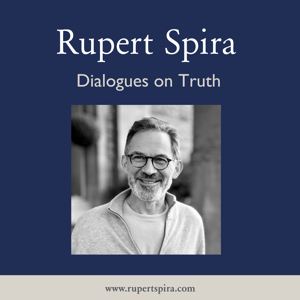
In this episode, Rupert Spira talks to Stuart Goodnick and Rob Schmidt from The Mystical Positivist. They discuss Rupert's spiritual journey, as well as the Direct Path, and the role of a teacher.
Stuart Goodnick and Rob Schmidt host a radio show called The Mystical Positivist, that involves discussion in and around the local and larger spiritual community.
In this episode Rupert Spira and Rupert Sheldrake talk about the nature of reality, consciousness, and beliefs about the universe, and discover a common understanding.
Rupert Sheldrake is a biologist best known for his hypothesis of morphic resonance.
Music written and played by Shena Power and recorded by Simon Power.
In this episode Rupert Spira talks to Jenny Beal about his work as a potter, and the evolution into his current activity, with Rupert making the transition from the form of clay to the form of words.
If you'd like to explore these themes further, Rupert's book A Meditation on I Am (2021) features the poem Rupert engraved onto large bowls. The book also includes a short afterword, 'Bowls out of Words'.
We hope you enjoy this episode. Please subscribe if you would like to be notified whenever new episodes are available. If you would like to find out more about events, publications, and Rupert's archive of recordings, please visit rupertspira.com
These dialogues are taken from Rupert Spira's 5th July 2019 evening meeting in London. For audio and video recordings of the full meeting and the entire library of Rupert Spira's recordings and publications, as well as information about attending live and streamed events, please visit rupertspira.com.
In this episode, Rupert uses the metaphor of the actor John Smith playing the part of King Lear to address questions about reincarnation, the nature of experience, and overcoming self-doubt.
These dialogues are taken from Rupert Spira's May retreat in Wales, The True Friend,and November 2019 weekend in Copenhagen, Sharing Our Being. For audio and video recordings of the full retreat and the entire library of Rupert Spira's recordings and publications, as well as information about attending live and streamed events, please visit rupertspira.com.
In this episode, questioners ask if expressing emotions is a good spiritual practice; if there are positive aspects of the separate self; who is the self that seeks happiness; and whether identification with the 'I' of experience is actually a subtle layer of the separate self.
These dialogues are taken from Rupert Spira's November 2019 weekend in Copenhagen, Sharing Our Being,and December 2019 retreat in Wales, Being Myself. For audio and video recordings of the full retreats and the entire library of Rupert Spira's recordings and publications, as well as information about attending live and streamed events, please visit rupertspira.com.
The perennial, non-dual understanding that lies at the heart of all the great religious and spiritual traditions – Advaita Vedanta, Buddhism, Christianity, Hinduism, Judaism, Sufism, Taoism and Zen, among others – allows us to investigate the essential nature of our experience. In the simple knowing of our own being, we discover the source of the peace and happiness for which all people long above all else.
In this episode a man who says he feels localised within his mind asks Rupert for guidance; another man asks about the creative power of narrative thoughts; a woman asks how to set boundaries without feeling resistance; and a 'recovering Catholic' says he has a residual sense of guilt about the direct path as opposed to surrendering oneself for the sake of others.
These dialogues are taken from Rupert Spira's March 2019 retreat in California, The Devouring of Experience, and April 2019 weekend in Amsterdam, The Nature of 'I'. For audio and video recordings of the full retreats and the entire library of Rupert Spira's recordings and publications, as well as information about attending live and streamed events, please visit rupertspira.com.
The perennial, non-dual understanding that lies at the heart of all the great religious and spiritual traditions – Advaita Vedanta, Buddhism, Christianity, Hinduism, Judaism, Sufism, Taoism and Zen, among others – allows us to investigate the essential nature of our experience. In the simple knowing of our own being, we discover the source of the peace and happiness for which all people long above all else.
In this episode a man asks about the process of integration following the recognition of our true nature; a woman asks how to focus attention on objects without contracting into a separate self; and a man asks if the observer of the observed is located inside the body.
These dialogues are taken from Rupert Spira's April 2019 retreat in New York, Naked, Self-Aware Being, and May retreat in Wales,The True Friend. For audio and video recordings of the full retreats and the entire library of Rupert Spira's recordings and publications, as well as information about attending live and streamed events, please visit rupertspira.com.
The perennial, non-dual understanding that lies at the heart of all the great religious and spiritual traditions – Advaita Vedanta, Buddhism, Christianity, Hinduism, Judaism, Sufism, Taoism and Zen, among others – allows us to investigate the essential nature of our experience. In the simple knowing of our own being, we discover the source of the peace and happiness for which all people long above all else.
In this episode a woman asks who or what is aware; another woman asks about memory and its relationship with identity; and a man asks if insentient things are a movement of consciousness.
These dialogues are taken from Rupert Spira's May 2019 retreat in Wales, The True Friend. For audio and video recordings of the full retreat and the entire library of Rupert Spira's recordings and publications, as well as information about attending live and streamed events, please visit rupertspira.com.
The perennial, non-dual understanding that lies at the heart of all the great religious and spiritual traditions – Advaita Vedanta, Buddhism, Christianity, Hinduism, Judaism, Sufism, Taoism and Zen, among others – allows us to investigate the essential nature of our experience. In the simple knowing of our own being, we discover the source of the peace and happiness for which all people long above all else.
In this episode, a woman asks why consciousness creates the world; another woman asks about time, the laws of physics and if the material world is a dream; and Rupert speaks about how all activities of mind, including time and space, are the movement of consciousness.
The dialogues in this episode are taken from Rupert Spira's May 2019 retreat in Wales, The True Friend. For audio and video recordings of the full retreat and the entire library of Rupert Spira's recordings and publications, as well as information about attending live and streamed events, please visit rupertspira.com.
The perennial, non-dual understanding that lies at the heart of all the great religious and spiritual traditions – Advaita Vedanta, Buddhism, Christianity, Hinduism, Judaism, Sufism, Taoism and Zen, among others – allows us to investigate the essential nature of our experience. In the simple knowing of our own being, we discover the source of the peace and happiness for which all people long above all else.
From the publisher's feed
Ranked by our users in the last 21 days
10,502 Listeners

1,852 Listeners
2,629 Listeners
1,479 Listeners
632 Listeners
21,048 Listeners
31,730 Listeners

8,527 Listeners
3,723 Listeners

29,204 Listeners
5,477 Listeners
869 Listeners
799 Listeners
1,423 Listeners
628 Listeners