
Sign up to save your podcasts
Or

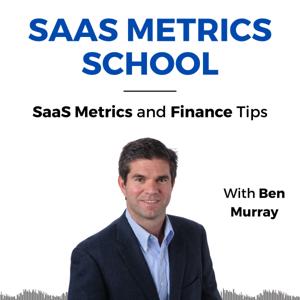


Are AI inference costs already eating into your gross margin — and you can't even see them on your P&L?
In episode #370, Ben Murray breaks down exactly what belongs in AI COGS for SaaS companies offering an AI-first or AI-infused product line. Inference bills are stacking up fast, infrastructure-layer spend is the surprise line item nobody priced in, and most finance teams haven't built the GL account structure to capture any of it cleanly. If you don't get the framework in place now, you'll be reporting AI gross margin you can't actually defend by next quarter — and your board will notice.
Tune in to get the AI COGS framework in place before your gross margin lands on a board slide you can't defend.
Did your AI bill just jump overnight — even though no one announced a price increase?
In episode #369, Ben Murray breaks down the hidden AI price hike that's quietly hitting SaaS P&Ls this month. Anthropic shipped a new tokenizer underneath Claude Opus 4.7 — same menu pricing as 4.6, but real enterprise workloads are showing 12-27% higher effective cost, with some prompts consuming up to 35% more tokens for identical output. Most finance teams won't catch this variance until the invoice lands. If you're running AI in production, paying for Claude Code, or modeling AI COGS into next year's plan, this is the cost dynamic you need on your radar before the next board meeting.
Tune in before your next Anthropic invoice lands — and learn what to track now so AI variance doesn't become a board question.
Can you actually prove what your AI product is doing for customers — or are you still pointing at token counts and hoping the board nods along?
In episode #368, Ben Murray breaks down the four layers of AI measurement that every SaaS company needs to communicate internally and externally. Token usage is table stakes. The real question is whether you can move up the stack from consumption to work performed to verified outcomes to quantifiable P&L impact. Get this wrong, and your AI story falls apart in front of investors, customers, and your own finance team. Get it right, and you finally have ROI math a CFO will actually approve.
Tune in before your next board meeting — your AI story needs more than token counts.
Salesforce just invented a new metric on their latest earnings call — not because they needed one, but because Wall Street didn't have the vocabulary to value what they built.
In episode #366, Ben Murray breaks down Salesforce's Q4 FY2026 earnings call — not the financials, but the narrative architecture: a new unit of measurement for AI value (the AWU), a framing strategy designed to neutralize the biggest fear enterprise buyers have about AI, and three customer testimonials brought live onto the call. This is the communication playbook every SaaS operator can steal when explaining AI to boards, investors, and customers — at a time when the old metrics (tokens, MAUs, queries) no longer tell the value story.
Tune in before your next board meeting or AI sales pitch — and steal the vocabulary that's about to define the category.
HubSpot's 50-cent bet may have just forced every SaaS founder to ask whether their current revenue model is still defensible.
In episode #365, Ben Murray breaks down HubSpot's April 2nd announcement — slashing its Breeze customer agent from $1 to 50¢ per resolved conversation, plus a shift on its prospecting agent to $1 per qualified lead — and what this risk transfer means for SaaS revenue, forecasting, and the metrics CFOs need to start tracking. With Salesforce Agent Force hitting $800M in Q4 run rate and over 60% of bookings coming from existing-customer expansion, the question is no longer whether AI is reshaping SaaS pricing, but how fast and how unevenly. Ben pulls in his SEC filings research and a sharp counterpoint from Salesforce's own earnings call to show why the "SaaS is dead" narrative is overplayed.
Listen before your next pricing committee meeting — and bring your CFO. The forecasting implications alone are worth the six minutes.
Is your AI SaaS company skating on thin ice because of exploding compute costs you're not tracking?
In episode #365, Ben Murray tackles one of the most pressing financial challenges facing AI-first SaaS companies: the structural margin compression caused by LLM inference costs. Traditional SaaS was built on near-zero marginal cost per customer — that era is over. If you're building on top of AI, every prompt, query, and agentic workflow is a hard COGS line that scales with revenue, and if you're not managing it, it will quietly destroy your unit economics.
Tune in before your next board meeting — because if you're not tracking AI inference costs at the feature level, you're flying blind on your most important unit economics.
Resources Mentioned
In episode #364, Ben Murray breaks down how SaaS finance teams should structure their chart of accounts to properly track inference costs, productivity AI, and agentic AI spend. As organizations shift from W-2 headcount to token costs and agentic software, your current expense coding may be out-of-date. If you can't see where the AI spend is going, you can't tie it to ROI — and you definitely can't make the case for going fully agentic.
Resources Mentioned
Is your SaaS company competing for funding in a market that's already decided AI wins? The Q1 2026 data is in — and the numbers are decisive.
If you're a SaaS founder thinking about your next raise — or a CFO modeling out valuation scenarios — understanding where investors are actually writing checks matters more than ever. In epsiode #363, Ben Murray covers:
Listen now to get the Q1 2026 funding breakdown — then download the full PDF report to see exactly where smart money is going before your next raise.
Are you feeding raw financial data straight into AI and wondering why the results are inconsistent — or worse, just wrong?
AI is only as good as the data architecture underneath it. For SaaS CFOs and operators running monthly FP&A cycles, that means the order of operations matters enormously. Skip the deterministic compute layer, and your AI narrates garbage. Get the structure right, and suddenly AI can do what no human ever could — synthesize five years of retention schedules and SaaS metrics in seconds.
In episode #362, I'll cover:
If you're building or buying any AI layer on top of your SaaS financials, listen to this before you ship anything — these five lessons will save you weeks of bad output.
Resources Mentioned
Everyone's saying AI will kill SaaS — but is the SaaSpocalypse actually real, or just the latest wave of disruption that enterprise software has survived before?
If you're a SaaS founder or operator watching vibe-coded apps spin up overnight, the fear is real. But the narrative is missing something critical: enterprise software isn't just code, and the moats that protect your ARR aren't going away anytime soon. Understanding what actually protects your revenue — and what doesn't — is the difference between panic and a clear-headed strategy. Here's what will you'll learn in episode #361 with Ben Murray.
Tune in for the full bull case on SaaS survival — and get the frameworks from Ben's SaaSpocalypse blog post linked in the show notes.
From the publisher's feed

542 Listeners
177 Listeners
2,344 Listeners
2,209 Listeners
339 Listeners

10,190 Listeners

61,781 Listeners
349 Listeners

30 Listeners
4 Listeners