
Sign up to save your podcasts
Or

By Slate Podcasts
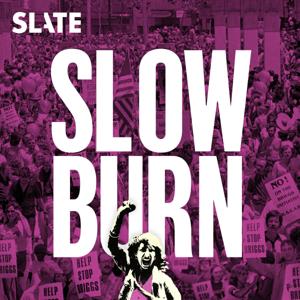
Slow Burn illuminates America’s most consequential moments, making sense of the past to better understand the present. Through archival tape and first-person interviews, the series uncovers the sur
... more

4.6
2379323,793 ratings


The podcast currently has 233 episodes available.
The most played episodes among Podcast App listeners.
McGruff the Crime Dog arrived on the scene at the dawn of the 1980s, just as a firehose of anti-drug PSAs was inundating the youth of America. These messages didn’t always work as intended—but they did work their way into the long term memories of the kids who heard them. In the second episode of our two-part series, originally released in 2022, on the weird world of PSAs and very special episodes, we look at how McGruff’s Smart Kids Album influenced everything from straight edge hardcore to a couple’s wedding playlist. We’ll hear from Sarah Hubbard, Daniel Danger, Joseph Cappella, David Farber, Mike Hawes, Robin Nelson, Daisy Rosario, and Tatiana Peralta. This episode was written by Willa Paskin, and produced by Willa Paskin and Katie Shepherd. It was edited by Jamie York. Decoder Ring is produced by Max Freedman and Evan Chung, our supervising producer. Merritt Jacob is Senior Technical Director. Our intern is Phoebe Mulder. Thank you to Derek John, Ari Merkin, Wendy Melillo, Dan McQuade, Dale Mantley, Larissa Zargeris, Dave Bledsoe, Larre Johnson, Duane Poole, Eric Greenberg, Charles and Karen Rosen, Jennifer Holland, Orla Mejia, Andres Martinez, and everyone else at the Rutgers University Library. You can listen to Daniel Danger’s McGruff cover album in its entirety or purchase it here. If you are interested in hearing the full McGruff educational program or any of Puppet Productions productions, they are available for purchase at puppetsinc.com. If you have any cultural mysteries you want us to decode, email us at [email protected] or leave a message on our hotline at (347) 460-7281. Get more of Decoder Ring with Slate Plus! Join for exclusive bonus episodes of Decoder Ring and ad-free listening on all your favorite Slate podcasts. Subscribe from the Decoder Ring show page on Apple Podcasts or Spotify. Or, visit slate.com/decoderplus for access wherever you listen. Need to set up your Slate Plus feed? If you subscribed through Slate.com, check out our FAQ at slate.com/podcastfaqs for easy instructions. Members subscribed via Apple Podcasts get automatic access—no setup required. Hosted on Acast. See acast.com/privacy for more information.

Podcasts are everywhere. They’re more popular and influential than they’ve ever been. But at the same time, what makes a podcast a “podcast” has never been more confusing. Until recently, the definition of “podcast” was clear: audio distributed over the internet. A podcast was something you listened to, not something you watched. But now, almost all of the most popular podcasts have video, too. And most of these podcasts share a video-friendly format: two or three people chatting behind big bulky microphones. You may have noticed that our podcast, Decoder Ring, does not have video, so these developments have given our team, like many other podcast-makers, no shortage of anxiety. In this week’s episode, we’re embracing our inner chatcast: host Willa Paskin and supervising producer Evan Chung trace the history and evolution of podcasting through their own histories with the medium, and wrestle with their complicated feelings about the state of the format in 2026. This episode was produced by Max Freedman. Merritt Jacob is Senior Technical Director. Our intern is Phoebe Mulder. Video production by Micah Phillips. Special thanks to Amanda Dobbins, Leon Neyfakh, Nick Quah, Ben Richmond, Amber Robinson, Susan Matthews, Mary Harris, and Mia Lobel. If you have any cultural mysteries you want us to decode, email us at [email protected] or leave a message on our hotline at (347) 460-7281. Sources for This Episode “How YouTube Ate Podcasts and TV,” Galaxy Brain, Dec. 12, 2025. Kang, Jay Caspian. “CNN’s ‘Podcast Look’ and the Slow Death of Cable News,” The New Yorker, March 24, 2026. Quah, Nicholas. “Will Video Kill the Audio Star in 2025?” New York Magazine, Dec. 31, 2024. Testa, Jessica. “It Was Just a Podcast. Now, It’s Kelce Land,” The New York Times, Apr. 24, 2026. Get more of Decoder Ring with Slate Plus! Join for exclusive bonus episodes of Decoder Ring and ad-free listening on all your favorite Slate podcasts. Subscribe from the Decoder Ring show page on Apple Podcasts or Spotify. Or, visit slate.com/decoderplus for access wherever you listen. Need to set up your Slate Plus feed? If you subscribed through Slate.com, check out our FAQ at slate.com/podcastfaqs for easy instructions. Members subscribed via Apple Podcasts get automatic access—no setup required. Hosted on Acast. See acast.com/privacy for more information.
McGruff the Crime Dog arrived on the scene at the dawn of the 1980s, just as a firehose of anti-drug PSAs was inundating the youth of America. These messages didn’t always work as intended—but they did work their way into the long term memories of the kids who heard them. In the first of two episodes, originally released in 2022, we take a look at PSAs and their strange afterlife through the lens of a trench-coat wearing bloodhound and his bizarre, yet catchy anti-drug songs. We’ll talk to Dan Danger, Sherry Nemmers, Joseph Cappella, David Farber, Mike Hawes, and Robin Nelson to discover how the McGruff Smart Kids Album came to exist in the first place. This episode was written by Willa Paskin. It was produced by Willa Paskin and Katie Shepherd. We had production help from Sam Kim. Editing by Jamie York and Derek John. Decoder Ring is produced by Max Freedman and Evan Chung, our supervising producer. Merritt Jacob is Senior Technical Director. Our intern is Phoebe Mulder. Thank you to Wendy Melillo, Dan McQuade, Dale Mantley, Larissa Zargeris, Daisy Rosario, Dave Bledsoe, Larre Johnson, Duane Poole, Ari Merkin, Charles and Karen Rosen, and Eric Greenberg. If you have any cultural mysteries you want us to decode, email us at [email protected] or leave a message on our hotline at (347) 460-7281. Get more of Decoder Ring with Slate Plus! Join for exclusive bonus episodes of Decoder Ring and ad-free listening on all your favorite Slate podcasts. Subscribe from the Decoder Ring show page on Apple Podcasts or Spotify. Or, visit slate.com/decoderplus for access wherever you listen. Need to set up your Slate Plus feed? If you subscribed through Slate.com, check out our FAQ at slate.com/podcastfaqs for easy instructions. Members subscribed via Apple Podcasts get automatic access—no setup required. Hosted on Acast. See acast.com/privacy for more information.
Here at Slow Burn, we explore the events and people who shaped America as we know it today. As the country marks its 250th birthday this summer, we want to introduce you to the first installment of First America, a great podcast series that explores a truly consequential moment from our nation’s past. We have been told the American Revolution was fought over taxation and representation. First America reveals the real story of why the colonists rebelled, what kind of government they created, and how it led to America’s current political moment. Hosted by Rebecca Nagle, an Indigenous author and former host of Crooked Media’s This Land podcast, the series looks at the hunger for Indigenous land that fueled the American Revolution—and questions how an entire country missed the point of its own founding document. The show's first episode takes its title from the lesser-known last grievance in the Declaration of Independence. Listen to “Merciless Indian Savages,” from First America—and find the rest of the series wherever you get podcasts. Need to set up your Slate Plus feed? If you subscribed through Slate.com, check out our FAQ at slate.com/podcastfaqs for easy instructions. Members subscribed via Apple Podcasts get automatic access—no setup required. Hosted on Acast. See acast.com/privacy for more information.
Most of us use GPS—the Global Positioning System—on a daily basis: to find our location when we’re driving, running, shopping, dating, and so much more. But GPS is even more important, and more vulnerable, than you think. In the last few years, GPS interference has been reported all over the world, from war zones to shipping routes to public squares. What was once the fanciful plot of a Bond movie—bad guy manipulates GPS to start World War III—is increasingly plausible. How did the world come to rely so heavily on such an unreliable system? In this episode of Decoder Ring, host Willa Paskin talks to journalist Katherine Dunn, author of the new book Little Blue Dot: How GPS Shaped the Modern World. You’ll learn how GPS works, why it was created, how it became so ubiquitous, and why it’s now under attack. You’ll also hear from Dr. Todd Humphreys, an aerospace engineer who manipulated GPS to trick an $85 million superyacht into following his direction—for science, of course. This episode was written and produced by Max Freedman. It was edited by Willa Paskin and Evan Chung, our supervising producer. Merritt Jacob is Senior Technical Director. Our intern is Phoebe Mulder. If you have any cultural mysteries you want us to decode, email us at [email protected] or leave a message on our hotline at (347) 460-7281. Sources for This Episode Burgess, Matt. “When a tanker vanishes, all the evidence points to Russia,” WIRED, Sep. 21, 2017. Dunn, Katherine. Little Blue Dot: How GPS Shaped the Modern World, Bloomsbury Publishing, 2026. Dunn, Katherine. “How to Hack a Superyacht,” The Walrus, Jun. 13, 2026. Hopper, Nate. “The Thorny Problem of Keeping the Internet’s Time,” The New Yorker, Sep. 30, 2022. Hopper, Nate. “The Timekeeper of Ukraine,” The Atlantic, Sep. 21, 2024. Need to set up your Slate Plus feed? If you subscribed through Slate.com, check out our FAQ at slate.com/podcastfaqs for easy instructions. Members subscribed via Apple Podcasts get automatic access—no setup required. Hosted on Acast. See acast.com/privacy for more information.
The podcast currently has 233 episodes available.

75,284 Listeners

90,968 Listeners

37,642 Listeners

9,176 Listeners

8,446 Listeners

1,378 Listeners
3,462 Listeners
12,015 Listeners

2,842 Listeners
992 Listeners

1,027 Listeners

5,629 Listeners

59,000 Listeners
1,866 Listeners

111,913 Listeners

53 Listeners
2,064 Listeners
238 Listeners
2,115 Listeners

19,175 Listeners
2,408 Listeners
1,284 Listeners

16,379 Listeners
1,198 Listeners
435 Listeners

441 Listeners

15,801 Listeners
60 Listeners
48 Listeners
97 Listeners

6 Listeners

131 Listeners

0 Listeners
46 Listeners