
Sign up to save your podcasts
Or

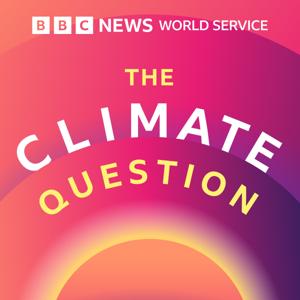
By BBC World Service
Why we find it so hard to save our own planet, and how we might change that.
... more

4.4
167167 ratings


The podcast currently has 315 episodes available.
The most played episodes among Podcast App listeners.
As shown by the recent flash floods, Nepali mountain communities are on the front line of climate change. Can they adapt? Host Jordan Dunbar talks to two Sherpas who have become climate researchers. They are glaciologist Tenzing Chogyal Sherpa, and Pasang Yangjee Sherpa, who researches how global warming affects indigenous groups in Nepal. This programme was recorded in July 2026. Got a question for The Climate Question? Email us: [email protected] Producers: Diane Richardson and Melanie Stewart-Smith Sound engineer: Tom Brignell and Dave O'Neill Editor: Simon Watts

Europe is reeling from a record-breaking drought which has closed nuclear power stations, stopped river traffic and sent food prices soaring. And there may now be more intense droughts in some parts of the world because of climate change. Our host Graihagh Jackson explores solutions from water usage apps in South Africa to solar irrigation systems in Egypt. She also looks at the challenges of adapting our energy infrastructure for a warming planet. Her guests are Dr Iain Staffell, Associate Professor of Sustainable Energy at Imperial College London, and Dr Vidhisha Samarasekara, Strategic Program Director for Water, Climate Change and Resilience at the International Water Management Institute. Got a question for The Climate Question? Email us: [email protected] Picture Credit: International Water Management Institute (IWMI) Producers: Diane Richardson and Melanie Stewart-Smith Sound Mix: Tom Brignell and Philip Bull Editor: Simon Watts
Experts say we may now need to spend more on cooling our homes than heating them because of climate change. In fact, the International Energy Agency thinks the equivalent of 10 new air conditioners every second will be installed for the next 30 years! This surge in air con will put strain on the world’s electricity grids, which are still mostly powered by fossil fuels. The units also pump heat into the streets outside our homes – making cities feel even hotter when we step outside. But there are alternative options – like redesigning houses to include more shading and increase the air flow, or using fans and misting systems. We could also plant more trees or even change the colours of our homes to reflect more sunlight! In this edition of The Climate Question, Host Graihagh Jackson talks to BBC Tokyo Correspondent, Kurumi Mori, and Radhika Khosla, Professor of Environmental Science and Policy at the University of Oxford. Got a question for The Climate Question? Email us: [email protected] Producers: Diane Richardson and Melanie Stewart-Smith Sound Mix: Tom Brignell and Ricardo McCarthy Editor: Simon Watts
African forests are vital for food and economic development, as well as for supporting millions of species of animals and plants. We find out how to protect them better with one of Africa’s top environmentalists! From the giant Congo rainforest to the Kenyan highlands and the mangroves of Mozambique, Africa’s forests are some of the most spectacular places on Earth. And these sensitive ecosystems are not just important for Africa: they play a vital role in the global climate because they store huge amounts of carbon dioxide and pump out oxygen. Kenyan environmentalist Wanjira Mathai has been campaigning to protect and nurture forests for decades. She tells The Climate Question about the challenges they now face across Africa from rapid urbanisation, mining and logging. The solution, according to Wanjira, is to place a proper economic value on the environmental services provided by forests and the communities who live in them – whether that’s supplying water and food, or helping to prevent floods sweeping through cities such as Nairobi. Wanjira Mathai is Managing Director, Africa and Global Partnerships at the World Resources Institute. She’s been chatting to The Climate Question host Jordan Dunbar and BBC Senior Climate Reporter Esme Stallard. Got a question for The Climate Question? Email us: [email protected] Producers: Diane Richardson and Melanie Stewart-Smith Sound Mix: Mike Regaard and Tom Brignell Editor: Simon Watts
The Philippines and Pakistan are now the world's top solar panel importers. We find out why, and what other countries can learn from the boom! Cheap solar panels, mainly imported from China, are transforming lives and slashing electricity bills across Asia. In the last year, Filipinos have put up five times as many rooftop solar panels as the previous ten years combined. Installation companies are struggling to keep up with demand. In Pakistan, where the boom started earlier, solar power has reached every sector of the economy from the textile industry to farming. Solar has helped Pakistanis weather the current energy crisis and reduced the country's reliance on imported fossil fuels. The Climate Question Host Jordan Dunbar talks to Filipino climate journalist, Jhesset Enano, and Pakistani energy analyst, Zeeshan Ashfaq, from the Renewables First think tank in Islamabad. Producers: Jordan Dunbar and Melanie Stewart Smith Sound Mix: Tom Brignell and Dafydd Evans Editor: Simon Watts
The podcast currently has 315 episodes available.

7,635 Listeners

867 Listeners

1,058 Listeners

5,485 Listeners

1,806 Listeners

1,812 Listeners

1,034 Listeners

1,898 Listeners

416 Listeners

421 Listeners

722 Listeners

217 Listeners

838 Listeners

469 Listeners

242 Listeners

976 Listeners
126 Listeners
459 Listeners

3,225 Listeners

751 Listeners

111 Listeners

1,004 Listeners

3,038 Listeners
227 Listeners