
Sign up to save your podcasts
Or



In today’s episode, I am chatting with Molly Badrawy all about lesson planning for ELs and the realities of working in a low incidence district. Molly Badrawy is a full-time ESOL teacher in New Hampshire, and a freelance consultant at FaCES, Fair Culture and English Services, providing customized cultural guidance and language instruction for and individual adult language learners and organizations, alike. A national and international career that spans public, private, higher education as well as the business sector, Molly has presented her work at many conferences, serves on the NH English Language Advisory Committee, and facilitates the NH Low-incidence Community of Practice cohort, which is where we met! She lives in Peterborough, NH with her husband, two daughters, two cats, and a dog and believes she has the best job in the world. It was wonderful to speak with Molly and to get to know her.
What you will learn about lesson planning for ELs:
Resources
As mentioned in the episode, I am linking some useful resources!
You may also be interested in:
Support the show
In today’s episode, I speak with Kristen Vibas, an ELL teacher from Virginia who I met on Instagram. Kristen has been teaching since 2005.
She shares how she went from aspiring actress to ELL teacher, and shares peeks into her classroom. You will love the tips and strategies she has developed on how to support multilingual students and how to teach reading to ELLs as much as I did.
Both content teachers and ELL teachers will find this episode valuable as reading is such a critical part of learning in all subjects.
What you will learn about how to teach reading:
Resources
As mentioned in the episode, I am linking some useful resources!
You may also be interested in:
Support the show
To us EL teachers, vocabulary pre-teaching is our daily bread, but I received a question from one of the content area teachers that made me think…what comes naturally to us, does not necessarily make immediate sense to our colleagues.
I recently saw a post from a science teacher tasked with teaching English Newcomers and suggested a list of ideas, one being pre-teaching vocabulary. But, how do you pre-teach vocabulary in a mainstream classroom? Today’s episode addresses this question and more.
Why is pre-teaching vocabulary good for all learners?
There are 3 tiers of words we talk about in EL instruction: Tier 1, or everyday, words, Tier 2, or frequently used words that show up across content areas, and Tier 3, or subject specific words. Pre-teaching, particularly tier 2 words, is important for access to the academics and equity. All students are building their vocabulary and ability to communicate their ideas and building confidence in demonstrating their content knowledge.
What you will hear in this episode:
Resources
As mentioned in the episode, I am linking some useful resources!
You may also be interested in:
Support the show
Today’s episode is the answer to the question from one of my readers/listeners. What do I do with my newcomers the last three weeks of school? They are so frustrated and will speak no English this summer. How can I help them without frustration?
I wanted to share some activities that will take the frustration away because they all involve creativity, flow and connection. The rules for the end of the year are really no different than those for the beginning of the year - there just might be less motivation and more exhaustion on both the teachers and the students’ parts.
Here is what you will hear in this episode:
As mentioned in the episode, I am linking some useful resources!
End of the Year Activity Packet for grades 6-12
End of the Year Memory Book (grades K-5)
Blog posts
5 End of the Year Activities for Your English Learners
End of the school year digital activities for ESL students
Support the show
I have been a big believer in the importance of social emotional learning for a long time. But, teaching amidst the pandemic for the last few years has really emphasized how vital it is for all students, particularly for English learners. There are five competencies to social emotional learning - self awareness, self management, social awareness, relationship skills, decision making skills. Each of these is worthy of a dedicated episode.
So, in today’s episode, I focus specifically on self management. I will share the challenges I see my middle and high school students face with regards to self management and the techniques I have developed to help them help themselves.
Here’s what you will learn about Self Management:
Resources
As mentioned in the episode, I am linking some useful resources!
You may also be interested in:
Support the show
In this episode, I am chatting with Beth Mailley. Beth is an ESL teacher in the Washington, DC area. She has been teaching for 23 years with 11 years as a classroom teacher before becoming an ESL teacher. She has been in that role for the past 12 years and loves it. When she is not teaching, she is most likely reading, hanging out with family, or trying to convince herself to exercise. It was such a pleasure to speak with Beth.
She shares how she ended up in the ELL field after being a language learner herself during a service trip to Mexico. She experienced first-hand how frustrating it can be to learn a new language and the importance of non-verbal communication and human connection in the process. She opens up about how she utilizes that human connection now to collaborate with teachers, families and students. And of course, she gives her best tips for making the most important connections and setting up your classroom for success.
What you’ll hear about collaboration:
As mentioned in the episode, I am linking some useful resources!
Connect with Beth:
You may also be interested in:
Support the show
Planning for middle school EL students is different from planning for just about any other class. You may have 20 students or just a few, and you will likely have a wide variety of different proficiency levels and students all at the same time. In my situation this school year, at least in middle school, I am teaching seventh and eighth grade students who span levels 1 through 4 on the WIDA language proficiency assessment. In this episode I will be sharing with you how I account for all of their unique needs and what my setup and planning looks like on a daily basis.
Here is what you will hear about middle school EL lessons:
As mentioned in the episode, I am linking some useful resources!
You may also be interested in:
Support the show
So often we hear advice from educators who have been in the classroom, honing their craft for years. While their experience is valuable, I thought it would be refreshing to hear from an ESL teacher who is in the beginning stages of her career. Today, I chat with Kennedy Merriam, my student teacher this semester, who has been so open and creative during her time with me. She shares her own journey to finding ESL teaching and the reasons she is so passionate about this career.
Kennedy is from Massachusetts and is currently a senior at Saint Anselm College in Manchester, NH. She will be graduating with a major in Spanish and a minor in ESOL education, with certification to teach ELL students in grades 9-12 in Massachusetts. She is passionate about the Spanish language, traveling, and writing music (she’s also a singer!). Extroverted, compassionate and a keen listener, Kennedy will always try to understand and support another person, and I have seen that in action so many times! She is eager to get even more experience working with newcomers so she can better serve them and can’t wait to continue her career working with English Learners and newcomers.
Here is what you will hear about ESL Teaching:
Resources
Mentioned in the Episode:
You may also be interested in:
Support the show
Teachers are often puzzled when they approach teaching grammar for a couple of reasons. Particularly if they are native english speakers, they often don’t feel like they know formal grammar rules very well. They just know when a phrase or sentence “sounds right.”
The other big struggle for teachers is not knowing what order makes sense to teach grammar rules to their students.
But the bottom line is ESL students do need to learn grammar so that they have a framework, a safety net, to rely on as they learn and practice the language. In fact, students often ask me for help with grammar and give a sigh of relief when they are handed a grammar worksheet. Remember, those rules provide them with a sense of safety.
In this podcast episode, I will break down the most important grammar points to touch upon when you get a new beginner English learner and the suggested order in which to teach them.
Here is what you will hear about Grammar for English Learners:
As mentioned in the episode, I am linking some useful resources!
The ESL Teaching Roadmap – membership community for middle and high school ESL/ELL teachers. As a thank you for listening, use code ESLPODCAST for 10% off when you join.
Follow me on Instagram
Join the Simply Ieva Facebook Group
How to Teach ESL Grammar for Beginners: Tips, Activities and Games
Video: Grammar Teaching Tips for ESL Teachers
Support the show
We all know that learning a new language requires vocabulary instruction, but what is the best approach? Which words should we teach? Which words are the most important? And how can we help students retain the academic vocabulary we teach them? I address these questions in today’s episode.
Language learning is not an overnight process, and vocabulary teaching is ongoing whether you work with exclusively newcomers or have long-term English learners. It is said that it takes learning a word seven times in different contexts for that word to become part of your vocabulary.
There are simple ways teachers can intentionally incorporate content vocabulary before, during, and after an activity that will greatly improve their ESL students’ ability to understand the lesson and retain the vocabulary. I share a few of my favorite tools and activities as well as two well researched frameworks for introducing new words to your students that will take your vocabulary instruction to the next level.
Here is what you will hear in this episode:
As mentioned in the episode, I am linking some useful resources!
Reminder - 10% of the proceeds from my sales in March 2022 will be donated to Unicef to benefit the people of Ukraine.
You may also be interested in:
The ESL Teaching Roadmap – membership community for middle and high school ESL/ELL teachers. As a thank you for listening, use code ESLPODCAST for 20% off when you join.
Support the show
From the publisher's feed
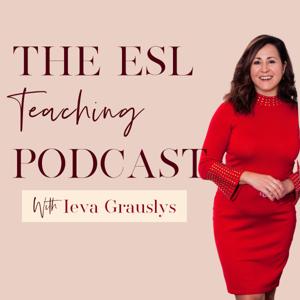
Welcome to The ESL Teaching Podcast, a place for K-12 teachers of English learners who are looking for simple and easy-to-implement ways to engage their students and for inspiration and empowerment…
2,549 Listeners

1,826 Listeners

1,040 Listeners

559 Listeners

178 Listeners
640 Listeners

26 Listeners
114 Listeners

27 Listeners