
Sign up to save your podcasts
Or



American rapper Hayden Inacio, professionally known as Bankrol Hayden, discusses his music career and cultural identity from his Modesto, California origins, born in a family of Portuguese descent, to gaining prominence in the music industry at a young age, accumulating over a billion streams early in his trajectory.
A central theme of this conversation with Bankrol Hayden focuses on a near-fatal car accident Inacio survived at the age of 16. During his hospital recovery, he wrote the single “29”, a track that served as a major commercial breakthrough and established his artistic focus on themes derived from personal adversity and pain.
The conversation with Tony Gonçalves also highlights Inacio's recent efforts to publicly embrace his Portuguese heritage, a shift that culminated in a victory at the International Portuguese Music Awards (IPMA). Despite not speaking the language fluently, the artist reflects on the legacy of his grandfather, who emigrated from the Azores to the United States. Bankrol still has his best years to come, but, so far, he seems to be doing incredibly well.
See omnystudio.com/listener for privacy information.
Born in Angola and raised on the south bank of Lisbon, in Almada, by Cape Verdean parents, Carlão, the voice of the emblematic hip-hop band Da Weasel, joins Tony Gonçalves in an earnest and nostalgic conversation about being 50, about legacy and about growing up either too white or too black.
Carlão guides us from the isolation of Almada, on the south bank of Lisbo, where “nothing happened,” to the early rock and hip-hop that shaped him and the decision to finally start writing in Portuguese, pushed by his brother. This was the start of one of the most emblematic bands of Portugal: Da Weasel.
The singer and writer revisits the pandemic’s silence: the void that made it difficult to create and the hunger for emotional connection that fuels his music. Da Weasel’s cross-generational reach becomes a quiet thread, anchored in honesty and the refusal to look away from pain or joy.
For his latest record, “Quinta-Essência - 75/25Carlão” stitched together tracks made with Beatbombers, his brother and Fred Ferreira, adding spoken-word fragments recovered from old notebooks. He closes with a simple map: Angola gave him the cradle, Cape Verde the roots, and Portugal the life—while the national art of “desenrascanço” remains, in his words, the Portuguese answer to almost everything.
See omnystudio.com/listener for privacy information.
For Richie Campbell, music has never been mere entertainment. Reggae offered him a profound sense of resistance and cultural depth that he found lacking in other genres, transforming his craft into a lifelong dedication rather than a fleeting commercial project. As part of a generation that sidestepped traditional radio and record labels, he helped forge an independent collective driven by a quiet defiance—a refusal to be dismissed by an industry that had previously overlooked them. This independence allowed him to protect his creative process, treating songwriting as an organic flow rather than a mathematical formula.
Yet, this unconventional trajectory forged a permanent duality in his life. In Jamaica, Campbell found an immediate sense of home, a sanctuary where the music itself was enough to validate his presence without question. In stark contrast, the Portuguese market demands perpetual reaffirmation. Even as a defining voice in his own country, he operates with the persistent feeling that he must continuously prove his worth to his audience, bridging the gap between local expectations and the uncompromised Caribbean culture he champions.
See omnystudio.com/listener for privacy information.
Pedro Abrunhosa’s career is nothing short of incredible, but his words always speak louder than fame or talent. A man of causes, he is quick to denounce the bombings in Gaza and Iran… in less than 10 minutes since the beginning of this conversation. He started as a double bass player, went to New York where he learned discipline and played with all the “cats”, then came back to Porto and, inspired by the sounds of dance music, crafted “Viagens”, a record about “sex, drugs and corruption” that featured Maceo Parker, James Brown’s saxophone player, and mixed sweaty funk with raw ballads that were sung by millions and led to completely sold out shows. He crafted a sound and a vibe that was unheard of, and totally unexpected, in the “grey Portugal” of the early 90s.
That record was a hit, so he did more. His second album “Tempo” was recorded with The New Power Generation, Prince’s band. And it spawned even more hits. He proved that he could do it. And has been doing it for 30 years. But he doesn’t believe in inspiration, that’s for the “rich guys in Beverly Hills houses overlooking the sea”. He is inspired by the world, the good, the bad and the pain. Pedro Abrunhosa navigates his words like he navigates a double bass or the piano his grandfathers had when he was growing up: with seriousness, measured tempo and wisdom.
See omnystudio.com/listener for privacy information.
The conversation between Joana Vicente and Tony Gonçalves examines the current strain on the industry: distribution bottlenecks, shrinking financing, and established directors struggling to secure budgets once considered routine. Vicente frames technology, including artificial intelligence, as a potential lever for independent cinema. Not as a replacement for creative work, but as a way to preserve ambition within tighter economic limits.
From that context, she introduces Open Cities, a production company built around an accelerator model. The approach is deliberately pragmatic: strong scripts, shorter development cycles, and decision-making that stays in the hands of directors and producers. AI as a tool for better stories, not better factories.
See omnystudio.com/listener for privacy information.
Emerging from Coimbra in the 1990s with Tedio Boys, Paulo Furtado’s early career was marked by confrontation, underground momentum and a rapid leap to international stages, including tours in the United States. The shift to a one‑man band came after the exhaustion of group dynamics and a deep attraction to the raw energy of Delta blues and punk. What began almost by accident evolved into an obsessive pursuit of sound, performance and total artistic control, with albums recorded live and a stage presence that carried both risk and solitude. Over time, that intensity softened: Tigerman expanded into collaborations, filmmaking and soundtracks, embracing a broader creative universe while maintaining autonomy over his work.
Fatherhood has recently introduced a new recalibration. Once convinced that art had to be the central force in an artist’s life, Paulo Furtado now acknowledges a different hierarchy, learning to balance creation with care, urgency with presence. The spark, he insists, remains the same — the need to make something new — but it now exists alongside a quieter clarity. Art, he says, saved his life. Today, it continues to shape it, just no longer alone.
See omnystudio.com/listener for privacy information.
Born in Rotterdam to immigrant parents, shaped by the Cape Verdean culture and global Black music, Nelson Freitas has a career forged through self‑reliance and constant hustle. He helped define ghetto zouk by merging zouk melodies with hip‑hop and R&B sensibilities, built his own label when no one believed in the sound, and learned the industry through failure as much as success. For him, artistry has always meant total involvement: sound, image, business, and the long grind of touring.
Now living in Portugal, Freitas says “Legacy” closes a chapter, not out of exhaustion, but clarity. Albums demand an emotional investment he no longer sees reflected in how music is consumed, increasingly reduced to singles and algorithms. He plans to keep creating and touring, but on his own terms. What endures, he suggests, is not the format, but the credibility earned by staying authentic and by carrying more than one world at once.
See omnystudio.com/listener for privacy information.
At the center of the conversation with Serena Kaos is fear. Not as a dramatic concept, but as a daily operating condition. The artist describes growing up as “the weird kid,” a creative outsider shaped as much by insecurity as by imagination, and how the search for belonging became a source of anxiety that followed her into adulthood. The decision she made at twelve, to be happy, endures not as naïveté but as a stubbornideal, complicated by the realization that happiness does not inoculate against discomfort.
After “The Voice”, Serena flew to London and started busking. Independence, meanwhile, carries no safety net: releasing music alone requires creative control paid for in exhaustion and burnout. What emerges is a portrait of an artist who understands that happiness is not an arrival point but a practice, sustained in motion between fear and resolve, solitude and contact, the street and the song.
See omnystudio.com/listener for privacy information.
Born in Lisbon’s Graça neighbourhood, Ângelo Freire grew up in fado houses, absorbing the language of the genre long before he began to articulate his own. He sang from the age of seven, picked up the Portuguese guitar shortly after, and by eleven was already performing on national television. Playing alongside figures such as Carlos do Carmo, Mariza, Ana Moura or Carminho required restraint as much as skill, while learning how to listen, react and support.
Only recently has Freire stepped forward with a self‑titled album, motivated less by self‑assertion than by concern for the future of the language of fado. With a repertoire still heavily dependent on centuries‑old melodic structures, he argues that fado risks repetition if new music is not written within its grammar. His compositions aim to extend the tradition without altering its matrix, offering new melodies that can be inhabited, reused and transformed by others. But it is on his guitar, that is always by his side, that Ângelo Freire’s voice (and soul) truly shines, as he demonstrates playing live for this podcast.
See omnystudio.com/listener for privacy information.
In this earnest conversation on “The Heart & Hustle of Portugal”, Jessica Cipriano opens a window onto a career shaped by pivotal encounters, exposed vulnerabilities, and an unwavering truth: music is the place where everything in her comes alive. She recalls her season on “The Voice”, the surprising impact of viral clips, and the discovery of a vocal identity that lives comfortably between fado‑pop, electronic production, and raw emotional storytelling. Her creative process — defined by both courage and fear — emerges as a cycle of reinvention: falling, getting lost, rising again.
The episode is also portrait of contemporary Portuguese music, a generation honoring tradition while boldly reshaping it. Jessica reflects on the weight of covering musical classics, the unmatched comfort she finds on stage, and the unexpected responsibility toward the younger fans who follow her. With honesty, humor, and a distinctly Portuguese intensity, she reveals herself as an artist still under construction yet firmly rooted in who she is. A vivid testament to how art can remain the compass even when the road seems to vanish.
See omnystudio.com/listener for privacy information.
From the publisher's feed
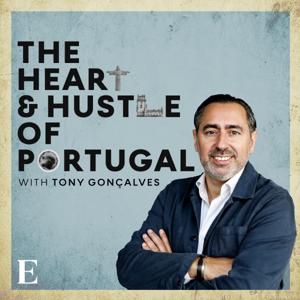
Each week, join Tony Gonçalves—a U.S.-based Portuguese immigrant and successful media executive—as he explores the stories of those driving Portugal’s influence on the global stage. From visionary…

1 Listeners

10 Listeners

0 Listeners
17 Listeners
6 Listeners

15 Listeners

4 Listeners

87 Listeners

1 Listeners

0 Listeners

0 Listeners

1 Listeners
7 Listeners

1 Listeners
![Fundação (FFMS) - [IN]Pertinente by Fundação Francisco Manuel dos Santos](/_next/image?url=https%3A%2F%2Fpodcast-api-images.s3.amazonaws.com%2Fcorona%2Fshow%2F2108484%2Flogo_300x300.jpeg&w=640&q=75)
2 Listeners
7 Listeners
28 Listeners

0 Listeners

0 Listeners

0 Listeners

0 Listeners
5 Listeners

3 Listeners
1 Listeners

0 Listeners

2 Listeners

0 Listeners

0 Listeners

0 Listeners

0 Listeners

0 Listeners
0 Listeners

0 Listeners

6 Listeners