
Sign up to save your podcasts
Or



Based on Podcast App listening data
No tanks. No invasion. No march on Tehran.
Instead: a methodical campaign to dismantle Iran’s war machine — missiles, drones, command networks, and the economy keeping it all alive.
But can you break a regime by breaking the system that sustains it?
Urban warfare expert John Spencer joins Mark Dubowitz to unpack the real logic of this war — from the “neurological” battlefield to the fight over Hormuz — and what victory actually looks like when there’s no surrender to sign.
Iran isn’t just under pressure. It’s under siege.
Its currency is collapsing. Its ports are constrained. Billions are bleeding out as war damage mounts and oil revenue tightens.
This isn’t sanctions as usual. It’s economic warfare—aimed at the regime’s ability to survive.
The question now: Does this force Tehran to the table… or push it toward something far more dangerous?
Back in January, the regime carried out the deadliest crackdown in modern Iranian history.
As it gunned down protesters in the streets, it launched a parallel war online. A coordinated campaign to turn a domestic uprising into a so-called CIA–Mossad plot — rewriting the story in real time and pushing that narrative deep into Western discourse.
The January crackdown and the narrative battle that accompanied it aren’t isolated incidents. They set conditions for the war that followed, shaping global perception before a single American fighter jet took flight.
So, was all of this just another page from the regime’s standard propaganda playbook? Or is information warfare now a core pillar of its survival?
For years, Washington has leaned on sanctions to contain Iran’s most dangerous capabilities.
Tehran’s drone and missile programs didn’t just survive under pressure, they adapted, scaled, and in many ways thrived, fueled in part by Western-made components slipping through global supply chains.
The result: a procurement network that’s harder to disrupt, more resilient, and still very much intact.
Now, Tehran isn’t just building for itself. It’s exporting the model — arming Russia in Ukraine, supplying proxies across the Middle East, and even laying the groundwork for drone production in places like Venezuela, putting parts of the United States within range.
So the question isn’t whether sanctions work — it’s whether we’re hitting the right targets.
To break all of this down, host Mark Dubowitz is joined by Kerri Bitsoff — a former senior official at the U.S. Treasury’s Office of Foreign Assets Control (OFAC) who has been called a ‘secret weapon’ in the fight against Iran's weapons procurement.
This war isn’t just being fought with missiles and drones. There's also a war of the words, a narrative battle.
While the regime pushes its narrative at home and abroad, the West struggles to keep up — and the Iranian people are caught in between.
So, who controls the story: the regime, the West, or the Iranian people?
Mark is joined by historian Ali Ansari to unpack the battle of narratives, the reality of regime power, and who may ultimately shape Iran’s future.
On the battlefield, the Iran war is expanding, and the real negotiations aren’t happening in backchannels — they’re happening in the Strait of Hormuz.
The Iran war isn’t just about Iran. It’s about energy, leverage, and whether Beijing—and even Taiwan—are already learning the lessons of this war in real time.
FDD’s Matt Pottinger joins host Mark Dubowitz to break down why a deal may be closer than it looks, why Trump may not take it, and how this war is already reshaping the global balance of power — and why China’s watching closely.
We’re marking one year of The Iran Breakdown by bringing you a special conversation from our sister FDD podcast.
In this episode of Foreign Podicy, host Cliff May sits down with Mark Dubowitz to unpack a question at the core of this show: what the Islamic Republic actually believes — and how it has waged war on the United States and its allies since 1979.
It’s a conversation about ideology, strategy, and a threat too often misunderstood.
If you want to understand the regime in order to make sense of the war, start here.
The regime is down — but it's not out. So... what does collapse actually look like? Not strikes... Not decapitations... The moment the regime loses control. Mark asks Ray Takeyh and Reuel Marc Gerecht to answer the only question that matters now: Are we close to the breaking point? If not, how do we close that gap?
The U.S. and Israel again struck deep inside Iran. The Supreme Leader is dead. The region is on edge. The question is no longer whether this is war — but how long will it last and what will be the impact.
The conflict has now spread far beyond Tehran’s borders: Hezbollah rockets have drawn Israel into full-blown engagements across Lebanon, Gulf states have condemned Iranian aggression as they reel from missile and drone salvos, and intelligence agencies warn of expanded retaliatory attacks against the United States and its allies.
On the streets and in the corridors of power, tectonic shifts are underway. Regional capitals brace for wider war, global energy markets react at threats to closing the Strait of Hormuz and attacks against oil infrastructure, and governments from Islamabad to London confront unrest and diplomatic peril.
The Iran Breakdown host Mark Dubowitz is joined by Eli Lake to assess the battlefield, the intelligence as we know it, and the stakes. Is the regime collapsing — or will it whether this confrontation as it has in the past? What comes next for the Iranian people, for Israel, for the region, and for the United States?
Eli's latestThe Breaking History podcast
March 2, 2026 | The Free Press | J.D. Vance’s Iran Dilemma
February 28, 2026 | The Free Press | Trump Keeps His Promise to Iran—and Takes a Big Gamble
Bonus Episode of The Iran Breakdown: Mark Dubowitz joins FDD's Jonathan Schanzer and Rich Goldberg for a late night FDD SITREP following the death of Khamenei.
---
In the early hours of February 28, the United States and Israel launched a coordinated military campaign against the Iranian regime—Washington calling it “Operation Epic Fury,” Israel calling it “Operation Lion’s Roar.” Strikes hit sites across Iran, targeting ballistic missile infrastructure, IRGC facilities, intelligence headquarters, and senior regime leadership.
Supreme Leader Ali Khamenei is dead. President Trump confirmed his elimination on February 28: “Khamenei, one of the most evil people in History, is dead.” U.S. officials told Fox News that the strikes were moved up after intelligence revealed Khamenei and dozens of senior Iranian officials were meeting at his compound. Among those killed: Defense Council Secretary Ali Shamkhani, IRGC Chief Mohammad Pakpour, Defense Minister Aziz Nasirzadeh, and multiple other senior military and intelligence figures.
Iran has retaliated. A ballistic missile penetrated Israeli air defenses and struck a residential building in central Tel Aviv, killing at least one woman. Over 200 missiles and drones were fired at Israel and U.S. bases across the region—striking the U.S. Fifth Fleet headquarters in Bahrain and causing casualties in Dubai and Syria. Regional governments have condemned Iran’s strikes in the strongest terms.
Inside Iran, the response is electric. Videos show Iranians cheering in the streets. Crown Prince Reza Pahlavi has called on the armed forces to defect and urged citizens to prepare to mobilize. The opposition is deploying secure communications, satellite broadcasts, and hacked regime infrastructure to sustain the moment. The regime is decapitated. The question now is whether it falls.
To assess fast-moving developments and their strategic implications, FDD hosts a timely SITREP moderated by FDD Executive Director and host of the FDD Morning Brief Jonathan Schanzer, featuring FDD CEO and host of The Iran Breakdown Mark Dubowitz, and FDD Senior Advisor and former White House National Security Council director Richard Goldberg.
From the publisher's feed
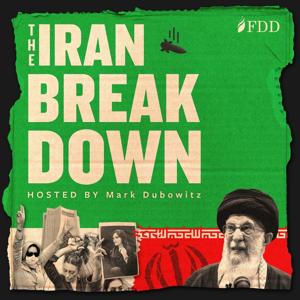
Welcome to The Iran Breakdown. Hosted by Mark Dubowitz, this show from FDD is here to guide you through one of the most critical geopolitical and human rights challenges facing the world…
The Islamic Republic of Iran has been a central player in global headlines for decades: its pursuit of nuclear weapons, development of a massive missile and drove arsenal, funding of terror groups like Hezbollah, Hamas, the Houthis, and others; its oppression of the Iranian people; and its growing alliances with global power states like China, Russia, and North Korea.
But beneath the headlines lies a deeper story: a regime that is losing legitimacy, battered nuclear and missile programs, a crumbling economy, a restless population hungry for freedom, and a global community with many conflicting ideas about how to respond. But a regime still standing and dangerous. And that’s what we’ll cover on The Iran Breakdown.
Ranked by our users in the last 21 days

40 Listeners
5,156 Listeners
648 Listeners
35 Listeners
16 Listeners
449 Listeners

1,216 Listeners

3,174 Listeners
1,067 Listeners

493 Listeners

8,430 Listeners
446 Listeners

87 Listeners

104 Listeners

1,065 Listeners

909 Listeners

123 Listeners
3 Listeners