
Sign up to save your podcasts
Or



Based on Podcast App listening data
The U.S. and Israel have conducted joint military action against the Islamic Republic of Iran. Dubbed "Operation Epic Fury" by Washington and "Lion's Roar" by Jerusalem, the strikes were launched on February 28 after nuclear negotiations with the regime failed to yield progress. President Trump stated that U.S. objectives are to "defend the American people by eliminating imminent threats from the Iranian regime." Key targets included the office compound of Supreme Leader Khamenei, the Ministries of Intelligence and Defense, and the Parchin military complex, with additional strikes on regime targets in Isfahan, Tabriz, and Bandar Abbas.
Israeli Prime Minister Netanyahu framed the operation's objectives as removing the "existential threat" posed by the Islamic Republic and creating conditions for the Iranian people to achieve regime change—calling on Persians, Kurds, Azeris, Baloch, and Ahwazi alike to "cast off the yoke of tyranny."
Iran has retaliated with ballistic missile strikes targeting U.S. bases and allies across the region, including Saudi Arabia, Jordan, Kuwait, Qatar, the UAE, Israel, and Bahrain—where a missile struck a facility affiliated with the U.S. Navy 5th Fleet.
Today, Iran is entering a decisive phase—where economic collapse, mass unrest, and direct military pressure are converging faster than at any point since 1979. As long as theocratic extremists rule in Iran, the Middle East will remain a factory for terror, missiles, and nuclear blackmail. These strikes have sharpened urgent questions about what comes next—for the regime, the Iranian people, and regional stability.
To assess fast-moving developments and their strategic implications, FDD will host a timely SITREP moderated by FDD CEO and host of The Iran Breakdown Mark Dubowitz, featuring FDD Executive Director and host of the FDD Morning Brief Jonathan Schanzer and FDD Senior Fellow and former IDF international spokesperson Jonathan Conricus.
How does Iran fit into the global ecosystem of terrorism — and why does the West struggle to see the full picture?
For decades, policymakers treated ISIS, al-Qaeda, and Iran’s proxy network as separate threats. But that's not reality. This is: They operate in the same battle space and exploit the same weaknesses in Western strategy.
To examine what the West missed — and what it may still be getting wrong — host Mark Dubowitz is joined by FDD senior fellow Ambassador Edmund Fitton-Brown. From Yemen to the United Nations, Edmund has first-hand experience tracking how states and terrorist groups adapt, cooperate, and project power.
📺: Watch this episode on YouTube here.
Ronald Reagan didn’t defeat the Soviet empire with tanks — he defeated it with pressure, principle, and moral clarity. Can the same strategy work in Iran? A recent FDD Memo, “Freedom for Iran: Learning From U.S. Support for Polish Anti-Communists in the 1980s,” says that it can. Mark is joined by the Memo’s authors, Charlie Laderman and Nazee Moinian, to break down how the playbook can be applied to the Islamic Republic — a regime that fears its own citizens most — including why regime change doesn’t require invasion, how internal pressure is Tehran’s greatest weakness, and why negotiating without leverage only empowers dictators. History doesn’t repeat, but it rhymes — and Iran may be next.
One of the gravest human rights crises in recent history is happening right now in Iran. The Islamic Republic has carried out mass killings on a scale not seen in modern Iranian history, slaughtering an estimated 33,000, arresting tens of thousands, and subjecting countless Iranians to torture, disappearance, and sham trials. Internet blackouts have plunged entire cities into darkness in an effort to conceal the carnage.
This is a regime ruling through terror because it has lost legitimacy and control.
Behnam Ben Taleblu joins Mark to break down the scale of the atrocities, why this moment is historically unprecedented, and why Iran’s human rights crisis is inseparable from the regime’s broader threat to regional and global security.
The regime in Iran has slaughtered tens of thousands of Iranians and plunged the country into an internet blackout — and dared the world to look away. Still, President Trump warned that American support was coming as U.S. military vessels made their way to the region. And yet — the decisive moment hasn’t arrived.
In this episode of The Iran Breakdown, host Mark Dubowitz is joined again by Rich Goldberg for a timely assessment of the waiting game: what military options are now on the table, why missiles — not nukes — may be the real center of gravity, whether negotiations are strategy or psychological warfare, and how delay reshapes deterrence, escalation, and the fate of the Iranian people. This isn’t a pause — it’s a countdown.
While the United States is on the brink of military action in Iran, Iran itself may be on the brink of something far bigger.
U.S. forces are repositioning. Allies are on alert. And in Tehran, a crippled regime already at war with its own people is threatening retaliation against the United States.
In this urgent episode of The Iran Breakdown, Mark is joined again by Reuel Marc Gerecht and Ray Takeyh to break down what a U.S. strike would actually mean — militarily, strategically, and for the Iranian people themselves — and why American credibility is once again on the line.
From Iran’s likely response to the durability of its repression, the conversation confronts the million-dollar question: Is this the moment the regime doubles down — or the moment Iranians begin to take their country back?
Read nextRay and Reuel's Wall Street Journal piece from January 12: Don’t Repeat Obama’s Mistake in Iran
Ray and Reuel's Wall Street Journal piece from January 8: Can Iran Hold the Line Against Its Protesters?
Watch nextIf you're new to The Iran Breakdown, welcome. Mark's interview with Crown Prince Reza Pahlavi should be your next watch.
Iran protest resourcesWe're tracking the Iran protests at fdd.org/iranprotests.
Follow FDD's Iran experts on X, like Mark, Behnam, Saeed, and Janatan
Iran Breakdown-ers, we're pleased to introduce you to Generation Jihad, a podcast from FDD's Long War Journal hosted by Bill Roggio.
It's January 12, 2026, day 16 of the Iran protests. Bill hosts Mark on Generation Jihad to discuss whether this is the moment.
We're tracking the Iran protests at fdd.org/iranprotests.
If you're new to The Iran Breakdown, welcome. Mark's interview with Crown Prince Reza Pahlavi should be your next watch.
Follow FDD's Iran experts on X, like Mark, Behnam, Saeed, and Janatan
...
The following content is cross-posted
Mark Dubowitz: The regime clings to its ninth life
After military defeat abroad and at home where the economy also has collapsed, the Islamic Republic is weaker than ever, and the Iranian people know it.
The regime is facing a nationwide uprising unlike anything seen in decades with Iranians across class, age, and ideology back in the streets, and they’re no longer asking for reform. They’re demanding an end to the Islamic Republic itself.
Meanwhile, President Trump warned that U.S. military action is on the table if the regime slaughters protesters. As we record, a brutal crackdown is underway with reports of hundreds of Iranians killed and tens of thousands arrested. Is this the moment?
Bill asks FDD CEO and host Mark Dubowitz.
The strong-as-ever Iranian people are back on the streets, protesting against the weak-as-ever regime in the shadow of the 12-Day War.
Recorded live on X Spaces on Thursday, January 8, 2026 as events unfolded, this episode of The Iran Breakdown brings you a real-time conversation with Mark Dubowitz, Behnam Ben Taleblu, and Janatan Sayeh as they assess what’s different about this protest wave, why fear inside Iran may be breaking, and how years of political repression, economic collapse, and environmental failure are converging into a single moment of reckoning.
Iran protest resources—We're tracking the Iran protests at fdd.org/iranprotests.
—If you're new to The Iran Breakdown, welcome. Mark's inaugural interview with Crown Prince Reza Pahlavi should be your next listen.
—Our Iran experts are on X, including Mark, Behnam, Saeed, Janatan, and others.
📺: Watch this episode on YouTube here.
Israel’s 12-day war with Iran upended years of assumptions and may have rewritten the rules of deterrence — but the aftermath could prove more dangerous than the war itself.
As Tehran absorbs the shock of defeat, it now faces a stark choice: regroup, retaliate, or retreat. The regime’s next move will determine whether this war was a turning point — or merely an intermission.
Retired Maj. Gen. Tal Kelman is one of Israel’s most accomplished fighter pilots and one of its top Iran strategists. He didn’t just help plan Operation Rising Lion — he flew missions in it.
Now a colleague at FDD, he joins host Mark Dubowitz to unpack Israel’s air campaign — including a damage assessment of the Islamic Republic's nuclear program — and discern what comes next as Tehran faces hard choices related to its missile forces, proxy network, and nuclear ambitions amidst growing ties with China and Russia and no clear “day after” in sight.
📺: Watch this episode on YouTube here.
We're bringing you another riveting episode from our sister podcast, Foreign Podicy, repackaged for Iran Breakdown followers: Behnam Ben Taleblu, Senior Director of FDD’s Iran Program, is joined by former senior U.S. intelligence official Norman Roule to assess Iran’s post–12-Day War reality, including the gap between regime propaganda and mounting internal pressure — and what this volatile moment might reveal about the Islamic Republic’s next moves.
From the publisher's feed
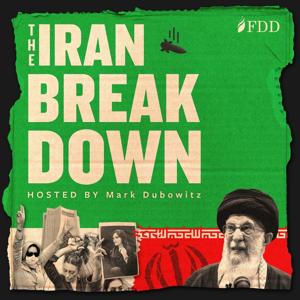
Welcome to The Iran Breakdown. Hosted by Mark Dubowitz, this show from FDD is here to guide you through one of the most critical geopolitical and human rights challenges facing the world…
The Islamic Republic of Iran has been a central player in global headlines for decades: its pursuit of nuclear weapons, development of a massive missile and drove arsenal, funding of terror groups like Hezbollah, Hamas, the Houthis, and others; its oppression of the Iranian people; and its growing alliances with global power states like China, Russia, and North Korea.
But beneath the headlines lies a deeper story: a regime that is losing legitimacy, battered nuclear and missile programs, a crumbling economy, a restless population hungry for freedom, and a global community with many conflicting ideas about how to respond. But a regime still standing and dangerous. And that’s what we’ll cover on The Iran Breakdown.
Ranked by our users in the last 21 days

40 Listeners
5,156 Listeners
648 Listeners
35 Listeners
16 Listeners
449 Listeners

1,216 Listeners

3,174 Listeners
1,067 Listeners

493 Listeners
8,430 Listeners
446 Listeners
87 Listeners

104 Listeners

1,065 Listeners
909 Listeners

123 Listeners
3 Listeners