
Sign up to save your podcasts
Or

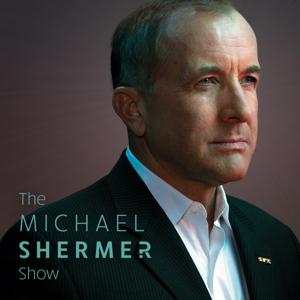
By Michael Shermer


4.4
900900 ratings


The podcast currently has 673 episodes available.
The most played episodes among Podcast App listeners.
Why does the universe produce ever more elaborate forms, from atoms and minerals to cells, organisms, brains, technology, and civilization? The familiar laws of physics can explain much of what happens in nature, but Robert Hazen and Michael Wong argue that something important has been missing: a law describing how evolving systems generate and select new forms over time. Michael Shermer speaks with Hazen and Wong about their proposed law of increasing functional information, the central idea behind their new book Time's Second Arrow. They discuss entropy and the second law of thermodynamics, the origin of life, the Cambrian explosion, emergence and complexity, Stephen Jay Gould and evolutionary contingency, whether evolution has a direction, and why the same basic process of variation and selection may apply far beyond biology. Shermer also presses them on what evidence could falsify their theory, whether AI could evolve far faster than biological organisms, and the biggest question of all: Does any of this imply that the universe has a purpose? Robert M. Hazen, a geoscientist at the Carnegie Institution for Science, is the author of Symphony in C, among other titles. Michael L. Wong is a planetary scientist and astrobiologist at the Carnegie Institution for Science.

UFOs were once the stuff of tabloids and conspiracy theories. Today they're the subject of congressional hearings, Pentagon investigations, mainstream news coverage, and a new wave of claims about government cover-ups and alien technology. Adam Kirsch, senior editor at The Atlantic and author of We Want to Believe: How Aliens Went Mainstream and Why It Matters, joins Michael Shermer to ask what changed—and why the idea of extraterrestrial visitors has such a powerful hold on us. They discuss Roswell, UFO "disclosure," eyewitness testimony, government secrecy, alien abductions, Carl Sagan and Contact, the religious impulse behind UFO belief, and the difference between testimony and scientific evidence. The conversation also turns to the serious scientific search for extraterrestrial intelligence: the Fermi paradox, why decades of SETI have found nothing, how rare intelligent life might be, and whether our ideas about aliens ultimately tell us more about ourselves than about anything actually out there. Adam Kirsch is the author of several books of poetry and criticism and a senior editor at The Atlantic. A 2016 Guggenheim Fellow, Kirsch has written for publications including The New Yorker, Slate, The Times Literary Supplement, The New York Times Book Review, Poetry, and Tablet. His new book is We Want to Believe: How Aliens Went Mainstream and Why It Matters.
Michael Shermer speaks with Wikipedia co-founder Larry Sanger shortly after Sanger was permanently banned from editing the site he helped create. Sanger tells the story of Wikipedia's founding, how its ideal of open collaboration hardened into a system dominated by a relatively small group of powerful editors, and why he believes its rules on sourcing and "consensus" now produce political and religious bias. In the second half of the conversation, Shermer and Sanger shift gears completely and discuss whether religious faith can be rational, the philosophical case for God, the resurrection, the Trinity, repentance and salvation, and whether a future superintelligent AI could become indistinguishable from God.
Why do reasonable people disagree so strongly about right and wrong? And why are we so quick to assume that people on the other side of a moral or political issue are irrational, selfish, ignorant, or simply bad? Michael Shermer speaks with Cornell psychologist Audun Dahl, author of Between Fixed and Fickle: Why Our Moral Views Keep Changing, about how human morality develops and why many familiar explanations fall short. They discuss whether babies are born with a moral sense, what children and other primates can really tell us about the origins of morality, how parents shape their children's values, classic experiments in moral psychology, and whether science can tell us what is right and wrong. The conversation also turns to abortion, competing rights, immigration, religion, and the growing tendency to misunderstand and demonize people who reach different moral conclusions. Audun Dahl is a professor of psychology at Cornell University, where he directs the Developmental Moral Psychology Lab. His research examines how people develop ideas about right and wrong across the lifespan, from infancy through adulthood, and how moral judgments are shaped by everyday social interactions. He is the author of Between Fixed and Fickle: Why Our Moral Views Keep Changing.
How do men and women differ? Where do the differences come from? And how do they shape modern life? Drawing on a century of research and a billion years of evolution, Steve Stewart-Williams explains why many sex differences appear despite socialization, not because of it; why in our mating and parenting patterns, humans are more like the average bird than the average mammal; and why sex differences are sometimes a sign of societal health rather than injustice. Steve Stewart-Williams is a professor of psychology at the University of Nottingham Malaysia. His first book, Darwin, God, and the Meaning of Life, was published in 2010. His second, The Ape That Understood the Universe, was published in 2018. His new book is A Billion Years of Sex Differences.
The podcast currently has 673 episodes available.

26,261 Listeners
2,273 Listeners

825 Listeners
1,069 Listeners

896 Listeners

2,199 Listeners
4,164 Listeners

799 Listeners
1,644 Listeners
508 Listeners
604 Listeners

21 Listeners

959 Listeners
203 Listeners

243 Listeners