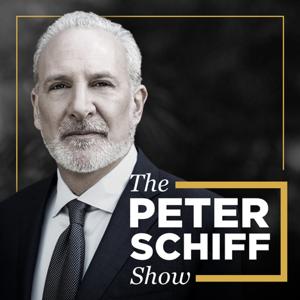
The Peter Schiff Show Podcast

The Peter Schiff Show Podcast

Download on the App Store
  • Ranking

    4th

    on Business News

  • Favorites

    1,764

    Followers

  • Typical duration

    58 min

    per episode

  • If it hooks

    49%

    finish an episode

Based on Podcast App listening data

The Peter Schiff Show Podcast episodes

  • U.S. Inflation Is Bullish for Gold and Bearish for the Dollar – Ep. 293
    Inflation Higher Than Expected
    Today we got the hotter than expected news on prices - on inflation.  We got the import/export prices.  Import prices were supposed to be up 0.5%, which in and of itself is a pretty big jump, but they were up 0.7. Export were also up; (we would want export prices to go up, because that means we are getting more for what we export) they were expected to rise 0,4%, and instead they rose by 0.8.  Double the expectation.
    Import/Export Index Methodology More Accurate
    Year over year, import prices are up 2.7%.  As of last month, the year over rise was just 2.1%, so that's a pretty big jump in the year over year gain.  Export prices were up 2.9% year over year.  Averaging these out, you get 2.8% as the average increase in 1 year of the price of the stuff we import and export.  That's a broad based increase - well above the supposed 2% level the Fed is looking for.  They are looking for consumer prices, measured by the CPI, but the Import/Export index represents things the consumers consume, and I would think these numbers are going to be more accurate than the CPI because there is less subjectivity in there.  I think the methodology is more accurate than the methodology on the CPI.  I think soon we're going to see year-over-year increases import and export prices with a 3 handle.
    Markets Working Counter-Intuitively
    When this news came out, the immediate reaction was to buy the dollar and sell gold.  Why?  Why is higher inflation bad for gold?  The main reason to buy gold is as an inflation hedge. If you think there is going to be more inflation, then you buy gold.  Perversely, the way the markets work now, you sell gold if you think there's going to be more inflation, in fact, you buy the currency of the country that is experiencing more inflation, which is counter-intuitive. Inflation by definition, is the currency losing value.  If the currency is losing its purchasing power, why would you want to buy more of it?  You would want to get rid of it to avoid that loss.
    Will Higher Inflation Produce a Tighter Fed?
    But the thinking is, if there is more inflation, as measured by these price indexes, that the Federal Reserve is now going to have to fight the inflation, that they are going to be more likely to raise interest rates, to raise them sooner, to raise them more, in the face of higher inflation. So it is the expectation that these higher numbers will produce a tighter Fed - that is what rallies the dollar,  That is what hurts gold - the anticipation of higher rates to fight off the inflation.
    Fighting Inflation vs. The Bubbles
    Reality is that the Fed will ignore the higher inflation numbers and do nothing.  Whatever it is going to do with rates, it will do it regardless of these numbers.  Ultimately, if the Fed has to make a choice between fighting inflation and unemployment (because the Fed believes in the Phillips Curve trade-off between employment and inflation), the Fed will always choose to fight unemployment.  It will prop up the labor market and sacrifice its inflation goal. It is more concerned with maintaining asset bubbles, propping up the U.S. government so it does not have to default on its debt.
    Letting Inflation Burn
    The reality is, higher inflation is not going to produce a tighter monetary policy.  The Fed is going to have to ignore higher inflation, which means the inflation is going to get even worse.  It is almost like the Fed has to ignore a fire, and because it ignores the fire, it is just going to get bigger, it's not going going to try to put it out because it is afraid that putting it out is actually worse than letting it burn.  If traders understood this, then they would be dumping the dollar and buying gold.
    Real Inflation vs. Nominal Inflation
    Even if the Fed ultimately raises rates, they're not going to get out in front of the inflation curve.

    42 min
  • Record Confidence in U.S. Stocks Means Trouble Ahead – Ep. 292
    Optimism Rules the Day
    Friday the 13th was not an unlucky day for the U.S. stock market; all three of the major stock market averages closing at all time record highs. Optimism is ruling the day. In fact, there was a consumer confidence number that came out today revealing confidence in the economy - the University of Michigan Consumer Confidence - and this is a measure of the belief that the U.S stock market will be higher 12 months from now than it is today.  By that measure, consumers have more confidence in the U.S. stock market than they have ever had in the past. That would include where we were just before the '08 Financial Crisis and where the market was at the peak of the dot com bubble.
    Complacent Investors
    In fact, there are other measures of investor sentiment that have never been this high.  Look at the VIX, for example, which is really a measure of risk, of investors' need to hedge their portfolios.  If you look at that, the VIX is at all time record lows.  Investors have never been this complacent about the U.S. stock market - ever! And all of those measures of fear, confidence, are at the lowest and highest readings, respectively, that they've ever been, even though the U.S. stock market is extremely expensive.
    Not a Bubble?
    The U.S. stock market has only been this expensive near the peaks of previous bubbles.  But what's different about this bubble is a) it's bigger, and b) people are even more confident now that it is not a bubble.  You have less fear, less anxiety and investors are more convinced that they can't lose than at any prior time, despite the fact that we actually probably have more risk now than during any of the previous bubbles. Of course, it's not just the investors who are confident.  Consumer confidence is high, in fact the consumer confidence number came out much higher than expected today.
    Government Inflation Numbers Real?  Not.
    The dollar rallied on that today. Initially, down because of the lower than expected CPI, which is seen, paradoxically as good for the dollar if there is less inflation.  Somehow, the way the markets react, if there is not enough inflation, they reduce the probability of a rate hike, so the dollar sold off.  The PPI that came out yesterday was a little higher than expected, so people were worried: "Oh, well, maybe there's more inflation, then the CPI comes out and it's lower than expected. Of course none of these numbers are actually real, because we all know consumer prices are rising a lot faster than these indexes purport to show.
    Fed Confusing Inflation with Employment
    Of course, then the Fed complains that we don't have enough inflation.  In fact the Fed actually claims they don't even understand why inflation is so low; they expect it to be higher.  Ironically, not because of all the money they printed, they think inflation should be higher based on how low the unemployment is.  They are looking at the Phillips curve and they don't understand why we don't have more inflation when the unemployment rate is so low.  They don't understand that there's no real relationship between employment and inflation. If there was, it's the opposite of what they think.  When people are productively employed, and making more things, that tends to keep prices down. When people are unemployed, governments have to subsidize them by printing a lot of money and making a lot of unemployment benefits or welfare benefits, that will generally lead to higher consumer prices. If anything, they will be correlated together, not opposite.


    Our Sponsors:
    * Check out Fast Growing Trees and use my code GOLD for a great deal: https://www.fast-growing-trees.com
    * Check out Plaud AI and use my code GOLD for a great deal: https://www.plaud.ai


    Privacy & Opt-Out: https://redcircle.com/privacy
    35 min
  • Record Confidence in U.S. Stocks Means Trouble Ahead – Ep. 292
    Optimism Rules the Day
    Friday the 13th was not an unlucky day for the U.S. stock market; all three of the major stock market averages closing at all time record highs. Optimism is ruling the day. In fact, there was a consumer confidence number that came out today revealing confidence in the economy - the University of Michigan Consumer Confidence - and this is a measure of the belief that the U.S stock market will be higher 12 months from now than it is today.  By that measure, consumers have more confidence in the U.S. stock market than they have ever had in the past. That would include where we were just before the '08 Financial Crisis and where the market was at the peak of the dot com bubble.
    Complacent Investors
    In fact, there are other measures of investor sentiment that have never been this high.  Look at the VIX, for example, which is really a measure of risk, of investors' need to hedge their portfolios.  If you look at that, the VIX is at all time record lows.  Investors have never been this complacent about the U.S. stock market - ever! And all of those measures of fear, confidence, are at the lowest and highest readings, respectively, that they've ever been, even though the U.S. stock market is extremely expensive.
    Not a Bubble?
    The U.S. stock market has only been this expensive near the peaks of previous bubbles.  But what's different about this bubble is a) it's bigger, and b) people are even more confident now that it is not a bubble.  You have less fear, less anxiety and investors are more convinced that they can't lose than at any prior time, despite the fact that we actually probably have more risk now than during any of the previous bubbles. Of course, it's not just the investors who are confident.  Consumer confidence is high, in fact the consumer confidence number came out much higher than expected today.
    Government Inflation Numbers Real?  Not.
    The dollar rallied on that today. Initially, down because of the lower than expected CPI, which is seen, paradoxically as good for the dollar if there is less inflation.  Somehow, the way the markets react, if there is not enough inflation, they reduce the probability of a rate hike, so the dollar sold off.  The PPI that came out yesterday was a little higher than expected, so people were worried: "Oh, well, maybe there's more inflation, then the CPI comes out and it's lower than expected. Of course none of these numbers are actually real, because we all know consumer prices are rising a lot faster than these indexes purport to show.
    Fed Confusing Inflation with Employment
    Of course, then the Fed complains that we don't have enough inflation.  In fact the Fed actually claims they don't even understand why inflation is so low; they expect it to be higher.  Ironically, not because of all the money they printed, they think inflation should be higher based on how low the unemployment is.  They are looking at the Phillips curve and they don't understand why we don't have more inflation when the unemployment rate is so low.  They don't understand that there's no real relationship between employment and inflation. If there was, it's the opposite of what they think.  When people are productively employed, and making more things, that tends to keep prices down. When people are unemployed, governments have to subsidize them by printing a lot of money and making a lot of unemployment benefits or welfare benefits, that will generally lead to higher consumer prices. If anything, they will be correlated together, not opposite.


    35 min
  • Middle Class Tax Hikes Put Trump Tax Cuts in Jeopardy – Ep. 291
    Congress May Not Deliver Promised Economic Growth
    I think part of the renewed weakness in the dollar may be due to the feeling that all the tax cuts are not going to pass.  The Trump/Republican plan outlined some days ago will be difficult to to get through Congress. Even if it does get through Congress it is not going to deliver the economic growth that is being advertised.
    Tax Cuts Masquerading as Reform
    Go back to the origins to the Republican dialogue about tax reform.  They actually wanted to do reform. All the reform is out the window now. All we have is tax cuts masquerading as reform.  But the initial concept that the Republicans had was to try to move toward a consumption-based tax system. They tried to do that through the back door with the BAT (Border Adjusted Tax), which is the opposite of what the Republicans are now promising, which was tax relief for the middle class. That's not what they are delivering.
    Getting Around Elimination of State & Local Tax Deductions
    A lot of people are going to get tax increases.  Part of the problem, though is the elimination of the deductibility of state and local taxes. I mentioned on an earlier podcast that the states can get around this by shifting the tax to a payroll tax that will be fully deductible for the employers.  Any resulting reduction in salary would be offset by the elimination of state and local taxes.  If the states react the way I think they will to the loss of the deduction, the governments will not reap the tax windfall that they expect, causing much bigger deficits.
    Big Deficits Ahead
    At the end of the day the bill may not pass because Congress may not be willing to sign on to anything that raises taxes.  They want everybody to get at tax cut.  How are you going to do that? How are you going to cut income taxes and not cut spending on anything without having a huge increase in the deficit - which of course is what is going to happen.
    Recession Ahead
    You can try to assume that some of that increase is not there because of dynamic scoring, you can assume that tax cuts are going to lead to economic growth.  Maybe they will, but I think regardless we're going to have a recession.  There is no recession in any of the forecasts. Nobody thinks a recession is coming at any point during the next 10 years, whether we cut taxes or not. I think, whether we cut taxes or not we're going to have a recession, and if there is a recession, you can throw all this dynamic scoring out the window!
    Production Equals Stimulus
    Even if the recession is not as severe as a result of the tax cuts, the results will still be huge increases  in the budget deficit. They are losing some Republican support and they are going to have to reach across the aisle, and there is no way the Democrats will sign on to any tax cuts for the "rich".  If they take away tax cuts on corporations, they take away the reduction in the marginal tax rate, then you lose any hope of economic stimulus. That is where the stimulus comes from.  Real economic stimulus comes from more capital investment, more job creation, less consumption. That is what you get when you reduce marginal taxes on people with the highest propensity to save and invest.
    Inflation Ahead
    The Keynesians have it backwards.  They think stimulus comes from consumption - it doesn't.  Consumption doesn't stimulate anything.  Consumption without production just leads to higher prices which is what is going to happen.  We are going to get more inflation.

    Our Sponsors:
    * Check out Fast Growing Trees and use my code GOLD for a great deal: https://www.fast-growing-trees.com
    * Check out Plaud AI and use my code GOLD for a great deal: https://www.plaud.ai


    Privacy & Opt-Out: https://redcircle.com/privacy
    33 min
  • Middle Class Tax Hikes Put Trump Tax Cuts in Jeopardy – Ep. 291
    Congress May Not Deliver Promised Economic Growth
    I think part of the renewed weakness in the dollar may be due to the feeling that all the tax cuts are not going to pass.  The Trump/Republican plan outlined some days ago will be difficult to to get through Congress. Even if it does get through Congress it is not going to deliver the economic growth that is being advertised.
    Tax Cuts Masquerading as Reform
    Go back to the origins to the Republican dialogue about tax reform.  They actually wanted to do reform. All the reform is out the window now. All we have is tax cuts masquerading as reform.  But the initial concept that the Republicans had was to try to move toward a consumption-based tax system. They tried to do that through the back door with the BAT (Border Adjusted Tax), which is the opposite of what the Republicans are now promising, which was tax relief for the middle class. That's not what they are delivering.
    Getting Around Elimination of State & Local Tax Deductions
    A lot of people are going to get tax increases.  Part of the problem, though is the elimination of the deductibility of state and local taxes. I mentioned on an earlier podcast that the states can get around this by shifting the tax to a payroll tax that will be fully deductible for the employers.  Any resulting reduction in salary would be offset by the elimination of state and local taxes.  If the states react the way I think they will to the loss of the deduction, the governments will not reap the tax windfall that they expect, causing much bigger deficits.
    Big Deficits Ahead
    At the end of the day the bill may not pass because Congress may not be willing to sign on to anything that raises taxes.  They want everybody to get at tax cut.  How are you going to do that? How are you going to cut income taxes and not cut spending on anything without having a huge increase in the deficit - which of course is what is going to happen.
    Recession Ahead
    You can try to assume that some of that increase is not there because of dynamic scoring, you can assume that tax cuts are going to lead to economic growth.  Maybe they will, but I think regardless we're going to have a recession.  There is no recession in any of the forecasts. Nobody thinks a recession is coming at any point during the next 10 years, whether we cut taxes or not. I think, whether we cut taxes or not we're going to have a recession, and if there is a recession, you can throw all this dynamic scoring out the window!
    Production Equals Stimulus
    Even if the recession is not as severe as a result of the tax cuts, the results will still be huge increases  in the budget deficit. They are losing some Republican support and they are going to have to reach across the aisle, and there is no way the Democrats will sign on to any tax cuts for the "rich".  If they take away tax cuts on corporations, they take away the reduction in the marginal tax rate, then you lose any hope of economic stimulus. That is where the stimulus comes from.  Real economic stimulus comes from more capital investment, more job creation, less consumption. That is what you get when you reduce marginal taxes on people with the highest propensity to save and invest.
    Inflation Ahead
    The Keynesians have it backwards.  They think stimulus comes from consumption - it doesn't.  Consumption doesn't stimulate anything.  Consumption without production just leads to higher prices which is what is going to happen.  We are going to get more inflation.
    33 min
  • Government Costs More When Paid for with Borrowed Money – Ep. 290
    Government Is Not Measured by What It Taxes, It Is Measured by What It Spends
    Democrats promise free stuff; Republicans promise free tax cuts.  What's a free tax cut?  That's a tax cut that happens even though you don't reduce government spending. In a recent panel discussion with Steve Forbes, I made the point that government is not measured by what it taxes, it is measured by what it spends. So, if the government is spending money, there is a cost associated with that, whether or not we pay for it through taxation, we're still going to pay for it.
    Cutting Taxes, but Borrowing and Printing the Difference Is Worse
    We're going to pay for it through more debt, higher inflation, and ultimately higher taxes in the future to not only repay the debt, but to pay the interest on the money we borrowed to finance the tax cuts.  So cutting taxes, but borrowing and printing the difference is worse.  I would rather pay for government with taxes than debt and inflation and higher taxes in the future. That is the argument I made with Steve Forbes is: If the Republicans are going to tell their constituents that they can get tax cuts even though the government continues to grow, they how do they have the political ability to generate the swell of public opinion to shrink government?
    You Can't Have Big Government and Low Taxes
    What I want the Republicans to do is make it all about less government.  I want the Republicans to say, "You've got a choice. You can have big government and high taxes, or you can have small government and low taxes."  That's it.  You can't have big government and low taxes. That's what the Republicans want to sell and that's what Steve Forbes was advocating, but if people think they can have their cake and eat it too, they they will vote for that.  But if you put it in those terms: "You want lower taxes, you need less government. If you want to pay less for government, then government has to cost less. Yes you can have a big tax cut, more take home pay, but these are the government programs you have to eliminate in order to make that possible."
    You Can't Tell the Voters They Can Have Tax Cuts First and Cut Spending Later
    You might be able to generate support for cutting government spending if people realize there is a reward for that. You cut government spending and then you get the tax cuts.  Steve Forbes was arguing to give the tax cuts first. If we get the tax cuts first, you will never get the cuts in spending.  It's like young kids who want dessert first, but if they want dessert, they have to eat their dinner. If I give my kids dessert first, they'll never eat their dinner! So you can't tell the voters they can have their tax cuts first and then we'll cut spending later because we we'll never get smaller government.  The tax cuts must be contingent on the spending cuts.

    Our Sponsors:
    * Check out Fast Growing Trees and use my code GOLD for a great deal: https://www.fast-growing-trees.com
    * Check out Plaud AI and use my code GOLD for a great deal: https://www.plaud.ai


    Privacy & Opt-Out: https://redcircle.com/privacy
    38 min
  • Government Costs More When Paid for with Borrowed Money – Ep. 290
    Government Is Not Measured by What It Taxes, It Is Measured by What It Spends
    Democrats promise free stuff; Republicans promise free tax cuts.  What's a free tax cut?  That's a tax cut that happens even though you don't reduce government spending. In a recent panel discussion with Steve Forbes, I made the point that government is not measured by what it taxes, it is measured by what it spends. So, if the government is spending money, there is a cost associated with that, whether or not we pay for it through taxation, we're still going to pay for it.
    Cutting Taxes, but Borrowing and Printing the Difference Is Worse
    We're going to pay for it through more debt, higher inflation, and ultimately higher taxes in the future to not only repay the debt, but to pay the interest on the money we borrowed to finance the tax cuts.  So cutting taxes, but borrowing and printing the difference is worse.  I would rather pay for government with taxes than debt and inflation and higher taxes in the future. That is the argument I made with Steve Forbes is: If the Republicans are going to tell their constituents that they can get tax cuts even though the government continues to grow, they how do they have the political ability to generate the swell of public opinion to shrink government?
    You Can't Have Big Government and Low Taxes
    What I want the Republicans to do is make it all about less government.  I want the Republicans to say, "You've got a choice. You can have big government and high taxes, or you can have small government and low taxes."  That's it.  You can't have big government and low taxes. That's what the Republicans want to sell and that's what Steve Forbes was advocating, but if people think they can have their cake and eat it too, they they will vote for that.  But if you put it in those terms: "You want lower taxes, you need less government. If you want to pay less for government, then government has to cost less. Yes you can have a big tax cut, more take home pay, but these are the government programs you have to eliminate in order to make that possible."
    You Can't Tell the Voters They Can Have Tax Cuts First and Cut Spending Later
    You might be able to generate support for cutting government spending if people realize there is a reward for that. You cut government spending and then you get the tax cuts.  Steve Forbes was arguing to give the tax cuts first. If we get the tax cuts first, you will never get the cuts in spending.  It's like young kids who want dessert first, but if they want dessert, they have to eat their dinner. If I give my kids dessert first, they'll never eat their dinner! So you can't tell the voters they can have their tax cuts first and then we'll cut spending later because we we'll never get smaller government.  The tax cuts must be contingent on the spending cuts.
    38 min
  • More Gun Laws Will Not Prevent Mass Killings – Ep. 289
    Gun Laws Do Not Prevent Crime
    The answer to preventing mass killings is not more gun control; Stephen Paddock would have been able to get those guns regardless of whether or not owning them was illegal. He would have found a way to get those guns. Heroine is illegal, cocaine is illegal - there are all kinds of things that are illegal - it doesn't stop people from getting them.
    Criminals Will Break Any Law
    If you are a criminal, you are going to break the law, and clearly, if you're willing to murder, you're willing to break the law about gun ownership. Had the police not found him when he did, who knows how many people he would have indiscriminately murdered?  He still had a hundreds of unused bullets that he was intending to fire at the crowd. He didn't even know who he was shooting; he did not care who he hit. So clearly, someone who is willing to commit that kind of murder is willing to break the gun laws.
    Another Person With A Gun Could Prevent the Murder
    So gun control would not have prevented him from committing this crime.  Maybe if someone with a gun in the hotel had found him earlier they could have shot that guy in the back of the head before he had the chance to shoot as many people as he did.
    Beware of Overreaction
    What really scares me, though, too, is what kind of backlash we might have, what kind of overreaction for additional security at hotels. Will it be confined to just Las Vegas hotels, or hotels all over the country? I get visions of checking into a hotel being just like the TSA lines at the airports. There is no way to be sure that a hotel can keep guns out of a hotel room.  They don't have cameras inside hotel rooms.  Is it possible that if they had had extra security at check-in Stephen Paddock would not have been able to get his guns up to his room? He might not have, but this was obviously a premeditated act that took days of preparation, and he could have found a way around the safeguards, or devised another way of killing.

    Our Sponsors:
    * Check out Fast Growing Trees and use my code GOLD for a great deal: https://www.fast-growing-trees.com
    * Check out Plaud AI and use my code GOLD for a great deal: https://www.plaud.ai


    Privacy & Opt-Out: https://redcircle.com/privacy
    37 min
  • More Gun Laws Will Not Prevent Mass Killings – Ep. 289
    Gun Laws Do Not Prevent Crime
    The answer to preventing mass killings is not more gun control; Stephen Paddock would have been able to get those guns regardless of whether or not owning them was illegal. He would have found a way to get those guns. Heroine is illegal, cocaine is illegal - there are all kinds of things that are illegal - it doesn't stop people from getting them.
    Criminals Will Break Any Law
    If you are a criminal, you are going to break the law, and clearly, if you're willing to murder, you're willing to break the law about gun ownership. Had the police not found him when he did, who knows how many people he would have indiscriminately murdered?  He still had a hundreds of unused bullets that he was intending to fire at the crowd. He didn't even know who he was shooting; he did not care who he hit. So clearly, someone who is willing to commit that kind of murder is willing to break the gun laws.
    Another Person With A Gun Could Prevent the Murder
    So gun control would not have prevented him from committing this crime.  Maybe if someone with a gun in the hotel had found him earlier they could have shot that guy in the back of the head before he had the chance to shoot as many people as he did.
    Beware of Overreaction
    What really scares me, though, too, is what kind of backlash we might have, what kind of overreaction for additional security at hotels. Will it be confined to just Las Vegas hotels, or hotels all over the country? I get visions of checking into a hotel being just like the TSA lines at the airports. There is no way to be sure that a hotel can keep guns out of a hotel room.  They don't have cameras inside hotel rooms.  Is it possible that if they had had extra security at check-in Stephen Paddock would not have been able to get his guns up to his room? He might not have, but this was obviously a premeditated act that took days of preparation, and he could have found a way around the safeguards, or devised another way of killing.
    37 min
  • Stock Indexes End Q3 at Record Highs – Ep. 288
    Record Highs in the Markets
    This is the last day of the third quarter; S&P 500 and NASDAQ ended at record highs.  I am not sure what made the Dow miss an all-time record - it was close but no cigar.  Other broader measures did hit record highs to close out the quarter, in fact, Donald Trump was tweeting about the record highs in the stock market earlier this morning.  Of course, when we were having record highs under Obama, it was a bubble and it didn't matter, but now that it is his bubble, it's now a bull market and it simply shows what a great job he is doing as President.
    Weak Dollar Boosts International Markets
    Of course, U.S stock markets were overshadowed by international markets, thanks in large part to the weakness in the U.S. dollar. The dollar did recover some of its losses in this closing week of the quarter (I believe, again, a bit of a dead cat bounce).  I think the dollar is going to have its weakest quarter of the year in the fourth quarter, so we'll see if I'm right on that. But even with a little bit of a bounce, the dollar index back up to 93.o7. Despite that, foreign markets still well out-performed the U.S. stock markets in Q3 as did gold stocks.  If you bought gold stocks, they did better than the S&P in Q3.
    Gold Seeking Key Level
    I think the divergence between the gold stocks and the S&P is going to accelerate in Q4.  Obviously 1300 was not really the breakout; gold got all the way up to $1350 before turning back, and it's now back below $1300; it was off another few bucks today. So I think maybe $1300 wasn't the key level.  It's probably $1350 or higher before we get the breakout.  I think we're at $1280 right now.
    Personal Income and Spending Weak
    More bad economic news: the big number was personal income and spending.  It met expectations, relatively, except they did revise July down.  It was originally reported at +1.4% and they revised it to +1.3%, so, weaker than they had originally reported.  For August it was up .2% and consumer spending was up .1%.  Last month's +.3 was unrevised but this month met expectations of +.1% and these are low numbers


    Our Sponsors:
    * Check out Fast Growing Trees and use my code GOLD for a great deal: https://www.fast-growing-trees.com
    * Check out Plaud AI and use my code GOLD for a great deal: https://www.plaud.ai


    Privacy & Opt-Out: https://redcircle.com/privacy
    38 min

About The Peter Schiff Show Podcast

From the publisher's feed

Peter Schiff is an economist, financial broker/dealer, author, frequent guest on national news, and host of the Peter Schiff Show Podcast. The podcast focuses on economic data analysis and unbiased…

Best of The Peter Schiff Show Podcast

Ranked by our users in the last 21 days

More shows like The Peter Schiff Show Podcast

Rich Dad Radio Show: In-Your-Face Advice on Investing, Personal Finance, & Starting a Business by The Rich Dad Media Network

Rich Dad Radio Show: In-Your-Face Advice on Investing, Personal Finance, & Starting a Business

3,835 Listeners

Peak Prosperity by Chris Martenson

Peak Prosperity

567 Listeners

Macro Voices by Erik Townsend

Macro Voices

3,058 Listeners

The Tom Woods Show by Tom Woods

The Tom Woods Show

3,360 Listeners

Ron Paul Liberty Report by Ron Paul Liberty Report

Ron Paul Liberty Report

2,266 Listeners

Quoth the Raven by Quoth the Raven

Quoth the Raven

933 Listeners

Gold Goats 'n Guns Podcast by Tom Luongo

Gold Goats 'n Guns Podcast

328 Listeners

Palisades Gold Radio by Collin Kettell

Palisades Gold Radio

259 Listeners

Rebel Capitalist News by George Gammon

Rebel Capitalist News

1,028 Listeners

Eurodollar University by Jeff Snider

Eurodollar University

457 Listeners

The Grant Williams Podcast by Grant Williams

The Grant Williams Podcast

1,340 Listeners

Wealthion - Be Financially Resilient by Wealthion

Wealthion - Be Financially Resilient

369 Listeners

Thoughtful Money with Adam Taggart by Adam Taggart | Thoughtful Money

Thoughtful Money with Adam Taggart

409 Listeners

The Julia La Roche Show by Julia La Roche

The Julia La Roche Show

83 Listeners

The David Lin Report by The David Lin Report

The David Lin Report

48 Listeners