
Sign up to save your podcasts
Or



Based on Podcast App listening data
We look at how the British and Japanese came about to select their aims and how they got to them.
What was the British mission and what did Churchill understand of the mission to be? How did Brooke Popham understand his mission and how did that impact the troops on the ground (and pilots in the air).
We have a slight diversion to look at the Whole of Government approach to defence and how the Australian Government undermined the Air Force and it's capabilities. Why would they do that? How effective was the Beaufort Bomber? Was a defence procurement decision influenced by political needs?
What role did the 'China incident' play with Japanese decision making processes? How did COL Tsuji influence the decision to go south and east as opposed to north and west.
The Imperial Japanese Navy was using 400 tonnes of oil an hour - how would they secure the resources they needed?
What were the similarities and differences between the Japanese and British thinking?
We look at Unity of Command in both the Japanese and British forces.
How did issues with command structure effect each of the forces?
What was the relationship between Bennett and Percival? Did Bennett's micromanagement of the Brigades limit their effectiveness. How would command issues effect 22nd and 27th Brigade.
What issues did LT GEN Yamashita have? What is Gekokujo and why was Charlie Chaplin nearly assassinated?
What was the May 15th incident and why did 350,000 people sign a petition in blood?
Allied Doctrine had seen little development between the war with significant budget cuts. The Army was relegated to an Imperial policing role. It is very Command and Control way of
We look at Sir John Dill and his visit to Tannenburg and his interpretation of 'Mission Command'.
Malaya was a very laissez-faire, with some units preferring not to train in the jungle.
LT COL Ian Stewart from the Argyll and Sutherland Highlanders. He trained one of the best battalions in Malaya. How was his training methodologies viewed at Malaya Command?
British Staff College focused on strategy, not on Brigade and Division Command, which meant that British officers struggled when commanding one up.
How did the 8th Division transition from the training for desert fighting once they landed in Malaya?
What was the thinking about Combined Arms and how was it trained for?
How did MAG GEN Gordon Bennett train the Division for the withdrawal and what where his thoughts on digging in?
How did the personalities of the individual Battalion Commanders impact each of their battalions.
The Japanese developed a Jungle Warfare in Taiwan to develop doctrine. They also conducted 10 major exercises for amphibious operations.
The reliance on the bicycle enabled rapid movements of troops with very little logistics impact.
The difference between the Japanese and British highlighted the amount of recent modern warfare experience that each Army had been subjected to.
How did the road impact the thinking for each of the commanders? How would it shape their actions and dispositions.
What is fighting for the road off the road and how did the British and Indian troops respond to this tactic?
How did the Japanese task organise for their upcoming offensive?
8th Division started from the ground up to develop their doctrine, which meant that there was still significant work to be done after first contact with the enemy.
The British planned to use Artillery and Air Power to defend Malaya.
Malaya is hot and humid and it has the 29th longest coastline (lots of areas for conducting amphibious operations). There is a steep mountain range splitting the country between the East and West, and there are very few laterals over the ranges.
The road infrastructure improved over time to support the rubber and tin industries in Malaya and this enabled easy road movement. They are often 2 lane highways and in a large number of places the roads are cut into the hills forming defiles, perfect for the defence.
The Air Force constructs a number of airfields. Little consideration was given to the provision of local defence for these airfields. This dictates the ground that the Army is required to defend.
The human terrain consists of British expats, Chinese, Malays, and Indians. The Chinese are very co-operative with the British, but the Malays, who are exploited as cheap labour, are more co-operative with the Japanese. Cheap wages for labourers create discontent among the Malays and Indians. The Indians, being exploited for labour, this increased feelings of Indian Nationalism.
Racism exacerbated the tensions between the Indians and the British. Britain relied on a massive expansion of the Indian Army. The IIIrd Indian Corps had a lot of junior, poorly trained troops.
In Australia, there was a pool of 80,000 in the Commonwealth Military Force. This pool created 6th Division, 7th Division and 8th Division. Eighth Div would provide the troops from Australia who would serve in Singapore and Malaya.
The Japanese had been our allies in WW1. We discuss the Marco Polo incident and the experience that the Japanese troops had prior to the invasion. The Japanese had been on a war footing for a long time and their Army was much better trained and equipped.
We ran out of time for Doctrine. Next episode we will try to make the doctrine interesting, if not fascinating!
The Centre of Gravity is that characteristic, capability or locality from which a force, nation or alliance derives its freedom of action, strength or will to fight.
For the British, the CoG was the Singapore Naval Base. It was the fundamental part of the defence of the whole of South East Asia. In times of need the Royal Navy would sail out to Singapore and defeat all comers and ensure that the Empire was secure. The port at Singapore was central to the defence of Australia. The base wasn't big enough for the fleet required to keep the seas free. The fleet was unlikely to sally forth if decisively engaged in Europe, so the fleet base was too small for a fleet that was unlikely ever sail there. It turned out to be the second largest graving dock in the world at the time.
We look at how the Singapore Strategy became increasingly untenable, but no one was prepared to
In 1940 it became apparent that the Navy would not be able to sail to Singapore 'for the foreseeable future."
LT GEN Percival conducted an analysis of the defence of Singapore before the war. This dictated that the defence of Singapore would need to be conducted in Malaya and northern Malaya at that.
As the war progressed, Churchill hoped that the US would provide the Navy required to support the British in the Far East, if provoked.
With no Navy to defend the base, the defence of Malaya fell to the Air Force. With not enough planes and the planes they had being too old, the last line of defence would be the Army.
The defence of the base dictated the way that the Battle of Malaya was fought.
For the Japanese, the CoG analysis is a lot easier. It was the tank.
The tanks the Japanese had were not great and the tactics they used were not modern, but they had tanks, used them very aggressively and the British had no tanks in Malaya. The Japanese used the tanks for filleting attacks which were devastating, especially against forces that were not well versed in combined arms, or even anti tank weapons.
A Critical Vulnerability of tanks, of course, is the logistics tail required. How will Yamashita overcome this?
Our first campaign that we will look at is from Malaya.
We detail some of the key people in the Malaya Campaign:
LT Gen Percival
AVM Pulford
LT Gen Heath
MAJ Gen Gordon Heath
LT Gen Yamashita
We look at the numbers for both sides. Yamashita was fighting significantly outnumbered, so how did he make up the numbers?
Armoured warfare - who had the advantage with tanks?
In late 1941 the war is going quite badly for the Allies, the Germans are at the gates of Moscow.
The Royal Navy sends Prince of Wales and Repulse to defend Singapore and Malaya. After Japanese landings, Force Z moves out to defeat the Japanese only to be sunk. Churchill describes it as the greatest naval disaster ever in the history of the Royal Navy.
The Japanese fight at Jitra and win. Within the first 100 hours, they have achieved control of the air, control of the sea and started to dominate on the land.
Yamashita pushes aggressively south down Malaya. A series of major withdrawals continue. He leapfrogs down the Western coast of Malaya outflanking the Allies out of prepared defences.
Wavell takes command of the ABDA command and he orders a 150 mile retreat.
We look at COL Tsuji, the God of Operations and how he prepared the strategy for the Japanese attack.
Wavell meets MAJ GEN Bennett and likes the aggressive spirit that he displays. An inexperienced divisional staff takes over command of 3 divisions.
The Battle of Muar is fought and lost and significant casualties are suffered by the Allies.
The situation is so bad in the air that unarmed flying club planes are used for recon.
The Japanese advanced 740 km in one month and 1 month and 23 days with a force ratio of 1:2, not the expected 3:1. How did they manage such a marked victory?
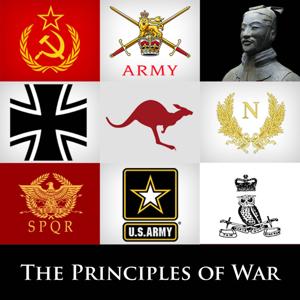
We look at how the Principles of War podcast is going to work, what we want to do and how we are going to do it.
We discuss how terrain plays a part in the outcomes of battles and we will be looking at leadership.
What role does leadership play in battle? What about Post H-Hour Execution and leadership? We look at some examples from General Grant's experiences that lead him to be the Commander of the Army of the Potomac.
We discuss each of the principles and give a brief example of why each is important.
Selection and the Maintenance of the Aim. Probably the most important of the principles.
Concentration of Force - My strategy is 1 against 10 - my tactics 10 against 1. The
Economy of effort - if you aren't the main effort, you will be short of everything except the enemy.
Co-operation - why is this so difficult to achieve. We briefly looked at the problems with co-operation for the D-Day landings.
Security - Truth is so precious it should be attended by a bodyguard of lies.
Surprise - To surprise the enemy is to defeat them. The Germans driving through the Ardennes forest in 1940. We talk briefly about technical surprise.
Flexibility - Auftragtaktik and Mission Command. We look at Yom Kippur.
Offensive Action - Britzkrieg.
Sustainment - Supplies set the left and right of arc of what is possible. Sherman's march to the sea and the Atlantic Conveyor in the Falklands.
Morale - The Army of the Potomac after the Battle of the Wilderness.
Sun Tzu said -The art of war is of vital importance to the State. It is a matter of life and death, a road either to safety or to ruin. Hence it is a subject of inquiry which can on no account be neglected.
This is why we need to understand the principles of war.
From the publisher's feed
Ranked by our users in the last 21 days
538 Listeners
1,234 Listeners

1,048 Listeners

4,761 Listeners
653 Listeners

466 Listeners
1,411 Listeners

3,364 Listeners
923 Listeners

22 Listeners

496 Listeners

1,886 Listeners
335 Listeners
790 Listeners
136 Listeners