
Sign up to save your podcasts
Or

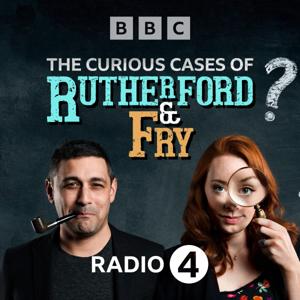

Why are some smells so nasty and others so pleasant? Rutherford and Fry inhale the science of scent in this stinker of an episode.
Our sleuths kick off with a guided tour of the airborne molecules and chemical receptors that power the sense of smell. Armed with a stack of pungent mini-flasks, Professor Matthew Cobb from the University of Manchester shows Hannah and Adam just how sensitive olfaction can be, and how our experience of some odours depends on our individual genetic make-up.
Dr Ann-Sophie Barwich from Indiana University reveals how most everyday smells are complex combinations of hundreds of odorants, and how the poo-scented molecule of indole turns up in some extremely surprising places.
With the help of a flavoured jellybean and some nose clips, Hannah experiences how smell is crucial to flavour, adding complexity and detail to the crude dimensions of taste.
Speaking of food, listener Brychan Davies is curious about garlic and asparagus: why do they make us whiff? Professor Barry Smith from the Centre for the Study of the Senses reveals it's down to sulphur-containing compounds, and tells the story of how a cunning scientist managed to figure out the puzzle of asparagus-scented urine.
Finally, another listener Lorena Busto Hurtado wants to know whether a person’s natural odour influences how much we like them. Barry Smith says yes - we may sniff each other out a bit like dogs - and cognitive neuroscientist Dr Rachel Herz points to evidence that bodily bouquet can even influence sexual attraction!
Producer: Ilan Goodman
Contributors: Professor Matthew Cobb, Professor Barry Smith, Dr Ann-Sophie Barwich, Dr Rachel Herz
 View all episodes
 By BBC Radio 4

4.8
738738 ratings
Why are some smells so nasty and others so pleasant? Rutherford and Fry inhale the science of scent in this stinker of an episode.
Our sleuths kick off with a guided tour of the airborne molecules and chemical receptors that power the sense of smell. Armed with a stack of pungent mini-flasks, Professor Matthew Cobb from the University of Manchester shows Hannah and Adam just how sensitive olfaction can be, and how our experience of some odours depends on our individual genetic make-up.
Dr Ann-Sophie Barwich from Indiana University reveals how most everyday smells are complex combinations of hundreds of odorants, and how the poo-scented molecule of indole turns up in some extremely surprising places.
With the help of a flavoured jellybean and some nose clips, Hannah experiences how smell is crucial to flavour, adding complexity and detail to the crude dimensions of taste.
Speaking of food, listener Brychan Davies is curious about garlic and asparagus: why do they make us whiff? Professor Barry Smith from the Centre for the Study of the Senses reveals it's down to sulphur-containing compounds, and tells the story of how a cunning scientist managed to figure out the puzzle of asparagus-scented urine.
Finally, another listener Lorena Busto Hurtado wants to know whether a person’s natural odour influences how much we like them. Barry Smith says yes - we may sniff each other out a bit like dogs - and cognitive neuroscientist Dr Rachel Herz points to evidence that bodily bouquet can even influence sexual attraction!
Producer: Ilan Goodman
Contributors: Professor Matthew Cobb, Professor Barry Smith, Dr Ann-Sophie Barwich, Dr Rachel Herz

7,696 Listeners

518 Listeners

877 Listeners

1,048 Listeners

296 Listeners

5,530 Listeners

2,108 Listeners

1,923 Listeners
4,881 Listeners

482 Listeners

411 Listeners
220 Listeners

363 Listeners

477 Listeners

367 Listeners

234 Listeners

141 Listeners

315 Listeners

3,173 Listeners

65 Listeners

92 Listeners

819 Listeners

548 Listeners
640 Listeners

188 Listeners

384 Listeners

237 Listeners

57 Listeners
77 Listeners

56 Listeners

73 Listeners