
Sign up to save your podcasts
Or

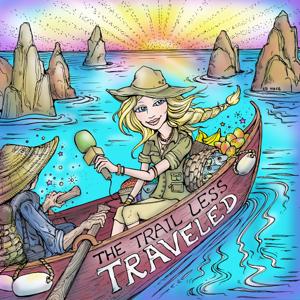


This episode was recorded on Sunrise Beach last week on the eastern coast of Australia and is part of a worldwide series I have been recording for a number of years regarding shark conservation. This episode features Dr. Leonardo Guida. In 2016 Dr. Guida completed his PhD at Monash University studying the effects of commercial fishing on shark and ray populations. He is the Australian Marine Conservation Society's Senior Shark Campaigner, leading their conservation campaign, "Shark Champions", in partnership with Humane Society International.
Dr. Guida will talk about baited drum lines which currently draw sharks to be killed in the name of protecting humans as well as shark finning and the effects of commercial fishing on shark and ray populations.
The ancestry of great white sharks is thought to date back more than 400 million years & modern sharks over 34 million years. Modern humans date back 200,000 years. Humans kill roughly 100 million sharks per year. Sharks kill 4-8 humans per year. Car accidents kill ~50,000 humans per year.
Hosted on Acast. See acast.com/privacy for more information.
Jorge was born and raised in central Havana, Cuba. He took advantage of a free education and studied both computer science and foreign language. Jorge speaks four languages & on his days off he gives tours around his beloved, passionate city. In this interview Jorge will talk about the recent introduction of internet & wifi in his country and its effect on the youth as well as highlighting some of the many things Cuba is known for including cigars, rum, the revolution, Che Guevara, Ernest Hemingway & classic cars.
*This interview does not express the opinions or views of anyone affiliated with The Trail Less Traveled. This interview was recorded on location in Havana, Cuba & we realize speaking about the Cuban revolution and the history behind Fidel Castro is a sensitive subject. This episode is part of an on going series recorded both on location in the country of Cuba as well as continued interviews with Cubans now living outside the country.
Hosted on Acast. See acast.com/privacy for more information.
This interview was recorded on the busy streets of Havana, Cuba. This interview features the extremely talented and dedicated musician, Jesse Weber. Jesse graduated from the University of Montana school of music & has been studying percussion in Cuba since 2000. This interview tells the journey of a child growing up in rural Wyoming who started playing percussion since he was a baby. Jesse talks extensively about the history of Cuban drumming from its origins in Africa. Learn how the music in Cuba has evolved from its roots in Africa (due to slavery) to distance radio frequencies from Miami and Mexico. Learn how the art of telling a story with a song was born. Learn about the birth of the rumba and the competition dance between a man and woman. Learn how Africa is the root of everything in music from hip-hop to country.
"The drums are the heartbeat of Rock and Roll".
Hosted on Acast. See acast.com/privacy for more information.
Hosted on Acast. See acast.com/privacy for more information.
Hosted on Acast. See acast.com/privacy for more information.
Hosted on Acast. See acast.com/privacy for more information.
Hosted on Acast. See acast.com/privacy for more information.
Hosted on Acast. See acast.com/privacy for more information.
Hosted on Acast. See acast.com/privacy for more information.
This interview was recorded while floating down the Colorado River in Grand Canyon National Park last summer. It was a challenge to edit due to extremely windy conditions, alas, attached you will find the final product ready to air. This episode features an interview with Christian Wright, a park ranger at Arches National Park in Utah. Christian helps visitors to Arches National Park embrace the difference between looking and seeing. Christian is also a historian with a focus on The United Mine Workers of America and the transformation of Utah's coal industry between 1966–1985. Christian wrote the book: For this Union to Survive, Miners for Democracy in Utah and the West. Christine asks the important question, "What does it mean to have no power and to fight for it?"
Christian will also describe what it was like to do a solo inflatable kayak expedition of the Grand Canyon his first time running the Colorado River...
Hosted on Acast. See acast.com/privacy for more information.
From the publisher's feed
Hosted on Acast. See acast.com/privacy for more information.

37,991 Listeners

37,611 Listeners

26,167 Listeners

513 Listeners

2,136 Listeners

38,070 Listeners
1,095 Listeners

111,876 Listeners
1,694 Listeners

9,624 Listeners

66 Listeners

1,677 Listeners

50,404 Listeners
5,634 Listeners

7,434 Listeners